Understanding Different Battery Chemistry
1.
Lithium-ion batteries are batteries that function based on the transfer of lithium ions between a cathode and an anode. Lithium-ion batteries have higher specific energies than batteries made from other materials such as zinc and lead due to the relatively lightweight and low density of lithium. Lithium batteries are also more stable overcharge/recharge cycles due to the small radii of lithium ions, which causes fewer disruptions of the electrode structure during ion transfer. Lithium-ion batteries commonly use graphite and metal oxide as additional electrode materials.
| Anode | Cathode | Charging and discharging reaction | |
| LCO | Graphite | lithium cobalt oxide | LiC6 + CoO2 `<=>` C6 + LiCoO2 |
| LMO | Graphite | manganese oxide | LiC6 + Mn2O4 `<=>` C6 + LiMn2O4 |
| NCA | Graphite | nickel, cobalt and aluminium | LiC6 + NiCoAlO2 `<=>` C6 + LiNiCoAlO2 |
| NMC | Graphite | nickel, manganese and cobalt | LiC6 + NiMnCoO2 `<=>` C6 + LiNiMnCoO2 |
| LFP | Graphite | phosphate | LiC6 + FePO4 `<=>` C6 + LiFePO4 |
| LTO | Lithium Titanate | Lithium Manganese Oxide | Li2TiO3 + 2Mn2O4 `<=>` 2LiMn2O4 + TiO3 |
| Anode Reaction | Cathode Reaction | |
| LCO | LiC6 → Li+ + e- + C6 | CoO2 + Li+ + e- → LiCO2 |
| LMO | LiC6 → Li+ + e- + C6 | Mn2O4 + Li+ + e- → LiMn2O4 |
| NCA | LiC6 → Li+ + e- + C6 | NiCoAlO2 + Li+ + e- → LiNiCoAlO2 |
| NMC | LiC6 → Li+ + e- + C6 | NiMnCoO2 + Li+ + e- → LiNiMnCoO2 |
| LFP | LiC6 → Li+ + e- + C6 | FePO4 + Li+ + e- → LiFePO4 |
| LTO | Li2TiO3 → TiO3 + 2Li+ + 2e- | Mn2O4 + 2Li+ + 2e- → LiMn2O4 |
lithium-ion uses a cathode (positive electrode), an anode (negative electrode) and electrolyte as conductor. The cathode is a metal oxide and the anode consists of porous carbon. During discharge, the ions flow from the anode to the cathode through the electrolyte and separator; charge reverses the direction and the ions flow from the cathode to the anode.When the cell charges and discharges, ions shuttle between the cathode (positive electrode) and anode (negative electrode). On discharge, the anode undergoes oxidation or loss of electrons, and the cathode sees a reduction or a gain of electrons. Charge reverses the movement.
All materials in a battery possess theoretical specific energy, and the key to high capacity and superior power delivery lies primarily in the cathode.
Lithium Cobalt Oxide:
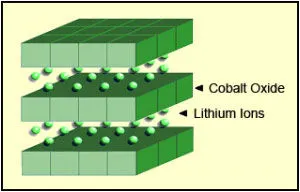
The battery consists of a cobalt oxide cathode and a graphite carbon anode. The cathode has a layered structure and during discharge, lithium ions move from the anode to the cathode. The flow reverses on charge.
Lithium Manganese Oxide:
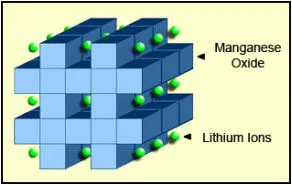
The architecture forms a three-dimensional spinel structure that improves ion flow on the electrode, which results in lower internal resistance and improved current handling. A further advantage of spinel is high thermal stability and enhanced safety, but the cycle and calendar life is limited. The cathode crystalline formation of lithium manganese oxide has a three-dimensional framework structure that appears after initial formation. Spinel provides low resistance but has a more moderate specific energy than cobalt.
Lithium Nickel Manganese Cobalt Oxide:
Nickel is known for its high specific energy but poor stability; manganese has the benefit of forming a spinel structure to achieve low internal resistance but offers low specific energy. Combining the metals enhances each other strengths.
The cathode combination is typically one-third nickel, one-third manganese and one-third cobalt, also known as 1-1-1. This offers a unique blend that also lowers the raw material cost due to reduced cobalt content. Another successful combination is NCM with 5 parts nickel, 3 parts cobalt and 2 parts manganese (5-3-2).
Lithium Iron Phosphate:
It uses phosphate as a cathode material as Li-phosphate offers good electrochemical performance with low resistance. This is made possible with nano-scale phosphate cathode material. The key benefits are high current rating and long cycle life, besides good thermal stability, enhanced safety and tolerance if abused.
Lithium Nickel Cobalt Aluminium Oxide:
Similar to NMC IT uses Nickel, Cobalt and aluminium as cathode offering high specific energy, reasonably good specific power and a long life span with lesser safety and high cost. Adding aluminium improves the stability of the compound.
Lithium Titanate:
Li-titanate replaces the graphite in the anode of a typical lithium-ion battery and the material forms into a spinel structure. The cathode can be lithium manganese oxide or NMC. Li-titanate is safe, has excellent low-temperature discharge characteristics and thermal stability at high temperatures.
2.
Lithium Cobalt Oxide(LiCoO2) — LCO
Due to their very high specific energy, these batteries are used for cell phones, laptops and electronic cameras. This type of battery has some drawbacks, including relatively short battery life and limited specific power. These batteries are not as safe as other types.
Lithium Manganese Oxide (LiMn2O4) — LMO
Lithium manganese oxide batteries are well known for their high-temperature stability and safety when compared to other lithium-ion battery types.
They are often used in medical equipment and devices, power tools, electric bikes and more.
Lithium Nickel Cobalt Aluminum Oxide (LiNiCoAlO2) — NCA
NCA batteries provide a high-energy option with a good lifespan, but they are not as safe as they could be compared to other lithium-ion battery types and are quite costly. NCA batteries must be accompanied by monitoring devices to ensure driver safety.
These types of batteries are used in electric powertrains and in grid storage.
Lithium Nickel Manganese Cobalt Oxide (LiNiMnCoO2) — NMC
Like other lithium-ion battery varieties, NMC batteries can have either a high specific energy density or a high specific power. They cannot have both properties. This battery type is most common in power tools and in powertrains for vehicles due to its very low self-heating rate.
Lithium Iron Phosphate(LiFePO4) — LFP
They benefit from low resistance properties, which enhance their safety and thermal stability. Other benefits include durability and longevity. Fully charged batteries can be stored with little change to the total lifespan of the battery’s charge. Li-phosphate batteries are often the most cost-effective option as well when their long battery life is considered.
These batteries are often used in electric motorcycles as well as other applications that need a long lifecycle and significant safety.
Lithium Titanate (Li2TiO3) — LTO
LTO batteries have lower inherent voltage or lower energy density than other lithium-ion battery varieties, which can present issues with powering vehicles efficiently. On the positive side, the density of lithium titanate batteries is still higher than other non-lithium-ion batteries.
Applications for these batteries can include military and aerospace uses, and they may also be used for storing wind and solar energy and creating smart grids.