Week 1 Understanding Different Battery Chemistry
1. Prepare a table which includes materials & chemical reactions occurring at the anode and cathode of LCO, LMO, NCA, NMC, LFP and LTO type of lithium ion cells.Give your detailed explanation on it
Lithium-ion batteries are extremely popular and versatile. Found in cell phones, automobiles, power tools, and several oth types of electronic devices, these rechargeable batteries are also making an impact powering material handling and airpo ground support equipment. The technology behind lithium-ion batteries make them a great choice because of their distin advantages and environmentally-friendly benefits.
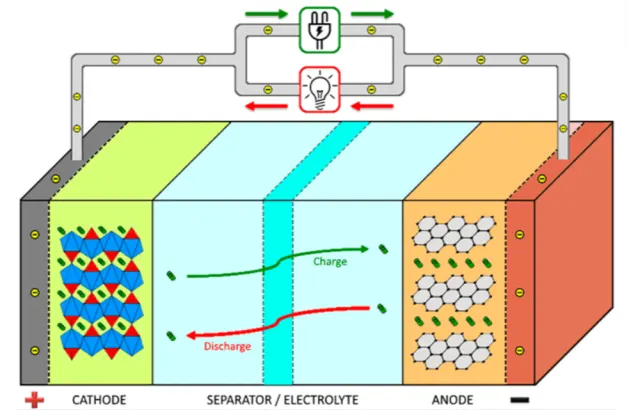
A Lithium ion battery is made up of an anode, cathode, separator, electrolyte, and two current collectors (positive and negative). The anode and cathode store the lithium. The electrolyte carries positively charged lithium ions from the anode to the cathode and vice versa through the separator. The movement of the lithium ions creates free electrons in the anode which creates a charge at the positive current collector. The electrical current then flows from the current collector through a device being powered to the negative current collector. The separator blocks the flow of electrons inside the battery.
CHARGE/DISCHARGE
While the battery is discharging and providing an electric current, the anode releases lithium ions to the cathode, generating a flow of electrons from one side to the other. When plugging in the device, the opposite happens: Lithium ions are released by the cathode and received by the anode.
Types of Lithium ion batteries:
Lithium cobalt oxide - LiCoO2 (LCO)
- Also known as lithium cobaltate or lithium-ion cobalt batteries, lithium cobalt oxide batteries are made from lithium carbonat and cobalt.
- They have a cobalt oxide cathode and use graphite carbon as their anode material; during discharge, lithium ions move fromanode to cathode, with the flow reversing when the battery is charging.
- This type of battery has some drawbacks, including a relatively short battery life and limited specific power. additionally, thes batteries are not as safe as other types.
Lithium Manganese Oxide - LiMn2O4 (LMO)
- Thisbattery is made with lithium manganese oxide as a cathode material.
- Lithium manganese oxide batteries are notable for their high temperature stability and are also safer than other lithium-io battery types.
- For this reason, they are often used in medical equipment and devices, but they may also be used in power tools, electric bike and more.
Lithium Nickel Cobalt Aluminium Oxide - LiNiCoAlO2 (NCA)
- Lithium nickel cobalt aluminum oxide batteries are also called NCA batteriesand has cathode made of nickel cobalt and aluminium
- Thesebatteries provide a high-energy option with a good lifespan, but they are not as safe as they could be compared to other lithium-ion battery types and are quite costly.
Lithium Nickel Manganese Cobalt Oxide - LiMnCoO2 (NMC)
- Also known as lithium manganese cobalt oxide or NMC batteries, include a cathode made of a combination of nicke manganese and cobalt.
- NMC batteries can have either a high specific energy density or a high specific powe
- This battery type is most common in power tools and in powertrains for vehicles.
- The cathode combination ratio is usually 60 percent nickel, 20 percent manganese and 20 percent cobalt.
Lithium Iron Phosphate - LiFePo4 (LFP)
- Lithium iron phosphate batteries, also known as li-phosphate batteries, use phosphate as a cathode.
- They benefit from lowresistance properties, which enhance their safety and thermal stability.
- Thebenefits include durability and a long lifecycle fully charged batteries can be stored with little change to the total lifespan of the battery’s charge.
- The lower voltage of the li-phosphate battery means that it has less energy than other types of lithium batteries.
Lithium Titanium Oxide - LiTiO2 (LTO)
- The lithium titanate, also known as li-titanate, is a class of battery that allows for ever-increasing applications.
- The mainadvantage of the li-titanate battery is its remarkably fast recharge time.
- These batteries have lower inherent voltage, or lower energy density, than other lithium-ion battery varieties, whic can present issues with powering vehicles efficiently.
Comparison
|
Battery type |
Anode |
Cathode |
Electrolyte |
At Anode |
At Cathode |
Complete chemical reaction |
|
LCO |
Graphite |
Lithium cobalt oxide(LiCoO2) |
Ethylene Carbonate |
LiC6 → Li+ + e- + C6 |
CoO2+Li++e- → LiCoO2 |
LiC6+CoO2 → C6+LiCoO2 |
|
LMO |
Graphite |
Lithium Manganese Oxide(LiMn2O4) |
Ethylene Carbonate |
LiC6 → Li+ + e- + C6 |
Mn2O4+Li++e- →LiMn2O4 |
LiC6+ Mn2O4→ C6 + LiMn2O4 |
|
NCA |
Graphite |
Lithium Nickel Cobalt Aluminium Oxide(LiNiCoAlO2) |
Ethylene Carbonate |
LiC6 → Li+ + e- + C6 |
NiCoAlO2+Li++e- →LiNiCoAlO2 |
LiC6+ NiCoAlO2→ C6 + LiNiCoAlO2 |
|
NMC |
Graphite |
Lithium Nickel Manganese Cobalt Oxide(LiNiMnCoO2) |
Ethylene Carbonate |
LiC6 → Li+ + e- + C6 |
NiMnCoO2+Li++e- →LiNiMnCoO2 |
LiC6+ NiMnCoO2→ C6 + LiNiMnCoO2 |
|
LFP |
Graphite |
Lithium Iron Phosphate(LiFePO4) |
Ethylene Carbonate |
LiC6 → Li+ + e- + C6 |
FePO4+Li++e−→LiFePO4 |
LiFePO4+6C→LiC6+FePO4 |
|
LTO |
Lithium Titanate |
Lithium Manganese Oxide(LiMn2O4) |
Ethylene Carbonate |
Li2TiO3→ TiO3+2Li++2e- |
Mn2O4+2Li++2e- →LiMn2O4 |
Li2TiO3 +2Mn2O4 → 2LiMn2O4 + TiO3 |
Hereby providing the excel link
https://in.docworkspace.com/d/sIAvT3PQt8uHyiAY
2. Compare the differences between each type of Li+ion batteries based on their characteristics
Some charateristics of the battery are
- Specific energy: This defines the battery capacity in weight (Wh/kg). The capacity relates to the runtime. Products requiring lon runtimes at moderate load are optimized for high specific energy.
- Nominal Voltage: It is the system voltage at which the device is designed to operate. The rated voltage is usually higher than th nominal voltage to ensure the safe operation of the device.
- Cut-off Voltage:Tthe cut-off voltage is the voltage at which a battery is considered fully discharged, beyond which further discharge could cause harm
- SOC: State of charge(SoC) is the level of charge of a battery relative to its capacity.
- Cycle: The charge and discharge make a Cycle
- Thermal Runaway: It is a condition where an increase in temperature changes the conditions which increase the temperatur further, often leading to disaster.
- Safety: This relates to factors such as the thermal stability of the materials used in the batteries. The materials should have th ability to sustain high temperatures before becoming unstable. Instability can lead to thermal runaway in which flaming gases ar vented. Fully charging the battery and keeping it beyond the designated age reduces safety.
|
S.no. |
Battery |
Nominal Voltage(V) |
Cut-off voltage (V) |
Specific energy (Wh/Kg) |
Charge efficiency (%) |
SOC |
Cycle |
Thermal runaway (oC) |
Safety |
|
1 |
LCO |
3.6 |
2.5 |
150-200 |
90 |
4.2 |
500-1000 |
150 |
moderate safety |
|
2 |
LMO |
3.7 |
2.5 |
100-150 |
90 |
4.2 |
300-700 |
250 |
low |
|
3 |
NCA |
3.6 |
3.0 |
200-260 |
90 |
4.3 |
500 |
150 |
moderate |
|
4 |
NMC |
3.6 |
2.5 |
150-220 |
85-90 |
4.2 |
1000-2000 |
210 |
low |
|
5 |
LFP |
3.2 |
2 |
90-120 |
90 |
3.65 |
2500-12000 |
270 |
low |
|
6 |
LTO |
2.4 |
1.6-1.8 |
50-180 |
85-90 |
2.8 |
6000-20000 |
Very low |
high |
Hereby providing the excel link for above comparison