Week 1 Understanding Different Battery Chemistry
Aim: - To Understand Different Battery Chemistry & their Characteristic.
Objective: -
1.Prepare a table which includes materials & chemical reactions occurring at the anode and cathode of LCO, LMO, NCA, NMC, LFP and LTO type of lithium ion cells.Give your detailed explanation on it.
2.Compare the differences between each type of Li-ion batteries based on their characteristics.
Introduction: -
Cells are the smallest individual electrochemical unit and deliver a voltage that depends on the combination of chemicals and compounds chosen to make the cell. Single-use cells are called primary cells and rechargeable cells are called secondary cells. Batteries or battery packs are made up from groups of cells. The schematic symbols for a cell and a battery are shown in Figure 1.1 below.
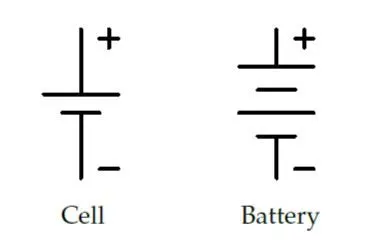
Fig 1.1
Technically, a cell is different from a battery, but many people (Including me, at times) use the term battery to describe any electrochemical energy source, even if it is a single cell, and this can lead to confusion. I will attempt to use the terms cell or battery cell consistently to refer to an individual electrochemical unit, and reserve the terms battery (used by itself) and battery pack to refer to an electrically connected group of cells. Note that it is not always obvious whether the correct term should be cell or battery since batteries are sometimes packaged in a single physical unit. For example, automotive “12 V” lead-acid batteries internally comprise six “2V” cells wired in series; also, many high-capacity lithium-ion batteries consist of a number of cells wired in parallel in a single package.
How Cells Work :-
Cells are built from a number of principal components. These include a negative electrode, a positive electrode, the electrolyte, and a separator. Certain types of cells also have current collectors that are distinct from the electrodes themselves. Fig. 1.2 shows a schematic of a lithium-ion cell, but the basic idea applies generally The negative electrode in an electrochemical cell is often a pure metal, or an alloy, or even hydrogen. For example, the negative electrode of a lead-acid cell is pure lead. Table shown below provides a lists negative-electrode materials for common types of cells.
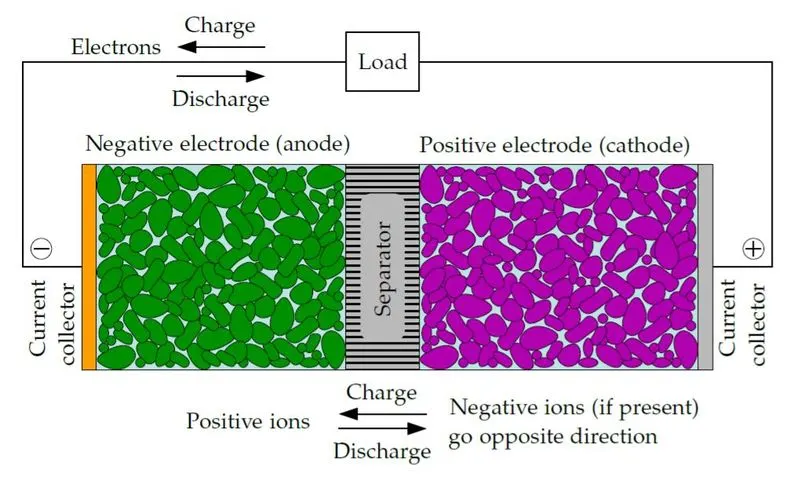
Fig 1.2
|
Electrochemistry |
Negative electrode |
Positive electrode |
Electrolyte |
Nominal voltage |
|
Lead acid |
Pb |
PbO2 |
H2SO4 |
2.1V |
|
Dry cell |
Zn |
MnO2 |
ZnCl2 |
1.6V |
|
Alkaline |
Zn |
MnO2 |
KOH |
1.5V |
|
Nickel cadmium |
Cd |
NiOOH |
KOH |
1.35V |
|
Nickel hydrogen |
H2 |
NiOOH |
KOH |
1.5V |
|
Nickel zinc |
Zn |
NiOOH |
KOH |
1.73V |
|
Silver zinc |
Zn |
Ag2O |
KOH |
1.6V |
|
Zinc air |
Zn |
O2 |
KOH |
1.65V |
During discharge, the negative electrode gives up electrons to the external circuit, a process by which the electrode is oxidized: oxidation of a species involves the loss of electrons or, equivalently, an increase in the oxidation state of the species (it becomes more positively charged). During charge, the negative electrode accepts electrons from the external circuit and is reduced: reduction of a species involves the gain of electrons or, equivalently, a decrease in its oxidation state (it becomes more negatively charged). Thus, the chemical processes that occur in an electrochemical cell are sometimes called reduction–oxidation or redox reactions and it is shown in fig 1.3.
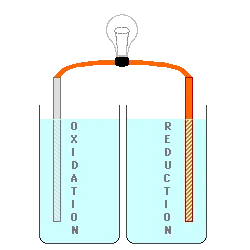
Fig 1.3
Working of Li-ion Battery :-
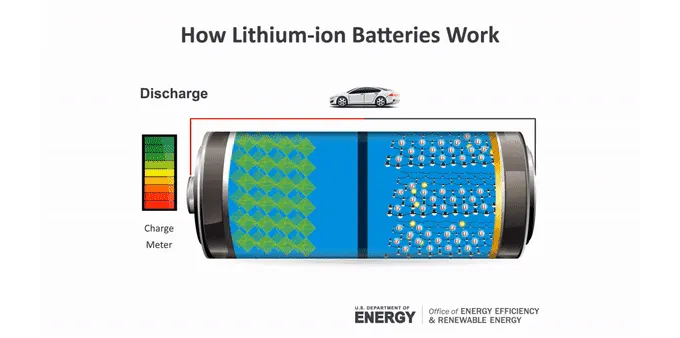
Fig 1.4
In a Lithium- ion batteries, The cathode (positive electrode) is made up of Lithium metal while anode (negitive electrode) is made up of carbon based material like graphite. The cell is filled with elecrolyte and both the electrodes are saperated by a saperator. A saperator is basically an ionic conductor but an electronic isolator.So, lithium ions can pass through a saperator but not electrons. During discharge, positively charged Li+ ions or cations moves through the electrolyte towards the positive electrode (Lithium metal) .
To charge a battery, this process runs in reverse order. The Li+ ions travels toward anode, While the lithium ions are settle between the thin layers of graphite as shown in the figure 1.4.
Energy Density: The energy density is the total amount of energy that can be stored per unit mass or mass or volume.This determines how long your device stays on before it needs a get recharged. For different batteries the energy density variation is shown in fig 1.5
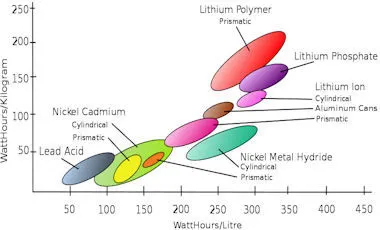
Fig 1.5
Types Of Li-ion Battery: -
1)Lithium Nickel Manganese Cobalt Oxide (LiNiMnCoO2)-NMC
2)Lithium Cobalt Oxide (LiCoO2)-LCO
3)Lithium Manganese Oxide (LiMn2O4) - LMO
4)Lithium Iron Phosphate (LiFePO4)-LFP
5)Lithium Nickel Cobalt Aluminum Oxide (LiNiCoAlO2)-NCA
6)Lithium Titanate (Li2TiO3)-LTO
Comparison Table for Different Li-ion Batteries :-
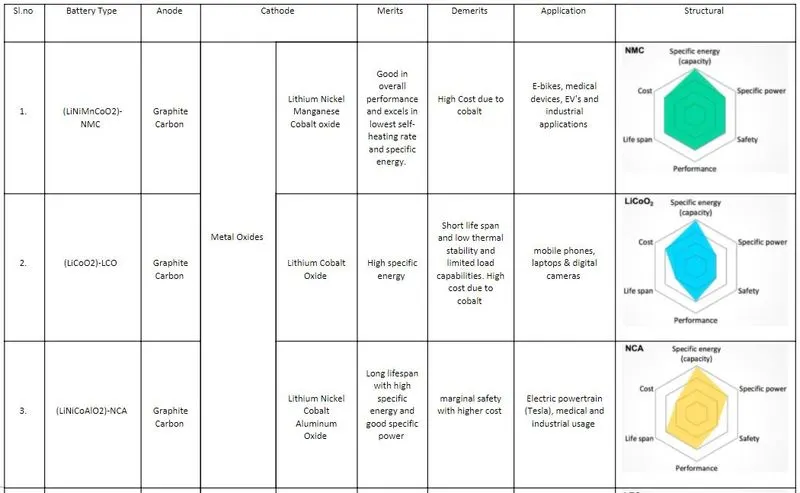
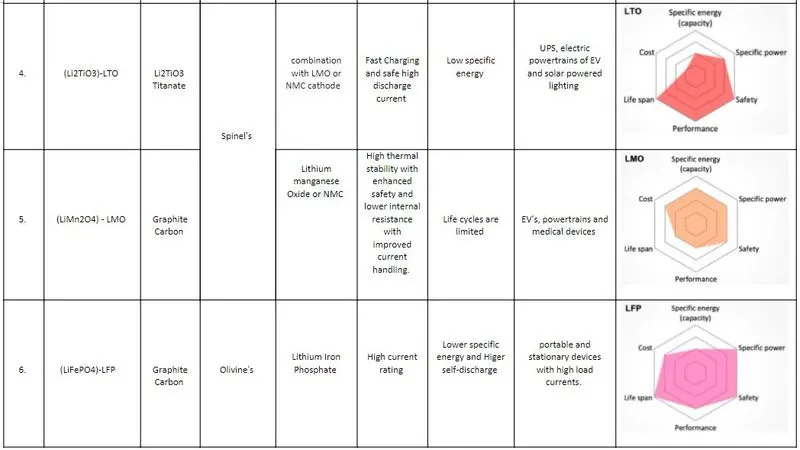
The google drive link for the above table in pdf is given below
Link:-https://drive.google.com/file/d/1Wn9lQh89iElj8VdiH8GN9tcCaOvwTRHH/view?usp=sharing
Chemical Reactions of Different Li-ion Batteries:-
1)Lithium Nickel Manganese Cobalt Oxide (LiNiMnCoO2)-NMC
One of the most successful li-ion cathode formulas developed to date is obtained by combining nickel, manganese, and cobalt. Lithium-Nickel-Manganese-Cobalt-Oxide (LiNiMnCoO2), abbreviated as NMC, has become the go-to cathode powder to develop batteries for power tools, e-bikes and other electric powertrains. It delivers strong overall performance, excellent specific energy, and the lowest self-heating rate of all mainstream cathode powders, which makes it the preferred option for automotive batteries.
While NMC powder can refer to a variety of blends, the formula typically consists of 33% nickel, 33% manganese and 33% cobalt. This blend, sometimes referred to as 1-1-1, is a popular option for mass-produced cells in applications requiring frequent cycling (automotive, energy storage) due to the reduced material cost resulting from lower cobalt content. The chemical reactions of NMC are shown below.
The positive electrode (cathode) half-reaction
NiMnCoO2 + Li+ + e− ↔ LiNiMnCoO2
The negative electrode (anode) half-reaction
LiC6 ↔ C6 + Li+ + e−
Full reaction (left→">→→right:charging & right→">→→left discharging)
LiC6 + NiMnCoO2 ↔ C6 + LiNiMnCoO2
2)Lithium Cobalt Oxide (LiCoO2)-LCO
Lithium cobalt oxide, sometimes called lithium cobaltate or lithium cobaltite,is a chemical compound with formula LiCoO. The cobalt atoms are formally in the +3-oxidation state, hence the IUPAC name lithium cobalt (III) oxide.
Lithium cobalt oxide is a dark blue or bluish-gray crystalline solid, and is commonly used in the positive electrodes of lithium-ion batteries. The chemical reactions of LCO are shown below.
The positive electrode (cathode) half-reaction
CoO2+Li++e−↔LiCoO2
The negative electrode (anode) half-reaction
LiC6 ↔ C6 + Li+ + e−
Full reaction (left→→right: charging & right→→left discharging)
LiC6+CoO2↔C6+LiCoO2
3)Lithium Manganese Oxide (LiMn2O4) - LMO
A lithium-ion manganese oxide battery (LMO) is a lithium-ion cell that uses manganese dioxide (MnO2), as the cathode material. They function through the same intercalation/de-intercalation mechanism as other commercialized secondary battery technologies, such as LiCoO. Cathodes based on manganese-oxide components are earth-abundant, inexpensive, non-toxic, and provide better thermal stability. The chemical reactions of LMO are shown below.
The positive electrode (cathode) half-reaction
Mn2O4 + Li+ + e− ↔ LiMn2O4
The negative electrode (anode) half-reaction
LiC6 ↔ C6 + Li+ + e−
Full reaction (left→→right: charging & right→→left discharging)
LiC6 + Mn2O4 ↔ C6 + LiMn2O4
4)Lithium Iron Phosphate (LiFePO4)-LFP
The lithium iron phosphate battery (LiFePO4 battery) or LFP battery (lithium ferrophosphate), is a type of lithium-ion battery using lithium iron phosphate (LiFePO4) as the cathode material, and a graphitic carbon electrode with a metallic backing as the anode. The energy density of LiFePO4 is lower than that of lithium cobalt oxide (LiCoO2), and also has a lower operating voltage. The main drawback of LiFePO4 is its low electrical conductivity. Therefore, all the LiFePO4 cathodes under consideration are actually LiFePO4/C. Because of low cost, low toxicity, well-defined performance, long-term stability, etc. LiFePO4 is finding a number of roles in vehicle use, utility scale stationary applications, and backup power. LFP batteries are cobalt-free. The chemical reactions of LFP are shown below.
The positive electrode (cathode) half-reaction
FePO4 + Li+ + e− ↔ LiFePO4
The negative electrode (anode) half-reaction
LiC6 ↔ C6 + Li+ + e−
Full reaction (left→→right: charging & right→→left discharging)
LiC6 + FePO4 ↔ C6+ LiFePO4
5)Lithium Nickel Cobalt Aluminum Oxide (LiNiCoAlO2)-NCA
The lithium nickel cobalt aluminium oxides (NCA) are a group of substances comprising metal oxides. Some of them are important due to their application in lithium-ion batteries. NCAs are used as active material on the positive pole (which is the cathode when the battery is discharged). NCAs are mixed oxides comprising the cations of the chemical element's lithium, nickel, cobalt and aluminium. The most important representatives have the general formula LiNixCoyAlzO2 with x + y + z = 1. In case of the NCA comprising batteries currently available on the market, which are also used in electric cars and electric appliances, x ≈ 0,8, and the voltage of those batteries is between 3.6 V and 4.0 V, at a nominal voltage of 3.6 V or 3.7 V. A version of the oxides currently in use in 2019 is LiNi0,84Co0,12Al0,04O2. The chemical reactions of NCA are shown below.
The positive electrode (cathode) half-reaction
NiCoAlO2 + Li+ + e− ↔ LiNiCoAlO2
The negative electrode (anode) half-reaction
LiC6 ↔ C6 + Li+ + e−
Full reaction (left→→right: charging & right→→left discharging)
LiC6 + NiCoAlO2 ↔ C6 + LiNiCoAlO2
6)Lithium Titanate (Li2TiO3)-LTO
Lithium titanate is a compound with the chemical formula Li2TiO3. It is a white powder with a melting point of 1,533 °C (2,791 °F). Lithium titanate is the anode component of the fast-recharging lithium-titanate battery. It is also used as an additive in porcelain enamels and ceramic insulating bodies based on titanates. It is frequently utilized as a flux due to its good stability. In recent years, along with other lithium ceramics, metatitanate pebbles have been the subject of research efforts towards tritium breeding materials in nuclear fusion applications. The chemical reactions of LTO are shown below.
The positive electrode (cathode) half-reaction
Mn2O4 + Li+ + e− ↔ LiMn2O4
The negative electrode (anode) half-reaction
Li2TiO3 ↔ TiO3 + 2Li+ + 2e−
Full reaction (left→→right: charging & right→→left discharging)
Li2TiO3 + 2Mn2O4 ↔ TiO3+2LiMn2O4
Reference: -
1.Battery Management systems, Vol 1 Gregory.L. Plett
2.Electric vehicle technology explained James Larminine, John Lowry
3. Wikipedia