Week 1 Understanding Different Battery Chemistry
Aim:
1.Prepare a table which includes materials & chemical reactions occurring at the anode and cathode of LCO, LMO, NCA, NMC, LFP and LTO type of lithium ion cells.Give your detailed explanation on it
2.Compare the differences between each type of Li+ion batteries based on their characteristics
Introduction to Batteries:
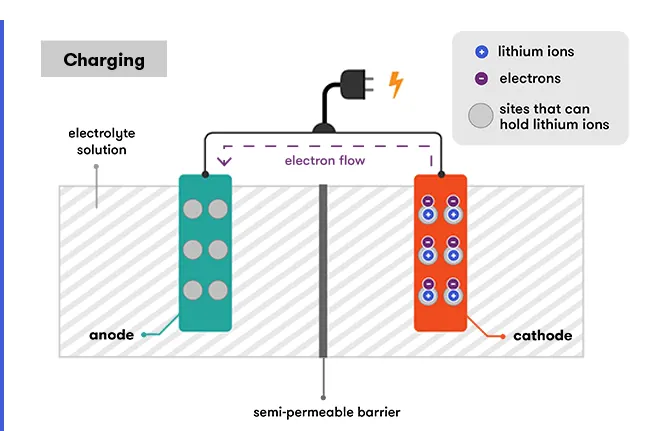
A lithium-ion (Li-ion) battery is an advanced battery technology that uses lithium ions as a key component of its electrochemistry. During a discharge cycle, lithium atoms in the anode are ionized and separated from their electrons. The lithium ions move from the anode and pass through the electrolyte until they reach the cathode, where they recombine with their electrons and electrically neutralize. The lithium ions are small enough to be able to move through a micro-permeable separator between the anode and cathode. In part because of lithium’s small size (third only to hydrogen and helium), Li-ion batteries are capable of having a very high voltage and charge storage per unit mass and unit volume.
Li-ion batteries can use a number of different materials as electrodes. The most common combination is that of lithium cobalt oxide (cathode) and graphite (anode), which is most commonly found in portable electronic devices such as cellphones and laptops. Other cathode materials include lithium manganese oxide (used in hybrid electric and electric automobiles) and lithium iron phosphate. Li-ion batteries typically use ether (a class of organic compounds) as an electrolyte.
Types of Lithium batteries:
LITHIUM COBALT OXIDE (LiCoO2)
The most common lithium-ion cells have an anode of carbon (C) and a cathode of lithium cobalt oxide (LiCoO2). In fact, the lithium cobalt oxide battery was the first lithium-ion battery to be developed from the pioneering work of R Yazami and J Goodenough, and sold by Sony in 1991. The cobalt and oxygen bond together to form layers of octahedral cobalt oxide structures, separated by sheets of lithium. It’s important that this structure allows the cobalt ions to change their valence states between Co+3 and Co+4 (lose and gain a negatively-charged electron) when charging and discharging.
Of all the various lithium-ion batteries, these guys have the greatest energy density, which is why they’re currently the batteries found in our phones, digital cameras and laptops. Their drawback is their thermal instability. Their anodes can overheat and, at high temperatures, the cobalt oxide cathode can decompose, producing oxygen. If you combine oxygen and heat, you’ve got a pretty good chance of starting a fire and, as the chemicals sometimes used in the electrolyte solution, such as diethyl carbonate, are flammable, there can be some safety issues with this battery.
Lithium-ion batteries have in-built protections to prevent overheating, and to prevent the complete discharge of the battery which can also be damaging. Additionally, these protection circuits can sometimes be used to prevent over-charging of lithium-ion batteries, which can have serious consequences. Lithium-ion batteries come in a wide variety of shapes and sizes, and some contain in-built protection devices, such as venting caps, to improve safety.
LITHIUM IRON PHOSPHATE (LiFePO4)
This cell has a high discharge rate and, because phosphate (PO4) can cope with high temperatures, the battery has good thermal stability, improving its safety. This makes it a good choice for things like electric vehicles and power tools, and for storing energy at power stations. It also has a long cycle life, meaning it can be discharged and charged many times. However, it has a lower energy density than a lithium cobalt oxide cell, and a higher self-discharge rate.
A lithium iron phosphate battery cell is similar to the lithium cobalt oxide cell. The anode is still graphite and the electrolyte is also much the same. The difference is that the lithium cobalt dioxide cathode has been replaced with the more stable lithium iron phosphate. In fact, no lithium or iron ions remain in the iron phosphate (FePO4) cathode of a fully charged cell. The lithium ions can intercalate into or out of the cathode material through well-defined tunnels in its structure without significantly altering the iron phosphate framework.
The cathode of this type of cell is made of negatively charged phosphate anions, bonded with positively charged iron cations in a structure that is capable of storing lithium ions within the iron phosphate molecules. The bonding arrangement in this structure means that the oxygen atoms are tightly bonded into the structure, which gives the cathode its chemical stability
LITHIUM MANGANESE OXIDE (LiMn2O4)
This type of lithium battery uses a cathode made from lithium-manganese spinel (Li+Mn3+Mn4+O4). Spinel is a type of mineral with a distinctive AB2O4 structure. The spinel structure has very good thermal stability, improving the battery’s safety. It also promotes ion flow within the electrolyte and lessens the internal resistance that contributes to the loss of a battery’s power over time.
While this type of lithium battery offers high discharge and recharge rates (also due to the spinel structure of the cathode) it has a lower capacity and shorter lifetime.
LITHIUM NICKEL MANGANESE COBALT OXIDE (LiNiMnCoO2 or NMC)
Adding nickel and cobalt back into the mix changes things slightly again. Nickel provides a high specific energy and, when added to the stable structure of the manganese spinel, also results in a battery with the benefits of the manganese spinel structure (low internal resistance, high charging rate, good stability and safety).
These batteries are generally made with a cathode with one-third nickel, one-third manganese and one-third cobalt, but the ratio can vary according to manufacturers’ secret formulas. These batteries are used in power tools, electric vehicles and medical devices.
Lithium manganese batteries are often coupled with a lithium nickel manganese cobalt oxide battery, producing a combination that is used in many electric vehicles. High bursts of energy (for rapid acceleration) are provided by the lithium-manganese component, and a long driving range is provided by the lithium nickel manganese cobalt oxide component.
| Si No. | Type of Li-ion battery | Cathode | Anode | Electrolyte | Chemical reaction |
| 1. | Lithium Cobalt Oxide (LCO) | LiCoO2 | LiC6 | LiPF6 in Ethylene Carbonate |
Anode: LiC6→xLi++xe−+C6 Cathode: Li1−xCoO2+xLi++xe−→LiCoO2 The overall reaction is: C6+LiCoO2⟷LixC6+Li1−xCoO2 |
| 2. | Lithium manganese oxide(LMO) | LiMn2O4 | LiC6 | LiPF6 in Ethylene carbonate |
Anode: LixC6→xLi++xe−+C6 Cathode: Li1−xMn2O4+xLi++xe−→LiMn2O4 The overall reaction is: C6+LiMn2O4⟷LiC6+Mn2O4 |
| 3.` | Lithium Nickel Cobalt Aluminium | LiNi0.8Mn0.1Co0.1O2 | Lic6 | LiPF6 in Ethylene carbonate |
Anode: LixC6→xLi++xe−+C6 Cathode: Li1−xNiCoAlO2+xLi+xe−→LiNiCoAlO2 The overall reaction is: C6+LiNiCoAl⟷LiC6+NiCoAlo2 |
| 4. | Lithium Nickel Manganese Cobalt Oxide(NMC) | LiNi0.8Mn0.1Co0.1O2 | LiC6 | LiPF6 in Ethylene carbonate |
Anode: LixC6→xLi++xe−+C6 Cathode: Li1−xNi0.8Mn0.1Co0.1O2+Li++xe-→LiNi0.8Mn0.1Co0.1O2 The overall reaction is: C6+LiNi0.8Mn001Co0.1O2⟷LiC6+Ni0.8Mn0.1Co0.1O2 |
| 5. | Lithium Iron Phosphate | LiFePO4 | LiC6 | LiPF6 in ethylene carbonate |
Anode: LiC6→Li++e−+C6 Cathode: LiFe(III)PO4+xLi++xe−→LiFe(II)PO4 FePO4+Li++e−→LiFePO4 Over all reaction: LiFePO4+6C→LiC6+FePO4 |
| 6. | Lithium Titanium Oxide(LTO) | LiMn2O4 | Li4Ti5O12 | LiPF6 in ethylene carbonate |
Anode: Li4Ti5O12→Ti5O12+4Li++4e- Cathode: 4Li1-xMn2O4+4Li+4e-→4LiMn2O4 Over all reaction: Li4Ti5O12+4Mn2O4⟷4LiMn2O4+Ti5O12 |
2.Compare the differences between each type of Li+ion batteries based on their characteristics
A lithium-ion battery or Li-ion battery is a type of rechargeable battery. Lithium-ion batteries are commonly used for portable electronics and electric vehicles and are growing in popularity for military and aerospace applications
Li-ion batteries are able to be recharged hundreds of times and are more stable. They tend to have a higher energy density, voltage capacity and lower self-discharge rate than other rechargeable batteries. This makes for better power efficiency as a single cell has longer charge retention than other battery types.
|
|||||||||||||||||||||||||||||||||||||||||||||||||||||||||||||||||
Outcomes of this challenge are:
1.Prepared a table which includes materials & chemical reactions occurring at the anode and cathode of LCO, LMO, NCA, NMC, LFP and LTO type of lithium ion cells.Gave detailed explanation of them
2.Compared the differences between each type of Li+ion batteries based on their characteristics.