Week 1 Understanding Different Battery Chemistry
Q1.
| Sl. No | Chemistry | Anode | Cathode | Description |
| 1. |
LCO Lithium Cobalt Oxide |
Graphite `LiC_6 harr C_6 + Li^+ + e^+` |
Cobalt Oxide `CoO_2 + Li^+ + e^+ harr LiCoO_2` |
While charging(left to right), Anode loses Li_+ ions which travels to cathode through electrolyte and combines with the Cobalt Oxide to give LiCoO_2. Electrons from anode move to cathode through external circuit. While discharge, the reverse process happens where the Li_+ ions are removed from cathode structure and move to anode to combine with graphite while electrons move through external circuit. |
| 2. |
LMO Lithium Manganese Oxide |
Graphite `LiC_6 harr C_6 + Li^+ + e^+` |
Manganese Oxide `Mn_2O_4 + Li^+ + e^+ harr LiMn_2O_4` |
While charging(left to right), Anode loses Li_+ and e_- ions from graphite layers which travels to cathode through electrolyte and external circuit seperately to combine with the Manganese Oxide to give LiMn_2O_4. While discharge, the reverse process happens where the Li_+ and e_- ions seperate from cathode structure and move to anode to intercalacte as Li atoms among the carbon layers. |
| 3. |
NCA Lithium Nickel Cobalt Aluminium Oxide |
Graphite `LiC_6 harr C_6 + Li^+ + e^+` |
Nickel Cobalt Alumininum Oxide `NiCoAlO_2 + Li^+ + e^+ harr LiNiAlCoO_2` |
Same situation as above where the anode reactions are same (graphite) and cathode is replaced by Nickel Cobalt Alumnium Oxide. Anode loses Lithium atoms while charging and gains them while discharging. |
| 4. |
NMC Lithium Nickel Manganese Cobalt Oxide |
Graphite `LiC_6 harr C_6 + Li^+ + e^+` |
Nickel Manganese Cobalt Oxide `NiMnCoO_2 + Li^+ + e^+ harr LiNiMnCoO_2` |
Same situation as above where the anode reactions are same (graphite) and cathode is replaced by Nickel Manganese Cobalt Oxide. Anode loses Lithium atoms while charging and gains them while discharging. |
| 5. |
LFP Lithium Iron Phosphate |
Graphite `LiC_6 harr C_6 + Li^+ + e^+` |
Iron Phosphate `FePO_4 + Li^+ + e^+ harr LiFePO_4` |
Same situation as above where the anode reactions are same (graphite) and cathode is replaced by Iron phosphate that accepts and hold Lithium atoms while charging (reduction) and loses Li atoms (oxidation) to anode while discharging. |
| 6. |
LTO Lithium Titatnate |
Titanate `Li_2TiO_3` `Li_2TiO_3 harr TiO_3 + 2Li^+ + 2e^+` |
Manganese Oxide `Mn_2O_4 + Li^+ + e^+ harr LiMn_2O_4` |
While charging, Lithium Titanate at the anode disintegrates to form Titanate oxide and Li_+ ions. These Li ions travel towards cathode to form LiMn_2O_4 just like in LMO cells. While discharge, they lose Li atoms to anode(oxidation). |
Q2.
| Sl.No | Chemistry | Characteristics | Features |
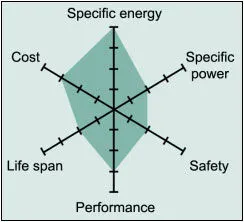
| 1. |
LCO Lithium Cobalt Oxide |
 |
|
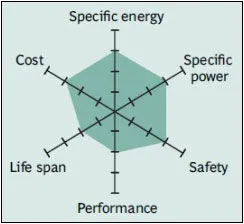
| 2. |
LMO Lithium Manganese Oxide |
 |
|
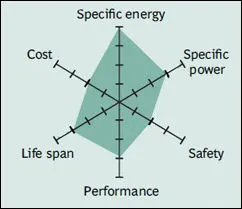
| 3. |
NCA Lithium Nickel Cobalt Aluminium Oxide |
 |
|
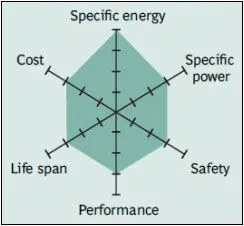
| 4. |
NMC Lithium Nickel Manganese Cobalt Oxide |
 |
|
| 5. |
LFP Lithium Iron Phosphate |
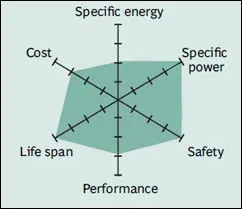 |
|
| 6. |
LTO Lithium Titatnate |
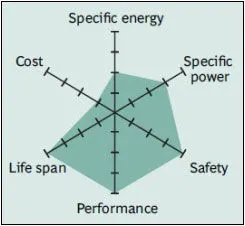 |
|
Reference - https://batteryuniversity.com/learn/article/types_of_lithium_ion