Week 1 Understanding Different Battery Chemistry
Aim:
Understanding Different Battery Chemistry
Objective:
1.Prepare a table which includes materials & chemical reactions occurring at the anode and cathode of LCO, LMO, NCA, NMC, LFP and LTO type of lithium ion cells.Give your detailed
explanation on it
2.Compare the differences between each type of Li+ion batteries based on their characteristics
Introduction&Theory:
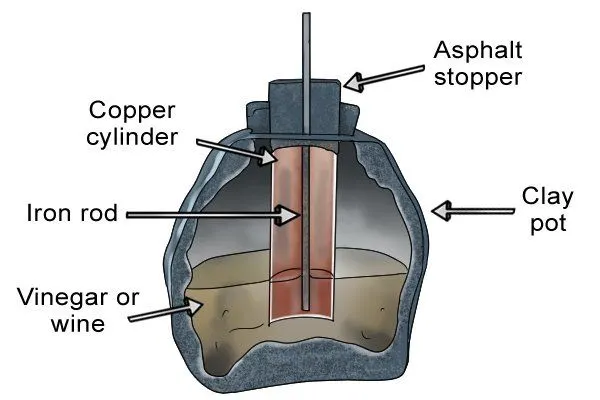
Battery: A Battery is a chemical device that store electrical energy in the form of chemicals and by means of electrochemical reaction, it converts the stored chemical energy
into direct current electric energy. Alessandro Volta, an Italian Physicist, invented the first battery in 1800.
The electrochemical reaction in a battery involves transfer of electrons from one material to another (called electrodes) through an electric current.
Cell and Battery:
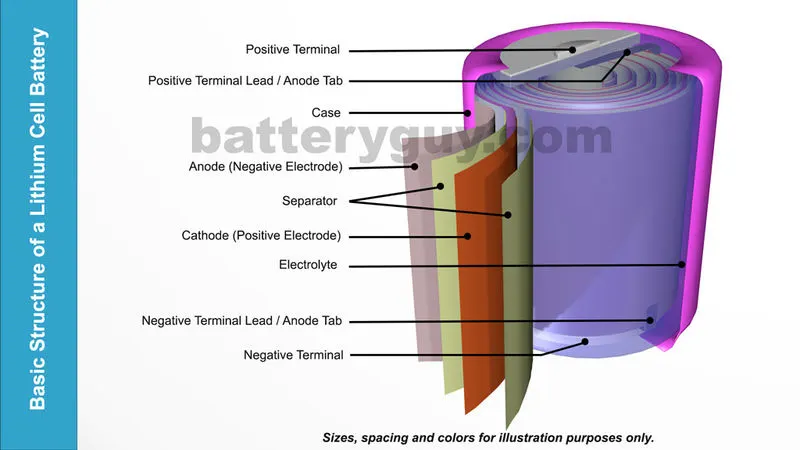
The cell is a single power generating unit which stores the chemical energy and then converts it into electrical energy. It has two electrodes namely cathode and the anode.
The cell has an electrolyte, a chemical substance that reacts with the electrodes and produces electric current.
The Anode is the negative electrode (also called the Fuel Electrode or the Reducing Electrode). It loses electrons to the external circuit and in the electrochemical reaction, it gets oxidized.
The Cathode is the positive electrode (also called the Oxidizing Electrode). It accepts electrons from the eternal circuit and in the electrochemical reaction, it gets reduced.
Hence, the energy conversion in a battery is due to electrochemical oxidation-reduction reaction.
The third important component of a cell is the electrolyte. An electrolyte acts as medium for transfer of charge in the form of ions between the two electrodes. Hence, the electrolyte is
sometime referred to as Ionic Conductor. An important point to be noted here that the electrolyte is not electrically conductive but just have ionic conductivity.
A battery often consists of one or more cells that are electrically connected in either a series or parallel configuration to provide the necessary voltage and current levels.
Types of Batteries:
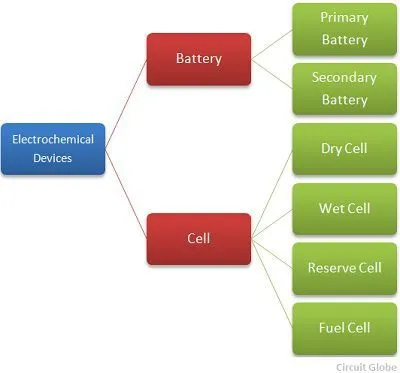
The electrochemical cells and batteries are classified into two types:
1.Primary (non-rechargeable)
2.Secondary (rechargeable)
1.Primary (non-rechargeable):A Primary Battery is one of the simple and convenient sources of power for several portable electronic and electrical devices like lights, cameras, watches,
toys, radios etc. As they cannot be recharged electrically, they are of “use it and when discharged, discard it type.
Usually, primary batteries are inexpensive, light weight, small and very convenient to use with relatively no or less maintenance. Majority of the primary batteries that are used in
domestic applications are single cell type and usually come in cylindrical configuration (although, it is very easy to produce them in different shapes and sizes).
Most significant development in the battery technology took place during the 1970 – 1990 period. It is during this time, the famous Zinc / Alkaline Manganese Dioxide batteries were
developed and they slowly replaced the older Zinc – Carbon types as the main primary battery.
Zinc – Mercuric Oxide and Cadmium – Mercuric Oxide batteries were also used during this period but due to the environmental concerns with respect to the usage of Mercury, these
battery types slowly phased out.
Lithium batteries are manufactured as button and coin cell for a specific range of applications (like watches, memory backup, etc.) while larger cylindrical type batteries are also available.
2.Secondary (rechargeable):A Secondary Battery is also called as Rechargeable Battery as they can be electrically recharged after discharge. The chemical status of the electrochemical
cells can be recharged to their original status by passing a current through the cells in the opposite direction of their discharge.
Secondary batteries can be used in two ways:
First category of applications, the secondary batteries are essentially used as energy storage devices where they are electrically connected to a main energy source and also charged
by it and also supplying energy when required.
such applications are Hybrid Electric Vehicles (HEV), Uninterrupted Power Supplies (UPS), etc.
Second category of applications of secondary batteries are those applications where the battery is used and discharged as a primary battery. Once it is completely discharged
(or almost completely discharged), instead of discarding it, the battery is recharged with an appropriate charging mechanism.
Such applications are all the modern portable electronics like mobiles, laptops, electric vehicles, etc.
Energy Density of secondary batterie are relatively lower than that of primary batteries but have other good characteristics like high power density, flat discharge curves, high
discharge rate, low temperature performance.
Types of Secondary Batteries but the four major types:
1.Lead – Acid Batteries
2.Nickel – Cadmium Batteries
3.Nickel – Metal Hydride Batteries
4.Lithium – Ion Batteries
Applications:
Portable Electronic Devices: Watches, Cameras, Mobile Phones, Laptops, Camcorders, Calculators, testing equipment (Multimeters).
Entertainment: Radios, MP3 players, CD Players, all infrared remote controls, toys, games, keyboards.
Household: Clocks, Alarms, Smoke Detectors, Flash lights, UPS, Emergency lights, tooth brushes, hair trimmers and shavers, Blood Pressure Monitors, Hearing Aids, pacemakers,
portable power tools (drills, screw driver).
1.Prepare a table which includes materials & chemical reactions occurring at the anode and cathode of LCO, LMO, NCA, NMC, LFP and LTO type of lithium ion cells.
Give your detailed explanation on it.
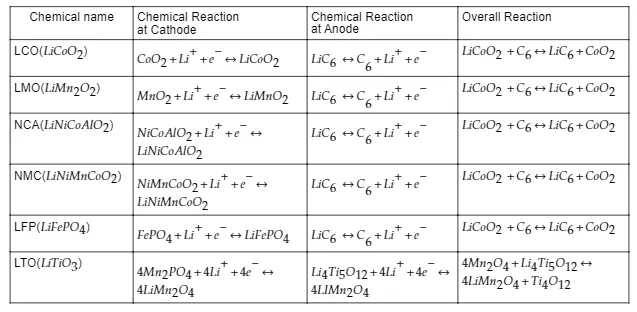
2.Compare the differences between each type of Li+ion batteries based on their characteristics:
1.Lithium Cobalt Oxide(LiCoO2)-LCO
2.Lithium Manganese Oxide(LiMn2O4)-LMO
3.Nickel Cobalt Aluminum Oxide (LiNiCoAlO2)-NCA
4.Lithium Nickel Manganese cobalt Oxide (LiNiMnCoO2)-NMC
5.Lithium Iron Phosphate (LiFePo4)-LFP
6.Lithium Titanate (Li2Tio3)-LTO
1.Lithium Cobalt Oxide(LiCoO2)-LCO
Its high specific energy makes Li-cobalt the popular choice for mobile phones, laptops and digital cameras. The battery consists of a cobalt oxide cathode and a graphite carbon anode.
The cathode has a layered structure and during discharge, lithium ions move from the anode to the cathode. The flow reverses on charge.
The drawback of Li-cobalt is a relatively short life span, low thermal stability and limited load capabilities (specific power).
illustrates the structure.
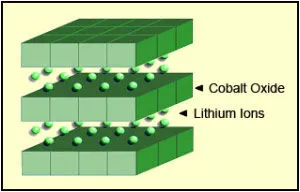
Li-cobalt structure.
(The cathode has a layered structure. During discharge the lithium ions move from the anode to the cathode; on charge the flow is from cathode to anode.)
The drawback of Li-cobalt is a relatively short life span, low thermal stability and limited load capabilities (specific power). Like other cobalt-blended Li-ion, Li-cobalt has a graphite anode
that limits the cycle life by a changing solid electrolyte interface (SEI), thickening on the anode and lithium plating while fast charging and charging at low temperature.
Newer systems include nickel, manganese and/or aluminum to improve longevity, loading capabilities and cost.
The Li-cobalt is losing favor to Li-manganese, but especially NMC and NCA because of the high cost of cobalt and improved performance by blending with other active cathode materials.
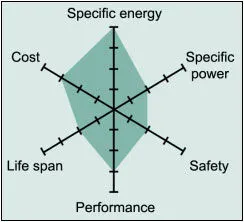
An average Li-cobalt battery.
Li-cobalt excels on high specific energy but offers only moderate performance specific power, safety and life span.
|
Lithium Cobalt Oxide: LiCoO2 cathode (~60% Co), graphite anode Short form: LCO or Li-cobalt. |
|
| Voltages | 3.60V nominal; typical operating range 3.0–4.2V/cell |
| Specific energy (capacity) | 150–200Wh/kg. Specialty cells provide up to 240Wh/kg. |
| Charge (C-rate) | 0.7–1C, charges to 4.20V (most cells); 3h charge typical. Charge current above 1C shortens battery life. |
| Discharge (C-rate) | 1C; 2.50V cut off. Discharge current above 1C shortens battery life. |
| Cycle life | 500–1000, related to depth of discharge, load, temperature |
| Thermal runaway | 150°C (302°F). Full charge promotes thermal runaway |
| Applications | Mobile phones, tablets, laptops, cameras |
| Comments |
Very high specific energy, limited specific power. Cobalt is expensive. Serves as Energy Cell. Market share has stabilized. |
2.Lithium Manganese Oxide(LiMn2O4)-LMO
Li-ion with manganese spinel.In 1996, Moli Energy commercialized a Li-ion cell with lithium manganese oxide as cathode material. The architecture forms a three-dimensional spinel
structure that improves ion flow on the electrode, which results in lower internal resistance and improved current handling. A further advantage of spinel is high thermal stability and
enhanced safety, but the cycle and calendar life are limited.
Low internal cell resistance enables fast charging and high-current discharging. In an 18650 package, Li-manganese can be discharged at currents of 20–30A with moderate heat buildup.
It is also possible to apply one-second load pulses of up to 50A. A continuous high load at this current would cause heat buildup and the cell temperature cannot exceed 80°C (176°F).
Li-manganese is used for power tools, medical instruments, as well as hybrid and electric vehicles.
The formation of a three-dimensional crystalline framework on the cathode of a Li-manganese battery. This spinel structure, which is usually composed of diamond shapes connected
into a lattice, appears after initial formation.
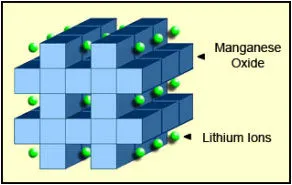
Li-manganese structure.
(The cathode crystalline formation of lithium manganese oxide has a three-dimensional framework structure that appears after initial formation. Spinel provides low
resistance but has a more moderate specific energy than cobalt.)
The spider web of a typical Li-manganese battery.The characteristics appear marginal but newer designs have improved in terms of specific power, safety and life span. Pure Li-
manganese batteries are no longer common today; they may only be used for special applications.
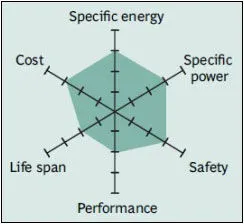
pure Li-manganese battery
Although moderate in overall performance, newer designs of Li-manganese offer improvements in specific power, safety and life span.
|
Lithium Manganese Oxide: LiMn2O4 cathode. graphite anode Short form: LMO or Li-manganese (spinel structure) |
|
| Voltages | 3.70V (3.80V) nominal; typical operating range 3.0–4.2V/cell |
| Specific energy (capacity) | 100–150Wh/kg |
| Charge (C-rate) | 0.7–1C typical, 3C maximum, charges to 4.20V (most cells) |
| Discharge (C-rate) | 1C; 10C possible with some cells, 30C pulse (5s), 2.50V cut-off |
| Cycle life | 300–700 (related to depth of discharge, temperature) |
| Thermal runaway | 250°C (482°F) typical. High charge promotes thermal runaway |
| Applications | Power tools, medical devices, electric powertrains |
| Comments | High power but less capacity; safer than Li-cobalt; commonly mixed with NMC to improve performance. |
3.Nickel Cobalt Aluminum Oxide (LiNiCoAlO2)-NCA
Lithium nickel cobalt aluminum oxide battery, or NCA, has been around since 1999 for special applications. It shares similarities with NMC by offering high specific energy, reasonably
good specific power and a long life span. Less flattering are safety and cost.
The six key characteristics. NCA is a further development of lithium nickel oxide; adding aluminum gives the chemistry greater stability.
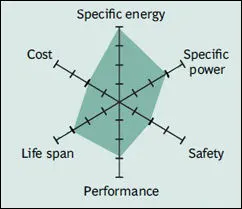
NCA
High energy and power densities, as well as good life span, make NCA a candidate for EV powertrains. High cost and marginal safety are negatives.
|
Lithium Nickel Cobalt Aluminum Oxide: LiNiCoAlO2 cathode (~9% Co), graphite anode Short form: NCA or Li-aluminum. |
|
| Voltages | 3.60V nominal; typical operating range 3.0–4.2V/cell |
| Specific energy (capacity) | 200-260Wh/kg; 300Wh/kg predictable |
| Charge (C-rate) | 0.7C, charges to 4.20V (most cells), 3h charge typical, fast charge possible with some cells |
| Discharge (C-rate) | 1C typical; 3.00V cut-off; high discharge rate shortens battery life |
| Cycle life | 500 (related to depth of discharge, temperature) |
| Thermal runaway | 150°C (302°F) typical, High charge promotes thermal runaway |
| Cost | ~$350 per kWh (Source: RWTH, Aachen) |
| Applications | Medical devices, industrial, electric powertrain (Tesla) |
| Comments | Shares similarities with Li-cobalt. Serves as Energy Cell. Mainly used by Panasonic and Tesla; growth potential. |
4.Lithium Nickel Manganese cobalt Oxide (LiNiMnCoO2)-NMC
One of the most successful Li-ion systems is a cathode combination of nickel-manganese-cobalt (NMC). Similar to Li-manganese, these systems can be tailored to serve as Energy
Cells or Power Cells. For ex, NMC in an 18650 cell for moderate load condition has a capacity of about 2,800mAh and can deliver 4A to 5A; NMC in the same cell optimized for
specific power has a capacity of only about 2,000mAh but delivers a continuous discharge current of 20A. A silicon-based anode will go to 4,000mAh and higher but at reduced loading
capability and shorter cycle life. Silicon added to graphite has the drawback that the anode grows and shrinks with charge and discharge, making the cell mechanically unstable.
NMC is the battery of choice for power tools, e-bikes and other electric powertrains. The cathode combination is typically one-third nickel, one-third manganese and one-third cobalt,
also known as 1-1-1. Cobalt is expensive and in limited supply. Battery manufacturers are reducing the cobalt content with some compromise in performance. A successful combination
is NCM532 with 5 parts nickel, 3 parts cobalt and 2 parts manganese. Other combinations are NMC622 and NMC811. Cobalt stabilizes nickel, a high energy active material
New electrolytes and additives enable charging to 4.4V/cell and higher to boost capacity.the characteristics of the NMC.
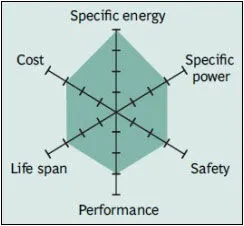
NMC
NMC has good overall performance and excels on specific energy. This battery is the preferred candidate for the electric vehicle and has the lowest self-heating rate.
|
Lithium Nickel Manganese Cobalt Oxide: LiNiMnCoO2. cathode, graphite anode Short form: NMC (NCM, CMN, CNM, MNC, MCN similar with different metal combinations) Since 2008 |
|
| Voltages | 3.60V, 3.70V nominal; typical operating range 3.0–4.2V/cell, or higher |
| Specific energy (capacity) | 150–220Wh/kg |
| Charge (C-rate) | 0.7–1C, charges to 4.20V, some go to 4.30V; 3h charge typical. Charge current above 1C shortens battery life. |
| Discharge (C-rate) | 1C; 2C possible on some cells; 2.50V cut-off |
| Cycle life | 1000–2000 (related to depth of discharge, temperature) |
| Thermal runaway | 210°C (410°F) typical. High charge promotes thermal runaway |
| Cost | ~$420 per kWh (Source: RWTH, Aachen) |
| Applications | E-bikes, medical devices, EVs, industrial |
| Comments | Provides high capacity and high power. Serves as Hybrid Cell. Favorite chemistry for many uses; market share is increasing. Leading system; dominant cathode chemistry. |
5.Lithium Iron Phosphate (LiFePo4)-LFP
In 1996, the University of Texas (and other contributors) discovered phosphate as cathode material for rechargeable lithium batteries. Li-phosphate offers good electrochemical
performance with low resistance. This is made possible with nano-scale phosphate cathode material.
The key benefits are high current rating and long cycle life, besides good thermal stability, enhanced safety and tolerance if abused.
Li-phosphate is more tolerant to full charge conditions and is less stressed than other lithium-ion systems if kept at high voltage for a prolonged time.
its lower nominal voltage of 3.2V/cell reduces the specific energy below that of cobalt-blended lithium-ion.
With most batteries, cold temperature reduces performance and elevated storage temperature shortens the service life, and Li-phosphate is no exception.
Li-phosphate has a higher self-discharge than other Li-ion batteries, which can cause balancing issues with aging. This can be mitigated by buying high quality cells and/or using
sophisticated control electronics, both of which increase the cost of the pack. Cleanliness in manufacturing is of importance for longevity.
There is no tolerance for moisture, lest the battery will only deliver 50 cycles
Li-phosphate is often used to replace the lead acid starter battery. Four cells in series produce 12.80V, a similar voltage to six 2V lead acid cells in series. Vehicles charge lead acid to
14.40V (2.40V/cell) and maintain a topping charge. Topping charge is applied to maintain full charge level and prevent sulfation on lead acid batteries.
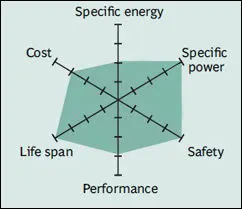
Typical Li-phosphate battery
Li-phosphate has excellent safety and long life span but moderate specific energy and elevated self-discharge.
|
Lithium Iron Phosphate: LiFePO4 cathode, graphite anode Short form: LFP or Li-phosphate. LIP is also common. |
|
| Voltages | 3.20, 3.30V nominal; typical operating range 2.5–3.65V/cell |
| Specific energy (capacity) | 90–120Wh/kg |
| Charge (C-rate) | 1C typical, charges to 3.65V; 3h charge time typical |
| Discharge (C-rate) | 1C, 25C on some cells; 40A pulse (2s); 2.50V cut-off (lower that 2V causes damage) |
| Cycle life | 2000 and higher (related to depth of discharge, temperature) |
| Thermal runaway | 270°C (518°F) Very safe battery even if fully charged |
| Cost | ~$580 per kWh (Source: RWTH, Aachen) |
| Applications | Portable and stationary needing high load currents and endurance |
| Comments |
Very flat voltage discharge curve but low capacity. One of safest Li-ions. Used for special markets. Elevated self-discharge. |
6.Lithium Titanate (Li2Tio3)-LTO
Batteries with lithium titanate anodes have been known since the 1980s. Li-titanate replaces the graphite in the anode of a typical lithium-ion battery and the material forms into a
spinel structure. The cathode can be lithium manganese oxide or NMC. Li-titanate has a nominal cell voltage of 2.40V, can be fast charged and delivers a high discharge current of 10C,
or 10 times the rated capacity. The cycle count is said to be higher than that of a regular Li-ion. Li-titanate is safe, has excellent low-temperature discharge characteristics and obtains a
capacity of 80 percent at –30°C (–22°F).
LTO (commonly Li4Ti5O12) has advantages over the conventional cobalt-blended Li-ion with graphite anode by attaining zero-strain property, no SEI film formation and no lithium plating
when fast charging and charging at low temperature. Thermal stability under high temperature is also better than other Li-ion systems; however, the battery is expensive.
At only 65Wh/kg, the specific energy is low, rivalling that of NiCd. Li-titanate charges to 2.80V/cell, and the end of discharge is 1.80V/cell.
The characteristics of the Li-titanate battery. Typical uses are electric powertrains, UPS and solar-powered street lighting.
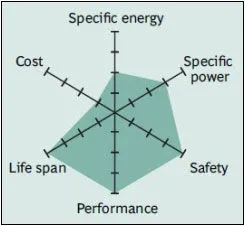
Li-titanate
Li-titanate excels in safety, low-temperature performance and life span. Efforts are being made to improve the specific energy and lower cost.
|
Lithium Titanate: Cathode can be lithium manganese oxide or NMC; Li2TiO3 (titanate) anode Short form: LTO or Li-titanate |
|
| Voltages | 2.40V nominal; typical operating range 1.8–2.85V/cell |
| Specific energy (capacity) | 50–80Wh/kg |
| Charge (C-rate) | 1C typical; 5C maximum, charges to 2.85V |
| Discharge (C-rate) | 10C possible, 30C 5s pulse; 1.80V cut-off on LCO/LTO |
| Cycle life | 3,000–7,000 |
| Thermal runaway | One of safest Li-ion batteries |
| Cost | ~$1,005 per kWh (Source: RWTH, Aachen) |
| Applications | UPS, electric powertrain (Mitsubishi i-MiEV, Honda Fit EV), solar-powered street lighting |
| Comments | Long life, fast charge, wide temperature range but low specific energy and expensive. Among safest Li-ion batteries. Ability to ultra-fast charge; high cost limits to special application. |
Conculsion:
Future Batteries:
Solid-state Li-ion: High specific energy but poor loading and safety.
Lithium-sulfur: High specific energy but poor cycle life and poor loading
Lithium-air: High specific energy but poor loading, needs clean air to breath and has short life.
The specific energy of lead-, nickel- and lithium-based systems. While Li-aluminum (NCA) is the clear winner by storing more capacity than other systems, this only applies to specific
energy. In terms of specific power and thermal stability, Li-manganese (LMO) and Li-phosphate (LFP) are superior. Li-titanate (LTO) may have low capacity but this chemistry outlives
most other batteries in terms of life span and also has the best cold temperature performance. Moving towards the electric powertrain, safety and cycle life will gain dominance over
capacity. (LCO stands for Li-cobalt, the original Li-ion.)
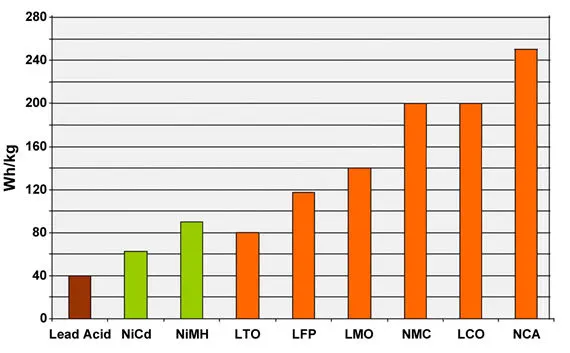
Typical specific energy of lead-, nickel- and lithium-based batteries.
NCA enjoys the highest specific energy.manganese and phosphate are superior in terms of specific power and thermal stability. Li-titanate has the best life span.