Week 1 Understanding Different Battery Chemistry
1.Prepare a table which includes materials & chemical reactions occurring at the anode and cathode of LCO, LMO, NCA, NMC, LFP and LTO type of lithium ion cells.Give your detailed explanation on it
Battery:
A Battery is a device consisting of one or more electrochemical cells with external connections for powering electrical devices such as Flashlights, mobile phones, and electric cars. When a battery is supplying electric power, its positive terminal is the cathode and its negative terminal is the anode. The terminal marked negative is the source of electrons that will flow through an external electric circuit to the positive terminal. When a battery is connected to an external electric load, a Redox reaction converts high-energy reactants to lower-energy products, and the free energy difference is delivered to the external circuit as electrical energy.
Lithium ion Battery:
Lithium ion batteries are batteries that function based on the transfer of lithium ions between a cathode and an anode.
Lithium ion batteries work by using the transfer of lithium ions and electrons from the anode to the cathode. At the anode, neutral lithium is oxidized and converted to Li + . These Li+ ions then migrate to the cathode, where they are incorporated into LiCoO2 . This results in the reduction of Co(IV) to Co(III) when the electrons from the anode reaction are received at the cathode. Because lithium is involved in the reactions at both electrodes, the battery can be recharged by running the reactions in reverse
Types of secondary lithium ion cells
- Lithium cobalt oxide(LCO)
- Lithium manganese oxide(LMO)
- Lithium iron phosphate(LFP)
- Lithium nickel manganese cobalt oxide(NMC)
- Lithium nickel cobalt aluminum oxide(NCA)
- Lithium titanate(LTO)
|
Cell type |
Anode |
Cathode |
Separator |
Electrolyte |
Application |
Image |
|
LCO |
Graphite |
Cobalt oxide LiCoO2 (~60%CO) |
polyolefin |
Ethylene carbonate |
Mobile phone,tablet,camera. |
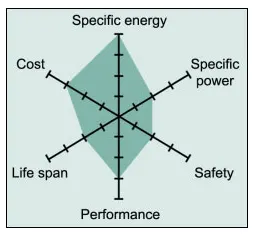 |
|
LMO |
Graphite |
Lithium manganese oxide LiMn2O4 |
polyolefin |
Lithium halide |
Power tools,electric powertrain,medical devices. |
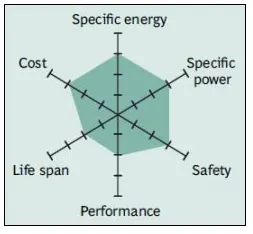 |
|
LFP |
Graphite |
Phosphate LiFePO4 |
polyolefin |
Ethylene carbonate |
Solar energy storage,battery for distribution power system |
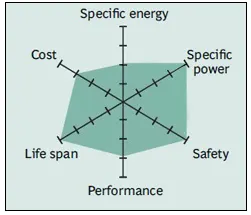 |
|
NMC |
Graphite |
Lithium manganese cobalt LiNiMnCoO2 |
polyolefin |
Lithium salt |
E-bikes,medical devices,EVs,industries. |
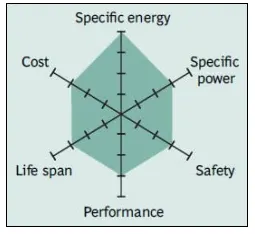 |
|
NCA |
Graphite |
Lithium nickel cobalt aluminium oxide LiNiCoAlO2 (~9%Co) |
polyolefin |
Ethylene carbonate |
Medical devices,electric powertrain,industrial. |
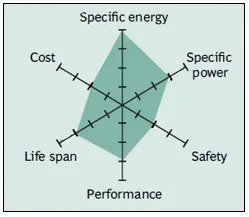 |
|
LTO |
Titanate |
Lithium manganese oxide |
polyolefin |
Lithium salt |
Solar powered street lighting,UPS. |
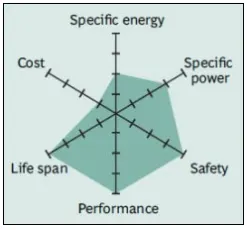 |
2.Compare the differences between each type of Li+ion batteries based on their characteristics
|
Cell type |
Nominal Voltage |
Charge C-rate |
Discharge C-rate |
Thermal Runaway ( Discharge, load temperature) |
Life cycle |
Energy Capacity |
|
LCO |
3.6 V |
0.7-1C charges to 4.2V (most cells) 3h charge typical. Charge current above 1C shortens battery life. |
1C; 2.5V cut-off. Discharge current above 1C shortens battery life. |
150degC(302degF) |
500-1000 |
150–200Wh/kg. Specialty cells provide up to 240Wh/kg |
|
LMO |
3.7,3.88 V |
0.7-1C, typical, 3C maximum, changes to 4.2V (most cells) |
1C; 10C possible with some cells, 30C pulse (5s), 2.5V cut-off |
250degC(250degF) |
300-700 |
100–150Wh/kg |
|
LFP |
3.2,3.3 V |
1C typical charges to 3.65V;3h charge time typical. |
1C, 250C on some cells; 40A pulse (2s); 2.5V cut-off (lower than 2V) causes damage) |
270degC(518degF) |
2000&higher |
90–120Wh/kg |
|
NMC |
3.6,3.7 V |
0.7-1C, charges to 4.2V (most cells); 3h charge typical. |
1C;2C possible on some cells;2.5V cut off |
250degC(250degF) |
1000-2000 |
150–220Wh/kg |
|
NCA |
3.6 V |
0.7-1C charges to 4.2V (most cells) 3h charge typical. |
1C typical; 3V cut-off; high discharge rate shortens battery life |
150degC(3.2degF) |
500 |
200-260Wh/kg; 300Wh/kg predictable |
|
LTO |
2.4 V |
1C typical; 5C maximum, changes to 2.85V |
10C possible, 30C 5s pulse; 1.8V cut-off on LCO/LTO |
one of the safest Li-ion cells |
3000-7000 |
50–80Wh/kg |