Week 1 Stress Concentration on a Plate with hole
Objective:
The objective of this challenge is to perform a static simulation of tensile load on a steel plate with holes. The challenge involved 2 cases with different geometries.
Case setup and execution:
First the Ansys Workbench was opened and Static structural module was selected. In this the geometry was created using SpaceClaim.
In both the cases, first a rectangle was created. Then a circle was created with its centre at the global origin. Then "Dimensions" tab was selected and the edges of the rectangle and the circle were selected and given the recommended dimensions in the question.
Then the pull option was used to extrude the sketch. The thickness of 30 mm was given.
Then from the Static structural module in the Ansys Workbench, "model" was opened by right-click-edit option.
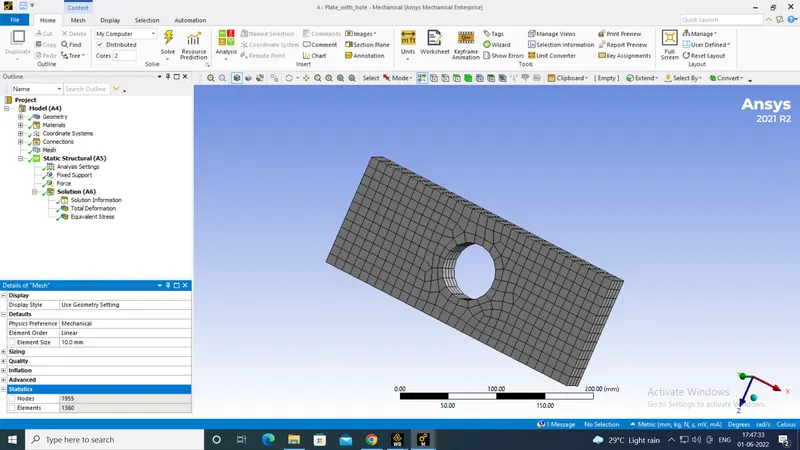
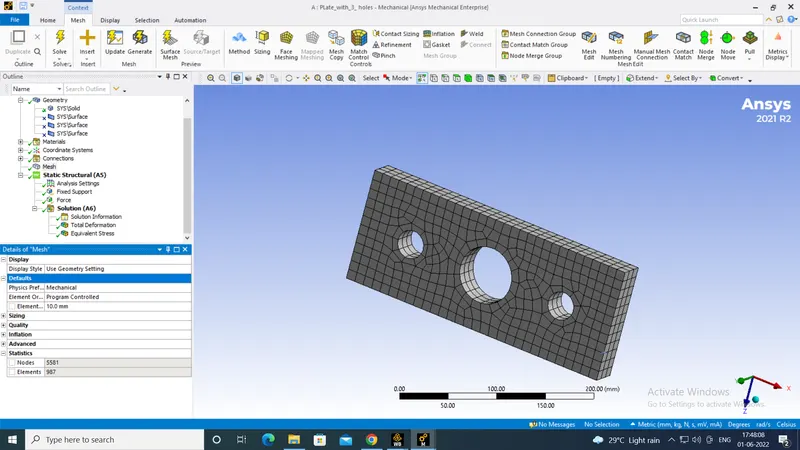
From the model tree, "mesh" was selected. In the "Defaults" section, the mesh size of 10 mm was given.
By right clicking on Analysis settings, the fixed support was given to the left face and a force of 500 N was applied to right face.
By clicking on the Analysis settings, number of substeps was given as 2 each of duration of 1 sec. The force was input as tabular data, with 0 N at 0 sec, 250 N at 1 sec and 500 N at 2 sec.
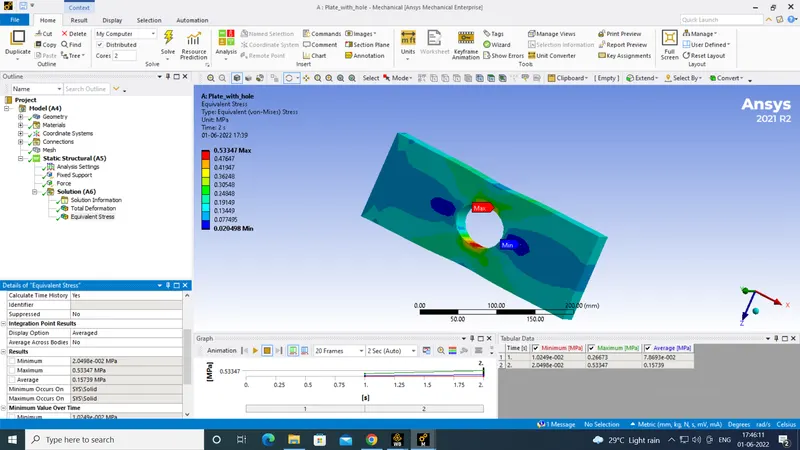
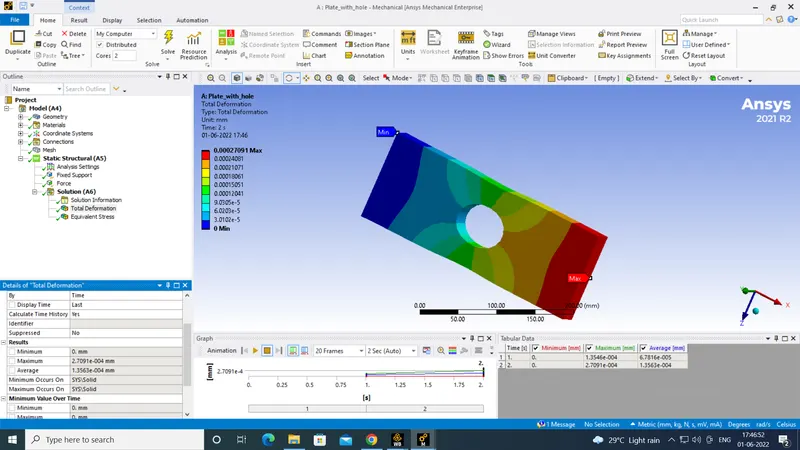
By right-clicking solution, output was obtained for total deformation and von mises stress.
Results:
| Case 1 | Case 2 | |
| Number of nodes | 1955 | 5581 |
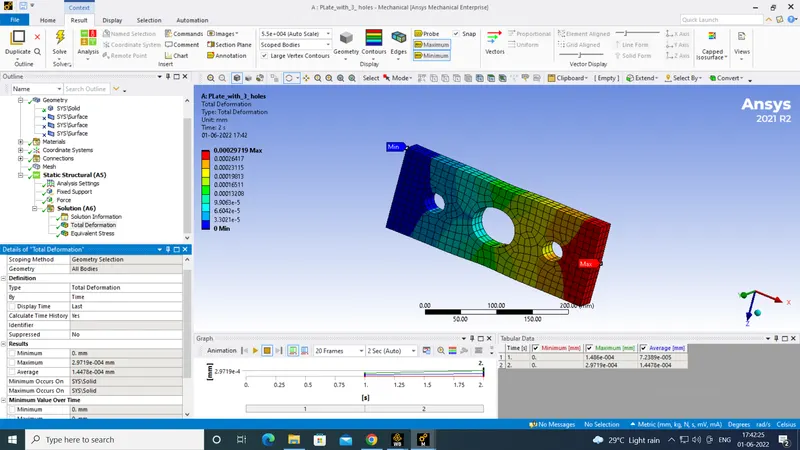
| Max. deformation (mm) | 2.7 e-04 | 2.97 e-04 |
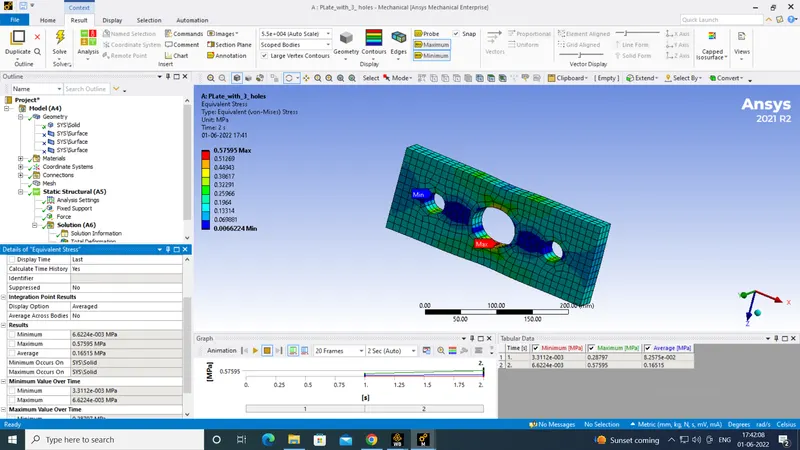
| Max. stress (MPa) | 0.5335 | 0.5759 |
The images for both the cases are attached below:
Case-1:
Mesh:
Stress:
Deformation:
Case 2:
Mesh:
Stress:
Deformation:
Selection of Design from the analysis point of view:
From the analysis point of view, it is better to select the design in Case-1, because of lesser deformation and stress values. The lower values are due to presence of 1 hole, as opposed to 3 holes in Case-2. This reduces the discontinuities in the design, resulting in a more robust design than Case-2.
Selection of Design from the Manufacturing point of view:
From manufacturiong point of view also, the design in Case-1 should be selected, as it involves only one hole. On the other hand, the Case-2 design involves 2 more holes of different diameter. This increases the manufacturing time as well complexity, as drills of 2 different diameters are needed. This also increases the cost of production. Hence design in case-1 should be preferred.
Conclusion:
Thus, it is clear, that both the deformation and stress values are higher in Case-2. It is also costlier to manufacture than the Case-1 design. Hence from both design and manufacturing perspective, case-1 design should be preferred. The analysis files are attached below in the zip file.