Week 1 Stress Concentration on a Plate with hole
ANALYSIS OF STRESS AND DEFORMATION IN A PLATE WITH A HOLE AND A PLATE WITH THREE HOLES
OBJECTIVE:
The objective of the analysis is to provide a valid solution for stress at a force on the plate, and to consider which one is the best to go with. In this analysis, a force is applied on the particular side of the plate and to find the maximum stress and maximum deformation acting on the plate.
DIMENSIONS OF THE APPARATUS:
(I) MATERIAL 1:
- Length = 300 mm
- Height = 120 mm
- Thickness = 30 mm
- Diameter of hole = 60 mm
(II) MATERIAL 2:
- Length = 300 mm
- Height = 120mm
- Thickness = 30 mm
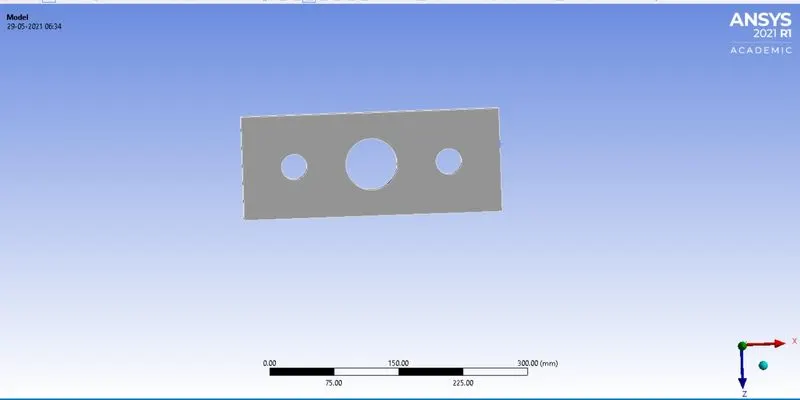
- Diameter of Center hole = 60 mm
- Diameter of small circles = 30 mm
ANALYIS OUTCOMES:
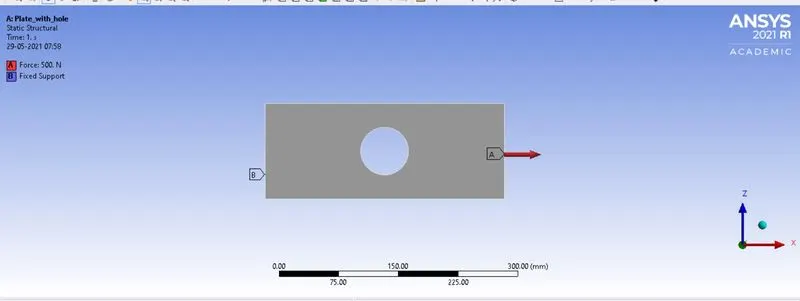
The material samples have been kept with one edge completely fixed and other end has been loaded with an axial load of 500N force. The resultant outcomes that are to be calculated are maximum stress and maximum deformation acting on it.
MATERIAL 1:
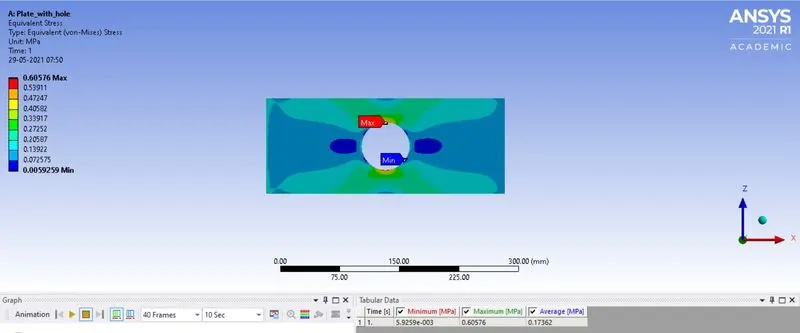
In such case, the maximum stress on material 1 when applied with 500N force is 0.60507 MPa, and the minimum stress is 5.9259e-003.
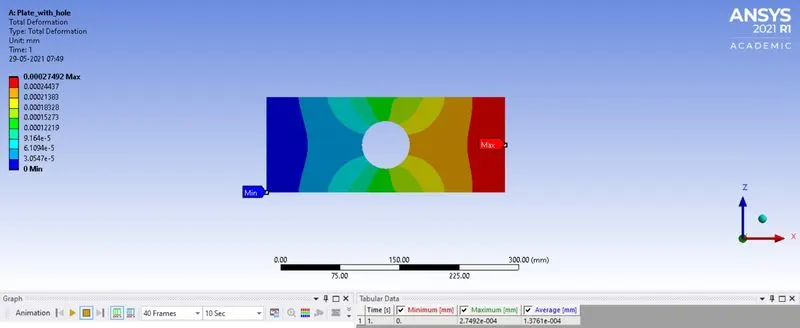
While the deformation in the plate is also noted and the maximum deformation in the apparatus is 2.7492e-004 mm and the minimum deformation is 0 mm.
MATERIAL 2:
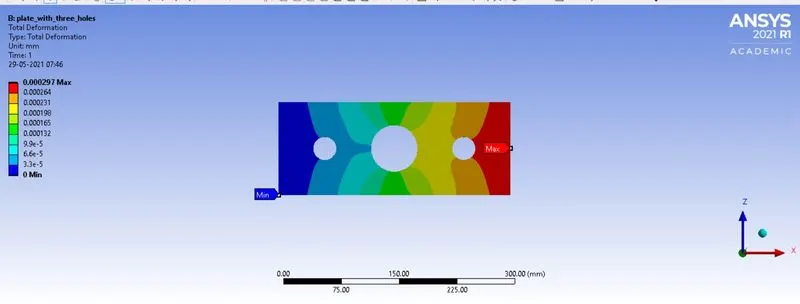
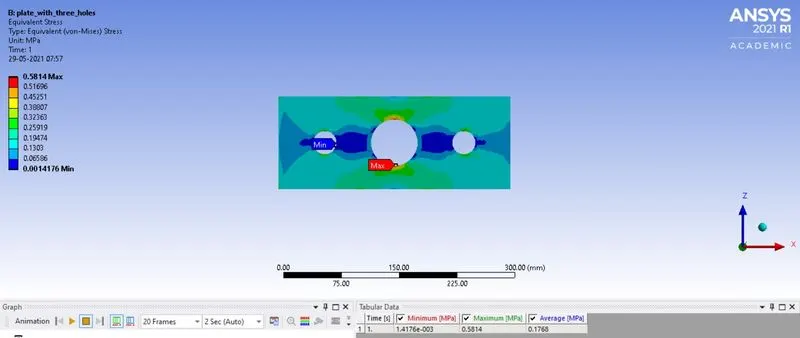
In this case the material 2 has three holes which is also subjected to the same constraints and the loads as the material 1, the resultant outcomes are maximum stress is 0.5814 MPa and the minimum stress is about 1.4176e-003 MPa. The deformation is, maximum deformation is 2.794e-004 mm, and the minimum deformation is 0 mm.
REPORT:
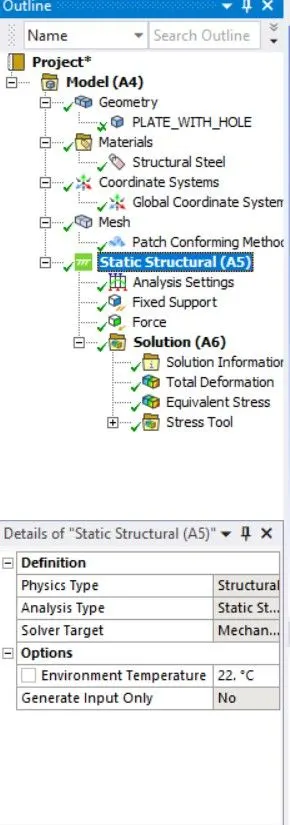
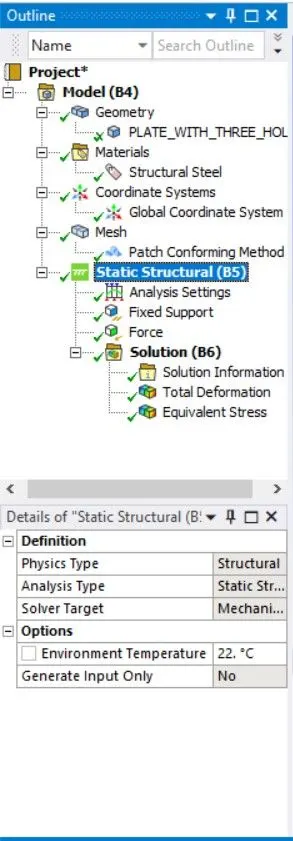
- Open the Ansys workbench and click on the static structural option in the analysis section
- Now, we are going to allot some preprocessing steps, such as defining the geometry of the process and assigning the suitable material. In this case we used structural steel for both of the apparatus.
- Once after assigning all the quantities in the geometry and materials section, we need to upload the geometry for the solving.
- After updating the model, we need to create a mesh accordingly. The structure of the mesh such as sizing and quality of the mesh can be assigning according to our will, but it should not reach the constrained limit. The mesh here used here in this analysis for both materials is tetrahedron. Since the plate has a hole where hexahedron won't be a proper type to solve has it won't appear smooth mesh.
- After finishing the generation of mesh, we need to give the solver steps to work on, the solver step is nothing but providing the boundary conditions which are force on the left side of the plate on the x-direction (in this process) and fixed support on either end of the material.
- After providing all the solver quantities, the solver will solve and provide the solution in the post processing state.
- In the post processing state, we can check any type of outcomes like strain, deformation, stress, etc. . In this case we need the maximum stress and maximum deformation. Which can be obtained by requesting the post-processing solution to provide the solution for equivalent stress where the maximum and minimum stress can be obtained,
- The same process is also for the deformation, we need to request the post – processing solution to provide the solution for the total deformation so that we can get the maximum and minimum deformation.
- After, this process we need to compare the outcomes of the both materials and provide a valid solution accordingly.
CONCLUSION:
As we conclude that after performing several analysis processes on both of the apparatus,
- From the ANALYST point of view, I will be considering the material 2, since it experiences lowest stress at the center of the small hole and also it is uniformly distributed on the other hole surface and it can also withstand even more force applied on the same side of the material. As the maximium stress occurs at the centre of the hole.
- From the manufacturing point of view, I will be recommending the material 1 as it is easy to manufacture, which doesn’t mean the material 2 is difficult to manufacture, the process of manufacturing is very less in the material1 when compared to material 2.