Spur Gear Simulation
OBJECTIVE:
CAD model is provided to setup the given case studies, run simulations and compare the results and present appropriate conclusion.
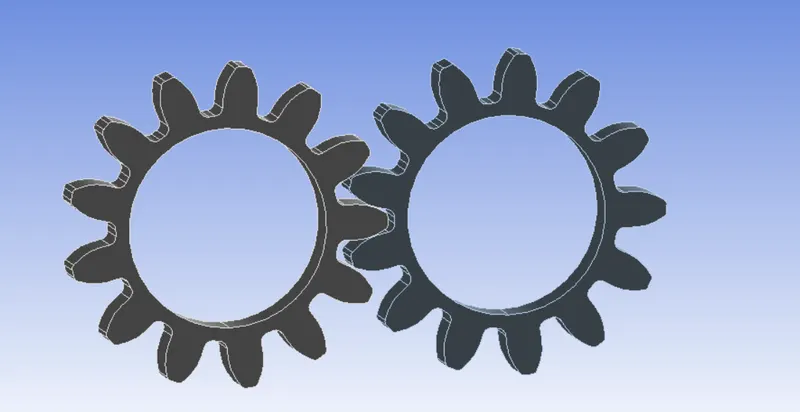
CAD MODEL - SPUR GEARS:
PROBLEM STATEMENTS:
| CASE -1 | CASE -2 | CASE -3 | |
| MODEL | Spur Gear | Spur Gear | Spur Gear |
| MATERIAL TO BE USED | Cast Iron(ductile) | Cast Steel | Cast Bronze |
| PARAMETERS TO BE STUDIED | Equivalent Stress | Equivalent Stress | Equivalent Stress |
| Stress Intensity | Stress Intensity | Stress Intensity | |
| Total Deformation | Total Deformation | Total Deformation |
VON-MISES STRESS:
Von Mises stress is a value used to determine if a given material will yield or fracture. It is mostly used for ductile materials, such as metals. The von Mises yield criterion states that if the von Mises stress of a material under load is equal or greater than the yield limit of the same material under simple tension then the material will yield.
DEFORMATION:
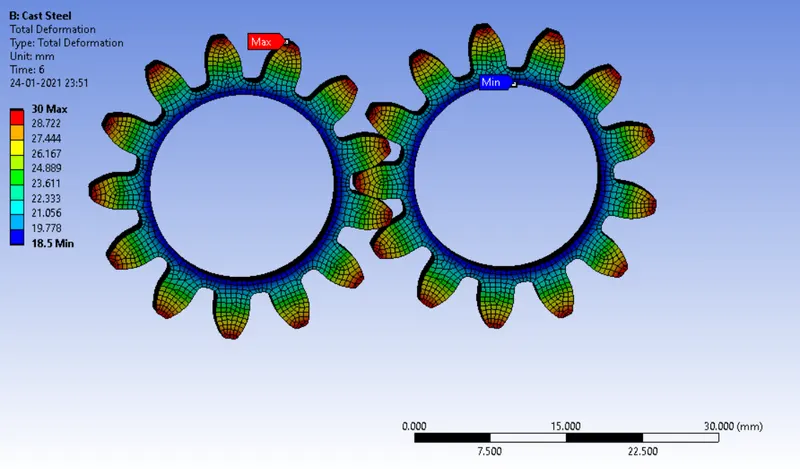
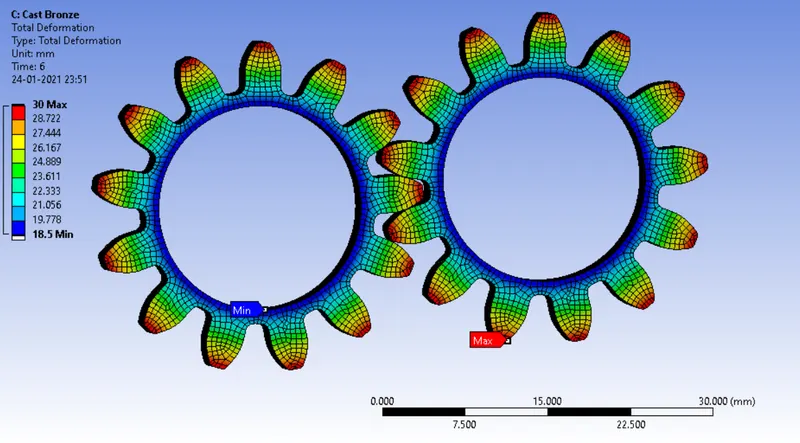
Deformation is the phenomenon in which a material undergoes changes in dimensions in response to mechanical forces. The deformation is said to be elastic if the material returns to its original size and shape upon removal of the applied load. On the other hand, it is referred to as inelastic deformation if the application of the mechanical load results in a permanent change in the dimensions of the material, i.e., it doesn't return to its original size and shape even if the mechanical load is no longer being applied to it.
STRESS INTENSITY:
The stress intensity factor (K) is used in the field of fracture mechanics. It predicts stress intensity near the tip of a crack caused by a remote load or residual stresses.
The magnitude of K depends on:
- Sample geometry
- Size and location of the crack
- Magnitude of load
- Distribution of load
The stress intensity factor is a single-parameter characterization of the crack tip stress field.
The following equation describes stress intensity:
Where ß describes the relationship between gross geometrical features to the stress intensity factors. ß can be a function of crack length as well as other geometrical features. K represents nominal stress that is remote from the crack.
The above equation shows that the intensity of the stress field — and therefore the stresses in the crack tip region — are linearly proportional to remotely applied stress and proportional to the square root of half the crack's length.
SIMULATION RESULTS COMPARISON:
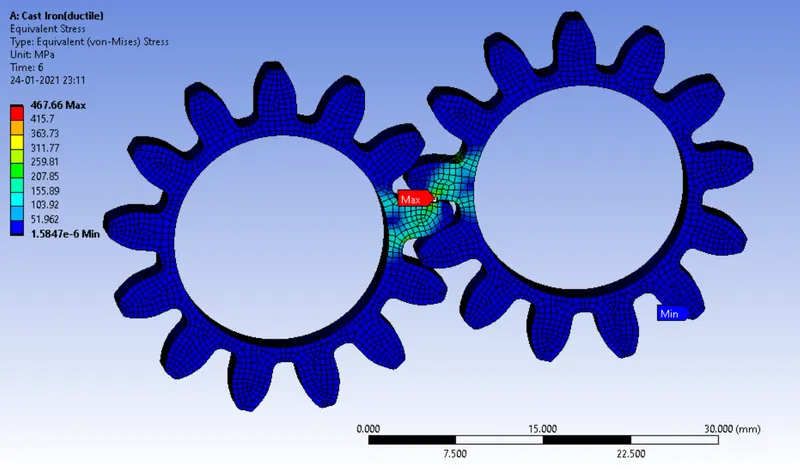
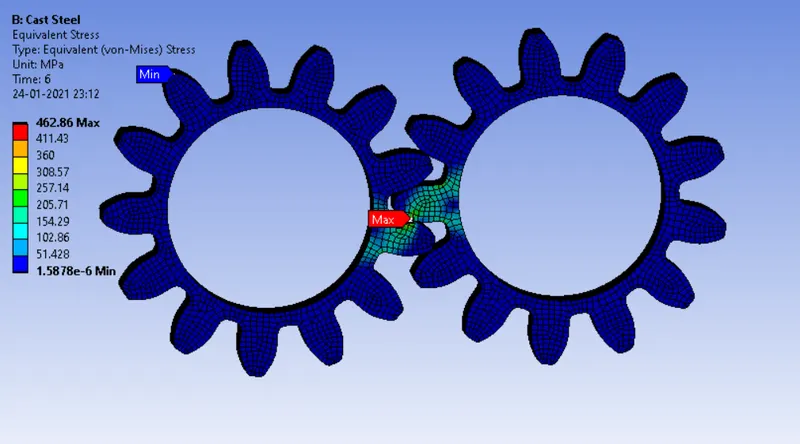
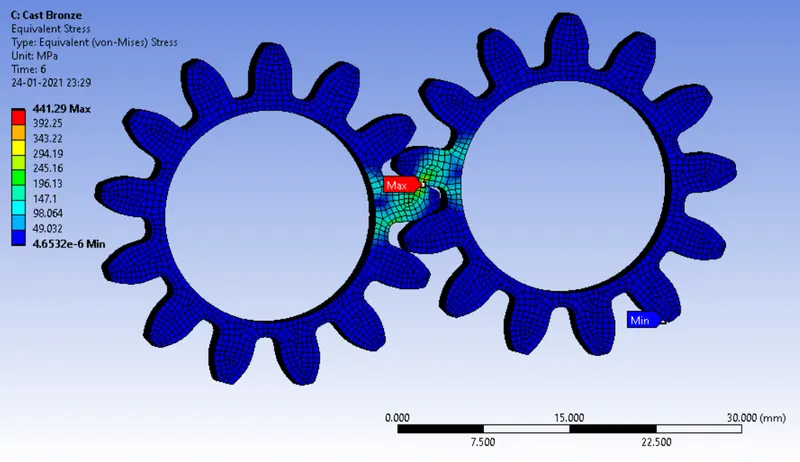
Equivalent Stress:
| CASE-1 | Cast Iron(ductile) | CASE-2 | Cast Steel | CASE-3 | Cast Bronze | |
| Equivalent Stress (Mpa) | 467.66 | 462.86 | 441.29 |
Stress Intensity:
| CASE-1 | Cast Iron(ductile) | CASE-2 | Cast Steel | CASE-3 | Cast Bronze | |
| Stress Intensity (Mpa) | 528.86 | 521.86 | 494.35 |
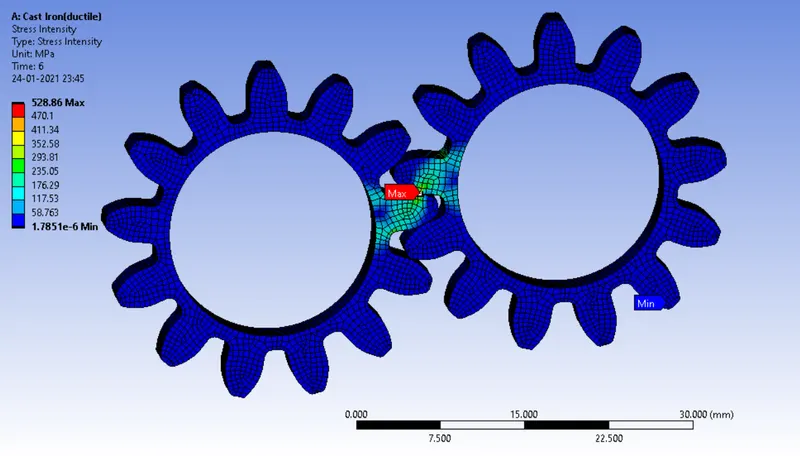
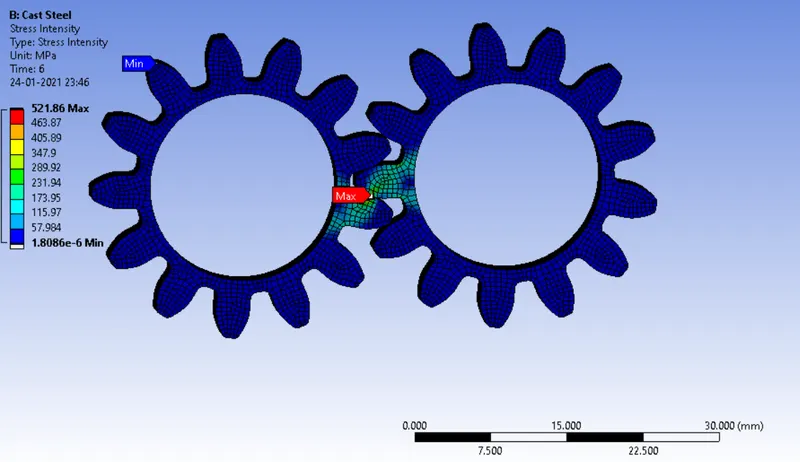
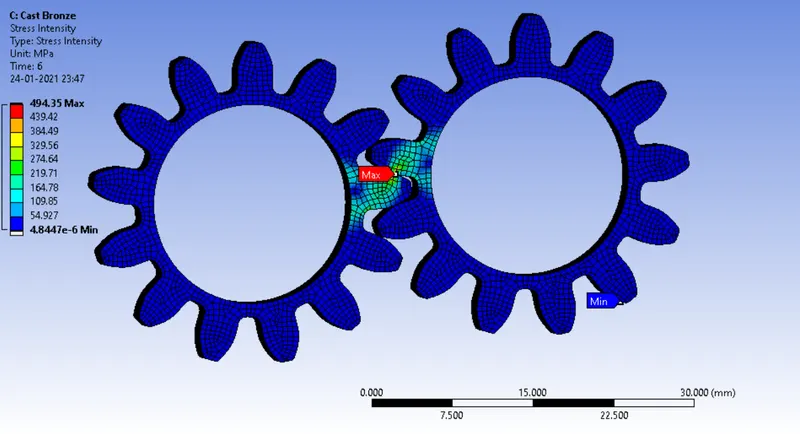
Deformation:
| CASE-1 | Cast Iron(ductile) | CASE-2 | Cast Steel | CASE-3 | Cast Bronze | |
| Total Deformation (mm) | 30 | 30 | 30 |
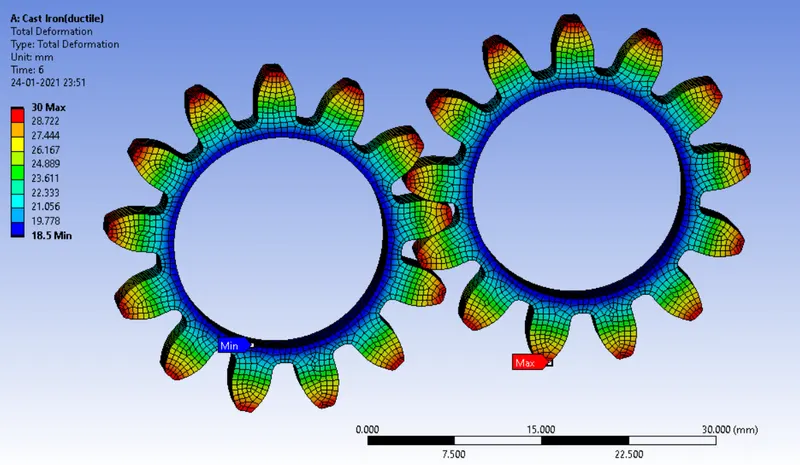
CONCLUSION:

From the above data we can infer that though the deformation is same for all three materials, the Equivalent Stress and Stress Intensity is both having a higher values as compared to the other two materials. This implies that gears made from Cast Iron will have better resistance to acting forces and the product will not fail on higher loads. Therefore, gears must be manufactured using Cast Iron (Ductile) as a material for better product life.