Week 1 Spur Gear Challenge
Aim :
To perform analysis and compare the results for the given different materials using ANSYS software.
Objective :
The main objective is to set the material, geometry and solution method to get the required results.
We solve the analysis for three different materials and compare the results to choose the best material suited for the process.
Given model :
Spur gears or straight-cut gears are the simplest type of gear. They consist of a cylinder or disk with teeth projecting radially. Viewing the gear at 90 degrees from the shaft length (side on) the tooth faces are straight and aligned parallel to the axis of rotation. Looking down the length of the shaft, a tooth's cross section is usually not triangular.
The given model for analysis is a set of Spur gear with 13 teeths on each. For the given model we use three different material to classify the best suited for working process.
The different materials are cast iron, cast steel and cast bronze.
Formula: Augmented Lagrange.
This method is also a penalty-based method. It uses the same equation for solving but has an extra augmentation constant, λ(lambda). Because there is an extra term in the equation, the contact force becomes less sensitive to the stiffness. So, there will be lesser penetration at the contacts. Hence, this formulation is preferred more.
𝑭𝒏𝒐𝒓𝒎𝒂𝒍 = 𝒌𝒏𝒐𝒓𝒎𝒂𝒍 × 𝒙𝒑𝒆𝒏𝒆𝒕𝒓𝒂𝒕𝒊𝒐𝒏 + 𝝀
If penetration present is large, the solver will require additional iterations to converge. Contact penetration is allowed in this formulation but it is more controlled than it was in pure penalty method. This method can be used with any type of contact.
The analysis to perform is Equivalent stress, Total deformation and Stress intensity.
Procedure :
- We perform Structural analysis here so we select and place it in the main screen.
- We have to add the material and material data in engineering tab.
- Next step we have to import the geometry in geometry tab.
- These operations are performed in work bench and for model tab we move to mechanical setup screen.
- In mechanical window we add data which is required to solve the process.
- For mesh we change the element size to be 1mm. In student edition we have limitations for nodes and elements.
- We choose connections option to select the faces of contact between both gears.
- In contacts we define the connection type in joint option as body to ground and the type as revolute. Through scope we fix the co- ordinates. For both the gears same method.
- We define the type of contact as Frictional contact.
- We change the behaviour to Symmetric.
- We define the formulation as Augmented Lagrange. Augmented Lagrange formulation reduces vibration and penetration and increases stiffness of gears.
- In geometry modification we change the interface treatment to adjust to touch.
- In static structural we choose analysis settings there we add the number of steps data and switch on the large deflection and auto time stepping. Which is defined by time.
- Add data like initial time step, minimum time step and maximum time step.
- In static structural we insert joint load for both the gears in that degree of freedom and magnitude values are added for the rotation of gears.
- In solution tab we choose three options which is asked to do analysis for they are,
- Equivalent stress,
- Total deformation,
- Stress intensity.
Analysis and report with screenshort :
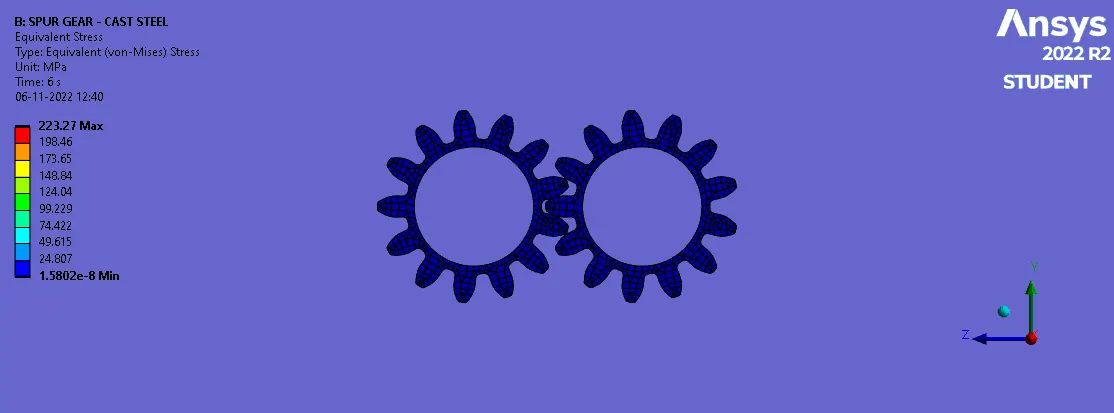
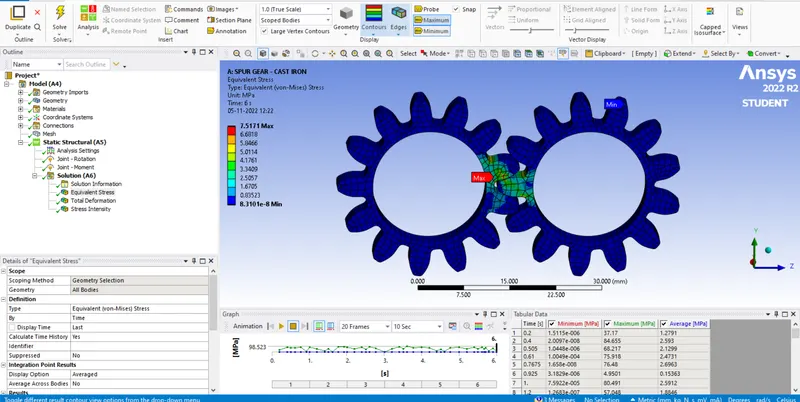
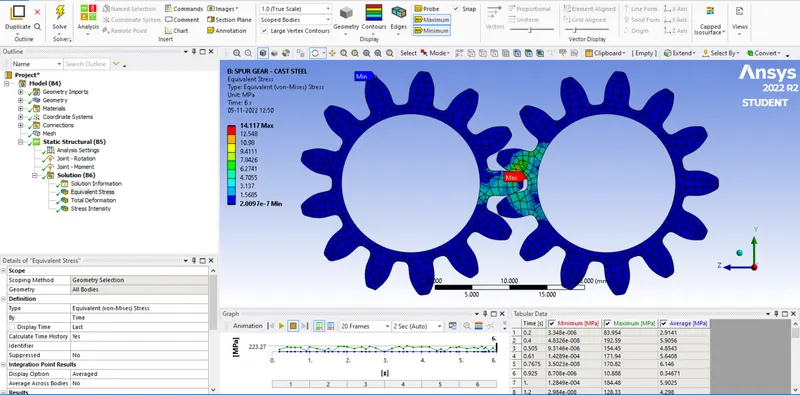
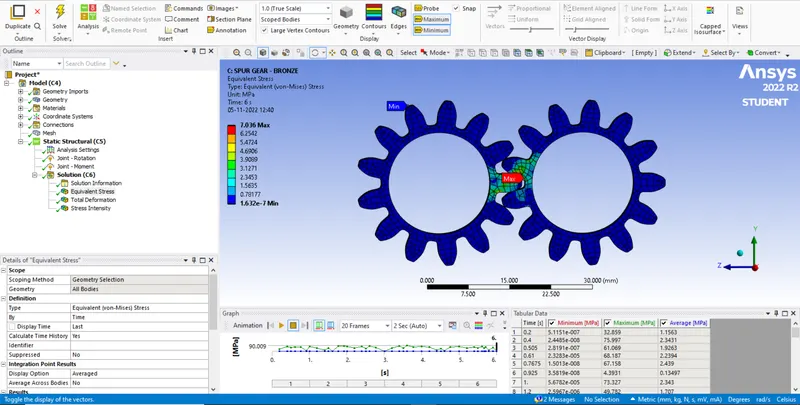
Equivalent stress
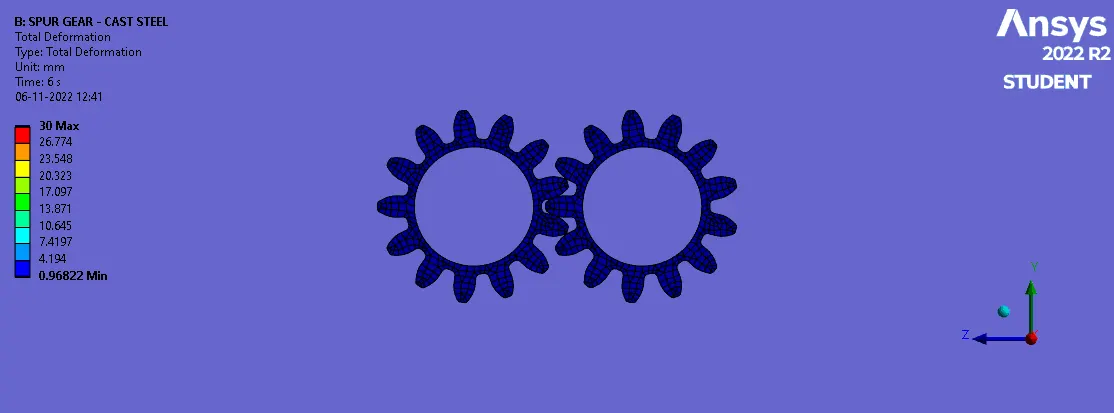
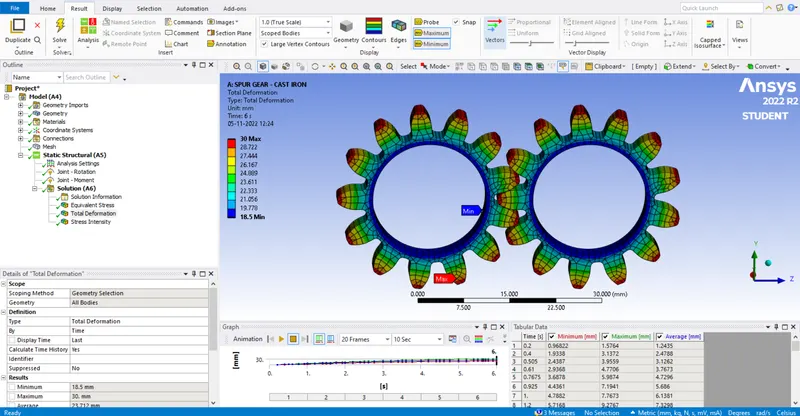
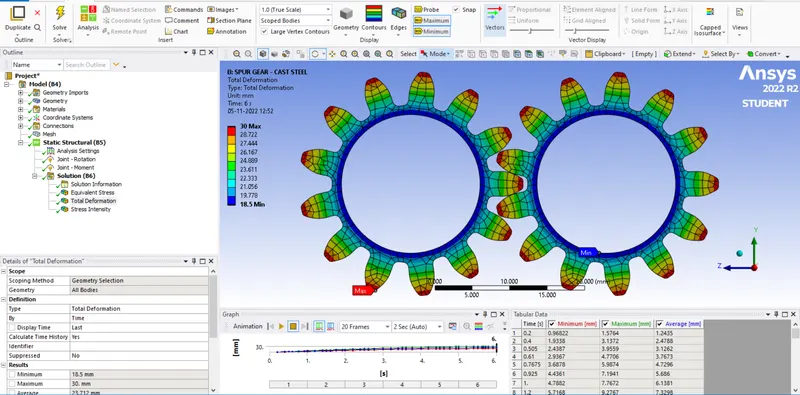
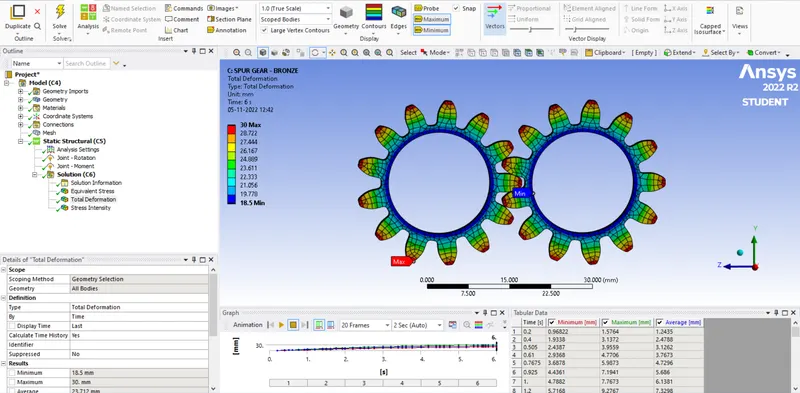
Total deformation.
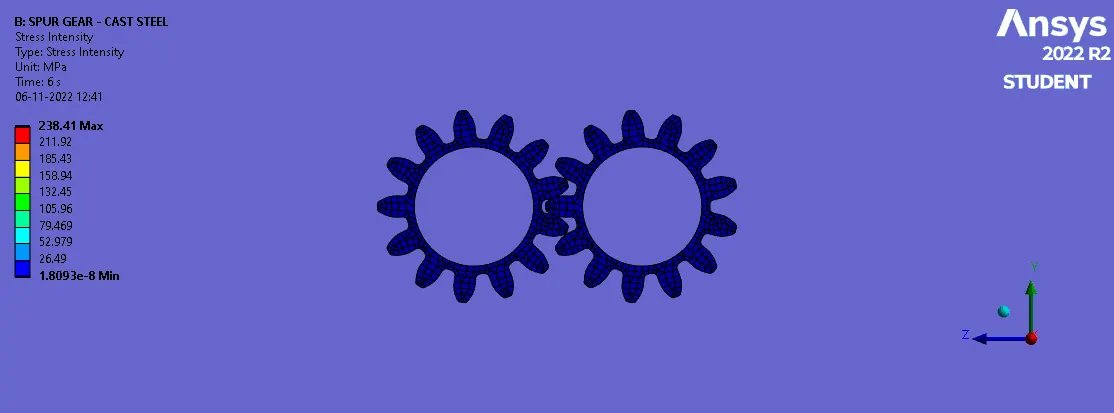
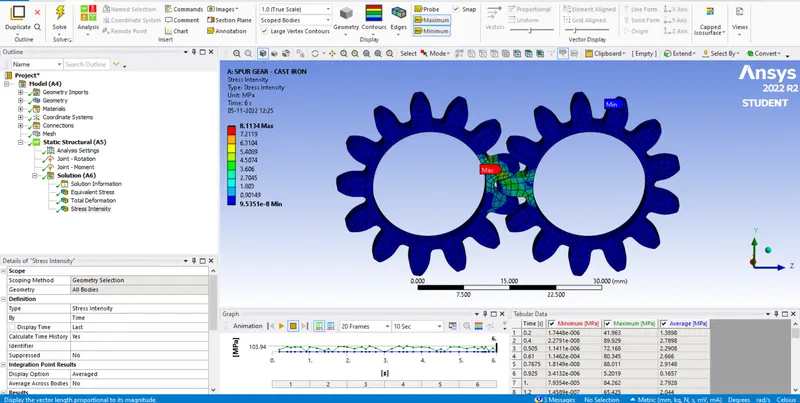
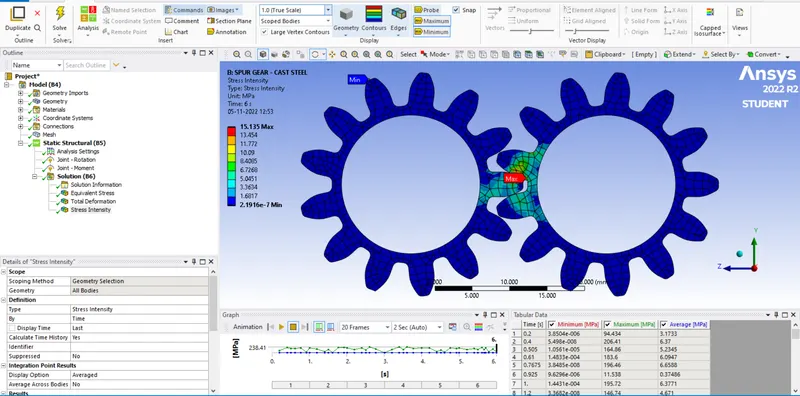
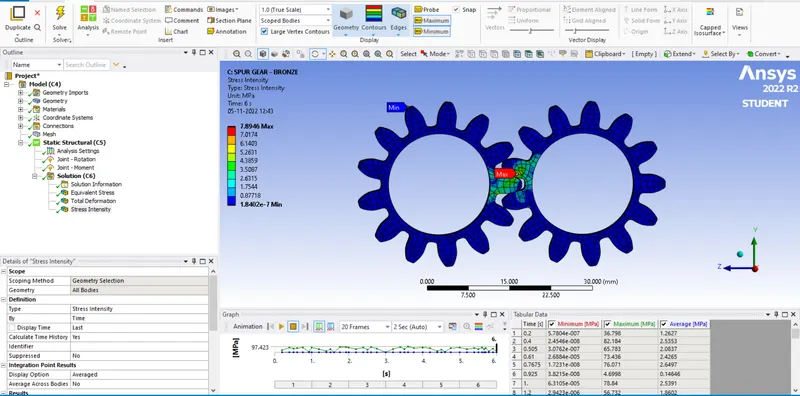
Stress intensity.
Result :
| Solution/Material | Cast Iron | Cast Steel | Cast Bronze |
| Equivalent stress |
7.5171Mpa(Max) |
14.117Mpa(Max) | 7.036Mpa(Max) |
| Total deformation | 30mm |
30mm |
30mm |
| Stress intensity | 8.1134Mpa(Max) | 15.135Mpa(Max) |
7.8946Mpa(Max) |
In fracture mechanics, the stress intensity factor is used to predict the stress state near the tip of a crack or notch caused by a remote load or residual stresses.
From the above table it is clear that Cast Steel has maximum Equivalent stress and Stress Intensity. So i choose Cast steel as first preference material, the other two materials like Cast iron and Cast Bronze has same maximum value and Total deformation remains constant for all.
Cast steel provides easier fabrication, strong working loads and vibration resistance.
Cast iron provides durablity and ease of manufacture.