Week 1- Mixing Tee
Aim: - To set up steady-state simulations to compare the mixing effectiveness T tubes for two different temperature inlets in Ansys Fluent.
Objective: -
- Using K-epsilon model to compare the mixing effectiveness when hot inlet temperature is 36°C & the Cold inlet is at 19°C for following cases-
Case 1 -
Short mixing tee with a hot inlet velocity of 3m/s.
Momentum ratio of 2 and 4 respectively.
Case 2 -
Long mixing tee with a hot inlet velocity of 3m/s.
Momentum ratio of 2 and 4 respectively.
- To compare the following values from the 2 cases.
- Cell count
- Average outlet temperature
- Number of iterations for convergence
Theory:-
Formula for calculating mixture temperature :
`T_(mix)= (m_(hot)*T_(hot) + m_(cold)*T_(cold))/(m_(hot) + m_(cold ) )`
Momentum ratio = velocity at cold inlet / velocity at hot inlet
K-epsilon model –
- It is used to simulate mean flow characteristics for turbulent flow conditions.
- It is a two-equation model that gives a general description of turbulence by means of two transport equations (PDEs).
- It is usually useful for free-shear layer flows with relatively small pressure gradients as well as in confined flows where the Reynolds shear stresses are most important.
- It can also be stated as the simplest turbulence model for which only initial and/or boundary conditions needs to be supplied.
K-Omega SST –
- The K-Omega SST (shear stress Transport) turbulence model is a two-equation eddy-viscosity model.
- It is a hybrid model combining the Wilcox k-omega and the k-epsilon models. A blending function activates the Wilcox model near the wall and the k-epsilon model in the free stream. This ensures that the appropriate model is utilized throughout the flow field.
- The k-omega model is well suited for simulating flow in the viscous sub-layer. The k-epsilon model is ideal for predicting flow behaviour in regions away from the wall.
since viscous sub layer phenomena is less dominant here in turbulent mixing and less chances of pressure gradient going adverse. We have done all the simulations in K-Epsilon model as it provides standard results.
Case setup:
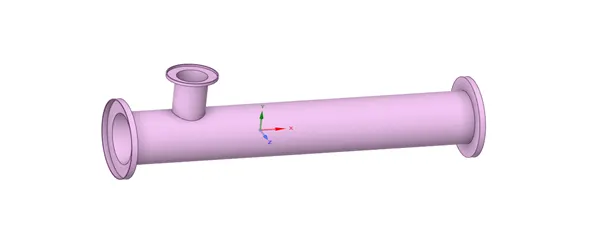
Short T dimension -
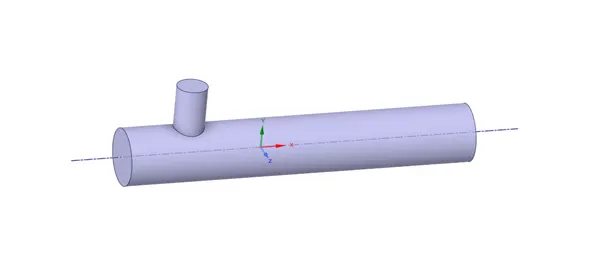
After volume extraction -
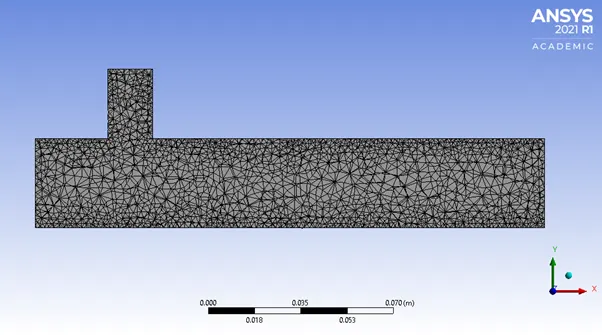
After Meshing and section plane preview -
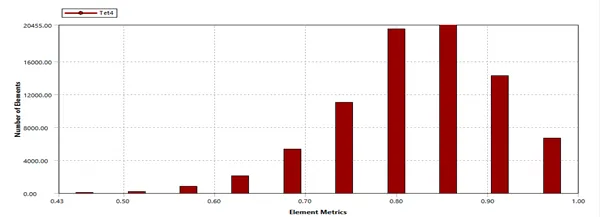
Mesh quality:
case 1(a) – Short T
hot inlet velocity = 3m/s
cold inlet velocity = 6 m/s
Results: -
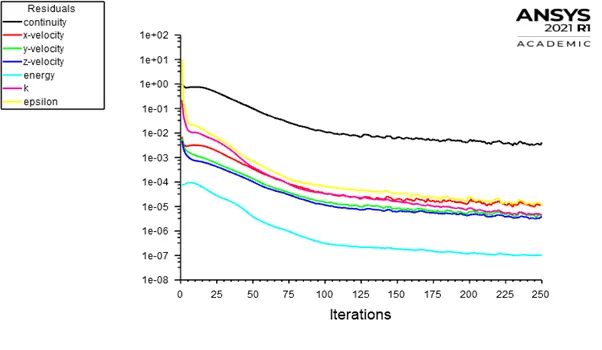
residual Plot:
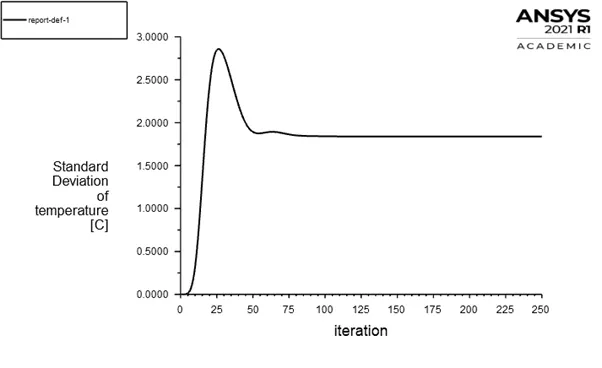
Standard Deviation plot:
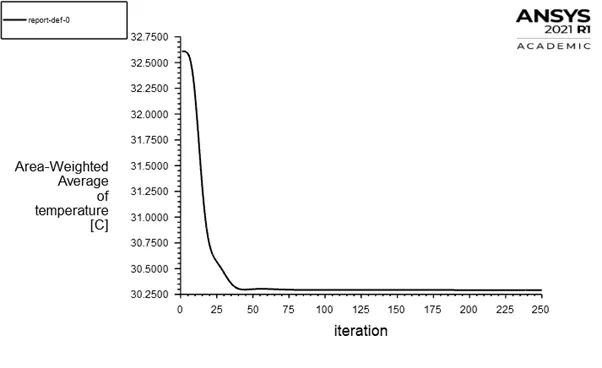
Temperature plot at outlet:
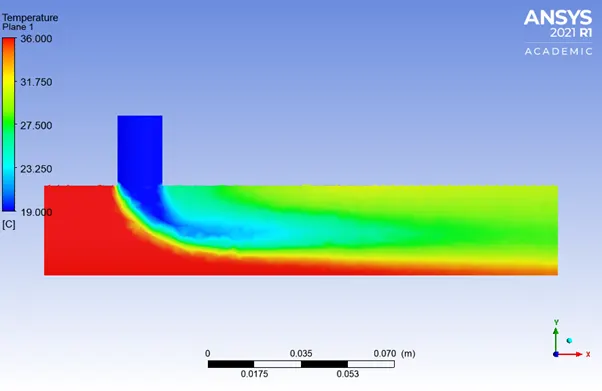
Temperature Contour at z = 0
Velocity Contour at z = 0
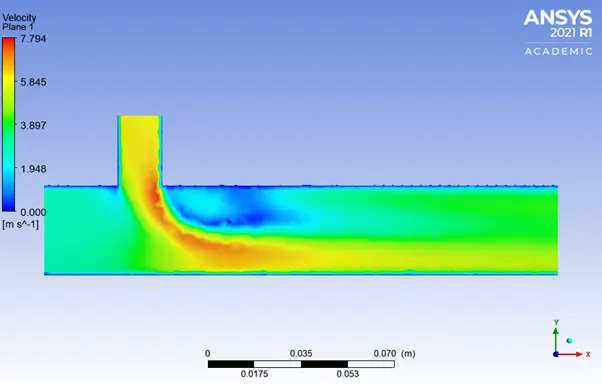
case 1(b) – Short T
hot inlet velocity = 3m/s
cold inlet velocity = 12 m/s
Results: -
residual Plot:
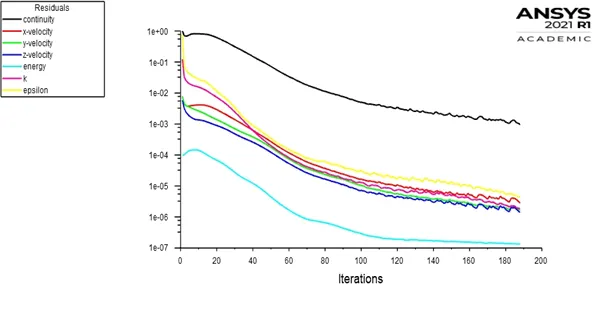
Standard Deviation plot:
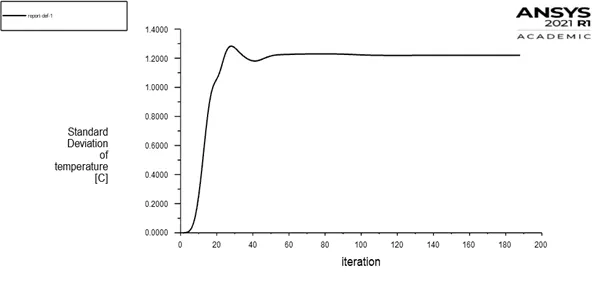
Temperature plot at outlet:
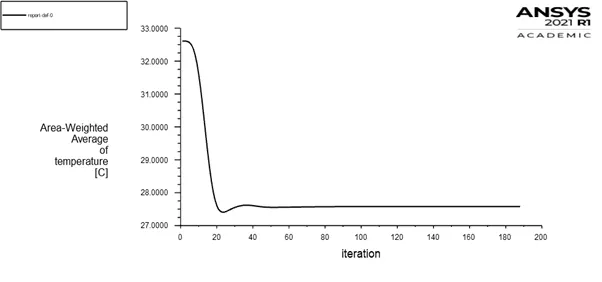
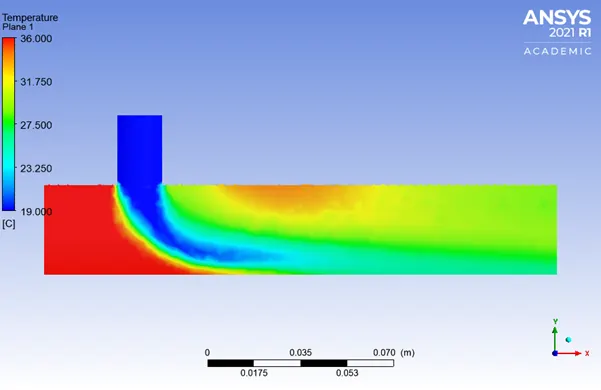
Temperature Contour at z = 0
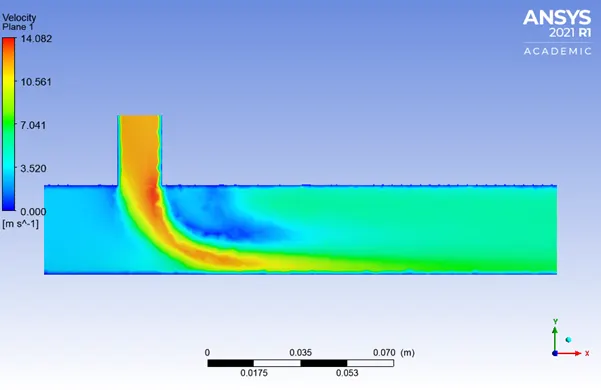
Velocity Contour at z = 0
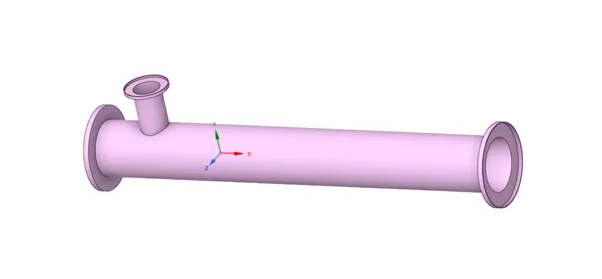
Long T dimension -
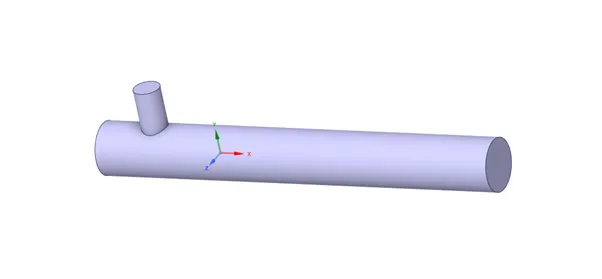
After volume extraction -
After Meshing and section plane preview -
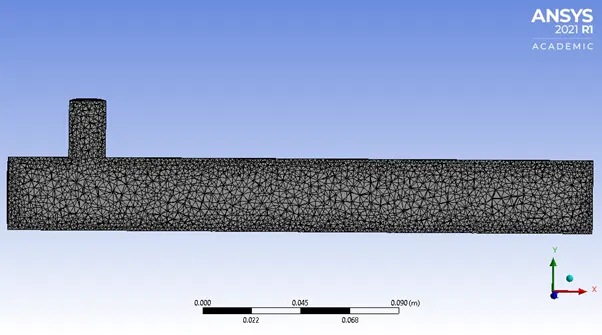
Mesh quality:
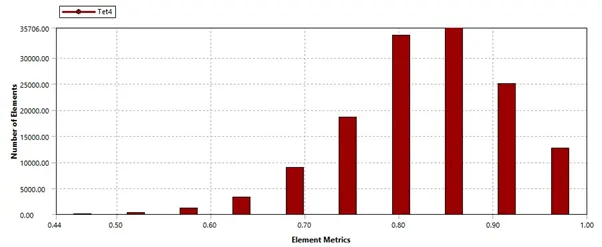
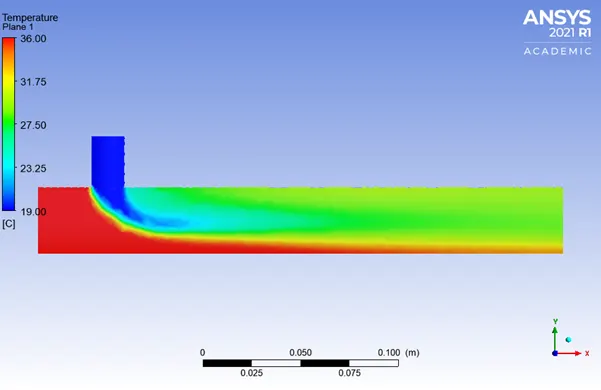
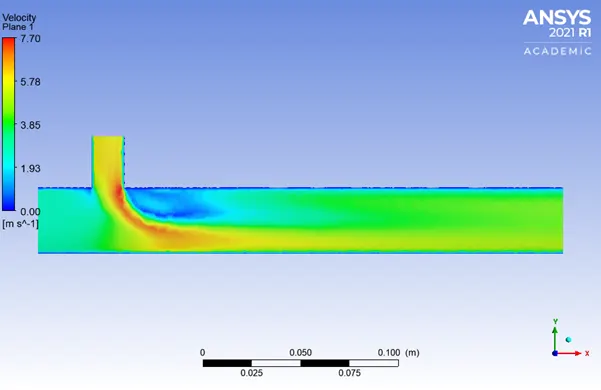
case 2(a) – Long T
hot inlet velocity = 3m/s
cold inlet velocity = 6 m/s
Results: -
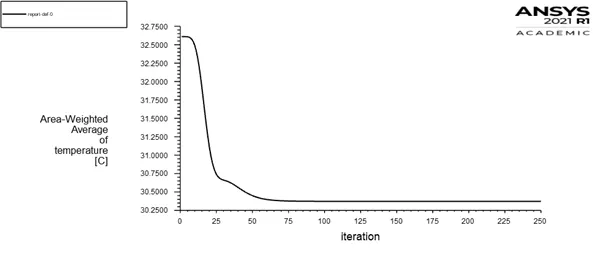
residual Plot:
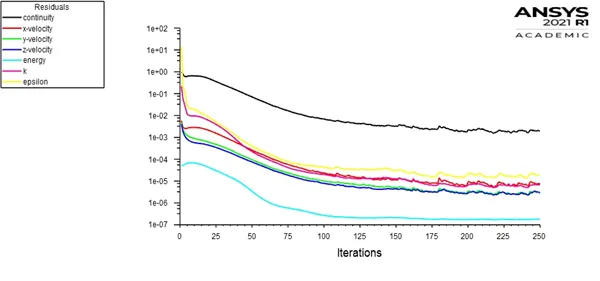
Standard Deviation plot:
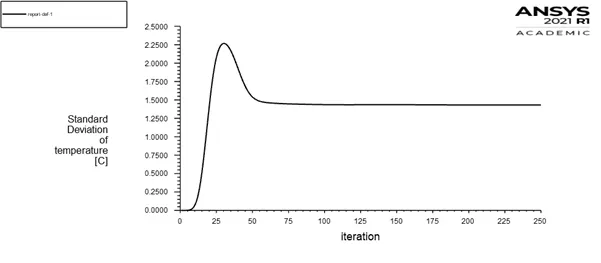
Temperature plot at outlet:
Temperature Contour at z = 0
Velocity Contour at z = 0
case 2(b) – Long T
hot inlet velocity = 3m/s
cold inlet velocity = 12 m/s
Results: -
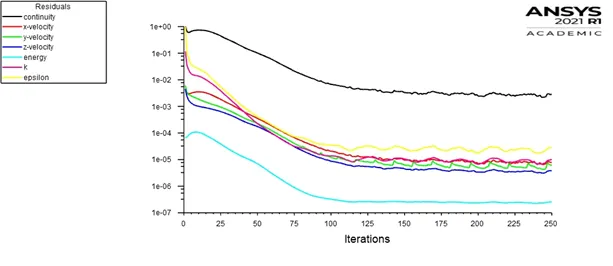
residual Plot:
Standard Deviation plot:
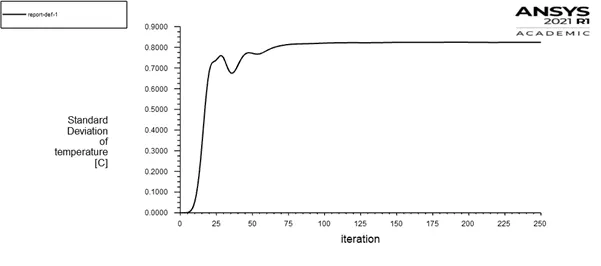
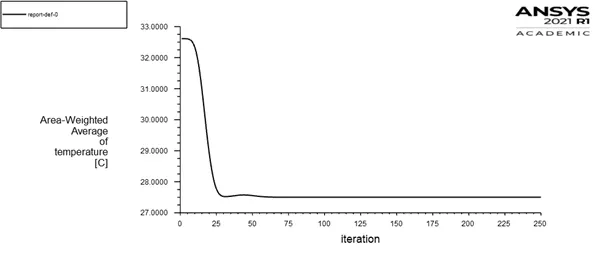
Temperature plot at outlet:
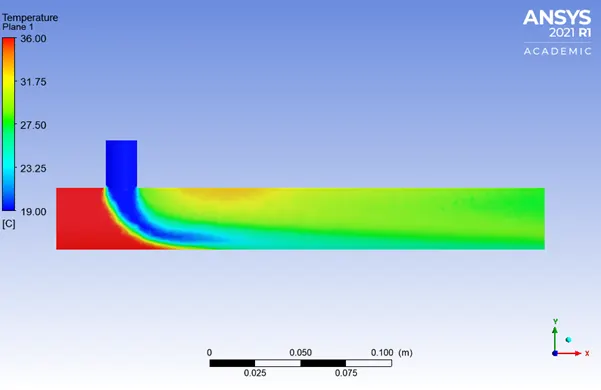
Temperature Contour at z = 0
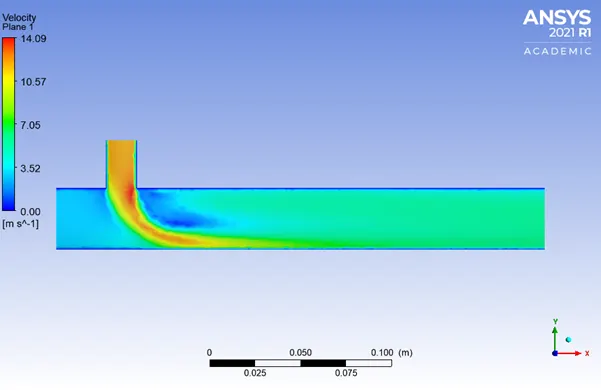
Velocity Contour at z = 0
Comparison of Results:
|
Mesh Cell Count |
No. of iteration to converge |
T(mix) outlet Analytical(K) |
T(mix) outlet Simulation(K) |
standard deviation at outlet |
|
|
Short T (MR =2) |
80775 |
110-120 |
303.4719 |
303.4421 |
1.8382 |
|
Short T (MR =4) |
80775 |
80-90 |
300.6376 |
300.7285 |
1.2196 |
|
Long T (MR =2) |
139355 |
110-120 |
303.4719 |
303.5222 |
1.4323 |
|
Long T (MR =4) |
139355 |
120-130 |
300.6376 |
300.6532 |
0.8237 |
Conclusion: -
- Long T with momentum ratio 4 is preferred over other as it is more accurate to the analytical solution at outlet.
- Long T also provide better mixing length as the standard deviation at outlet is very low as compared to others.