Week 1- Mixing Tee
Aim: The aim of this study is to investigate and compare the mixing effectiveness within a mixing tee using ANSYS Fluent simulations, specifically focusing on scenarios where the hot inlet temperature is 36 degrees Celsius and the cold inlet temperature is 19 degrees Celsius. The primary objective is to analyze how these temperature differentials impact the thermal mixing performance within the system.
Mixing tees are fundamental components in various industrial processes, playing a crucial role in achieving thermal homogeneity of fluids with different temperatures. Understanding the dynamics of fluid mixing within a tee is essential for optimizing processes in fields such as chemical engineering, heat exchangers, and environmental engineering. In applications such as chemical processing, where reactions are temperature-sensitive, or in heat exchangers, where thermal efficiency is paramount, optimizing the mixing tee design can lead to significant improvements in overall system performance. Additionally, in environmental engineering, understanding how temperature variations impact mixing can aid in the design of systems for water treatment or pollutant dispersion.
Procedure:
The geometry is simplified in Ansys Spaceclaim, where the volume is extracted inside the case and the covering is suppressed for physics. The finalised geometry is finalised and then prepared to be imported into the design modeler for meshing.The named selections are given according to the direction of motion of the fluid. After the automated meshing is completed, the geometry is prepared for CFD analysis. Initially, the mesh is checked to find any errors. If no errors are found, the boundary conditions are set up, which include inlet velocities at "Inlet-x" along the X-axis and "Inlet-y," which is the cold inlet. For case 1, the CFD analysis was performed on a short mising tee with an inlet velocity at the hot end of 3 m/s and an inlet velocity at the cold end of 6 m/s in order to get the momentum ratio of 2. The k-omega SST viscous model was selected for case 1 and the K-epsilon model for case 2. The surface reports for standard deviation, temperature, and velocity grades for the outlet wall are added for a post-processing overview.
The simulation is executed after initializing at t=0 for 150 iterations for case 1 and 250 iterations for case 2. The results are plotted below.
Results:
According to the plots at the outlet wall, the standard deviation of 1.5 degrees is observed for the short mixing tee, whereas the average temperature is 31.9 degrees. For the long mixing tee, the average temperature noted is 27.5 Degrees and the standard deviation is of 0.6 degrees.
Case 1: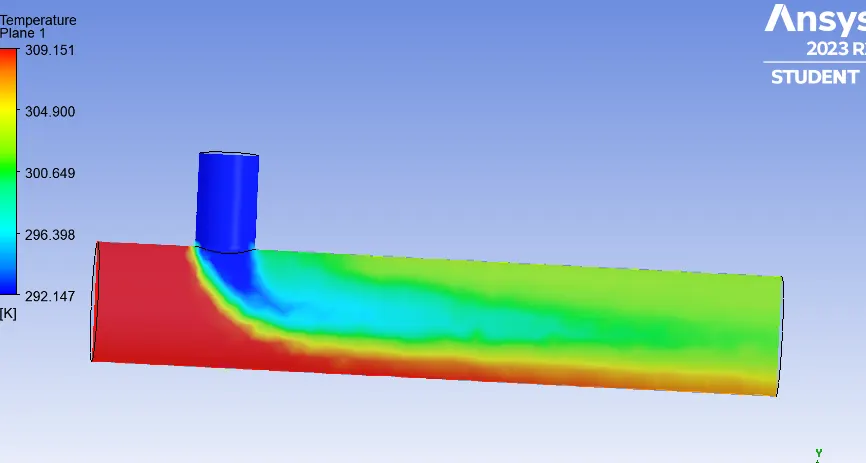
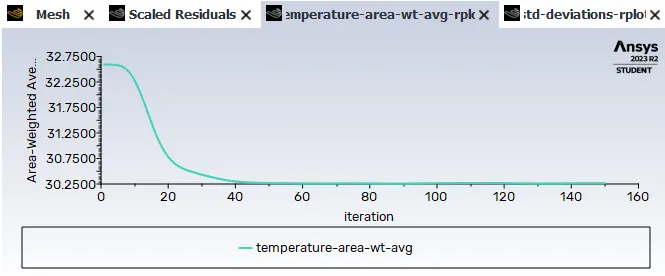
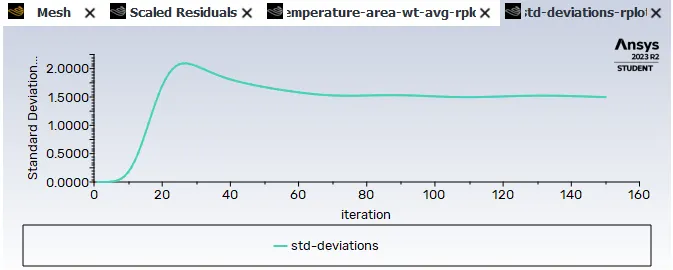
Case 2:
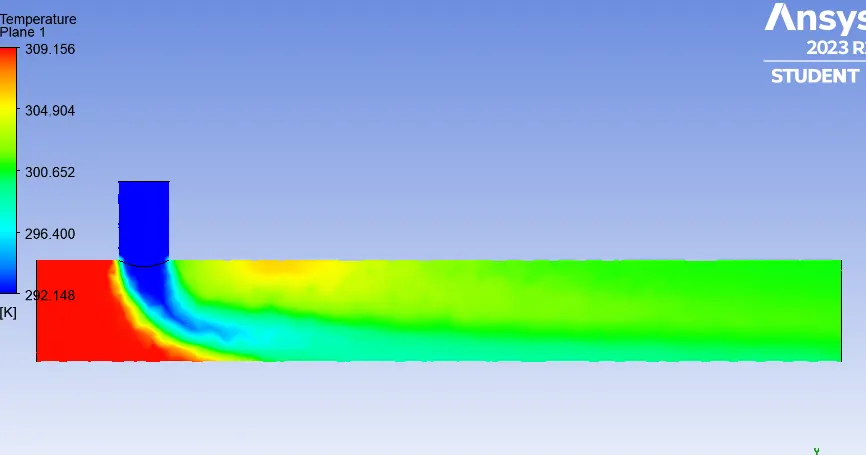
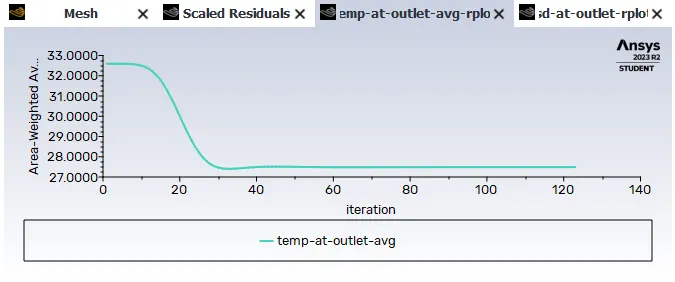
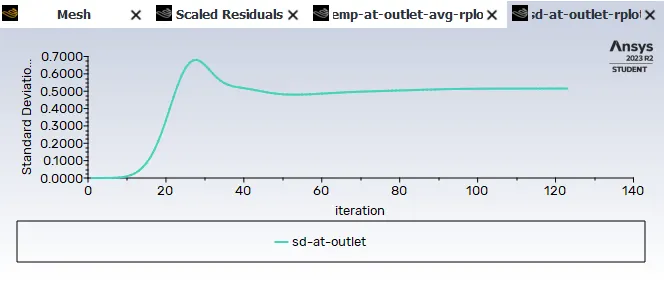
| Case Number |
Cell count (Mesh number of elements) |
Average Outlet Temperature (degree celsius) |
Number of Iterations |
| 1 | 12780 | 31.9 | 150 |
| 2 | 15727 | 27.5 | 250 |
Conclusion:
The simulation of mixing tee using ANSYS Fluent has provided valuable insights into the mixing effectiveness under varying inlet temperatures. The comparison between the hot inlet temperature of 36 degrees Celsius and the cold inlet temperature of 19 degrees Celsius has revealed crucial information about the thermal mixing performance of the system. The simulations have demonstrated that the temperature difference between the hot and cold inlets significantly influences the mixing efficiency within the tee. The results indicate that higher temperature differentials tend to enhance the mixing process, leading to more effective thermal homogenization within the mixing tee. These findings are crucial for optimizing the design and operational parameters of mixing systems, especially in applications where precise temperature control and homogeneity are essential.