Week 1- Mixing Tee
OBJECTIVE
1.To perform the steady state simulations of mixing Tee to compare the mixing effectivenss when hot inlet temperature is at 360C & the Cold inlet is at 190C.
2. To do the follwing cases and compare the results
- Case 1
- Short mixing tee with a hot inlet velocity of 3m/s.
- Momentum ratio of 2, 4.
- Case 2
- Long mixing tee with a hot inlet velocity of 3m/s.
- Momentum ratio of 2, 4
Problem Setup
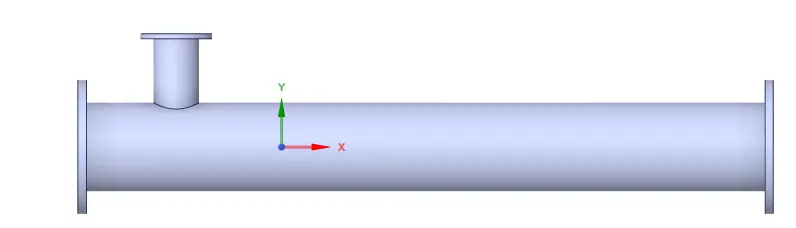
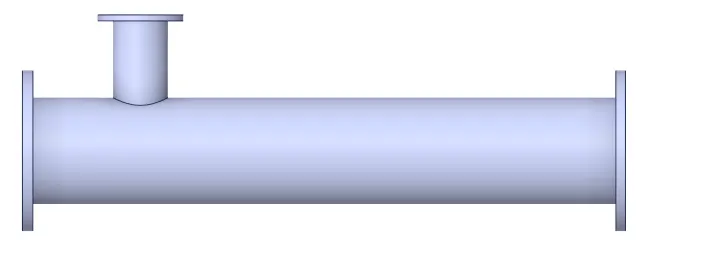
1. Geometry(Space-claim)
1.1 Long Mixing Tee
1.2 Short Mixing Tee
2. Mesh(Workbench Mesh)
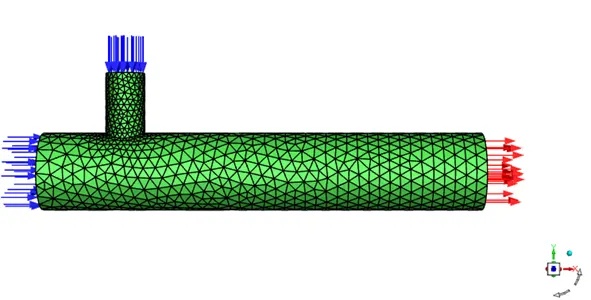
Figure: Mesh for case 1(Cell count: 12613)
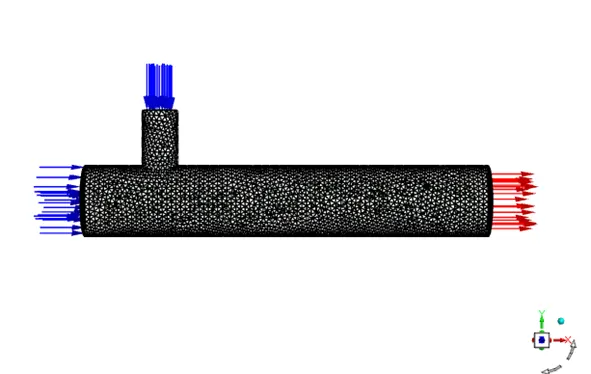
Figure: Mesh for case 8(Cell count: 14308)
3.Simulation(ANSYS-Fluent)-Results
Simulation for differnt cases has been carried out in ansys fluent and tabulated in the following table
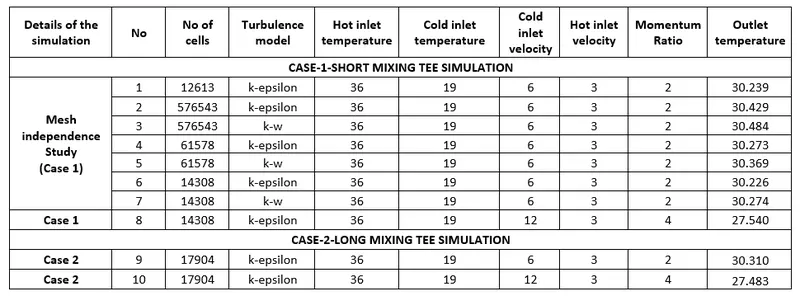
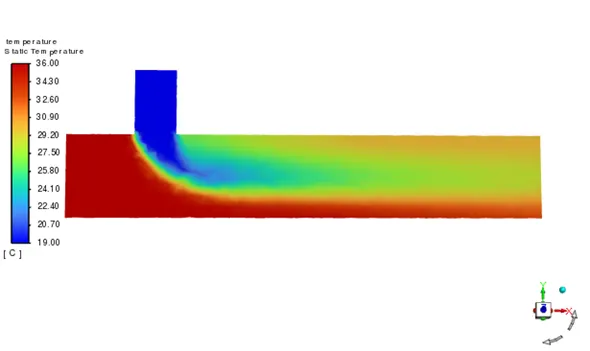
Figure : Static Temperature contour of CASE 1
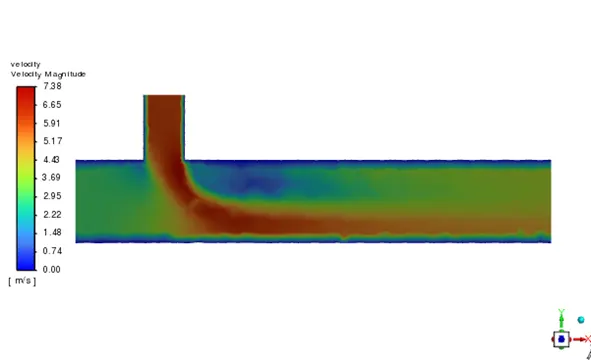
Figure :Velocity contour of CASE 1
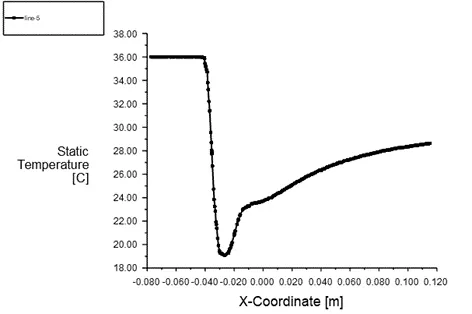
Figure: Static Temperature profile (line plot) for CASE 1
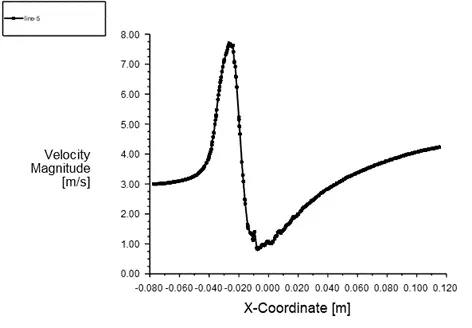
Figure: Velocity profile (line plot) for CASE 1
Conclusion
- k-epsilon models predict the flow virtullay far from boundaries(wall). and k-w predicts near the wall. As in this case we need a flow simulation far from the wall. Therfore k-epsilon model is suitable for this study and used in this study.
- solving the first simulation with coarse mesh gives an initial overview of the analysis and to know the time and iterations taken for the convergence. As element number increases, more time is required for getting the converged solution. Therefore, from the mesh indipendence study we can able to know the mesh size is required for further simulation with less compuational effort and timew without affecting the desired accuracy.
- To get better mixing at outlet, high velocity of flow is effective. Therfore, a ahiger momentum ratio gives better mixing of hot and cold fluid stream at the outlet.
- As the length of mixing tee increases because diffusion flow alyways gives slightly better mixing of two fluids.
- we can conclude that if momentum ratio is increased, simulation graph is showing outlet temperature is decreased and there is no effect of velocity even though length is increased