Week 1- Mixing Tee
For this challenge, we have created two versions of the mixing tee. One of them is longer than the other.
AIM :
Use the k-epsilon and k-omega SST model for the first case and based on your judgment use the more suitable model for further cases. Giving the reason for choosing a suitable model is compulsory.
- Case 1
- Short mixing tee with a hot inlet velocity of 3m/s.
- Momentum ratio of 2, 4.
- Case 2
- Long mixing tee with a hot inlet velocity of 3m/s.
- Momentum ratio of 2, 4.
Momentum ratio = velocity at cold inlet / velocity at hot inlet
Your job is to set up steady-state simulations to compare the mixing effectiveness when hot inlet temperature is 360C & the Cold inlet is at 190C.
In a table, compare the following values from the 2 cases.
- Cell count
- Average outlet temperature
- Number of iterations for convergence
Expected results:
- Velocity and temperature contour plots on the cut planes along and across the pipe.
- Velocity and temperature line plots along and across the length of the pipe.
- Perform Mesh independent study for any one case.
- Discuss the effect of length and momentum ratio on results.
our job is to find out the analytical temperature value and compare to the practical solution and we will have to decide which model we have to use based on the results we get.
we do use a model which is close to the analytical solution.
Case 1
sub case 1 -k omega model :
- Short mixing tee with a hot inlet velocity of 3m/s.
- Momentum ratio of 2.
- Momentum ratio = velocity at cold inlet / velocity at hot inlet
- 2 = velocity at cold inlet/3
velocity at cold inlet = 6m/s.
Geometry cleanup :
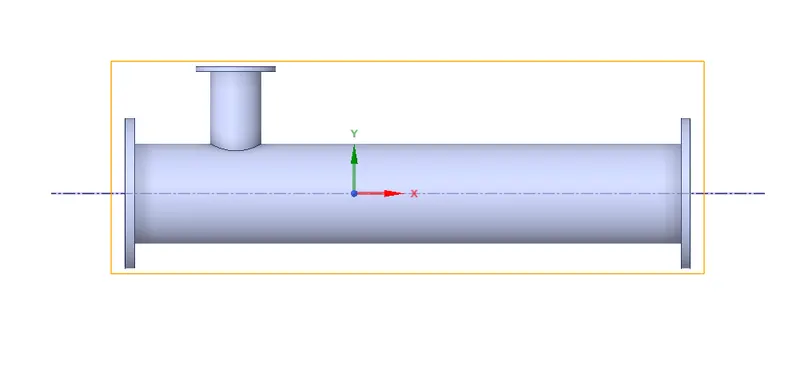
Original geometry for shorter length pipe :
This is the geomtry we are going to use the entire project for shorter length pipe cases.
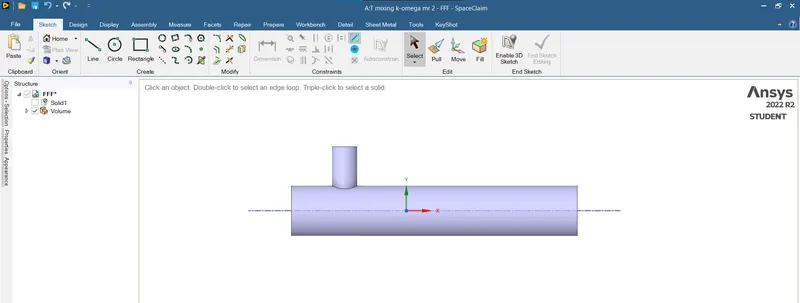
Fluid occupied geometry :
We are going to hide or surprase the portion which is not interact with the the fluid
for this space claim help us to get the required volume occupied geometry by obeying the unwanted portion.
Meshing :
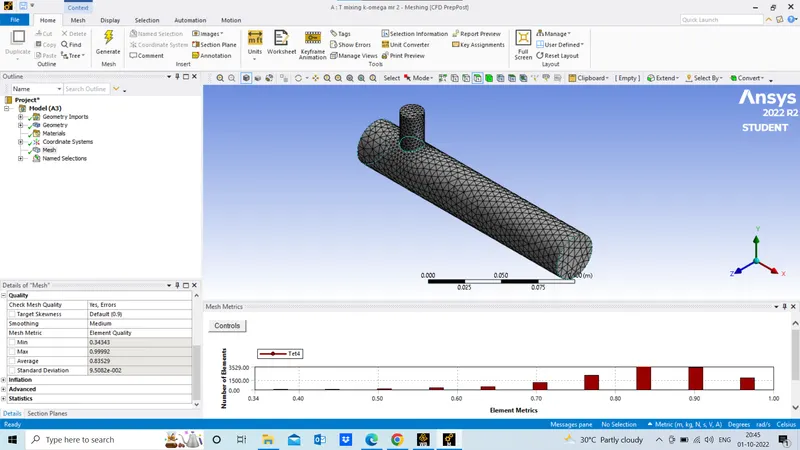
- Load the geometry into meshing and generate the mesh.Since we are doing a basic simulation we are not concentrating much on changing parameters.
- Only thing that we are changong here is quality. Mesh metric as an element quality.if the mesh metric value is lesser than 0.5. we can proceed with the furthur process.Since we are getting 0.34 which is lesser than the 0.5.
- so we can proceed with the setting up the simulation.
- we are setting up the boundary and initial condition by slecting the faces of the geometry. we are setting up 2 initial conditions and 1 outlet and 1 wall as an initial and boundary conditions.s
Setup and solution on Ansys fluent :
Launch the ansys fluent by slecting double precission and parallel solver is set to be 4 so the process for the simulation is bit faster.
Set up the simulation as per the given conditions and the conditions are same to all the cases that we are going to solve except boundary conditions that will be mention while solving the respective cases.
|
SETUPS |
SHORT TEE (MR=2 AND HOT INLET VELOCITY = 3m/s)
|
|
|
K-EPSILON |
K-OMEGA |
|
|
SOLVER TYPE |
Pressure based |
Pressure based |
|
VELOCITY FORMULATION |
Absolute |
Absolute |
|
TIME |
Steady |
Steady |
|
VISCOUS MODEL |
Realizable K-epsilon with standard wall function |
K-omega SST model |
|
MATERIAL |
Air |
Air |
|
CELL ZONES |
Fluid type : air |
Fluid type : air |
|
BOUNDARIES |
- Inlet_x (velocity inlet) Velocity magnitude 3m/s Temperature - 360c - Inlet_y (velocity inlet) Velocity magnitude 6m/s Temperature – 190c - Outlet (pressure outlet) Gauge pressure – 0 pa 1atm presuure - Walls – stationary walls |
- Inlet_x (velocity inlet) Velocity magnitude 3m/s Temperature - 360c - Inlet_y (velocity inlet) Velocity magnitude 6m/s Temperature – 190c - Outlet (pressure outlet) Gauge pressure – 0 pa 1atm pressure - Walls – stationary walls |
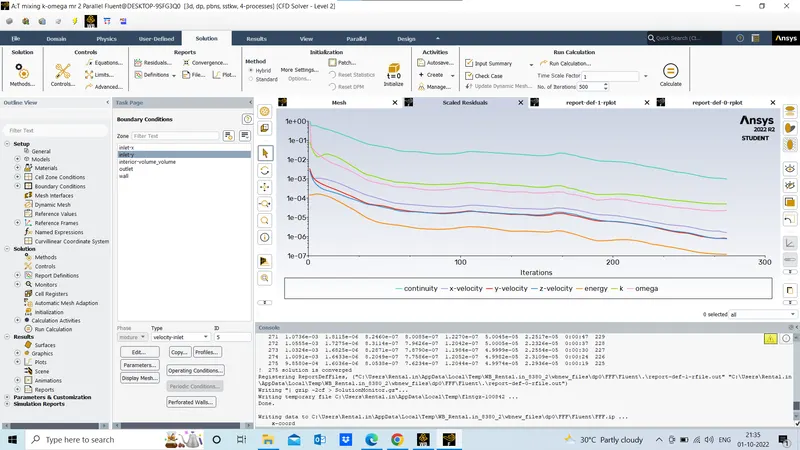
The hybrid scheme is used for initialization and the no. of iterations are setup and then click on calculate option.
Residual plot :
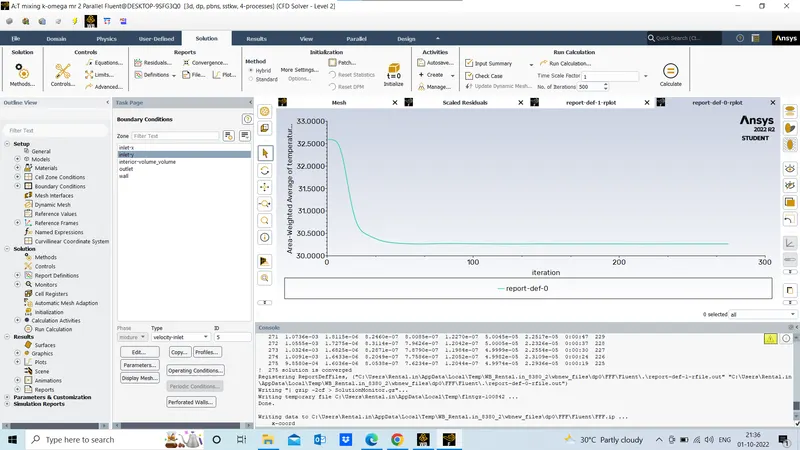
Area weighted average temperature at outlet :
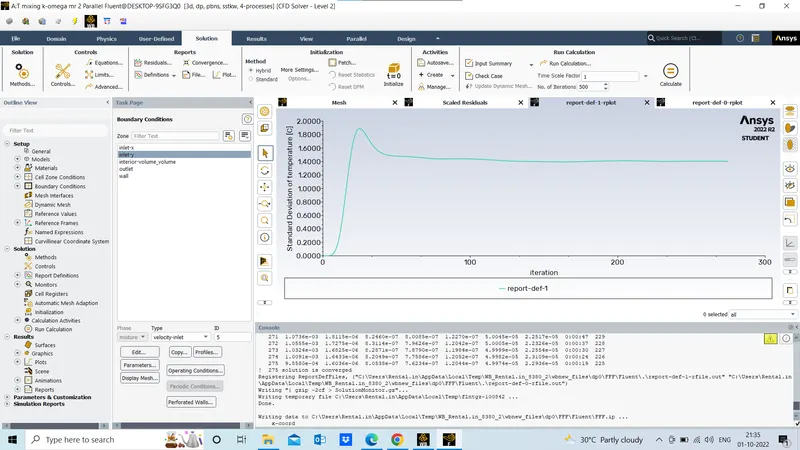
Standard deviation temperature at outlet :
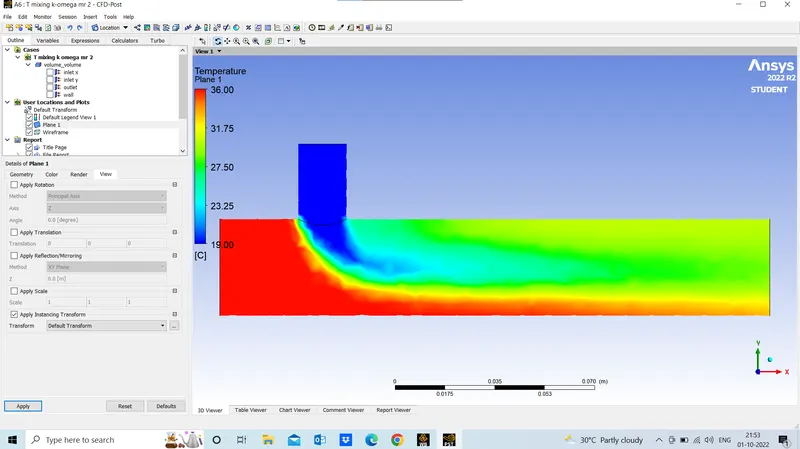
CFD post processing :
Temperature
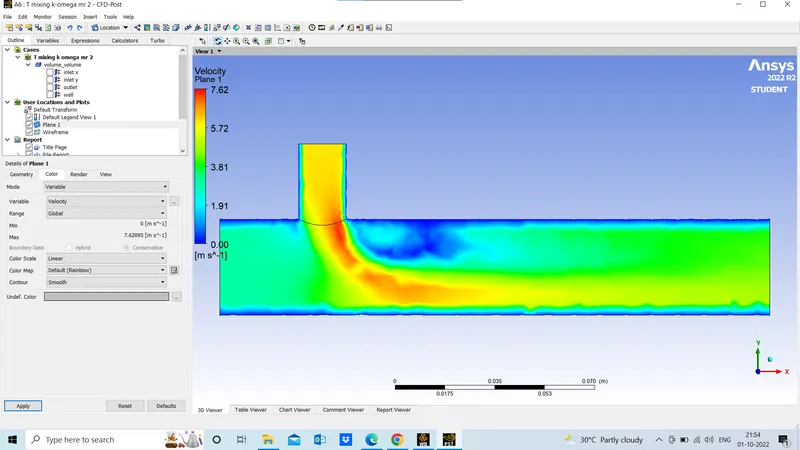
Velocity profile :
sub case 1 -k epsilon model :
- Short mixing tee with a hot inlet velocity of 3m/s.
- Momentum ratio of 2.
- Momentum ratio = velocity at cold inlet / velocity at hot inlet
- 2 = velocity at cold inlet/3
velocity at cold inlet = 6m/s.
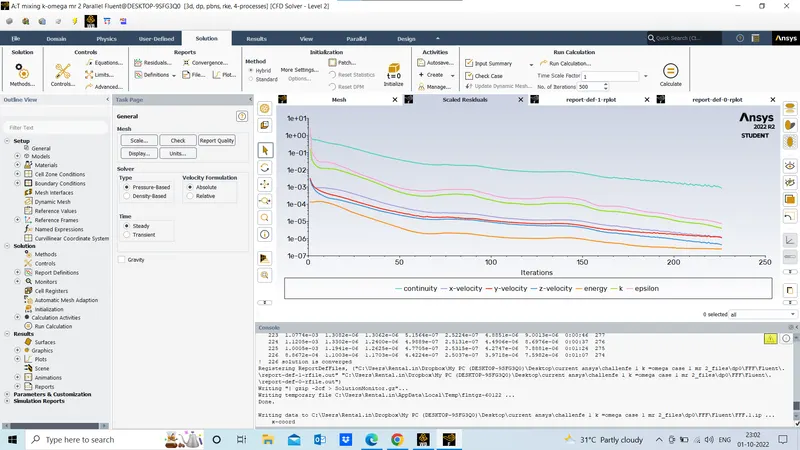
residuals :
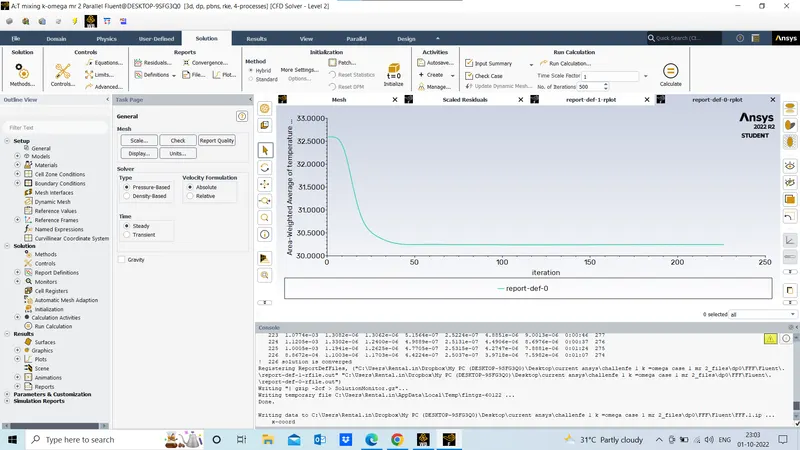
Area weighted average temperature :
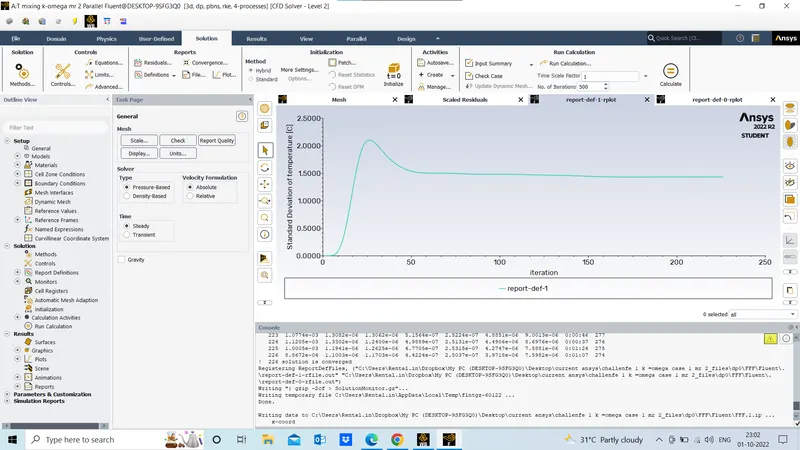
Standard deviation :
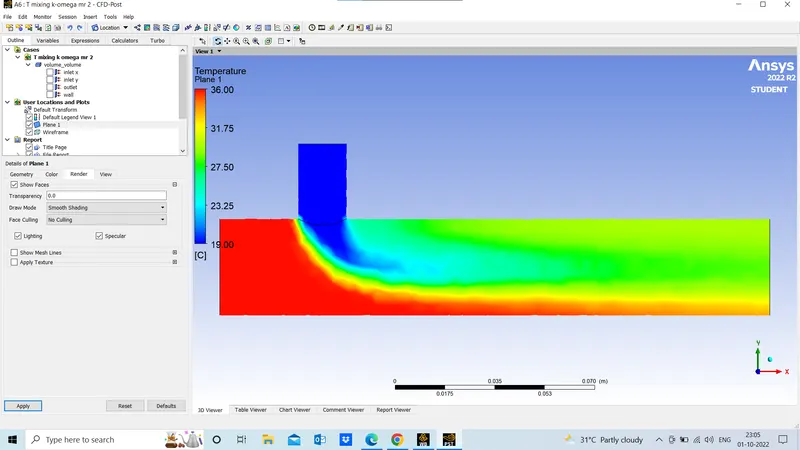
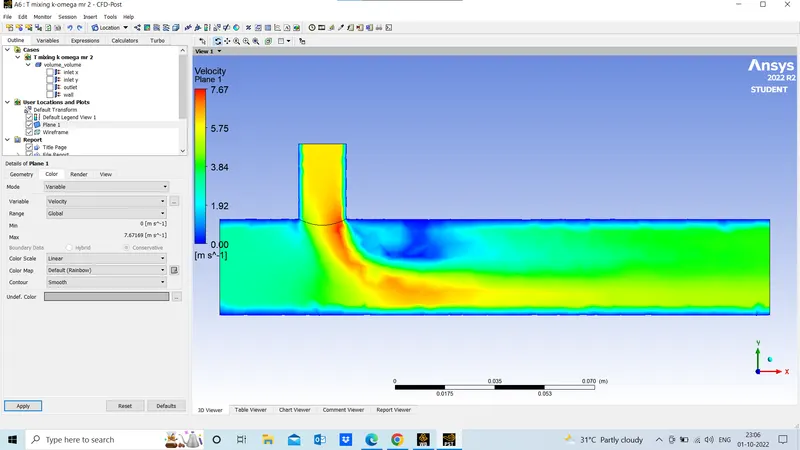
Post cfd :
Temperature profile :
velocity profile :
| k -epsilon | k -omega | |
| iterations | 226 | 275 |
| standard deviation | 1.4242 | 1.4056 |
| Area weighted average temperature | 30.2455 | 30.2601 |
MOMENTUM RATIO 2
- Temperature of mixture (Tmixture) = (mh*Th + mc*Tc)/(mc + mh) = 30.76920c.
Analytical Temperature -30.7692
- If we observe the above analytical and simulation results standard deviation is less in k -omega model when compared to the k epsilon model. and also the temperature of k omega value is nearly equal to the analytical solutio. Eventually if we look the no of iteration it took to converge is less when we are using k epsilon model and also we are getting near to the analytical solution.
- So considering the above parameters am using k -epsilon model for the further cases .
- Case 1
sub case 2 using k-epsilon
- Short mixing tee with a hot inlet velocity of 3m/s.
- Momentum ratio of 4.
-
- Momentum ratio = velocity at cold inlet / velocity at hot inlet
- 4 = velocity at cold inlet/3
velocity at cold inlet = 12m/s.
MOMENTUM RATIO 4
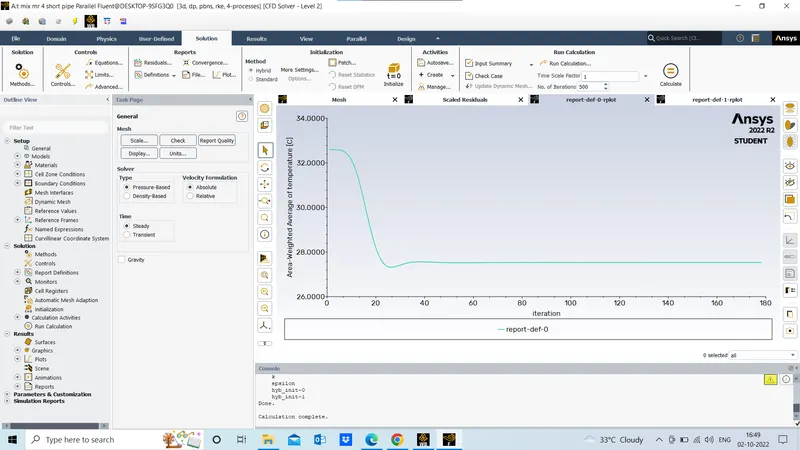
- Temperature of mixture (Tmixture) = (mh*Th + mc*Tc)/(mc + mh) = 27.990c = 300.99k
residuals :
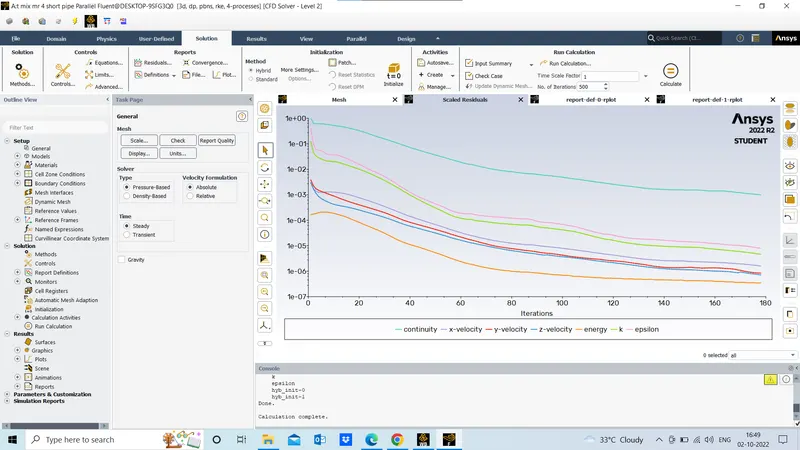
Area weighted average temperature:
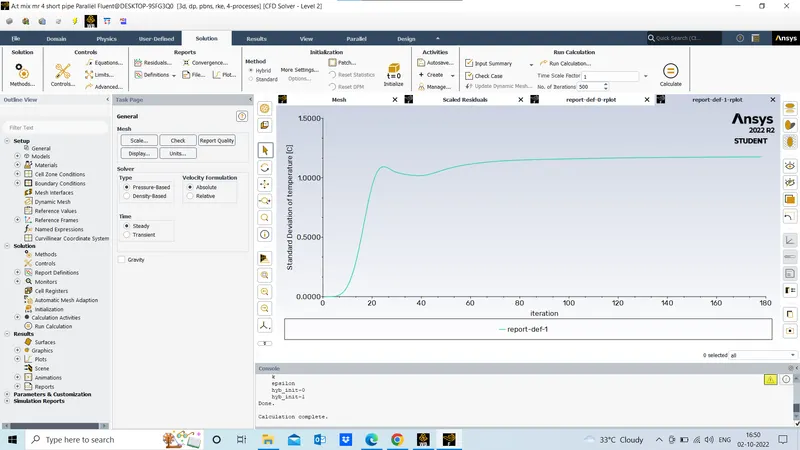
Standard deviation :
Post cfd :
Temperature profile :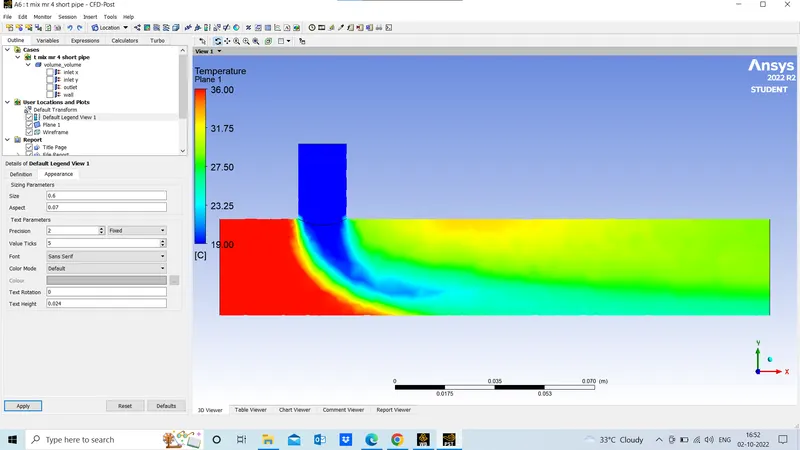
velocity profile :
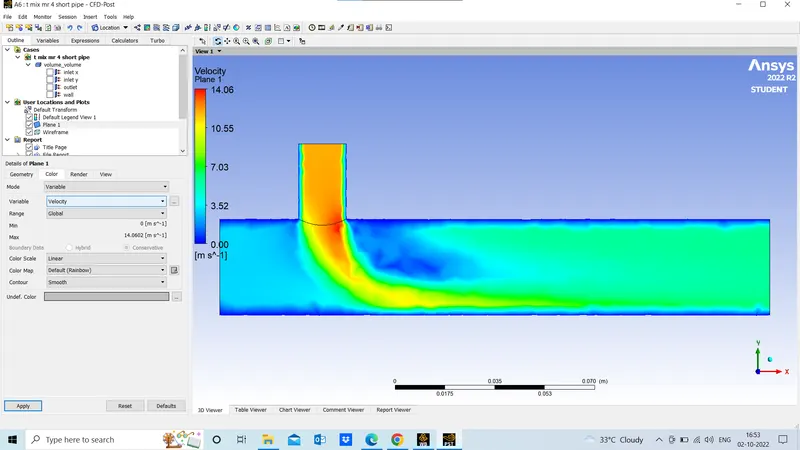
Case 2
sub case 1 -k epsilon model :
- Long mixing tee with a hot inlet velocity of 3m/s.
- Momentum ratio of 2.
- Momentum ratio = velocity at cold inlet / velocity at hot inlet
- 2 = velocity at cold inlet/3
velocity at cold inlet = 6m/s.
Residuals :
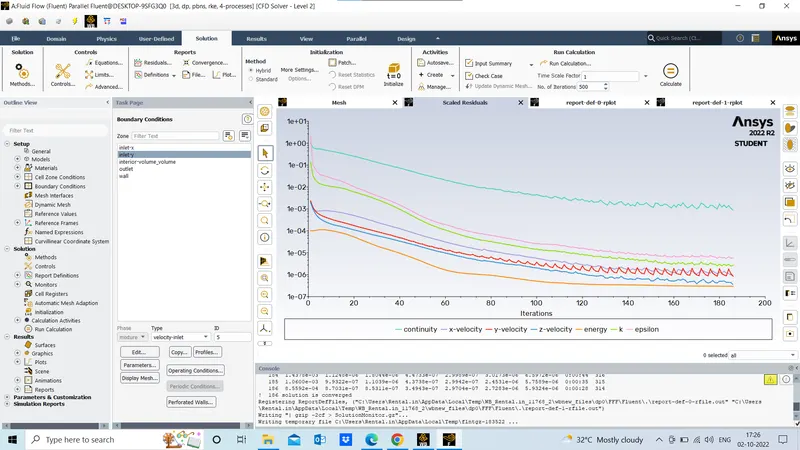
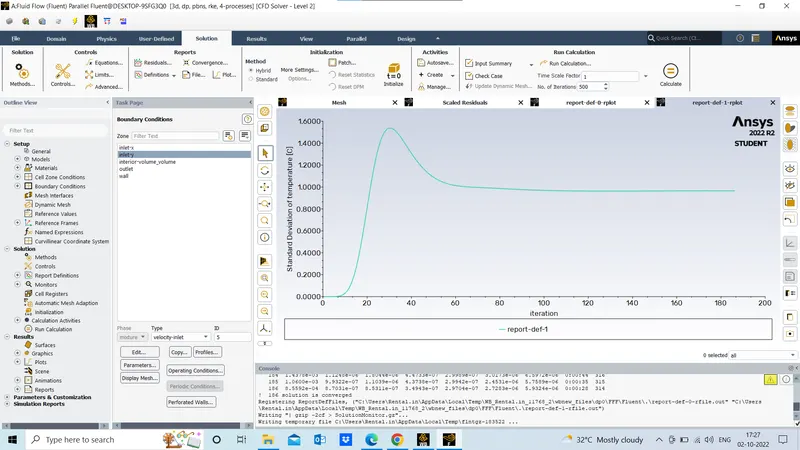
Area weighted average temperature :
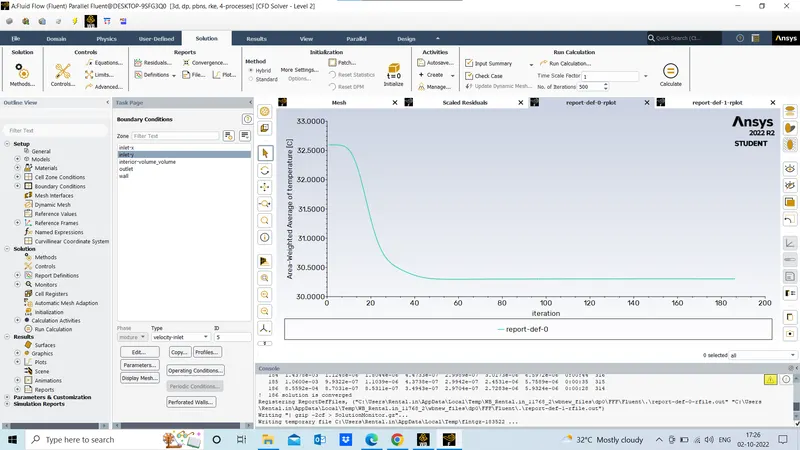
Standard deviation :
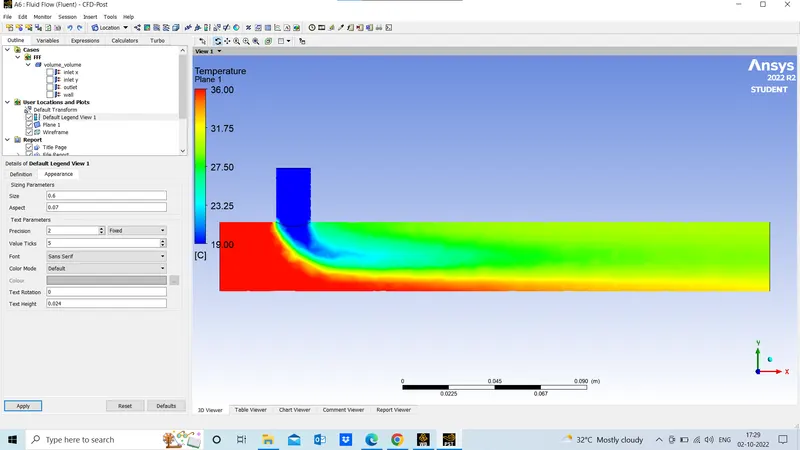
tempetature profile :
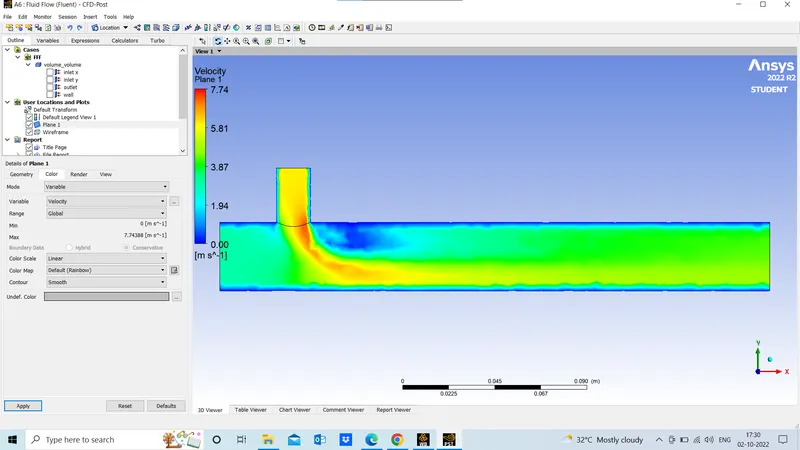
velocity profile :
Case 2
sub case 2 -k epsilon model :
- Long mixing tee with a hot inlet velocity of 3m/s.
- Momentum ratio of 4.
- Momentum ratio = velocity at cold inlet / velocity at hot inlet
- 4 = velocity at cold inlet/3
velocity at cold inlet = 12m/s.
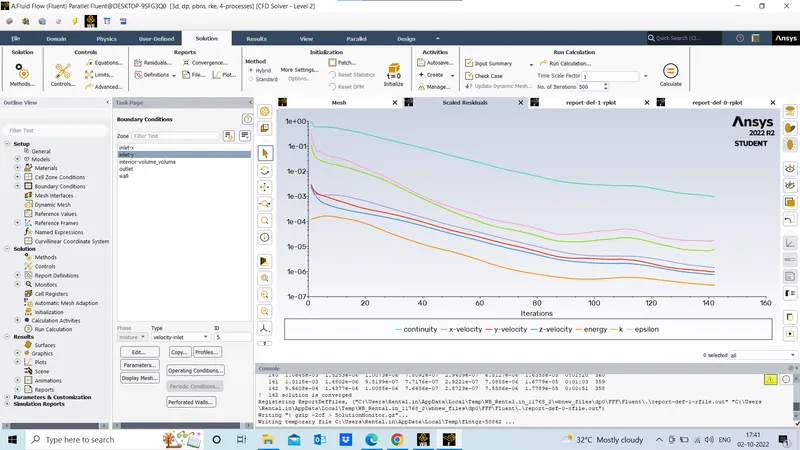
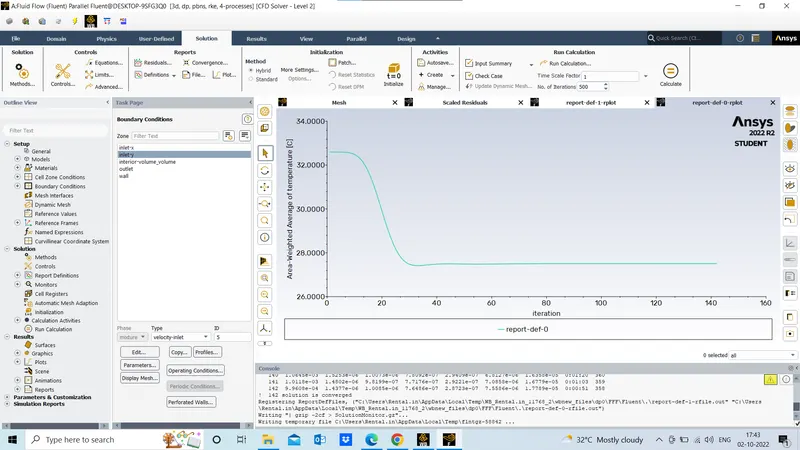
Residual :
Area weighted average temperature :
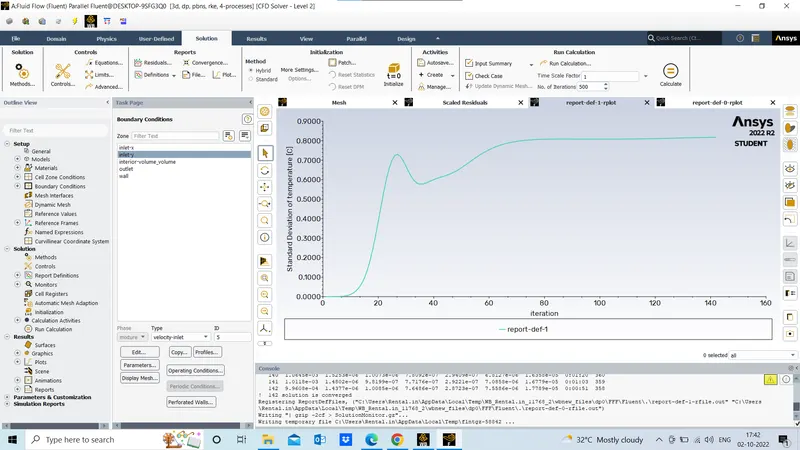
Standard Deviation :
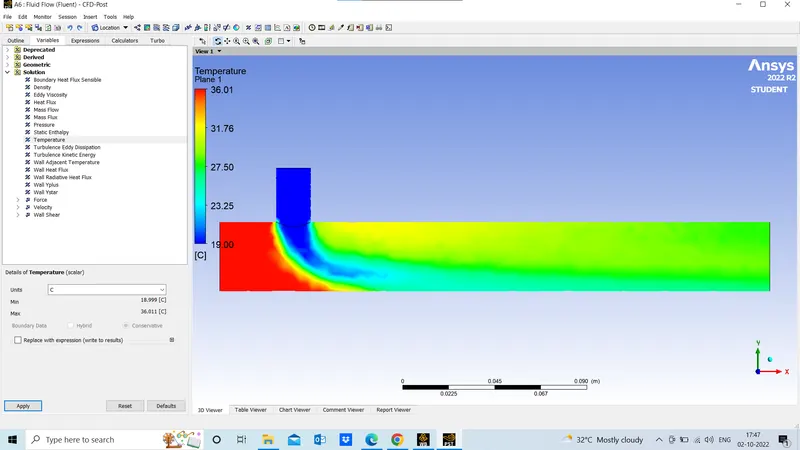
Temprature profile :
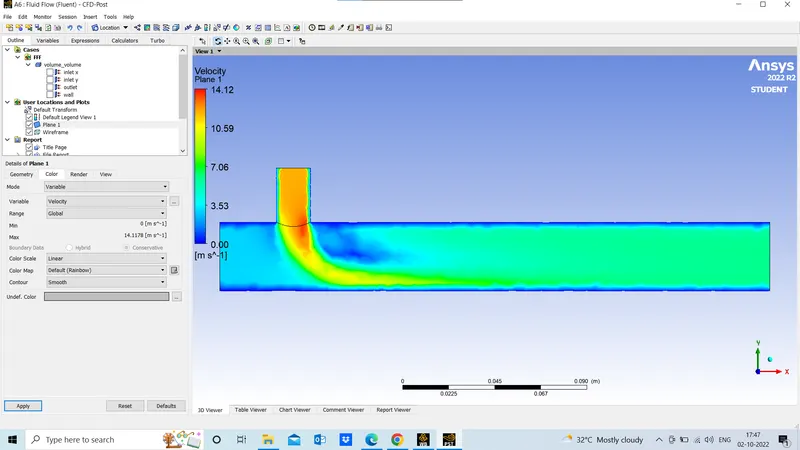
Velocity profile :
| Geometry & Momentum ratio | MR=2(short pipe) | MR=4(short pipe) | MR=2(long pipe) | MR=4(long pipe) |
| Avg outlet temperature | 30.2364 | 27.5514 | 30.2993 | 27.5392 |
| Standard deviation | 1.4242 | 1.1741 | 0.9653 | 0.8166 |
| no of iterations | 226 | 178 | 186 | 142 |
in this we can observe high momentum ratio causes to decrease the over all average output temperature.
We can use either shortr or longer,its totally depend upon the moment ratio with respect to the fluid velocity.High momentum ratio and the higere the velocity of the cold inlet gives us the best possible result upon all the cases.
So based on the results we can say shorter pipe with high moment ratio is the best convergence rate compared to all.
Grid dependancy test :
We are going to do a grid dependency test for the shorter pipe.
7mm mesh size :
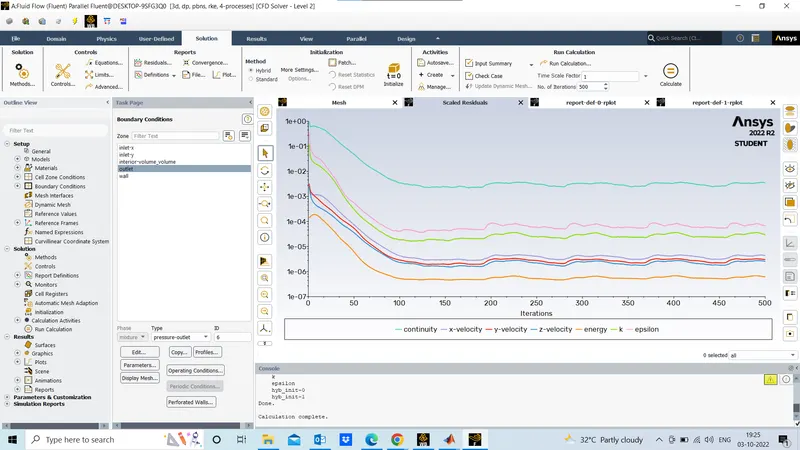
Residuals :
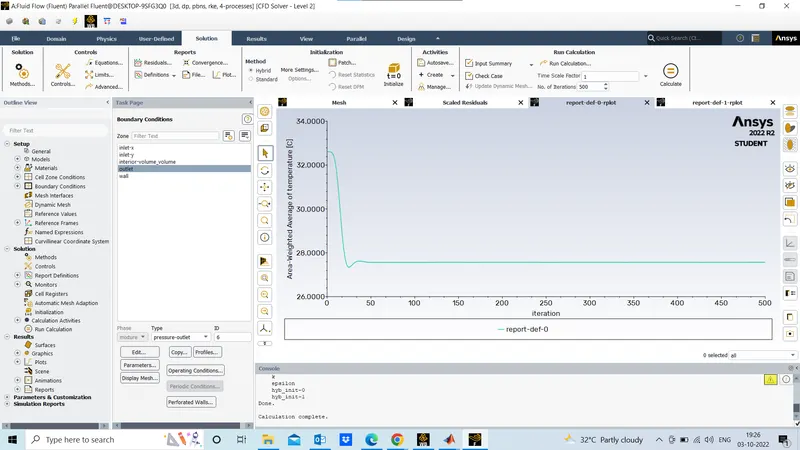
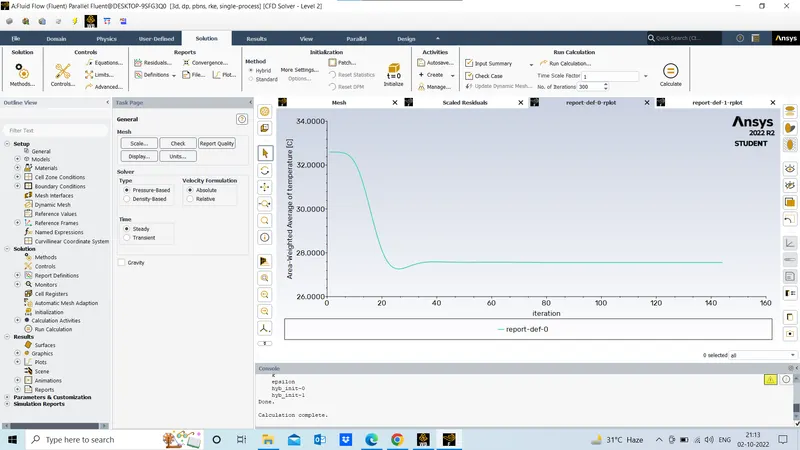
Area weightted average temperature :
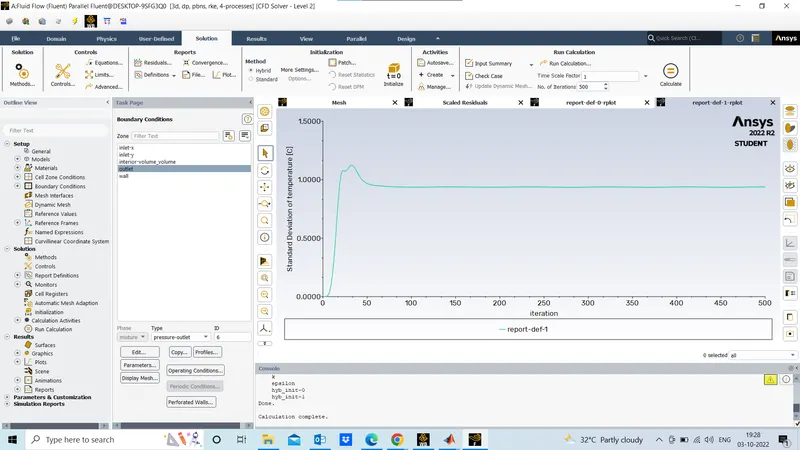
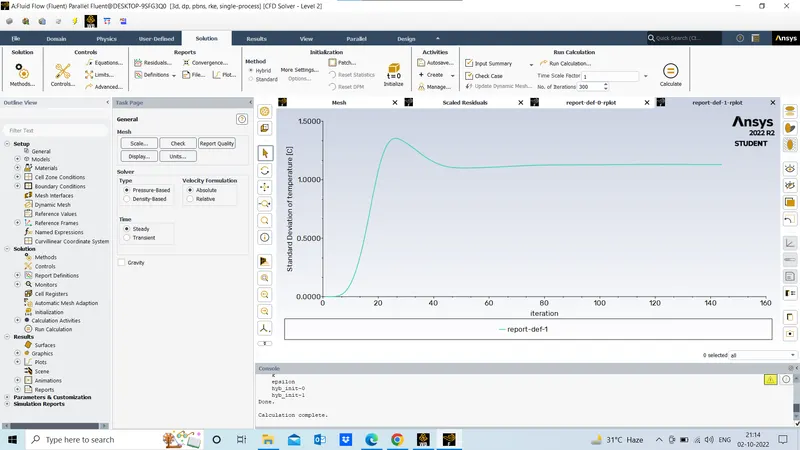
Standard deviation :
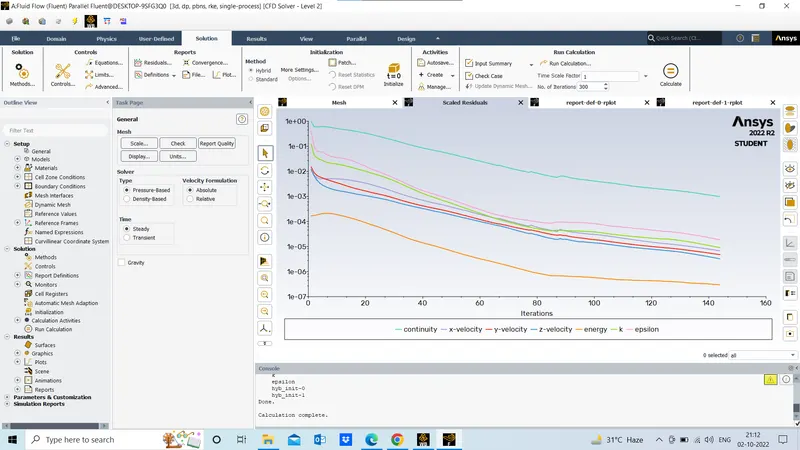
5mm mesh size :
Residuals :
Area weightted average temperature :
Standard deviation :
3mm mesh size :
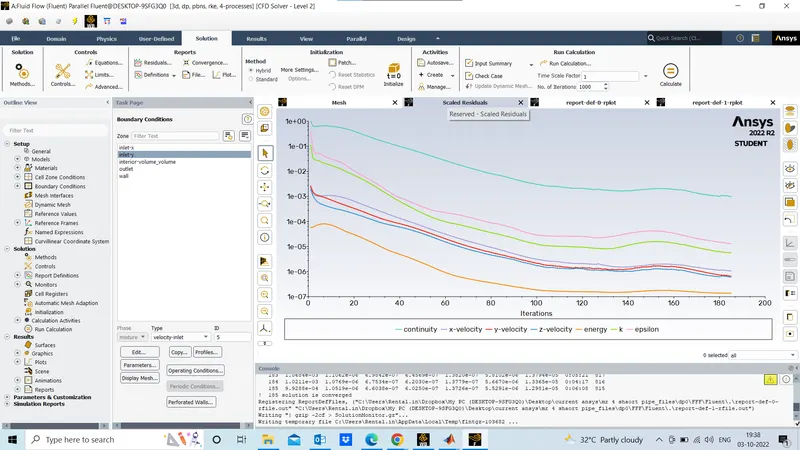
Residuals :
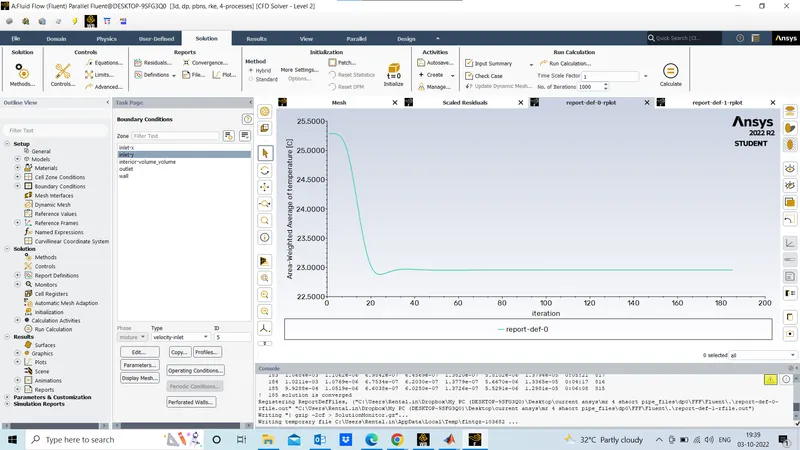
Area weightted average temperature :
Standard deviation :
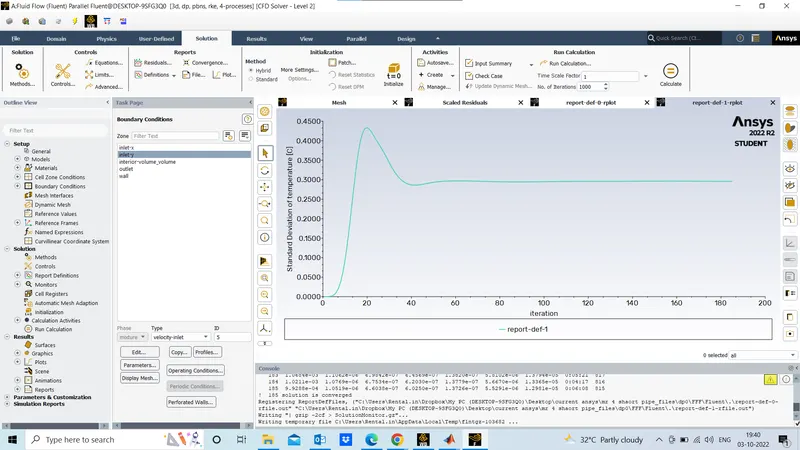
If we observe all the three cases 7mm,5mm,3mm in the above we can clearly observe that ,
5mm mesh size has converged fastly and its very close to the analytical temperature value and we considering this mesh size as a good mesh because it took very less computational time to reach the steady state and also very close to the analytical solution.
3mm mesh size has taken little bit high number of iterations when compare to the previos one and it is close the analytical value
7mm mesh size took more number of iterations than the previous two and it is taking more computational time so we are not considering this mesh size as a good mesh.