Week 1- Mixing Tee
Objective: - To simulate the flow of hot and cold air through mixing tee and understand the effect of momentum ration and length on result.
Introduction
Mixing is a unit process that involves manipulation of a heterogeneous physical system with the intent to make it more homogeneous. Mixing is performed to allow heat or mass transfer to occur between one or more streams, components or phases.
The present project describes the mixing of hot and cold air flow in a mixing tee a different inlet velocity. Mixing tee utilizes a specifically engineered internal geometry to efficiently mix two fluid streams into one combined stream. Mixing tees are widely used in the petrochemical, HVAC industry etc.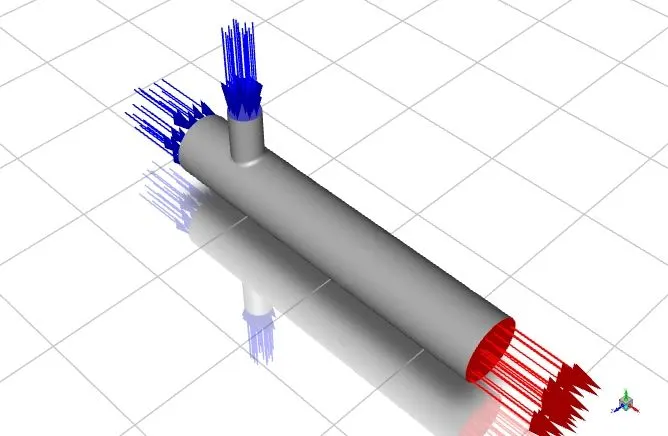
Hot air flowing in the main pipe is mixed with cold air flowing through a tee.
For this, we have two different models of mixing tee of different length.
Given data
Hot inlet temperature `T_(hot)=36^oC`
Cold inlet temperature `T_(cold)=19^oC`
Case 1
- Short mixing tee with a hot inlet velocity of 3m/s.
- Momentum ratio of 2 and 4.
Case 2
- Long mixing tee with a hot inlet velocity of 3m/s.
- Momentum ratio of 2 and 4.
Mathematical calculations
`text(momentum ratio)=text(cold inlet velocity)/text(hot inlet velocity)`
For momentum ratio 2
Cold inlet velocity = 6 m/s
For momentum ratio 4
Cold inlet velocity = 12 m/s
Temperature of mixture
`T_(mixture=(m ̇_(hot)xxT_(hot)+m ̇_(cold)xxT_(cold))/(m ̇_(hot)+m ̇_(cold) )`
Area of inlet-x `= 9xx10^(-4) m^2`
Area of inlet-y =`2xx10^(-4) m^2`
Density of air at`19^o C=1.208(Kg)/m^3`
Density of air at`36^o C=1.142(Kg)/m^3`
Mass flow rate`m ̇=ρAV`
For momentum ratio 2
Mass flow rate for inlet-x `m ̇_(cold)=1.142xx9xx10^(-4)xx6=1.45xx10^(-3) (Kg)/sec`
Mass flow rate for inlet-y `m ̇_(hot)=1.208xx2xx10^(-4)xx3=2.7xx10^(-3) (Kg)/sec`
`T_(mixture)=(2.7xx10^(-3)xx36+1.45xx10^(-3)xx19)/(2.7xx10^(-3)+1.45xx10^(-3) )=30.06^o C`
For momentum ratio 4
Mass flow rate for inlet-x `m ̇_(cold )=1.142xx9xx10^(-4)*12=2.9xx10^(-3) (Kg)/sec`
Mass flow rate for inlet-y `m ̇_(hot )=1.208xx2xx10^(-4)xx3=2.7xx10^(-3) (Kg)/sec`
`T_(mixture)=(2.7xx10^(-3)xx36+2.9xx10^(-3)xx19)/(2.7xx10^(-3)+2.9xx10^(-3) )=27.76^o C`
GRID INDEPENDENC TEST FOR SHORT MIXING TEE (Realizable K-Epsilon Model Used)
|
Mesh size (mm) |
No. of cells |
No. of iteration |
Standard deviation |
Analytical temperature |
Experimental temperature |
% error |
|
10.219 |
12546 |
133 |
1.23 |
30.06 |
30.26 |
0.66 |
|
8 |
12546 |
133 |
1.23 |
30.06 |
30.26 |
0.66 |
|
5 |
14035 |
248 |
1.43 |
30.06 |
30.24 |
0.59 |
|
1 |
568678 |
118 |
1.80 |
30.06 |
30.42 |
1.20 |
Here I have ran 4 cases each of them has similar outlet temperature. And percentage error with respect to analytical temperature is very less in all the cases. So, we can say that the simulation is independent of no. of grids.
but for remaining cases we can run the simulation for 10.219mm mesh size because it's convergence time is faster than other meshes(8,5,1) also the percentage error is very less.
CASE -1 (short mixing tee)
Geometry
The CAD model is imported into SpaceClaim to extract the flow volume from the model.
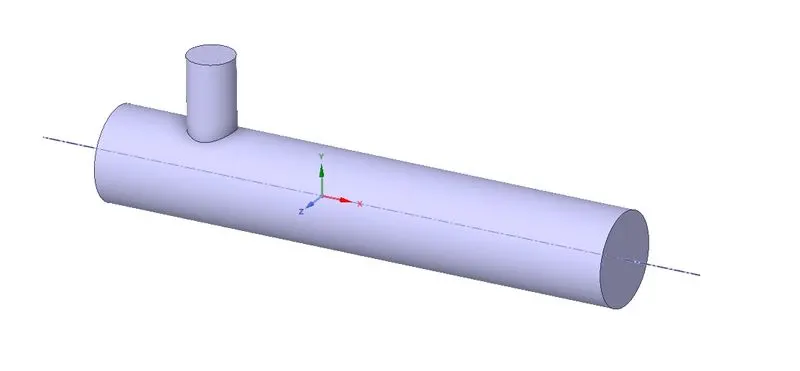
Extracted volume
Mesh
Mesh is generated here and boundary names are given here.
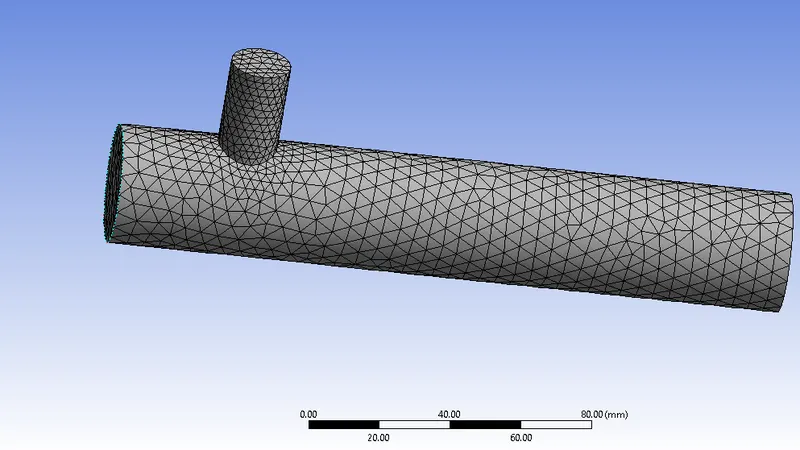
generated mesh
Setup
In this section we set the physical and boundary conditions of flow like inlet velocity and temperature, material selection (air in this case), selection of turbulence model.
To choose the suitable turbulence model between k-epsilon and k-omega we have some data from the simulation. Based on that we can choose any of them.
|
Turbulence model |
Momentum ratio |
Mesh size (mm) |
No. of cells |
No. of iteration |
Standard deviation |
Analytical temperature |
Experimental temperature |
% error |
|
k-epsilon |
2 |
10.219 |
12546 |
133 |
1.23 |
30.06 |
30.26 |
0.66 |
|
k-omega |
2 |
10.219 |
12546 |
109 |
1.20 |
30.06 |
30.29 |
0.77 |
From the above data we are getting almost similar result in both turbulence model also the percentage error is very less for both turbulence models. so, we can conclude that any model is suitable for this case.
Solution
Here we create report definition for standard deviation of temperature and area weighted average of temperature. Then we initialize (hybrid initialization) the case the run the simulation for suitable no. of iterations.
Output plots for momentum ratio 2
mesh size 10.219(default)
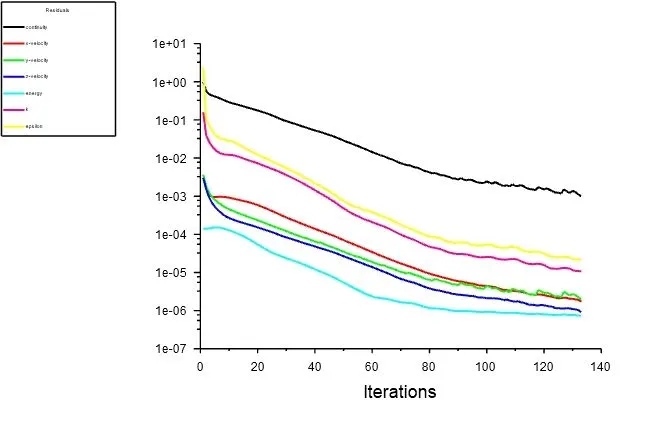
residual plot
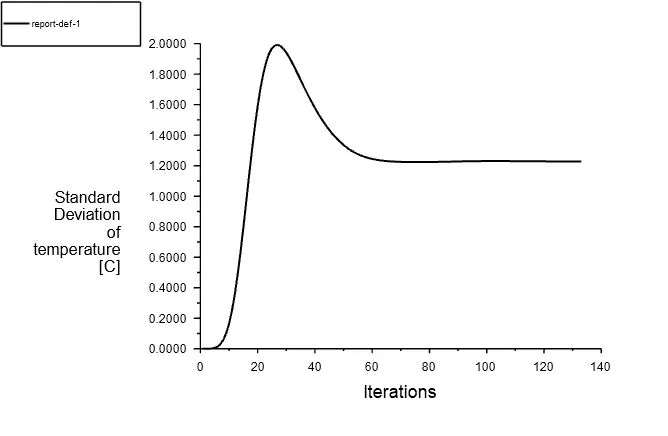
standard deviation
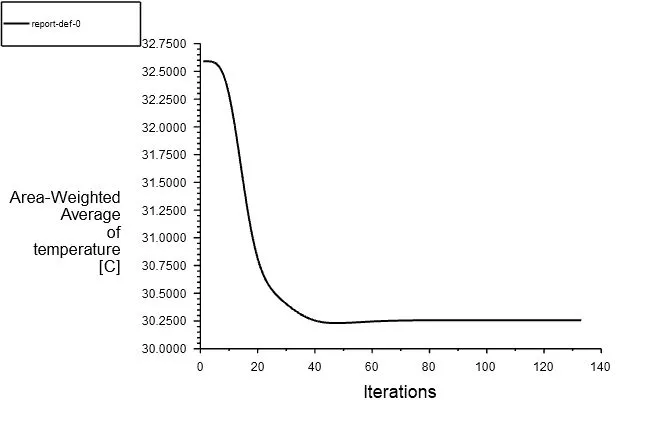
area-weighted -average of temperature
OUTPUT DATA
|
Momentum ratio |
Mesh size (mm) |
No. of cells |
No. of iteration |
Standard deviation |
Analytical temperature |
Experimental temperature |
% error |
||||||
|
2 |
10.219 |
12546 |
133 |
1.23 |
30.06 |
30.26 |
0.66 |
||||||
|
4 |
10.219 |
12546 |
126 |
1.16 |
27.76 |
27.54 |
0.79 |
||||||
Result
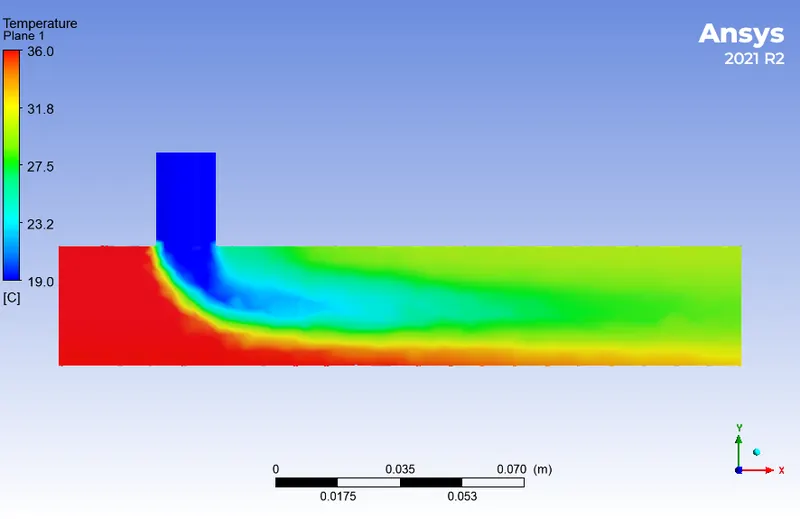
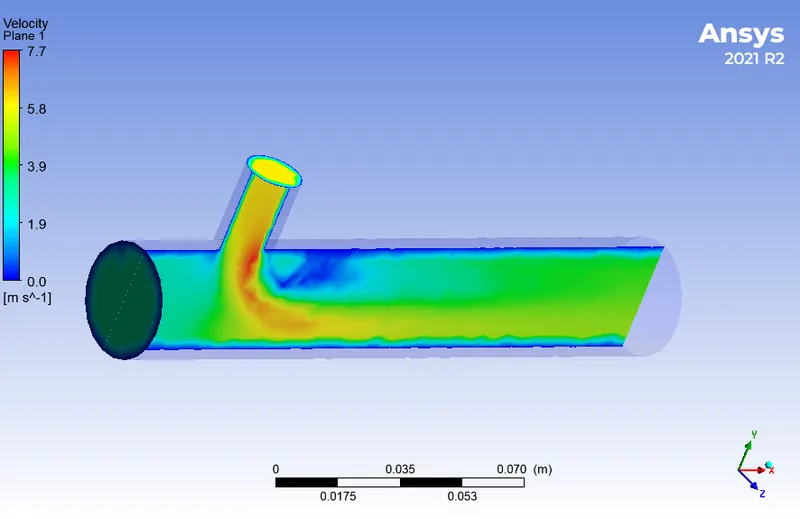
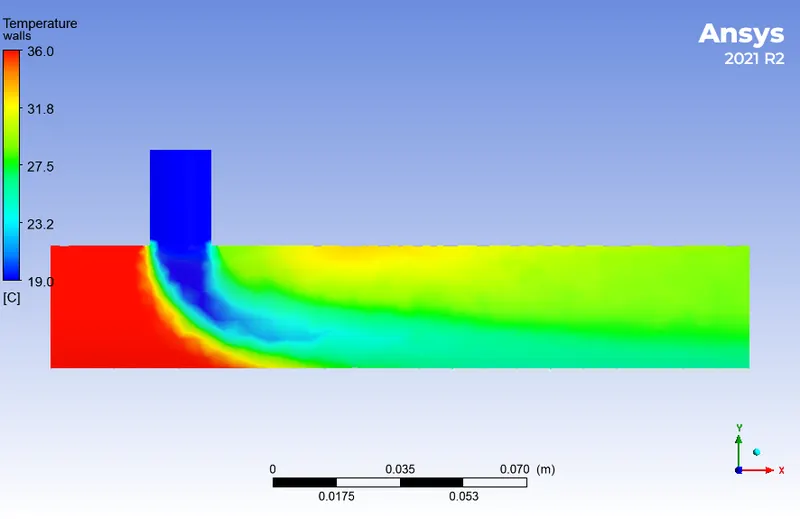
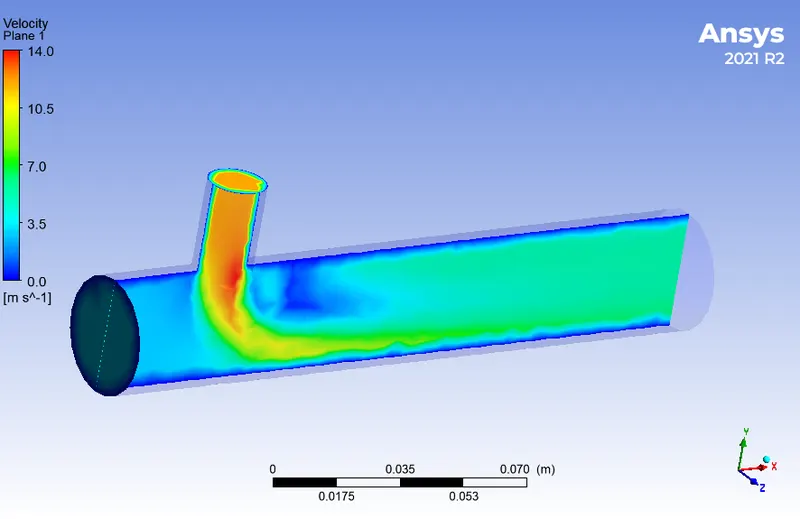
Here we can visualize the profiles of physical quantities like velocity, temperature etc.
Temperature profile for momentum ratio 2
Velocity profile for momentum ratio 2
Temperature profile for momentum ratio 4
Velocity profile for momentum ratio 4
Case-2 (long mixing tee)
note: - case setup for long mixing tee is similar to case-1
Output plot for momentum ratio 2
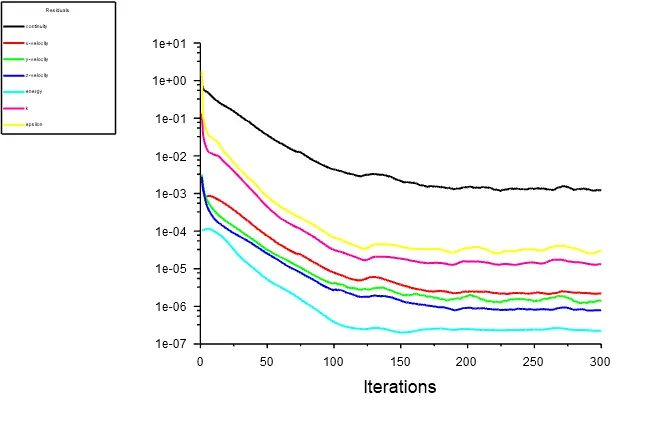
residual
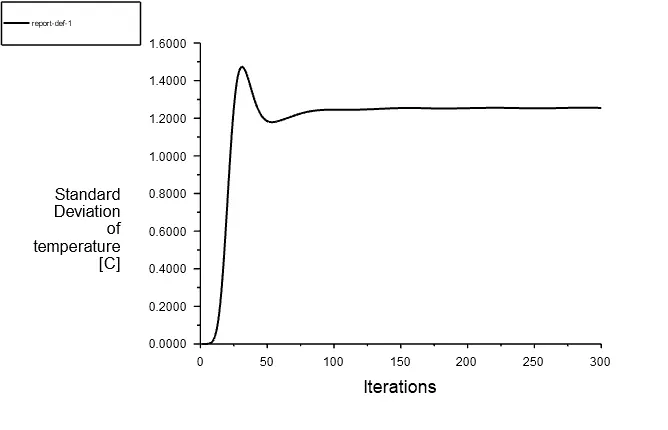
standard deviation
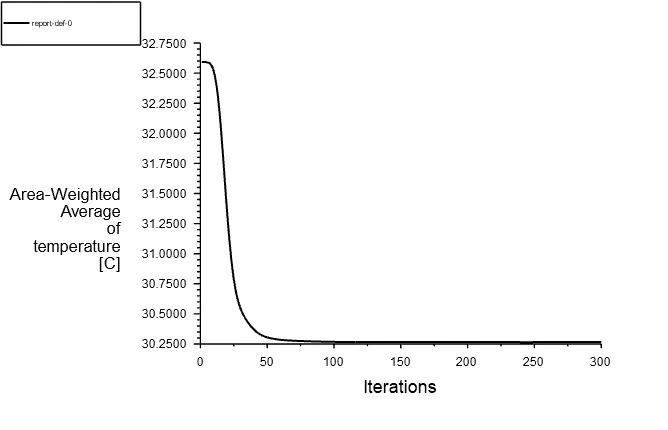
area-weighted-average of temperature
Output plot for momentum ratio 2
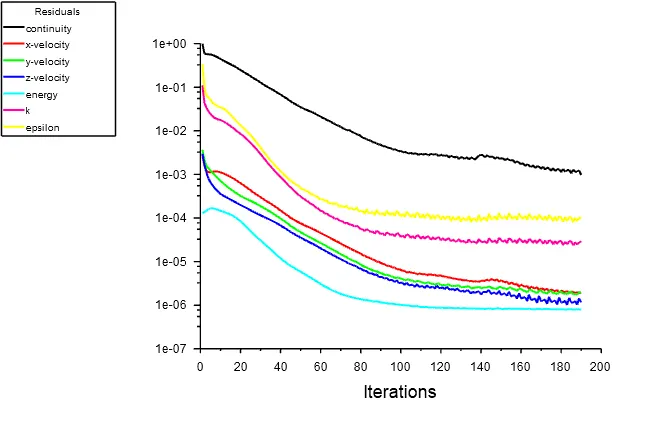
residuals
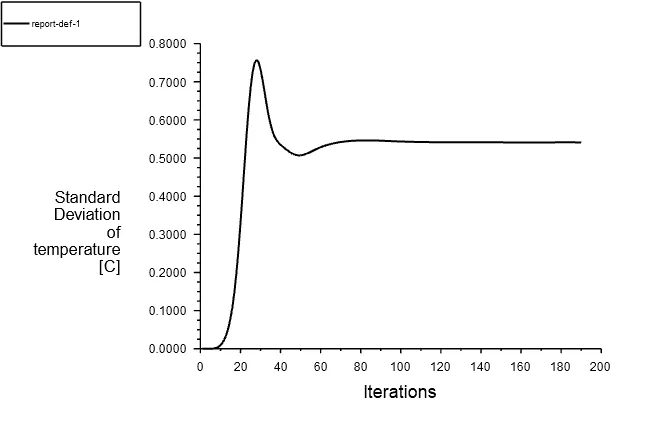
standard deviations
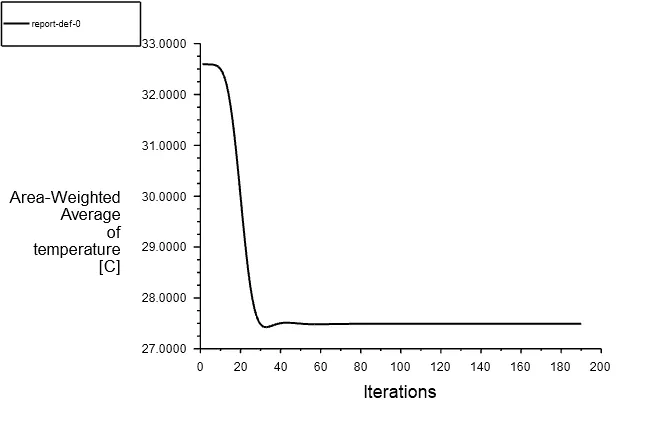
area-weighted-average of temperature
Output data
|
Momentum ratio |
Mesh size (mm) |
No. of cells |
No. of iterations |
Standard deviation |
Analytical temperature |
Experimental temperature |
% error |
|
2 |
10 |
15566 |
160(approx.) |
1.25 |
30.06 |
30.27 |
0.70 |
|
4 |
10 |
15566 |
190 |
0.54 |
27.76 |
27.49 |
0.97 |
Result
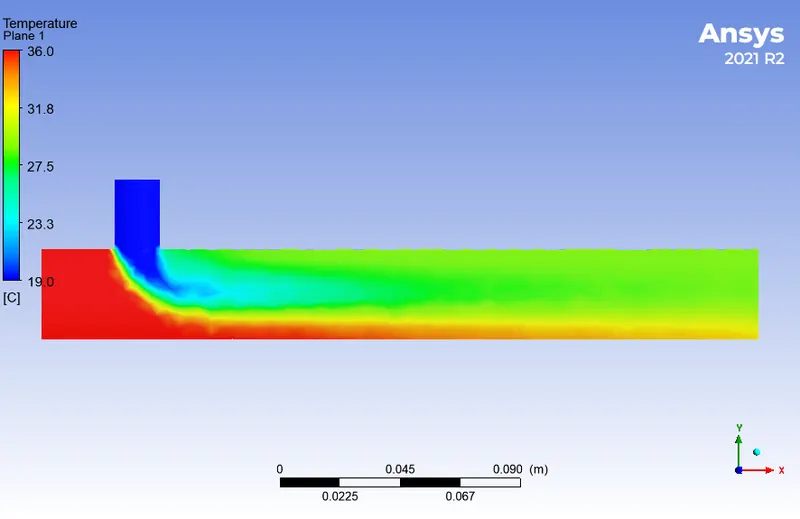
temperature profile for momentum ratio 2
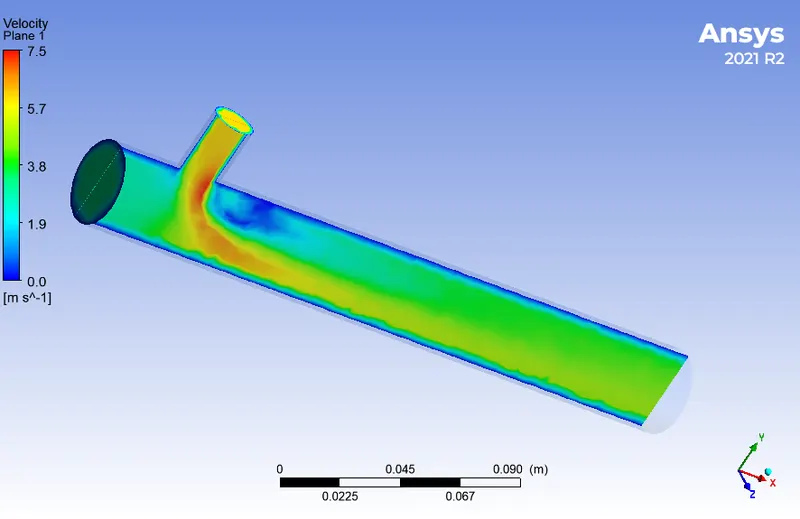
Velocity profile for momentum ratio 2
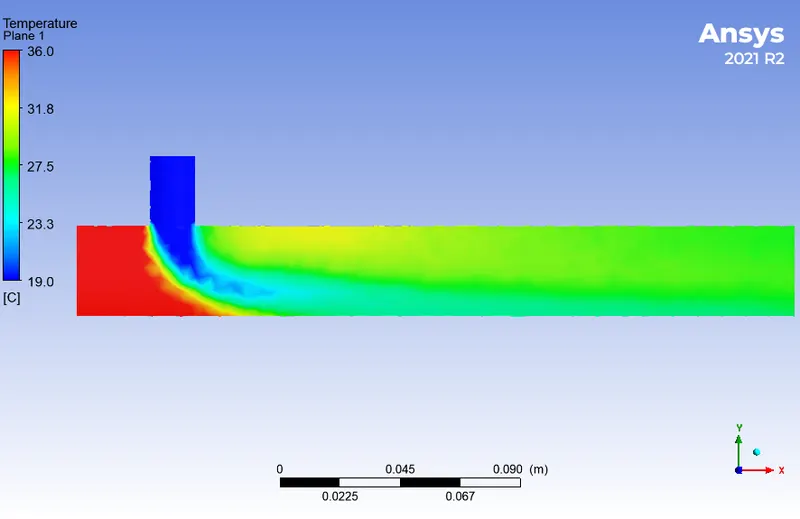
temperature profile for momentum ratio 4
Velocity profile for momentum ratio 4
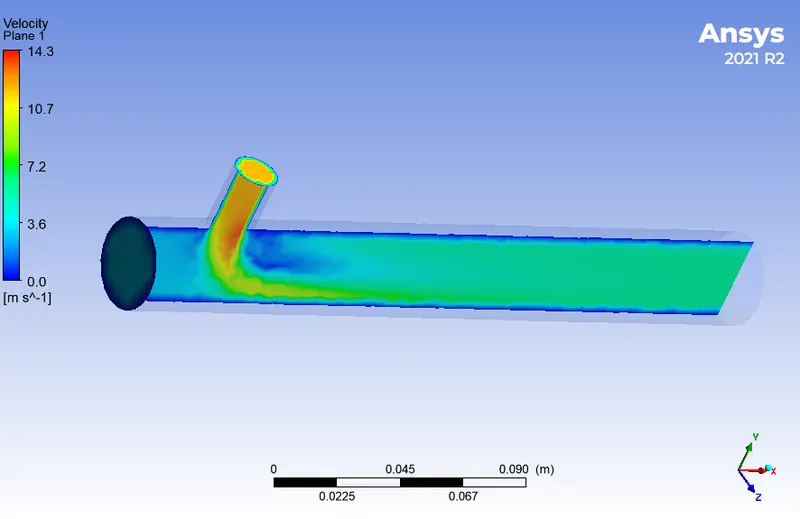
Conclusion
In both the cases for momentum ratio 4 the temperature at the outlet drops down significantly due to high velocity of cold air from the inlet. This is possible due turbulent mixing at the tee joint between hot air and cold air because of high velocity of cold air. The temperature contour at the outlet for short tee case shows that some of the high temperature flow through without properly mixing with the flow. However, in case of long tee we can see at the outlet temperature is quit uniform because long tee has more time for mixing. So, it has well mixed output temperature, however little streams are at lower temperature in bottom than rest of the above contour. If we will increase the pipe length then it mixes uniformly. So, we can recommend using the long tee and high velocity inlet for mixing applications.