Week 1:- Introduction to BiW and Fixtures Challenge
1. What is BIW & define its parts?
BIW stands for Body in White. BIW is an assembling of all welded sheet metal panels as before going for priming and as well painting. BIW refer to the welded sheet metal structure to which other component willbe married i.e.engine, chassis, exterior and interior trim.
Body in white or BIW refers to the stage in automotive design or vehicle manufacturing in which car body sheet metal( including door, hoods and deck lids) has been assembled or designed but before the components ( chassis, motor) and remove ( windshields, seats, upholstery, electronics, etc.) have been added. All activities in the production of a vehicle body or block before it goes to the paint shop. are, done in a weld shop. and the end product of a Weld shop is referred to as BIW.
Fig-1
components of the BIW fixture
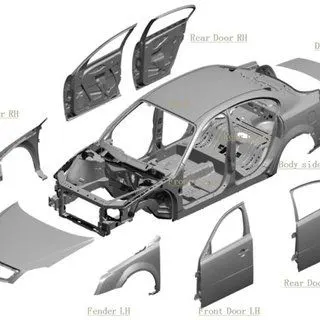
BIW structure can be divided in following substructures:
- Underbody structure
- Front end structure
- Body side structure
- Closure
- Roof
following fig shows about all structures
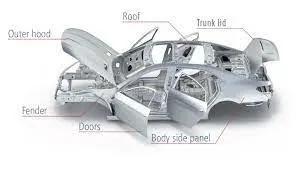
1) An Underbody Structure consists of following major panels:
- Dash panel - Dash panelprovides a partition between engine and the driver/passenger cabin inside car
- front Floor - provides a base for seats mounting and provides partition between transmission /propeller shaft/ground and the cabin.
- Riser- Riser connects Front floor to Rear Floor by providinga level difference
- Rear Floor- Rear Floor is the floor on the Rear of the car and provides a partition from ground also provide base for Rear seat mounting.
- Rear wheelhouse.
2) Front end structure consists of following major panels:
- PLENUM Panel- Plenum is a chamber located between the throttle body and the runners of the intake manifold, used to distribute the intake charge evenly and enhance engine breathing.
- FRT wheelhouse/ Fender - FRT Wheelhouse or Fender is an encasement around the FRT
- Wi ng,12anel - Wing panelare the outer most side panelin the
- Cowl - Cowlis the portion of the body bounded by the front fender the base of the windshield, and the rear edge of the hood
- 1!f;mer ti e bar- Upper tie bar is the upper panelin front connectingthe two sides (RH/LH) of Front structure.
- Lower tie bar- Lower tie bar is the lower panel in front connectingthe two sides (RH/LH) of Front structure.
3) BODY SIDE structure consists of following major panels
- A -12ill ar- A-Pillar is the front most support to Roof.
- B-12ill ar- B-Pillar is the second support to the roof and situated on the locking side of the Front door.
- CID 12ill ars- (-Pillar is the Rear most support to roof in case of a two row seats car, OR third support to the roof. D-pillar is the forth support to the roof and usually on the rear side of quarter
- Ring,12ane l- Ring panelis a structure panel connectingthe rear portion of the body to front, and constitutes a big part in side structure.
- Quarter 12anels- Quarter panel is rear most panelof a body side st
- Dri P- rail s/Gutters- Drip rails/Gutters is an exposed channelapplied to the roof over the side windows to direct water away from the windows and to cover structural welding.
4) Closures consists of following major panels
- A ll Doors
- Hood/Bonnet -Hood is a hinged panel providing access to the engine
5) Roof structure consists of following major panels
- Headers- Header is the structuralmember above the windshield at the juncture with the forward edge of the roof
- Bows- Those are used to support the roof.
2 What do you understand by BIW Nomenclature?
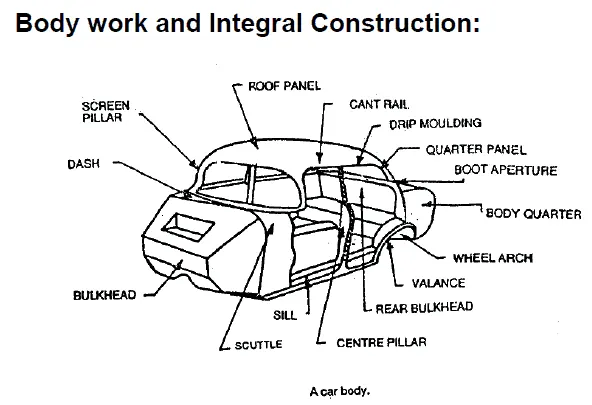
Nomenclature is basically choosing names for things. BIW have no.of parts in it. All parts have different specifications.As automotive industry is spread worldwide. Every nation has its own regional language. So the same part in BIW have different part in its region.For example, One component of BIW is called suspension tower in UK & same component called shock tower in U.S. Below fig show BIW nomenclature.
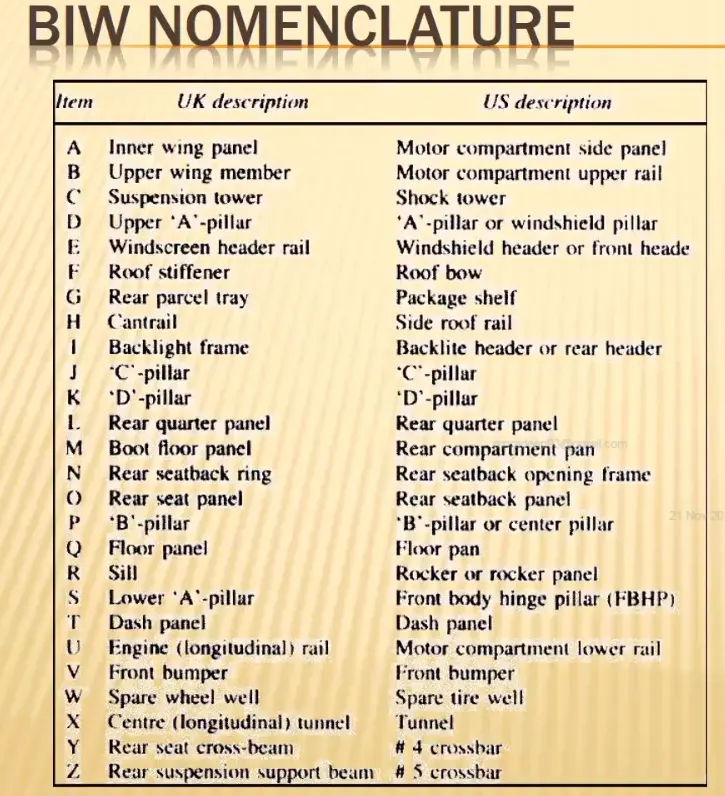
U.S and U.K nomenclatures
3. What is fixture & its type?
Fixture is device which holds the work piece to be processed (Welded) by using 3-2-1 pri nciple.
In general a welding fixtures (tool) consist of number of units together to hold car panel together. Weld i ng fixtures are normally designed to hold and support the various component to be welded. It is necessary to support them in proper location which is capable of preventing
distortions in work pieces during weld ing. For this the locating elements need to be placed carefully, clamping has to be light but firm, placement of clamping elements has to be clear of welding area and the f ixture has to be quite stable and rigid to withstand the welding stresses.
2. Pre-production Fixture- It is generally defined as prototype fixture. It is designed to study feasibility of initial batch production to check which things are need to be improving before starting production.This fixture is base of production f ixture in benchmark and criteria & helps us to rectify error. In preproduction operation fixture there willbe more involvement of manualoperations, engineer, and quality person. It haslarger cycle time than production fixture. But won't practice by designing preproduction fixture because it takes lots of time & cost. We have to maintain cost of car as low as possible so we directly go to production fixture by considering standards, checklist to maintain error free production
3.Checking Fixture- As name suggest this fixture is used for checkingassembly which came out from geo fixture. Checking fixture are same as geo fixture except there are no operation done like welding,gluing or hemming. Instead of that we use different in built gauges or externalgauges to check various dimension, gap,relative dimension, tolerance.These data is compared with data provided by designer or design team of that particular.The geometry of welded part also checked in this f ixture to ensure part maintains the required dimension & geometry.
4.What is basic principle of fixture design?
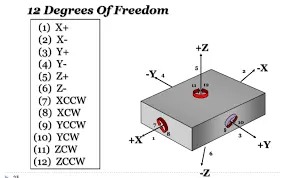
For a fixture designer major portion of design time is spent on how to locate the work piece in fixture. For any free body there are total 12 degrees of freedom(D.O.F) as below.
6 translation degrees of freedom:
+X
-X
+Y
-Y
+Z
-Z
6 rotationaldegrees of freedom
- Clock wise around X axis (CROT-X)
- Anti clock wise around X axis (ACROT-X)
- Clock wise around Y axis (CROT-Y)
- Anti clock wise around Y axis (ACROT-Y)
- Clockwise around Z axis (CROT-Z)
- Anti clock wise around Z axis (ACROT-Z)
3-2-1 locating principle:
Holding fixtures used in assembly operations often follow a locating scheme called 3-2-1 principle to position parts. Under this scheme, three locators position a part in a primary plane or direction (e.g., high/low). Two locators then position the part in a secondary direction (e.g., in/out),leaving one locator for the tertiary direction (e.g.,fore/aft). This approach fixes the part in 3-dimensional space and satisfies the six degrees of freedom constraint. Below fig. show 3-2-1locating principle.
5.Elaborate types of BIW station?
In BIW assembly line is in where different types of panelare joined together in each specified
zones. Each panelcategories will have individual zone. As under body zone, door zone, hood zone etc. These zones are further divided into stations. There are followingtypes of station in BIW.A Station is the place where an operation is done by couple of tools. For example, a station can contain one Geo set weld fixture (weld tool}, robots, end effectors, etc. to perform a single operation in the assembly line.So there will be proper flow of inventory. Below fig.shows station category.
- Tool stations
- Gripper stations
- Stand stations
- Miscellaneous station.
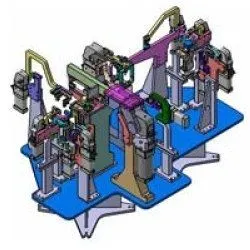
Tool station (Geo station)- Geo tool is a fixtu re in which geometry of the panels which are welded together are defined accurately. The pin tolerance for geo pin will be of closure tolerance i.e.-0.15 in general. For example, consider panel hole size 20mm, the pin diameter should be 19.85mm.All parts must be located with two locating pin. Tolerance level in all terms should be very less with geo fixture. Pin should be undersize & pin tolerance for geo pin will be closer. Below fig. show geo station.
Gripper stations
gripper station- A gripper is device or a fixture which holds the car panel & is fixed to the manipulating end of robot or an end eff ector. Also known as EOAT ( End of arm tooling)
b) Process Grippers- Process grippers are designed for handling the car panelone station to other & in addition to that it under goes process like pedestalwelding, pedestalriveting,gluing,sealing etc.
c)Combo gripper- Combo gripper is designed for handlingcar panelfrom one station to other also with combination of weld gun at another side of gripper for welding. It is multiple taskingtypes.
Weld gun + Grippe
d) Dual gripper- Dualgripper is designed for handling car panelfrom one tool (station) to other, with two sided gri It can hold two panelsimultaneously one RH & one LH side.
Gripper+ Gripper
- Stand station- Below fig. show stand types
Pedestal stand- Weld gun is mou nted to the floor permanent ly. The gripper can carry the panel under the stand to do some operation. Below fig shows pedestarail stand
Gluing & sealer stand- Gluing or sealer gun is attached to standard stand which is grouted to floor permanently fixing is required. So stand should not move due to vibration or other factors
Docking stand-When robots are selected of multitask ing like material handling & welding, which cannot carry both due to some limitations (payload capacity of robot or space constraint. It is also called as parking stand for gripper.
- In this case we add docking stand to put some equipment which is not use for current operation but will be required for next operation.
- Hence robot can drop or a gripper or gun & pick next operation equipment to complete the task from docking stand.Date stamP- stand- Every man ufactu red product have some data to stamped or to be embossed on it like serial no, batch no, date etc. For some future reference or for data collection
Buffer stand- Af ter some operation we can put the no. of assemblies in this stand which is buff er stock & it can be transported to another station in easy way. They are also used to store the inventory while the machine is undergoing for some maintenance. Below fig shows buff er storage.
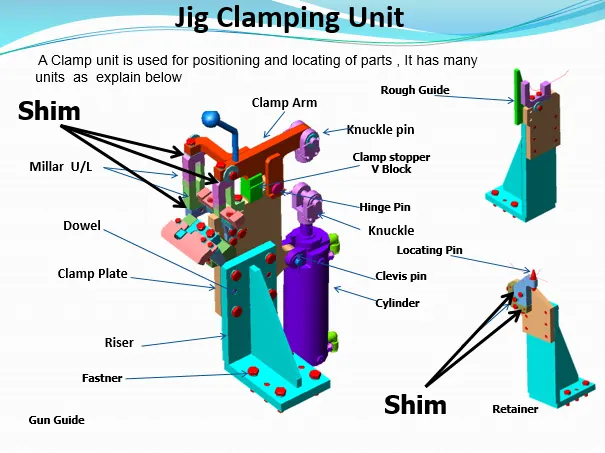
4. What are basic terminologies used in the BIW fixture?
The basic termi nologies used in BIW are
- NC/MYLARS/FINGERS- These are parts are used to hold panel. They are globally called as mylar. Top side mylar is called as clamping mylar & bottom side is called resting mylar. Every clamping mylar should have resti ng mylar. It is jaw type. It prevent panel from def orming while welding.
- PrinciP-le l oP-oint (PLP). - These are point which are used for the accurate location of part to maintain the geometry of assembly. means pri nciple locating points are those where we use pin for locating panel. These are defined in drawing. The positional dimensions or relative dimensions are very precise in stamping & in fixture also.
- Risers- Risers can be of L-type, welded or square tube or frame These are basically manufactu red parts are used to give height to assembly.
- Blades- Blades are plates attached to riser. Other part likes cylinder, arms etc are mou nted on theblade.
- Shims- In fixture we are providing tolerance to each part mostly man Those tolerance tend to stack up & reflect together. I n order to avoid that we use shims so we can easily adjust afterassembly so whatever stack up there we wi ll rectif y it through shims. Shims come in thickness of 0.1,0.2, 0.5 etc.
- Rough locators- Rough locators are those used majorly for manual There is chance that operator can place part in wrong orientation mistaken ly. The rough locator will work as a guide while placing the part in the fixture & part wi ll be loaded in desired orientation.
- Hardwares- Hardwares are like the hex head bolts, allen bolt, hex nuts, spring washers, self locking nuts
- CMM- CMM stands for coord inate measu ring machi It is a device that measu res the geometry ofphysical objects by sensing discrete points on the surface of object with probe. It generates report by comparing the data with the CAD file data.
- Units- The fixture is assembly of diff erent types of u nits to form a fixtu There are diff erent unit likepin unit, base unit, clamping unit etc
- Number Rlates- Nu mber plate is the aluminum embossed plate placed on each unit to recognize the uni
- Co-ordinate Rlate- When we discuss about fixture on every fixture we have tooling hole which is called master hole through all fixture checked on CMM masteri ng that part icular hole. Cover that hole so that it won't get other impu rities & hole does not get any wear, tear & distortion.
- Name Rlate- The plate on which basic information described like company name, fixture name, fixture weight, panel name are embossed & joined to
- ClamR arm- Clamp arm is part of clamp unit which moves about Over clamp are mylars are mounted
- Pivot- It is axis about which clamp arm willClass 'A' surface/ skin surface- The outer panels of car like hood,door, backdoor, fender, roof etc are visible to The outer panels should be aesthetically very good. No any scratches or dent mark is acceptable over it. While designing fixture to the skin surface the clamping material should be soft, so that it could not able to left any impression or dent over skin. Generally nylon or PU materialisused for clamping purpose.Reed switches & sensor- These are the electric components used in automated The sensor & reed switches are used only in that situation where fixture is fully automatic or semiautomatic that run through PLC, control paneletc. Sensor are used to detect part present or not, clamp is close or open whereas reed switches confirms position of piston i.e. it is at top or down. Below fig shows unit used in BIW.