Week 1:- Introduction to BiW and Fixtures Challenge
BIW - EXPLANATION ABOUT (BIW) PARTS & FIXTURES IN DETAIL:-
BIW DEFINATION:-
- Body In White (BIW) refers to the welded sheet metal components which from the vehicles structure to which the other components will be married, (Engine, Chassis, Ecterior and Trim)
- BIW refers to the stage in automotive design or automobile manufacturing in which the car body sheet metal (including doors, hoods and deck lids) has been assembled or designed but before the components (chassis, motor) and trim, (windshields, seats, upholstery, electronics, etc) have been added.
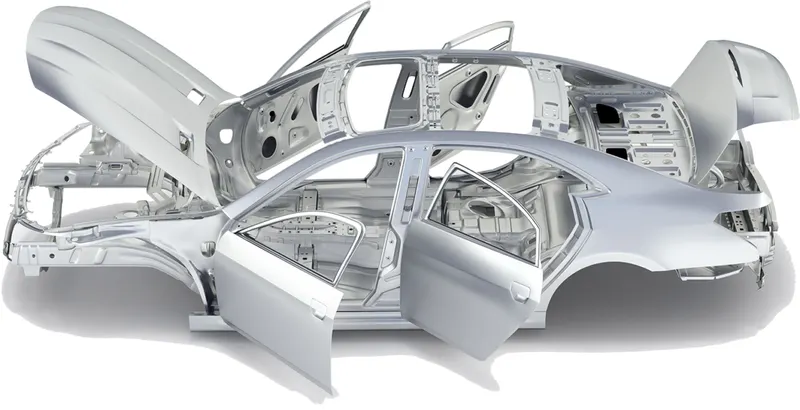
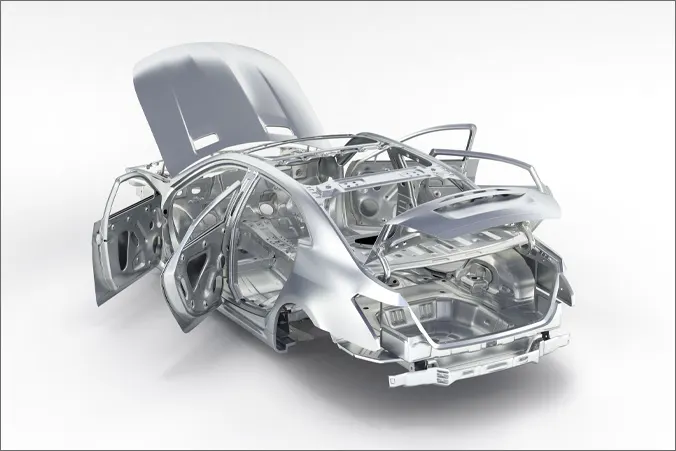
BIW - The stage in automotive design or automobile manufacturing in which the car body sheet metal components are been assembled by welding and by other joining process.
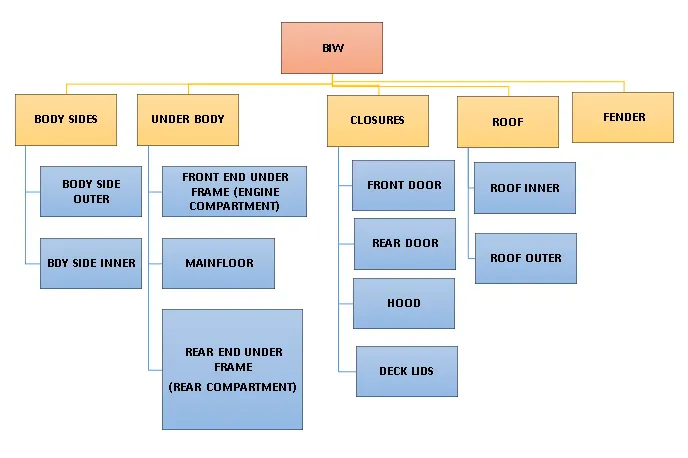
BIW PARTS ARE MAINLY CATEGORIZED AS BELOW:-
- BODY SIDE
- UNDER BODY
- CLOSURES
- ROOF
- FENDER
BODY SIDE:-
There are two types
- body side outer
- body side inner
It generally refers to both side of the car left and right side. Its mount various biw components like A-Pillar, B-Pillar, C-Pillar, etc.
UNDER BODY:-
The floor of the car body is divided in to three section
- Frond End Under Frame (Engine Comportment) Inthis comportments are mount to the engine and other components of automobile like battery, radiator, etc.
- Rear End Under Frame (Storage Compartment) Inthis comportments are mount to the space of rear closure and boot space.
- Main Floor (Passenger Comportment) Inthis comportments are mount to the interior parts like seats.
CLOSURE:-
There are four types
- Front Door - (Two front door on each side)
- Rear Door - (Two rear door on each side)
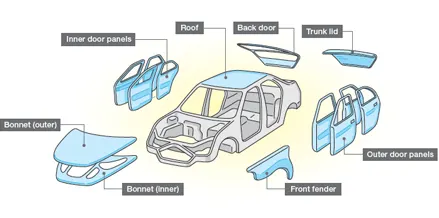
- Hood - (To cover the engine comportment)
- Back Door - (To cover the interior and boot space)
These called as closured which are movable components of car.
ROOF:-
There are two parts
- Roof Inner
- Roof Outer
The top most area of the acr called as roof which protects from the wing, heat etc, which is joined with the body side, A-Pillar, B-Pillar, C-Pillar etc. The two separate parts are joined with the hemming operation both inner & outer panel as additional strength like reinforcements.
FENDER:-
Fender has a single panel which is fixed in the top of the wheel which acts as the covering the engine comportment, and this part comes under the pedestrain safety criteria also. The main purpose of the fender to not allow the small partcles stone while the vehicle is moving condition.
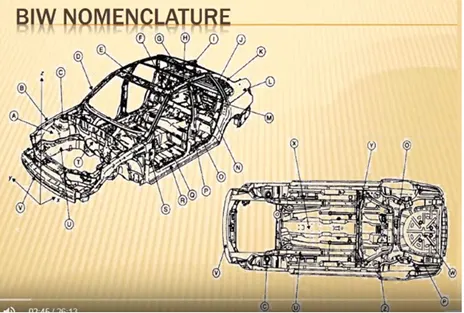
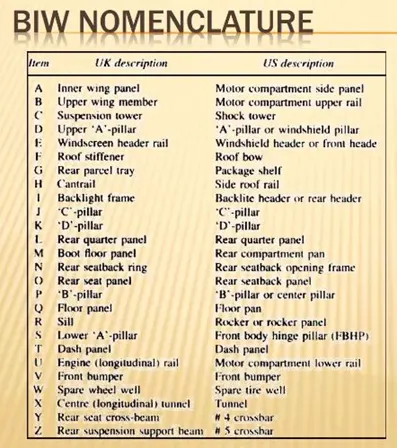
BIW NOMENCLATURE:-
A nomenclature in BIW is basically naming every part of the body. These names can be said as sub parts of the already categorized parts above. The nomenclature differs a little bit from region to region but the overall idea is to name individual automative sheet metal components. Below image show the nomenclature of BIW.
BIW FIXTURE:-
A fiture is the device which holds the work piece to be processed (welded) by using 3-2-1 principle. In general a wlding fixture (tool) consist of number of units together to hold the car panel, and is mounted on a vase unit.
Welding fixture are normally designed to hold and support the various components (work pieces) to be welded. It is necessary to support them in a proper location which is capable of preventing distortions in work pieces during welding. For this the locating elements need to be placed carefully, clamping has to be light but firm, placement of clamping elements has to be clear of the welding area and the fixture has to be quite stable and rigid to with stand the welding stresses.
3-2-1 Principle
- X-axis (Longitudunal Direction) For and after
- Y-axis (Transvers Direction) Center O Line
- Z-axis (Vertical Direction) Up and Down
- The front center of the vehicle serves as the origin (0,0,0) for these axes.
TYPES OF FIXTURE:-
Below are the general types of BIW fixture
- Production Fixture
- Pre-Production Fixture
- Checking Fixture
PRODUCTION FIXTURE:-
These fixture are used for mass production. It required high consistency through its operation to maintain the geometry of the parts so the materials used are well tested for hardness and aesthetics, this quality for maintining the dimensions&tolerances is also checked. The production fixture need to be easy for maintenance purposes, this fixture needs some maintenance after completing number of operation. The times required for assembly & dissembly should be as low as possible which saves lots of time.
PRE-PRODUCTION FIXTURE:-
These fixture are designed as prototype fixture to check the feaibility of initial batch production and to check which things need to be improved before starting the production. This fixture can be taken as the base fixture which sets the benchmark & criteria and helps us to rectify the erroes that we could get from preproduction fixture. In this process many manual operations are involved, many engineers & quality related person are required. It has large cycle time as compared to production fixture and its required lot of time and cost also. We have to maintain the cost of the car as low as possible so we directly go to the production fixture by considering standerds a checklist to maintain error-free producetion.
CHECKING FIXTURE:-
These fixture are used for checking purposes. No processing is done in these fixtures. These fixture cinsist of gauges for checking the dimenion and tilerance and its accuracies. In some checking fixture, fixture are fixed and CMM devices check the geometrical accuracies.
PRINCIPLE OF FIXTURE DESIGN:
The basic principle is fixture the parts and locking all the twelve degrees of freedom (6 movements & 6 rotations). For a fixture designer, the major portion of design time is spent deciding how to locatedthe workpiece in the fixture.
Six translational degrees of freedom:
- +X, -X, +Y, -Y, +Z, -Z
Six rotational degrees of freedom:
- Clockwise around X axis (CROT- X)
- Anticlockwise around X axis (ACROT- X)
- Clockwise around Y axis (CROT- Y)
- Anticlockwise around Y axis (ACROT- Y)
- Clockwise around Z axis (CROT- Z)
- Anticlockwise around Z axis (ACROT- Z)
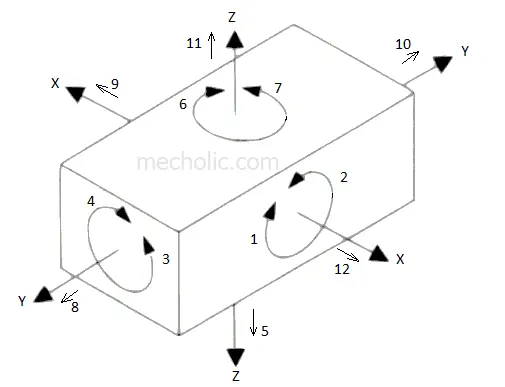
To make sure the proper fixing of the part we need to restrict all the 12 degrees of freedom in order to locate the work piece in the fixture. So, 12 degrees of freedom of the workpiece need to be fixed & thus we can achive zero degree of freedom for the work piece.
ELABORATE TYPES OF BIW STATIONS:-
The BIW assembly line is where different types of panels are joined together in each specified zone like Underbody zone, Hood zone, etc. These zones are futher subdivided into stations, where various process like welding gluing and inspection are done to the part of that particular zone before they are being assembled together. For instance in the roof zone, various reinforcement is to be added before they are married to the side zone.
BIW ASSEMBLY LINE:-
- Tools
- Grippers
- Stands
- Miscellaneous
The tool is a fixture which consists of number of different units to hold a car panel or assembly.
1.TOOLS STATIONS:-
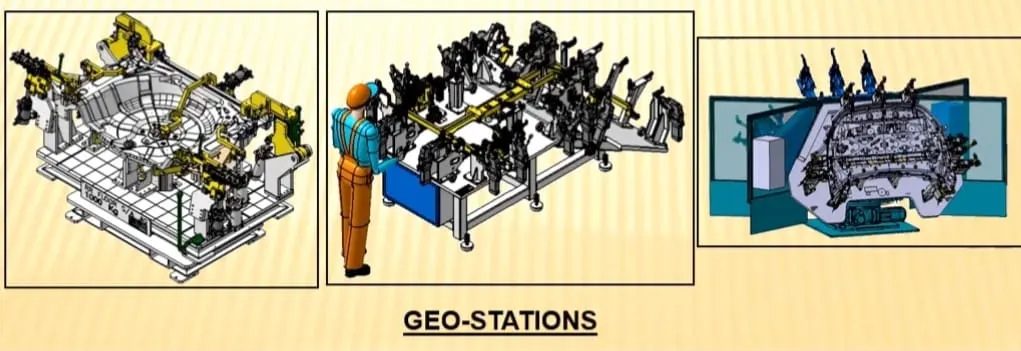
GEO TOOL:
- The geo fixture is where the geometry of two parts is fixed. This can be achived through either welding or riverting.
- In this station, the precision and geometry of the finished product are defined.
- Locating pins are used to precisely position the components. These pins have a tight tolerance of 0/-0.15.
- For example, if the hole diameter of a panel is 16 mm, the minimum pin dia can be 15.85mm.
RE-SPOT TOOL:
- After the product comes out of the geo station, there may be left-out spots where additional spot welding or riveting is required.
- These left-out spots could be due to factors like clamp plan, cycle time, robot reachability, or other reasons.
- In the re-spot station, pin have a tolerance of up to 0/-0.28 mm

MARRIAGE TOOL:
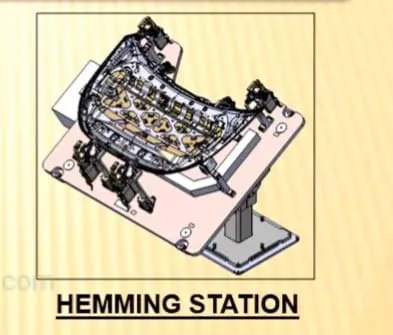
- Marriage or hemming tool is a fixture in which the inner panel and outer panel is joined together.
- Hemming is not done for every part but only for those parts where we want to join two panels without other joining process as it may affect the aesthetics of the car.
- Hemming can be found on Hood, Back door etc.
FRAMER TOOL:
- framer fixture is next station after the marriage fixture
- in a framer fixture, the roof is attached to the output of the marriage fixture & it forms like a frame hence it's called a framer tool.
CHECKING FIXTURE:
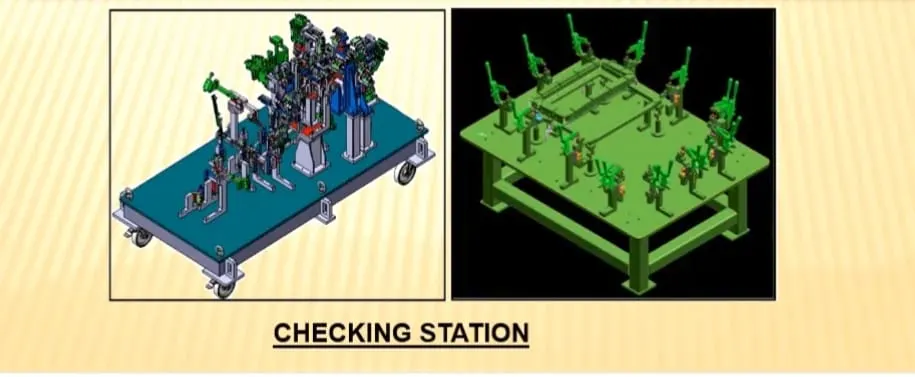
- It is used to check the automotive part or assembly to ensure all the coordinated, relative dimensions and positions are as per tolerance. It can be classified as follows
- Gauge type checking fixture is where the work piece is held and various gauges are introduced to ensure the dimensions and repeatability.
- Fixed type checking fixture is where the work piece is fixed using clamps and pins and the CMM is used to measure the coordinates of different points of the panel and compare it with the nominal value and give its report to rectify any errors.
- Automated checking fixture is where the automated setting are being done through sensors, PLCs, switches etc, to give a signal in case of any irregularities which can be rectified. As it is expensive, it is not widely used.
2. GRIPPERS:-
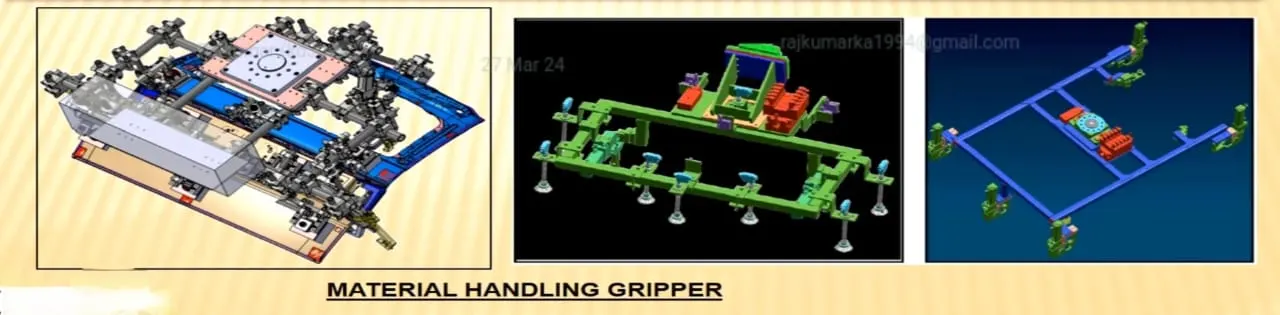
A gripper is a device that enables the holding of an object to be manipulated. The easier way to describe a gripper is to think of the human hand. Just like a hand, a gripper enables the holding, tightening, handling, and releasing of an object. A gripper is just one component of an automated system. A gripper can be attached to a robot or it can be part of a fixed automation system. Also known as EOAT - Ensd Of Arm Tooling.
MATERIAL HANDLING GRIPPER
- As the name suggests These grippers are used for material.
- These grippers can pick assembly from one station & will drop the assembly at another station.
PROCESS GRIPPER
- These grippers are used to carry out some specific processes like gluing, welding, riveting in addition to material handling.
- The gripper will go under gluing stand in case of gluing process & will goes under the pedestal weld stand in case of the welding process.
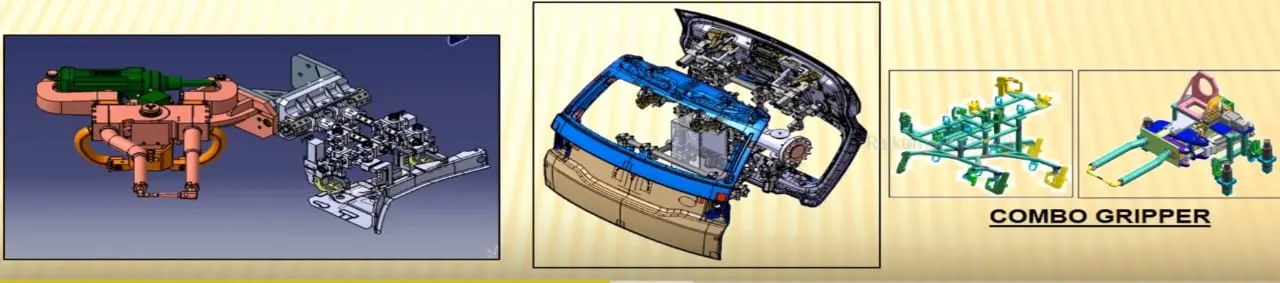
COMBO GRIPPER
- Combo grippers are the ones which can carry out multiple tasks like it can do material handling & also it can carry out some specific process like gluing, welding as well.
- For example Weld gun + Gripper
DUAL GRIPPER
- These are two-sided In case when we want one LH & one RH part, these grippers are used. It can handle the material from one station to another station
- For example Gripper + Gripper
3. STANDS:-
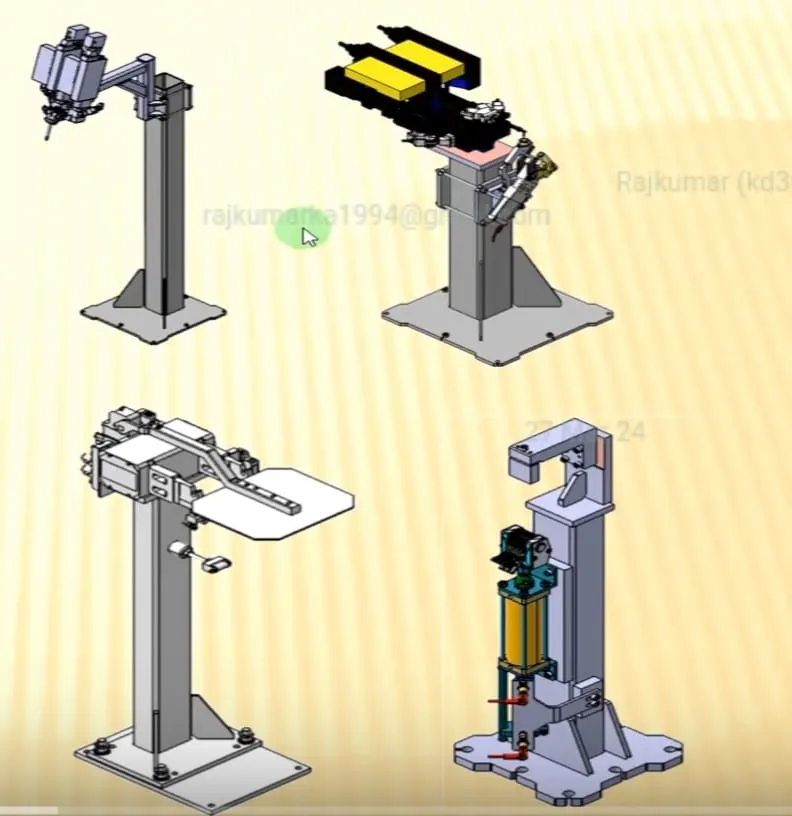
PEDESTAL STAND
- Weld gun is mounted on the fixed stand which is mounted to the floor The gripper can carry the panel under the stand to do the operation.
GLUING STAND
- Gluing gun or sealer gun is fixed to a welded or a standard stand which is grouted to the floor
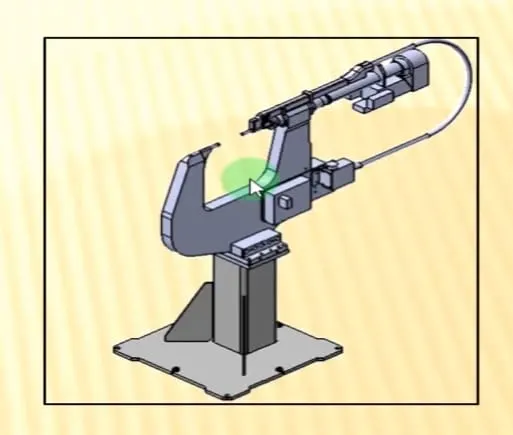
DOCKING STAND
- limitation of load capacity docking stand is used.
DATE STAMP STAND
- Every manufactured product has some data to stamped or to be embossed on it like serial no, batch no, Date for some future reference, or for data collection.
- The required data is stamped or embossed by using the stamping device mounted.
4. MISCRLLANEOUS:-
CURING
- These stand is used to provide curing timme to the components or parts.
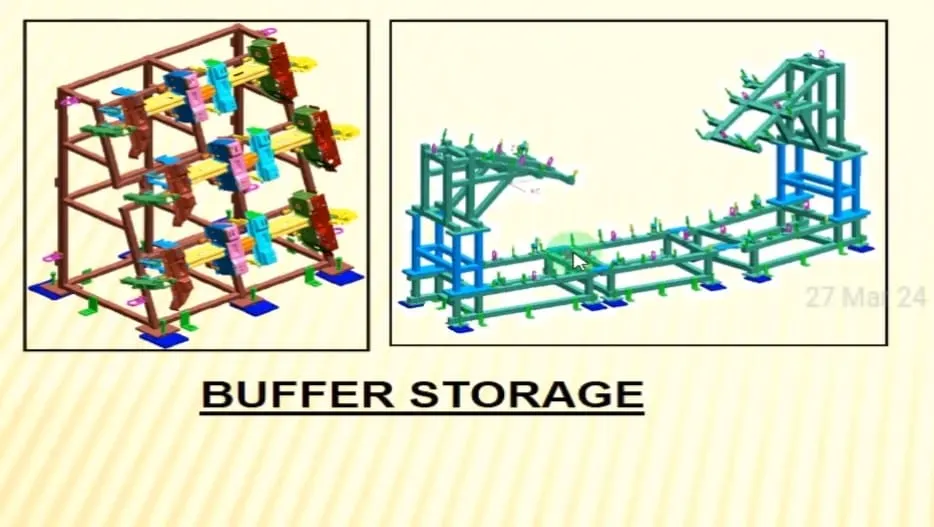
BUFFER STAND
- These stand is used to store components.
TAKE OUT TROLLEYS
- It is used to take out component or parts in assembly line for inspection purpose.
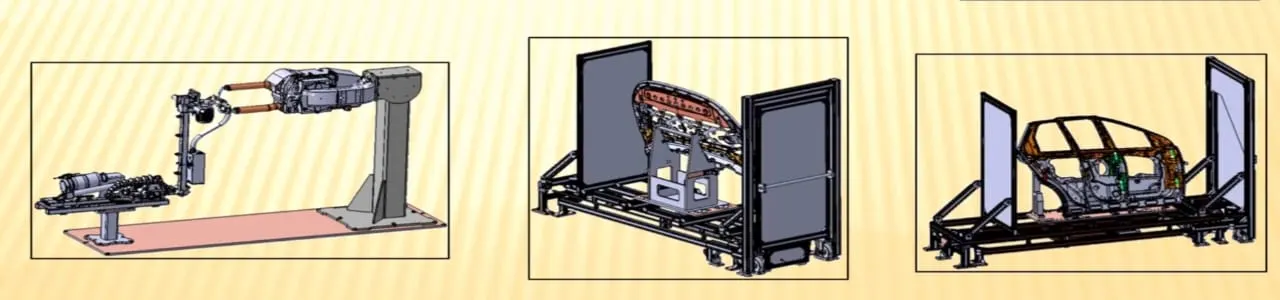
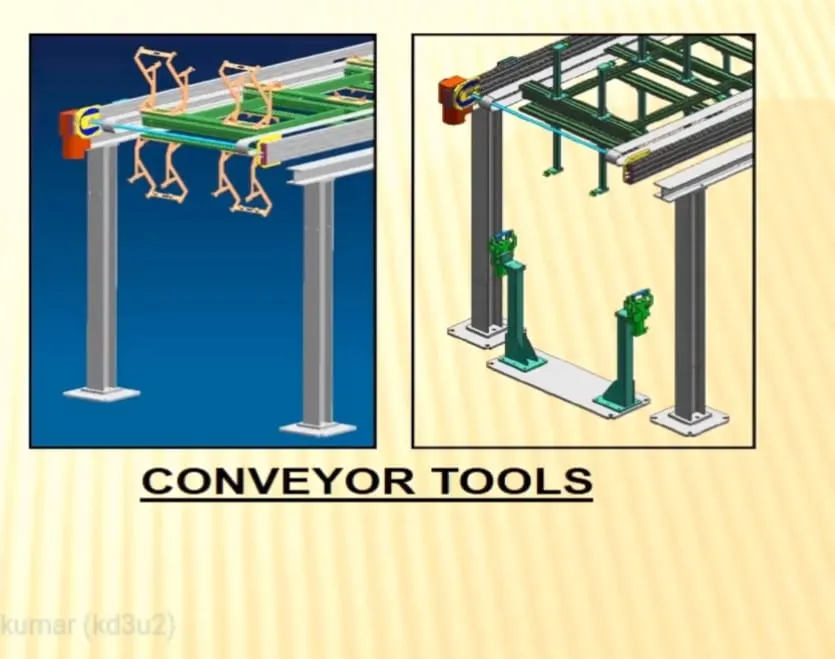
CONVEYORS
- Conveyors are used material handling.
BASIC TERMINOLOGIES USED IN THE BIW FIXTURE:-
The following terminologies are used in BIW:
NC/ Mylars/ Fingers:
- It direct contact with the fixture from both the sides.
PLP (principle locating points):
- It helps to locate the component with accurate the geometry.
Blade:
- Blades are mounted on risers.
Raiser:
- It used to give the height to the units fixture.
Shims:
- It is used to adjust the stability of the fixture by using plates of 3mm or 5mm.
Rough locators:
- It hold the component in correct manner and also support or rest the component.
Hardware:
- It consists if nuts or bolts etc.
CMM:
- It is used to measuring the geometry of the component.
UNITS:
- The fixture is the assembly of different types of units to form a There are different units like pin unit, base unit, clamping unit, etc.
Number plates:
- It is used to mention the numbe on parts.
Clamps arm:
- It used to clamping the component securely.
Pivot:
- It is axis along wich arm rotates.
Class A surface or Skin surface:
- Outer visible surface of components knows as class A or skin surface.
Read Switches:
- It is used to operate the cylinder in fixtures.
Sensors:
- It used to sense and send some inputs to electronic or mechanical devices for better result of understanding.
Nameplate:
- It is used to mention the name of parts.