Week 1:- Introduction to BiW and Fixtures Challenge
CHALLENGE 1
AIM = Answer the following questions with relevant images.
***I HAD USED IMAGES OBTAINED FROM SKILL LYNC VIDEO LECTURES AND FROM OTHER SOURCES LIKE GOOGLE, SINCE IT'S MENTIONED IN THE QUESTION TO PROVIDE RELEVANT IMAGES***
1. What is BIW & define its parts?
- In the automobile industry, It is the stage in automobile where body shell structure sheet metal components are welded together in weld shop just before painting.
- BIW design is always driven by aesthetic, aerodynamic and cost criteria
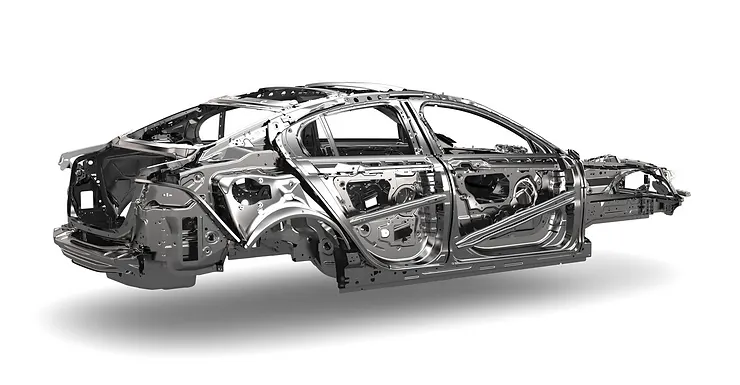
- Requirements of BIW structure:
- Comfortable space
- Strength & stiffness
- Low weight material
- Corrosion resistant
- Aerodynamic & good appealing structure
- Sufficient space for packaging and provisions made for inner trim and aggregates
- Pedestrian and occupant protection during roll over accident
- All exterior components like front bumper, rear bumper, fenders, mirrors, etc.. mounted on structure in means of mounting brackets and nuts on the BIW
- Monocoque construction (Chassis in built in Body)
- BIW Components
2. What do you understand by BIW nomenclature?
- Nomenclature is basically choosing of names for things.BIW have no. of parts in it. All parts have differenent names.
- As the Automotive industry is spread worldwide. Every nation has its own language. So the same part of the BIW have different names in its region.
- For example, The one component of the BIW is called suspension tower in Uk & the same component is called shock tower in US.
3. What is fixture & its types?
- Fixture is a holding device which holds the workpiece to be processed. In general fixtures are designed using 3-2-1 principle. Further, fixture should firmly hold the work piece without causing vibrations, distortions, stresses in the workpiece and also fixture should not disturb or interfere the processing of the workpiece.
- Types of Fixture
- Production fixture = These fixtures are used for mass production. Since these fixtures are used for mass production, they should be simple, rigid and hard. These fixtures should be periodically maintained in regular intervals to avoid errors and repairs. The design of the fixture should be in such a way that it should be easy to load and unload the workpiece within seconds to increase the productivity of the processing/assembly.
- Pre production operation fixture = These fixtures are basically newly designed fixtures for the new products or parts. These may be complex, manual and heavy based on the application. These can be referred as the protype fixtures. Once the preproduction operation fixture functions properly, then modifications are made to improve and to make it simple and reliable. These fixtures are used in special cases or during initial or trail stages of processing/production
- Checking fixture = These fixtures are used for checking and inspection purpose. No processing is done in these fixtures. These fixtures consist of gauges for checking the dimensions and tolerances and its accuracies. In some checking fixtures, fixtures are fixed and CMM devices check the geometrical accuracies.
4. What is the basic principle of fixture design?
- 3-2-1 principle is used for the design of the fixtures
- For a fixture designer, the major portion of design time is spent deciding how to locate the workpiece in the fixture.
- You know that any free body has a total of twelve degrees of freedom as below:
- 6 translational DOF
- +X
- -X
- +Y
- -Y
- +Z
- -Z
- 6 rotational DOF
- Clockwise around X-axis (CROT-X)
- Anticlockwise around X-axis (ACROT-X)
- Clockwise around Y-axis (CROT-Y)
- Anticlockwise around Y-axis (ACROT-Y)
- Clockwise around Z-axis (CROT-Z)
- Anticlockwise around Z-axis (ACROT-Z)
- 6 translational DOF
5. Elaborate types of BIW Stations?
|
||
|
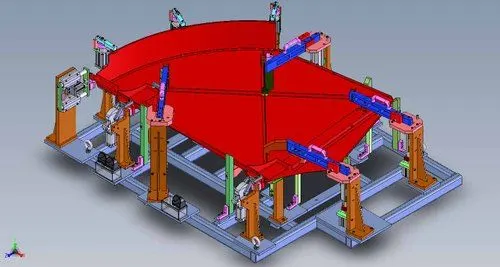
Tool stations |
|
|
|
||
|
||
|
 |
|
|
||
|
Gripper stations |
A gripper is a device that enables the holding of an object to be manipulated. The easier way to describe a gripper is to think of the human hand. Just like a hand, a gripper enables the holding, tightening, handling, and releasing of an object. A gripper is just one component of an automated system. A gripper can be attached to a robot or it can be part of a fixed automation system. | |
|
||
|
||
|
||
|
||
|
Stand station |
Stands are used to hold the part when not in use or also it is used to mount some parts or bodies on it.
|
|
|
Miscellaneous stations |
|
|
|
||
|
||
|
||
6. What are the basic terminologies used in the BIW fixture?
- NC/Mylars/Fingers = Mylars is the component which holds the panel while operation. These are placed from top side & from bottom side also. The top side Mylars called as Clamping Mylars & the bottom side Mylars called as Resting Mylars. Every clamping Mylars have resting Mylars. It dont allow deformation of the part due to welding stresses.
- Principle Locating Points (PLP) = These are the points that are used for the accurate location of the part to maintain the geometry of the There is lots of holes on the panel which are not accurate due to stamping operation. The PLP are defined in the drawing. The positional dimensions or relative dimensions are very precise in stamping & in fixtures also.
- Risers = Risers are of different types like L-typer rises, Square tube riser Riser is the manufacturing part which gives height to the assemblies.
- Blade = Blades are plates mounted on the Other parts like cylinder, arms, etc are mounted on the blade.
- Shims = Shims are the small part that comes with the thickness of 0.1mm, 0.2mm, 0.5mm, etc. These will compensate for the stackup tolerance which reflects at the panel holding part called We give tolerance to all the parts of the fixture. Due to this tolerance, the Mylars will either lift up or goes down from their defined position.
- If the Mylars go down from the defined height it will make an impression or dent on the panel. If the Mylars lift up then there will be a distorsion due to welding stress. To adjust the Mylars At its defined position we use shims so the panel won't be deformed & also don't get any impression on it.
- Rough locators = The operator can place the part in the wrong orientation The rough locator will work as a guide while placing the part in the fixture & the part will be loaded in the desired orientation. It is a part of foolproofing.
- Hardware = Hardware is like the Hex head bolts, Allen Bolts, Hex nuts, Spring washers, Self-locking nuts.
- CMM = CMM stands for coordinate measuring It is a device that measures the geometry of physical objects by sensing discrete points on the surface of the object with a probe. It generates a report by comparing the data with the CAD file data.
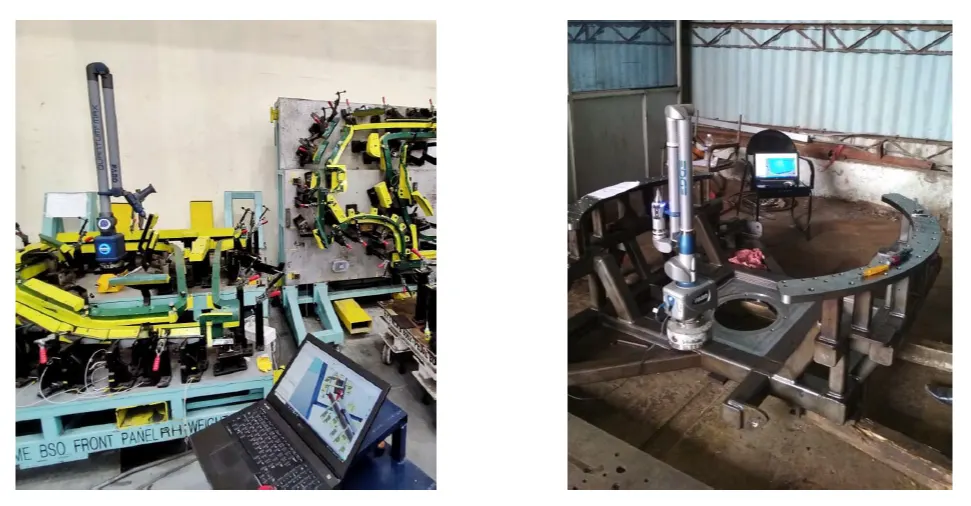
- Unit = The fixture is the assembly of different types of units to form a There are different units like pin unit, base unit, clamping unit, etc.
- Number plates = The number plate is the aluminum embossed plate placed on each unit for easily recognizing the
- Nameplate = The data like manufacturing company name, fixture type, Fixture weight is embossed on the plate & joined to the fixture.
- Clamp Arm = The clamp arm is the part of the clamp unit which moves an Over clamp arm the Mylars are mounted.
- Pivot = It is an axis about which the clamp arm will rotate.
- Class A Surface/Skin surface = The outer panels of the car like a hood, door, backdoor, fender, roof are visible to the customer. The outer panels should be aesthetically very good. No scratches or dent is acceptable over it. While designing the fixture to the skin surface the clamping material should be soft, so that it could not able to left any impression or dent over the skin. generally, nylon or PU material is used for clamping purposes.
- Reed switches & sensors = These are the electric components used in automated The reed switch is an electrical switch operated by an applied magnetic field. The detects the panel is loaded or not is done by sensors.