Week 1:- Introduction to BiW and Fixtures Challenge
Week 1:- Introduction to BiW and Fixtures Challenge
Q1. What is BIW & define its parts?
ANS:
Definition: Body in White (B.I.W.) refers to the welded sheet metal components which form the vehicles structure to which the other components will be married, i.e., engine, chassis, exterior and interior trim.
In other words, Body in White or BIW refers to the stage in automotive design or automobile manufacturing in which the car body sheet metal (including doors,hoods, and deck lids) has been assembled or designed but before the components (chassis, motor) and trim (windshields, seats, upholstery, electronics, etc.) have been added.
BODY IN WHITE (BiW): The stage in automotive design or automobile manufacturing in which the car body sheet metal components are been assembled by welding and by other joining process.
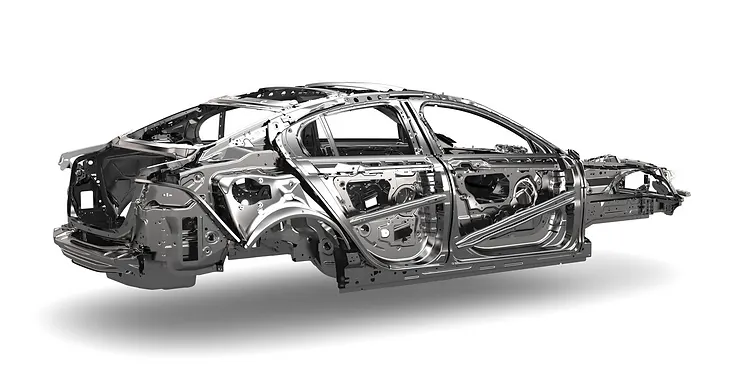
• To withstand mechanical stresses from various sources while supporting the weight of the transported passengers and cargo as well as the mechanical components needed for vehicle propulsion, control, and other system tasks.
• To minimize damage to people on the roadways (pedestrians, wheelers) in the event of a collision while maintaining the integrity of the interior of the vehicle during the impact.
This BiW is mainly differentiated into five parts, Those are:
- Body Sides
- Under Body
- Closures
- Roof
- Fender
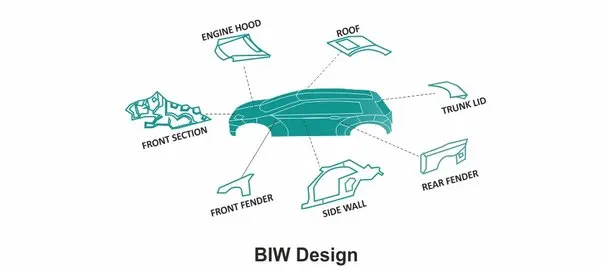
And subdivided into category wise, which can be seen in flow chart given below.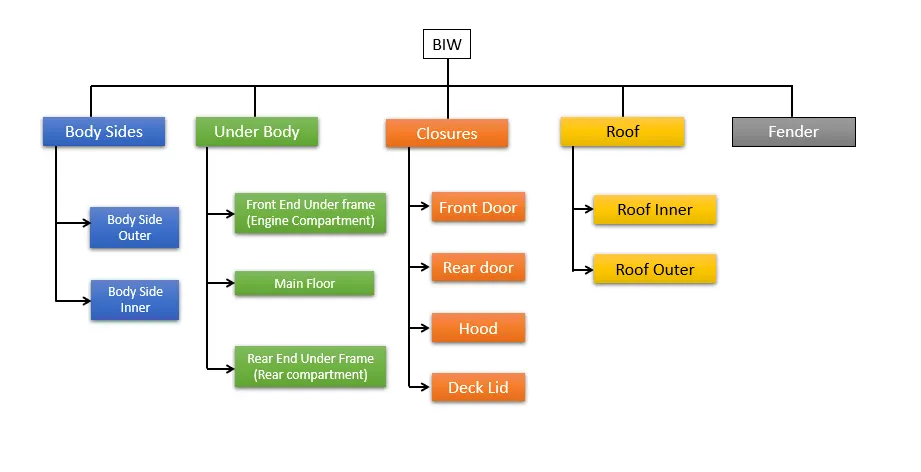
Flowchart showing BiW parts in catagory wise.
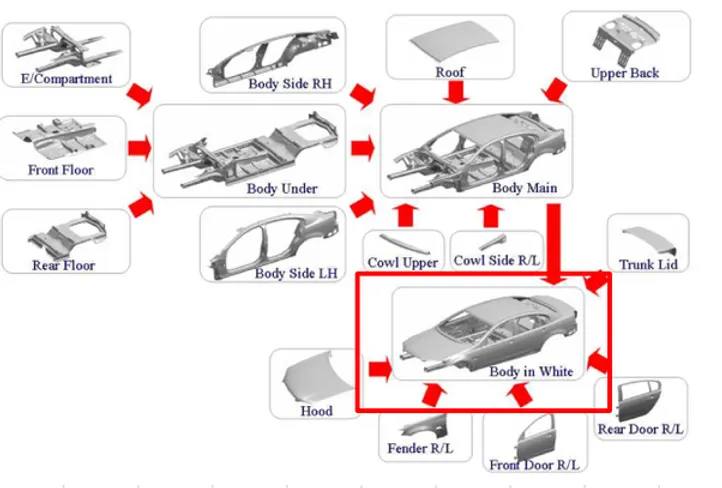
Image of BiW and its parts are shown in detail
............................
Q2. What do you understand by BIW nomenclature?
ANS:
BIW nomenclature typically refers to "Body in White" nomenclature in the context of automotive manufacturing. The term "Body in White" (BIW) refers to the stage in automotive manufacturing where the body shell of a vehicle is assembled but not yet painted or fitted with its interior components. It represents the skeletal structure of the vehicle before adding all the final elements like doors, windows, interior panels, and paint.
In BIW nomenclature, various parts and components of the vehicle's body structure are assigned specific codes or designations for identification and tracking purposes. These codes help manufacturers, engineers, and suppliers communicate effectively about the different parts and assemblies that make up the vehicle's body. BIW nomenclature is crucial in the automotive industry as it aids in managing the complexity of vehicle assembly, ensuring accurate communication between different teams, and facilitating efficient production processes. It allows for consistent documentation, quality control, and tracking of components throughout the manufacturing process.
There are two types of body structures are in use:-
- Monocoque Body or Unibody:-
- There is no separate chassis in this sort of body structure since the chassis is integrated into the BIW itself. A suspension system is used to directly attach the wheels to the vehicle. It comes with less weight and used for small vehicles only.
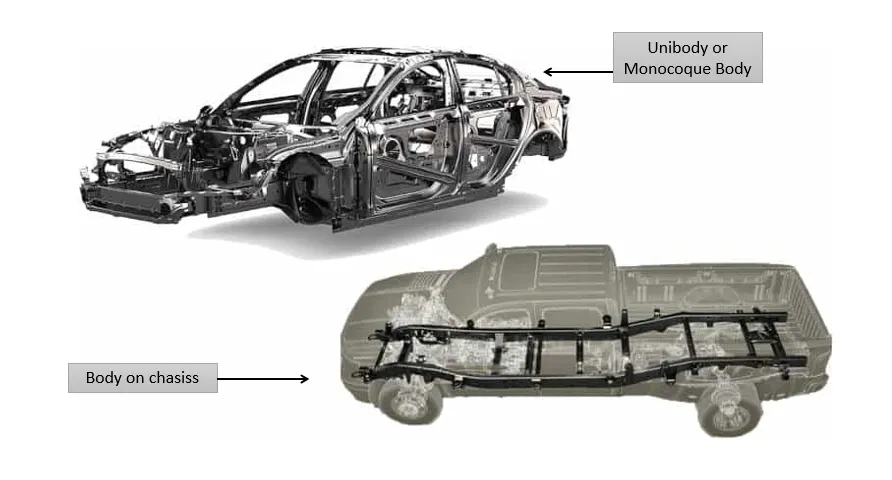
- Frame mounted body Structure:-
- The body is mounted on a separate chassis or frame with this type of body structure, and the wheels are attached to the chassis instead of the body. This type of BIW is used for heavy vehicles which contains more weight than Unibody.
This is how Body in White with nomenclature looks like
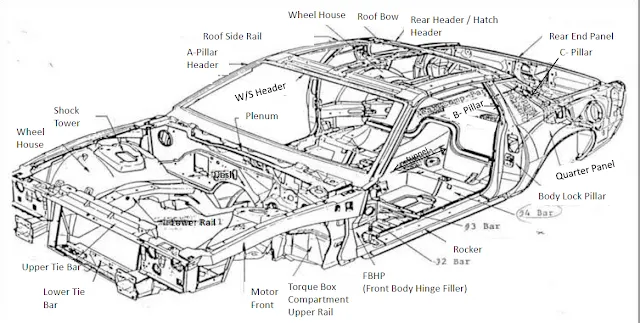
Nomenclature changes with the area, like UK uses different name compared to US
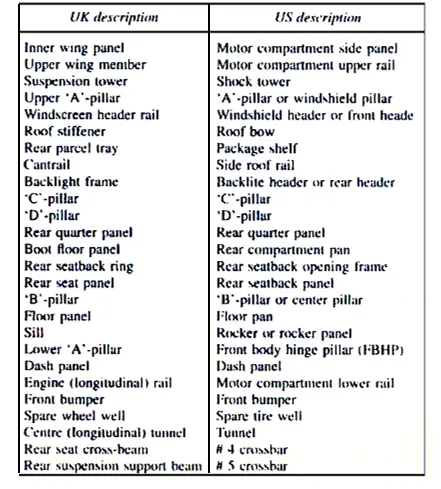
....................................
Q3. What is fixture & its types?
ANS:
Fixture: A fixture is a device which holds the work piece to processed (Welded), by using 3-2-1 principle.
In general a welding fixture (tool) consist of number of units together to hold the car panel, and is mounted on a base unit.
In manufacturing and engineering, a fixture is a specialized tool or device used to hold and support a workpiece during machining, assembly, or inspection processes. Fixtures are designed to ensure accurate and repeatable positioning of the workpiece, which is essential for achieving precise and consistent results in various manufacturing operations. Fixtures help reduce errors, increase productivity, and maintain quality standards in production processes.
Welding fixtures are normally designed to hold and support the various components (work pieces) to be welded. It is necessary to support them in a proper location which is capable of preventing distortions in work pieces during welding. For this the locating elements need to be placed carefully, clamping has to be light but firm, placement of clamping elements has to be clear of the welding area and the fixture has to be quite stable and rigid to withstand the welding stresses.
Types of fixtures:
Below are the general types of BIW fixtures:
- Production Fixtures — mass production purpose
- Pre production operation fixtures(PPO) — For initial batch production to study the feasibility.
- Checking fixtures — For car panel geometric inspection purpose.
Production Fixture: This fixture is intended for mass production.In order to retain the geometry of the pieces, it needs to operate with high consistency, which means that the materials employed must pass rigorous tests for hardness and appearance. Additionally examined is the quality for preserving the dimension and tolerance. The production fixture must be simple to maintain. After finishing a number of procedures, the fixture requires minor maintenance. The amount of time needed for assembly and disassembly should be as little as feasible to save time.
Preproduction Operations fixtures (PPO): These fixtures are created as a prototype fixture to determine whether initial batch manufacturing is feasible and to determine what needs to be changed before production begins. These fixtures can be regarded as the baseline fixtures that establish the standards and guidelines that enable us to correct any errors that may arise during preproduction operation fixtures. Numerous engineers and people with experience in the field of quality are needed for these numerous manual tasks. In comparison to production fixtures, it has a long cycle time. It takes a lot of time and money.
Checking fixture: These fixtures are used for checking, as the name implies. In this fixture, no processes like welding, gluing, or hemming are done. These fixtures use gauges to measure the components, and the tolerances part with data is compared to the design dimension to determine whether the component is working as intended or not.
Fixture images are provided below
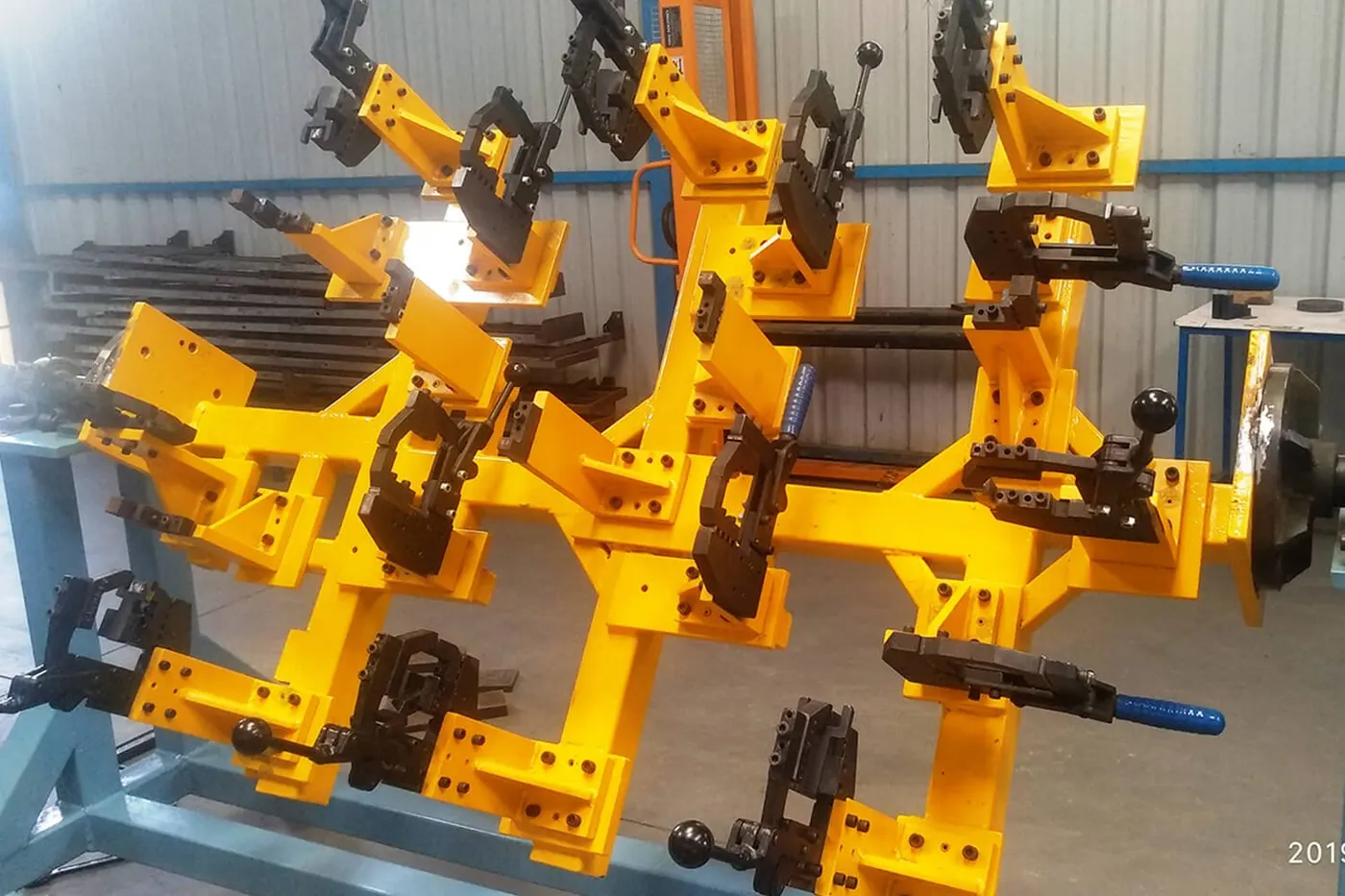
Best BIW lines Manufacturer in 2022 from Pune, India
...........................
Q4. What is the basic principle of fixture design?
ANS:
Principle of Fixture Design: For a fixture designer, the major portion of design time is spent deciding how to locate the work piece in the fixture.
For any free body there are total of twelve degrees of freedom as below:
6 translational degrees of freedom: +X, -X, +Y, -Y, +Z, -Z
And 6 rotational degrees of freedom:
- Clockwise around X axis (CROT-X)
- Anticlockwise around X axis (ACROT-X)
- Clockwise around Y axis (CROT-Y)
- Anticlockwise around Y axis (ACROT-Y)
- Clockwise around Z axis (CROT-Z)
- Anticlockwise around Z axis (ACROT-Z)
You must fix all the 12 degrees of freedom in order to locate the work piece in the fixture. So, 12 degrees of freedom of the work piece need to be fixed & thus we can achieve zero degree of freedom for the work piece.
3-2-1 Principle: The 3-2-1 principle of location, also known as the six-point positioning principle, is used to constrain the movement of a workpiece along the three axes XX, YY, and ZZ. This principle is achieved by providing six locating points, including three pins in the base plate, two pins in the vertical plane, and one pin in a plane perpendicular to the first two planes.1 The principle states that the workpiece has six degrees of freedom in space, and six locators are sufficient to restrict the required degree of freedom of any workpiece. A three-pin base can restrict five motions, while six pins restrict nine motions.
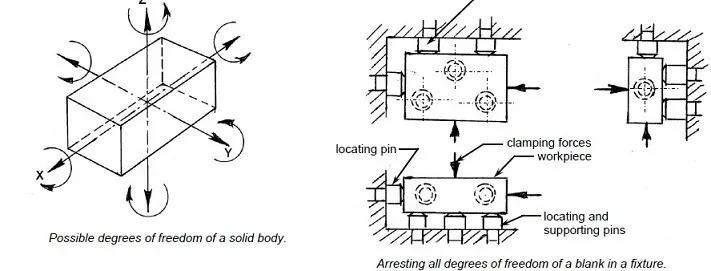
The basic principle of fixture design revolves around ensuring that a workpiece is securely and accurately positioned during various manufacturing operations, such as machining, assembly, welding, or inspection. The ultimate goal is to achieve consistency, precision, and efficiency in the production process. Here are the key principles that guide fixture design:
- Accurate positioning for precision.
- Stability and rigidity to resist forces.
- Easy loading/unloading for efficiency.
- Repeatable clamping ensures consistency.
- Access to operation areas, no interference.
- Ergonomics reduce operator strain.
- Modularity/versatility for various workpieces.
- Durable, stable material selection.
- Cost-effectiveness in design and production.
- Clear alignment, datum points for reference.
- Proper documentation for manufacturing and maintenance.
.....................................
Q5. Elaborate types of BIW Stations?
ANS:
The assembly line is, in where the different types of panels are joined together in each specified zones.
Each panel categories will have individual zones As under bod zone Doors zone Hood zone etc.
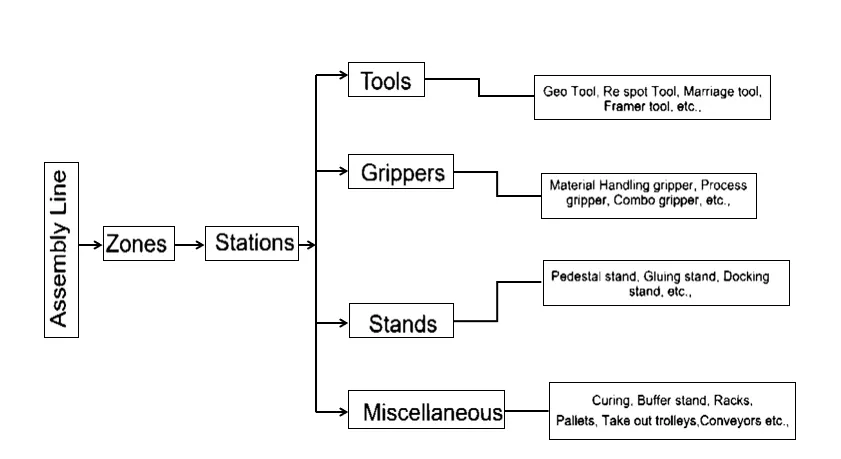
Body in White (BIW) stations are crucial locations in the production of automobiles where the different parts of the body structure are put together. When assembling the body shell of a vehicle before painting and final assembly, these stations are vital to the process. Different BIW stations are made to handle particular components and duties. Here are a few typical BIW station types:
- Tools
- Grippers
- Stands
- Miscellaneous
Tool: A tool is a fixture which consist of number of units together to hold a car part in general.
Types of tools:
Geo Tool: A geo tool is a fixture in which the geometry of the panels which are welded together is defined accurately. The pin tolerance for a geo pin will be of closer tolerance i.e. -
0.15 in general.
For example: Consider anel hole size 20mm, the in diameter should be 19.85
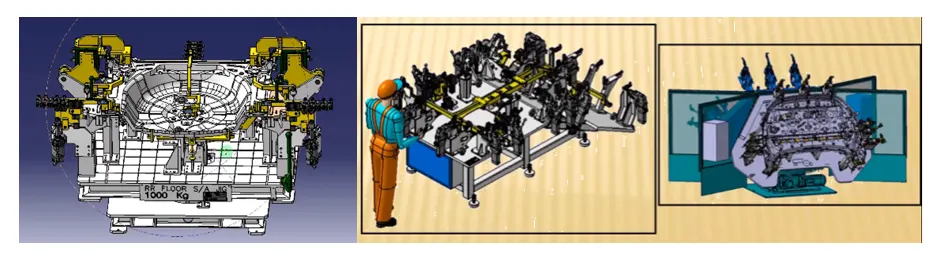
Image of Geo-Station
Re-spot Tool: A re-spot tool is a fixture in which the remaining weld spots which are not achieved in geo tool are welded for the pre welded panel from the geo tool. The pin tolerance for a re-spot pin will be of tolerance with -0.28 in general.
For example: Consider panel hole size 20mm, the pin diameter should be 19.72
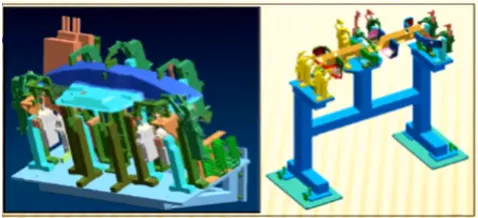
Image of Re-Spot Stations
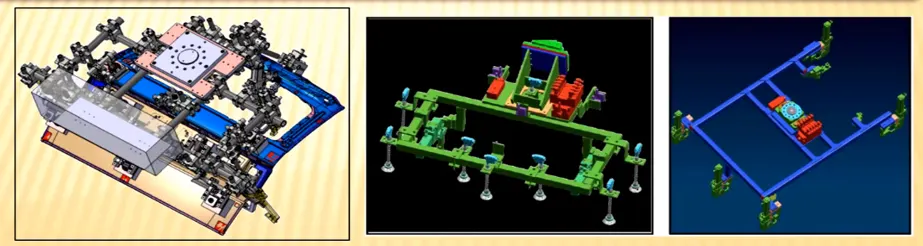
Marriage or Hemming Tool: A marriage or a hemming tool is a fixture in which the inner panel assembly and outer panel assembly are joined together. These are done by welding or by hemming in case of closure panels.
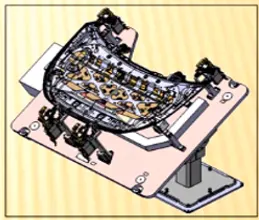
Image of Hemming Station
Checking Stations: A Checking Station tool is a fixture which is used to check the automotive parts or assemblies, ensuring all the coordinates, relative dimensions & positions as per the
tolerances. A checking station can be a gauge type, fixed type and automated checking fixtures. A Checking gauge is a tool where work piece is hold & various measuring gauges are introduced to ensure the dimensions & repeatability.
A fixed type checking fixture is used where the work piece is fixed with clamps & pins & a CMM (Coordinate Measuring Machine) is used which measures the coordinates of different points of the panel or assembly, compares it with the nominal values & gives a report.
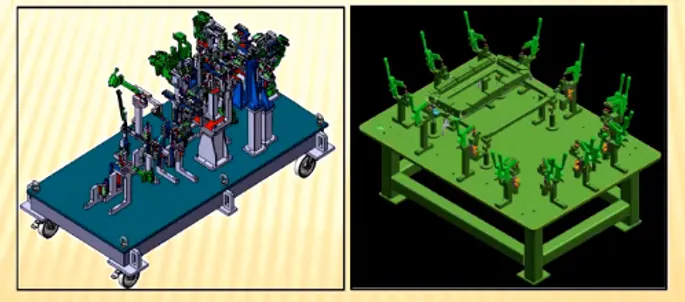
Image of Checking Stations
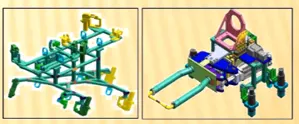
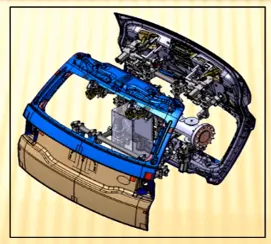
Gripper: A Gripper is a device or a fixture which holds the car panel, and is fixed to the manipulating end of a robot or an end effector. Also know as EOAT — End Of Arm Tooling.
Types of Grippers:
- Material Handling Gripper (MH): Material Handling gripper are designed for handling the car panel from one tool(Station) to other tool(Station)
- Process Gripper: Process gripper are designed for handling the car panel from one tool(Station) to other tool(Station), And in addition to that it under goes process like pedestal welding, pedestal riveting, Gluing, sealing, etc.,
- Combo Gripper: Combo gripper are designed for handling the car panel from one tool(Station) to other tool(Station), Also with combination of weld gun at another side of the Gripper for welding.
Gripper + Weld Gun - Dual Gripper: Dual gripper are designed for handling the car panel from one tool(Station) to other tool(Station), With two sided gripper.
Gripper + Gripper
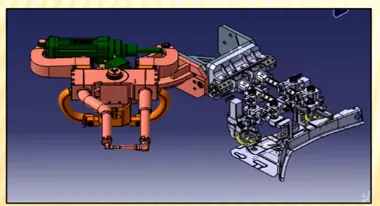
Stands and types of stands
-
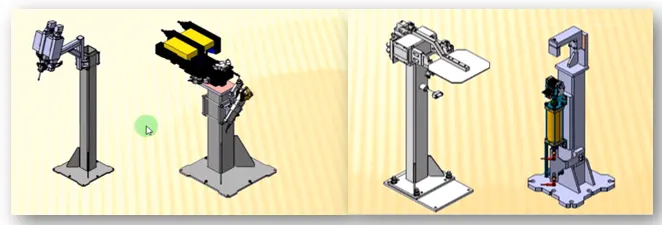
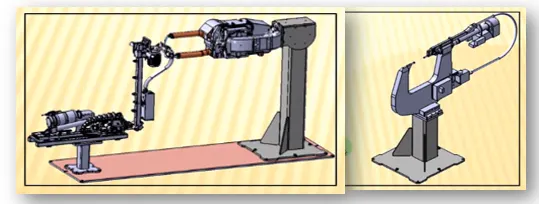
- Gluing and sealer stand: Gluing gun or sealer gun is fixed to a welded or a standard stand which is grouted to the floor permenantly.
- Docking stand: When robots are selected for multi tasking like material handling & welding , which cannot carry both due to some limitations ( pay load capacity of the robot or space constraint) the robot will drop and pick the gripper or gun after completing the respective operation with the help of Docking stands.
- Date stamp stand: The panel will get the date embossed on to it, with the date stamping device mounted on this date stamp stand.
- Pedestal gun stand: Weld gun is mounted to a fixed stand which is grouted to the floor permanently, Where the process gripper carries the car panel to weld the spot with this fixed weld gun.
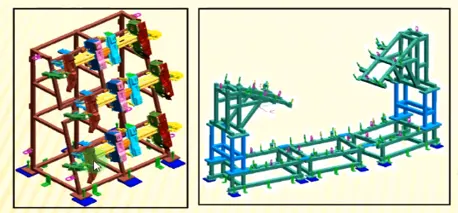
Buffer Storages: Buffer storages are temporary holding areas used to manage production flow and accommodate fluctuations in demand.
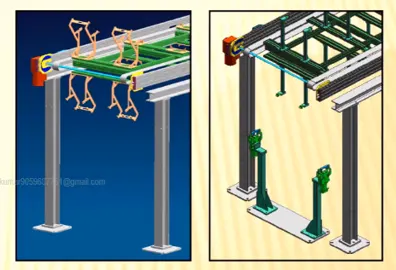
Conveyor Belts: Conveyor belts are mechanized systems used to transport materials or products efficiently within a manufacturing or logistics environment.
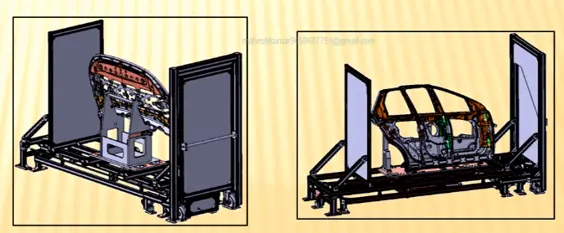
Take out Trolley: Take out trolley is used to take the car panel out of the robotic working cell between the cycle for inspection purpose.
....................................
Q6. What are the basic terminologies used in the BIW fixture?
ANS:
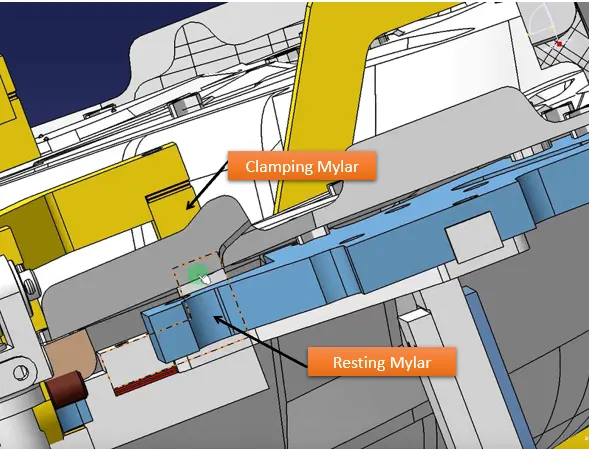
- NC/MYLARS/FINGERS : Mylars are the part that keeps the panel in place; they are positioned from both the top and bottom. Mylars are divided into two types: clamping mylars on the top and resting mylars on the bottom.There are resting mylars on every clamping mylar.It prevents the part from deforming as a result of welding forces.
- PLP - Pinciple Locating Points : There are several holes on the panel that are not exact as a result of the stamping procedure, and these points are employed for the accurate location of the part to maintain the geometry of the panel. In the drawing, the PLP's are described. Both in stamping and in fixtures, the positional or relative measurements are quite accurate.
- BLADE : Blades are plates which connects external components like cylinders, arms, etc. attached to risers.
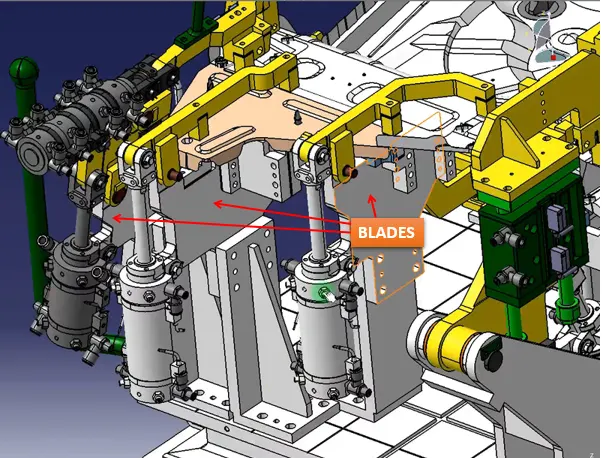
- RISERS: A riser in BIW fixtures is a raised platform that elevates a workpiece to provide better access for manufacturing or assembly operations.
- SHIMS: a collection of thin plates with a maximum thickness of 0.5mm. Shims placed between mylers and pin units help reduce dimensional errors brought on by stacking tolerance and plate wear.
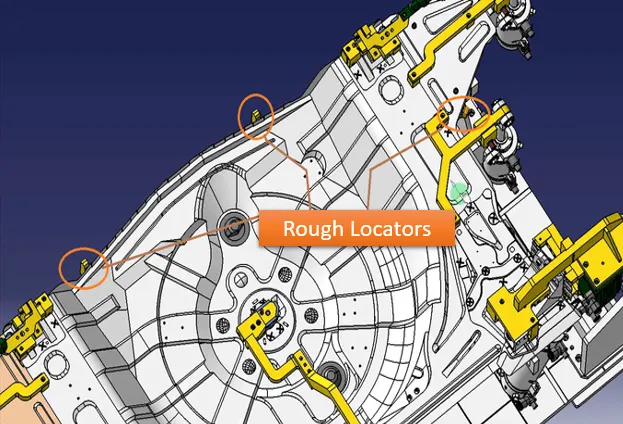
- ROUGH LOCATORS: The part may be positioned incorrectly by the operator. The part will be loaded in the desired orientation and the rough locator will serve as a guide while putting the part in the fixture. This is a guide used in manual fixtures to roughly locate a panel on fixtures.
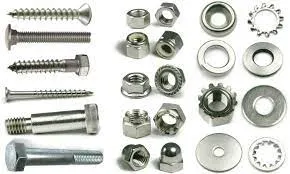
- HARDWARES: Hardware is like Hex head bolts,allen bolts,Hex nuts,Spring washers,Self-locking nuts.
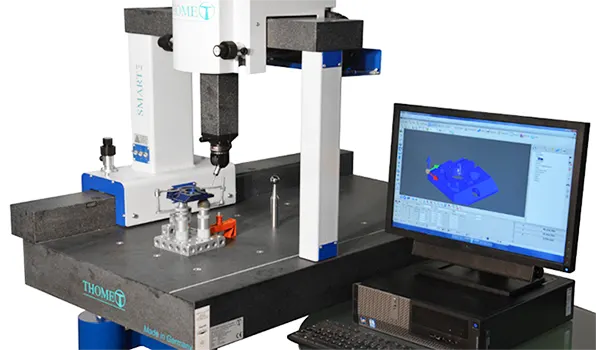
- CMM: CMM stands for Co-ordinate Measuring Machine. It is a tool for measuring the geometry of real-world objects by using a probe to detect specific locations on their surface. By comparing the data with the data in the CAD file, it generates a report.
- UNITS: The fixture is a combination of many various types of units, such as pin units, base units, clamping units, and others, to create a particular unit.
- NUMBER PLATE: Each unit has a number plate made of an embossed aluminum plate for easy recognition.
- CO-ORDINATE PLATE: On the base unit, there is a master hole or reference hole from which all other coordinates in the CMM are measured. To guard against damage, a coordinate plate has been placed over these holes.
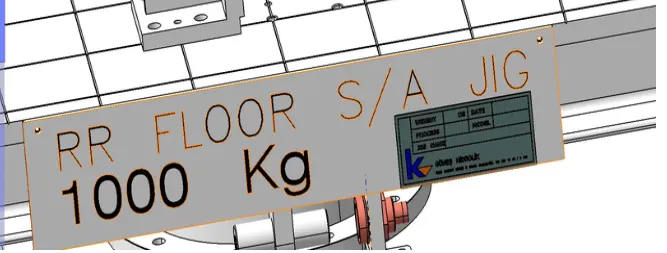
- NAME PLATE: A plate fixed to the Base unit's exposed front. The Nameplate contains basic information such the Company name, Panel Name, and Fixture Type.
- CLAMP ARM: The component of the clamp unit that slides over the clamp on which the mylars are placed is called the clamp arm.
- PlVOT: To fix and unfix the part, the clamp arm will spin around this axis.
- CLASS 'A SURFACE/SKIN SURFACE: The customer may see the car's exterior components, including the hood, doors, backdoor, fenders, and roof. The aesthetic quality of the outside panels should be good. It cannot have any dents or scratches on it. The clamping material should be soft when tailoring the fixture to the skin's surface so that it won't leave any marks or dents on the skin. For clamping purposes, nylon or PU material is typically employed.
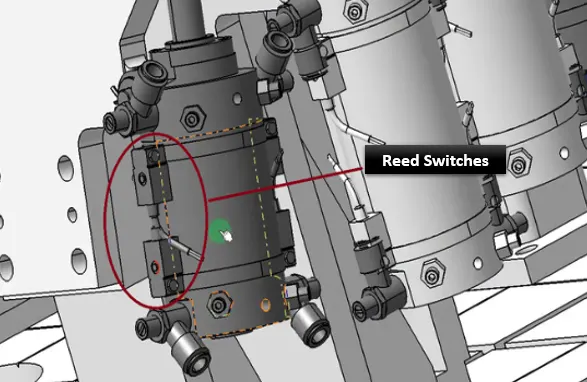
- REED SWTCHES: For use in making next process decisions, an electromagnetic switch installed on the cylinder measures the position of the cylinder's pistons.
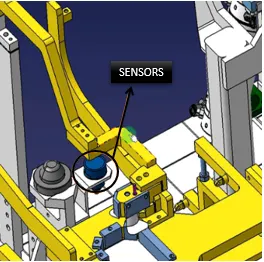
- SENSORS: It's an electronic device hidden behind panels that mounts a fixture. It transmits the signals to continue with the procedure after determining whether the panel is loaded in a fixture. Fixtures use a variety of sensors, including photovoltaic and proximity sensors, among others.
..................................