Week 1:- Introduction to BiW and Fixtures Challenge
Q1: What is BIW & define its parts?
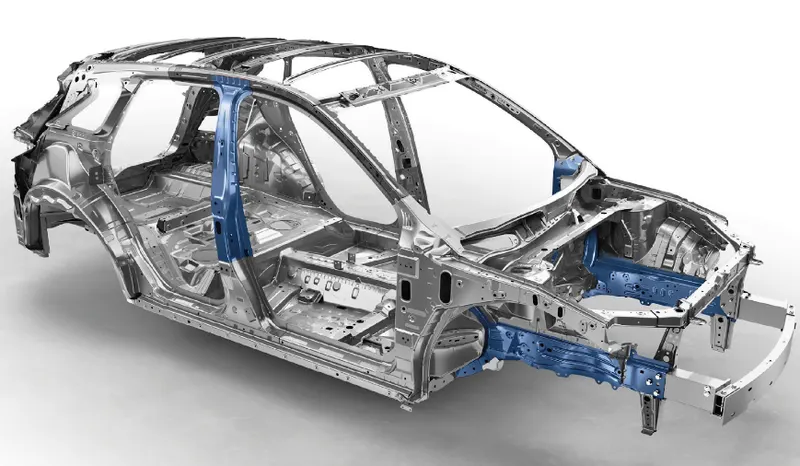
Answer: BIW means Body in White. It is a stage in automotive design or automobile manufacturing in which car body sheet metal components have been welded together to form vehicle structure or more like body shell.
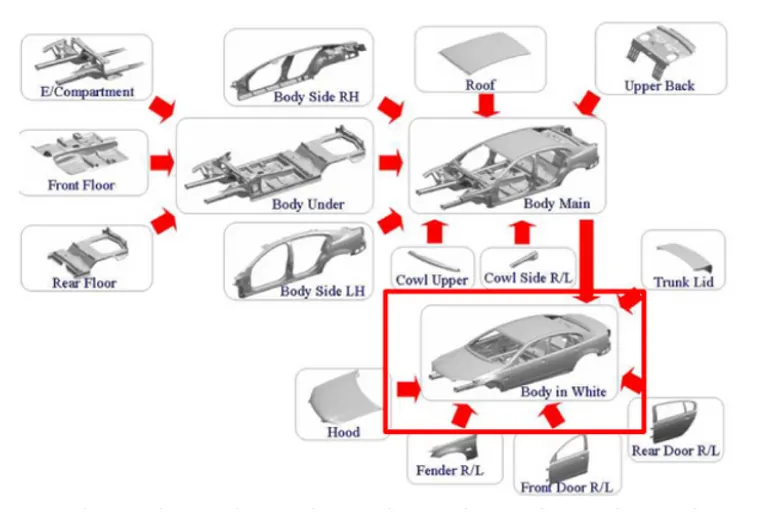
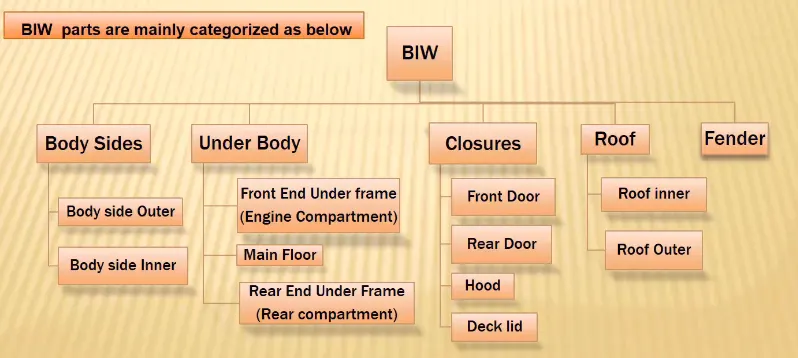
To create the welded metal shell known as the Body in White, sub-assemblies such as the Under Body, Body side Left Hand Side/ Right Hand Side, Front End, Roof, etc. are joined together using a variety of metal joining processes, such as resistance spot welding, Laser welding, and MIG welding.
BIW parts:
Engine Compartment: It is BIW part in which engine, battery etc, are mounted. This comprtment is then covered by the hood/bonet.
Body Side RH: It is the right hand side of the body where front door, rear door, and fender are mounted.
Roof: The upper portion of the body which covers the passengers and driver from the top from environmental factors. The roof consists of roof rails and bow roofs to provide extra strength to the roof structure.
Front Floor: As the name suggests, it is the front portion of the floor in the body. Since the chasis in BIW is integrated as one piece frame, front floor is thr front portion of the same.
Rear Floor: Back portion of the floor.
Upper Back: It is on the back of the body where backdoor/tailgate is mounted upon.
Q2. What do you understand by BIW nomenclature?
BIW stands for Body in White
The phrase "body in white" gets its name from the way an automobile body appears after being submerged in a white primer (undercoat paint) bath, despite the primer's real grey hue.
Q3. What is fixture and its types?
Answer: A fixture is a tool for supporting or holding work in the manufacturing sector. Fixtures are used to locate (securely position in a particular location or orientation) and support the work, guaranteeing that all parts produced using the fixture will preserve conformance and interchangeability. Utilizing a fixture increases production efficiency by facilitating rapid and easy transitions from one part to the next, lowering the need for skilled labour by streamlining the mounting of workpieces, and enhancing uniformity throughout a production run.
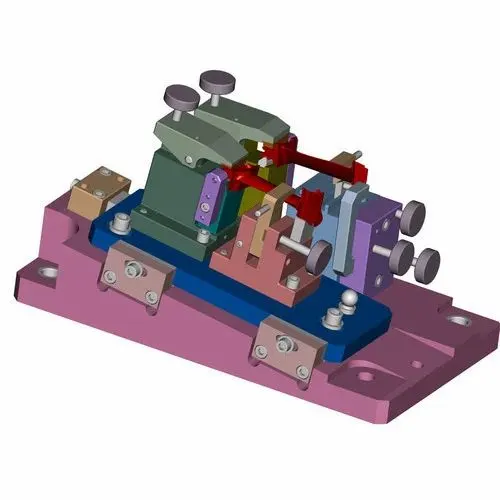
In BIW, fixtures are of following types:
1. Production Fixtures: These fixtures are used for mass sproduction purpose in an industry.
2. Pre-production operation fixtures: This fixture is used to study the feasibility by running initial batch.
3. Checking fixtures: This fixture is used to measure car geometric dimensions and tolerances.
Q4. What is the basic principle of fixture design?
Answer: The main concern for a fixture designer is to locate the workpiece in a fixture.
For a free body there are total 12 degrees of freedom, 6 translational degrees of freedom and 6 rotational degrees of freedom. To locate the workpiece in a fixture, one needs to restrict all the the 12 degrees of freedom.
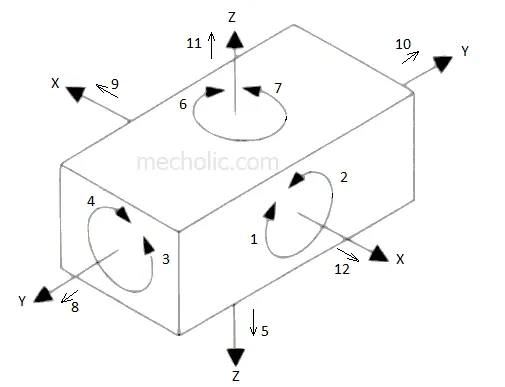
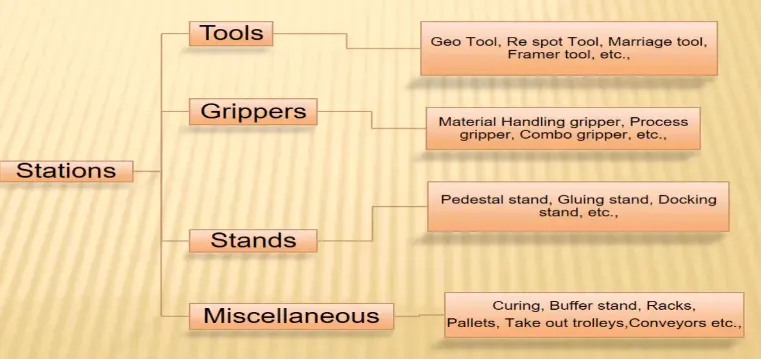
Q5. Elaborate types of BIW stations.
Answer:
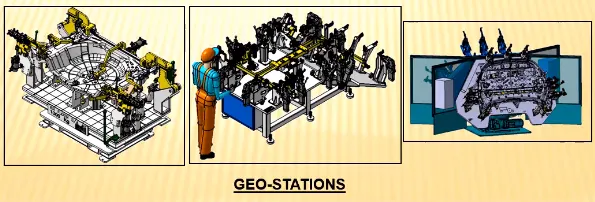
Geo Station:
All of the components that will be assembled in the Geo setup are being tack welded. According to standard Geo fixture specifications, every component must be located using two locating pins. To join two or more parts together, use a pin. All machine parts in the case of a Geo fixture should have a maximum tolerance of 0.02 mm, and pin positioning precision should be 0.1 mm. Spot/MIG welding is carried out in Geo fixtures in a way that ensures it will obtain the required accuracy after being removed from the fixture and won't be disturbed while being transported from one Geo fixture to another. The geo fixture regulates the accuracy of the sub assembly along all three axes.
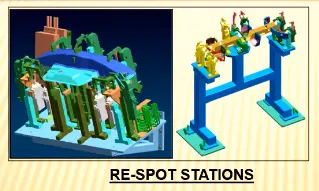
Re-Spot Station:
A re-spot is a fixture in which the remaining weld spots which are not achieved at the geo station are welded for the pre-welded panel from geo station. The pin tolerance for re-spot position is -0.28mm generally.
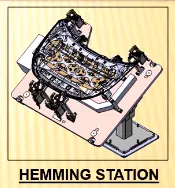
Hemming Station:
This is also known as marriage station. In this station, outer and inner panel assemblies are assembled together by hemming process.
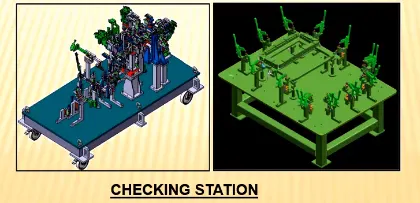
Checking Station:
A checking station tool is a fixture used to ensure that all coordinates, relative measurements, and locations are within tolerances while checking automotive parts or assemblies. A checking station might be an automatic checking fixture, a fixed type, or a gauge type. A checking gauge is a device used to hold the work piece while multiple measuring gauges are used to check its dimensions and repeatability. The work piece is fixed with clamps and pins in a fixed type checking fixture, and a CMM machine is used to measure the coordinates of various places on the panel or assembly, compare them to the nominal values, and provide a report.
Gripper: A gripper is a tool or fixture that is attached to the manipulating end of a robot or end effector and holds the automobile panel in place. Also referred to as EOAT, or end-of-arm tooling
Types of Grippers:
Material Handling Gripper (MH): Material Handling gripper are designed for handling the car panel from one tool(Station) to other tool(Station).
Process Gripper: Process grippers are made to move automobile panels from one tool (Station) to another while also undergoing processes like pedestal welding and pedestal riveting. sealing, glueing, etc.
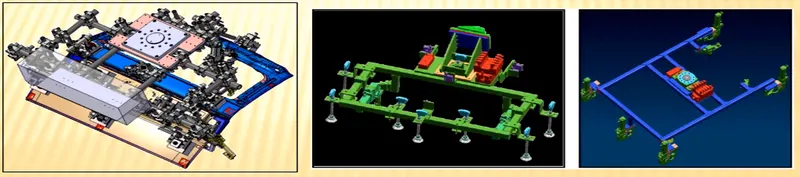

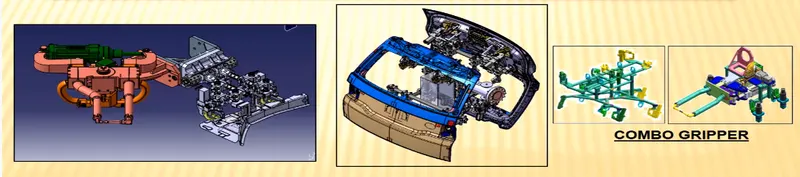
Combo Gripper:
Combo grippers are made to move automobile panels from one tool (Station) to another tool (Station), as well as to combine a welding gun on the opposite side of the gripper.
Gripper + Weld Gun
Dual Gripper:
With two sided grippers, dual grippers are intended to handle the car panel from one tool (Station) to another tool (Station).
Gripper + Gripper
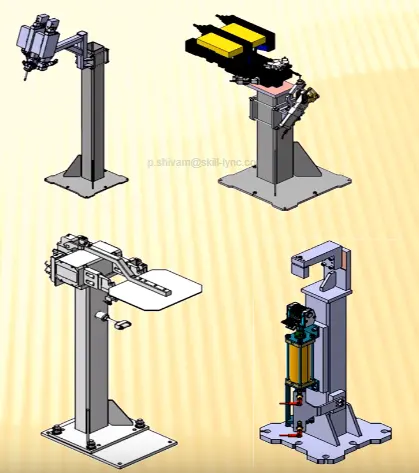
Stands and types of stands
Gluing and sealer stand:
A standard or welded stand that is permanently grouted to the floor supports a glue or sealant gun.
Docking stand: The robot will drop and pick the gripper or gun after finishing the appropriate operation with the aid of Docking stands when robots are used for multitasking like material handling & welding, which cannot carry both owing to some constraints (pay load capacity of the robot or space constraint).
Date stamp stand: With the date stamping device set on this date stamp stand, the panel will have the date embossed onto it.
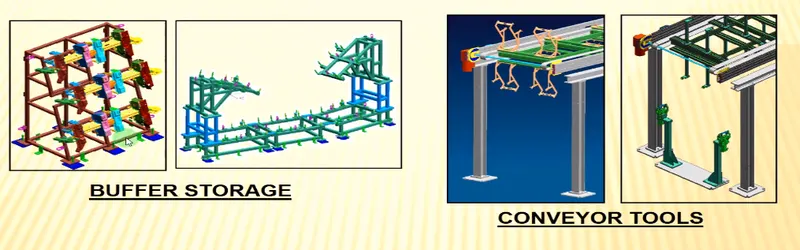
Buffer Station:
Production processes function more smoothly with the help of buffer storage. In buffer storage areas or systems, items that will be required for manufacture or orders are temporarily kept. In buffer storage, there are typically no designated storage locations for certain items. Buffer storage facilities are commonly placed close to shipping and receiving ports, as well as in the spaces between two production zones along manufacturing lines, to assist seamless processes.
Conveyor Tool Station:
It is used for transporting parts/assemblies via a conveyor belt. This belt would have different station for respecvtive stops.
Q6. What are the basic terminologies used in BIW fixtures?
Answer:
- NC/MYLARS/FINGERS: MYLAR resembles a block that contacts the panel and clamps or holds it in place. Mylars are always intended in the motor industry. Mylar is also known as NC (Numerically Controlled) Block.
- PIN: The circular movement of the panel is held in place by pins. Round pins and diamond pins are the two main types of pins. Depending on the pin's angle in relation to the carline, pins can move in two or three directions.
- BLADE:The Blade connects the Riser and the Clamp cylinder with a plate. This plate is essential to the unit's construction.
- L BLOCK:A plate in the shape of a L is known as a L block. This component acts as a bridge between Blade and Mylar. Shimming frequently uses L blocks to supply it.
- PIN BOCK:Pin Block is also known as a pin retainer. The pin is secured by this block, which also stops it from turning. There are also made pin blocks and ordinary pin blocks available.
- RISER: The part that is fastened to the base plate and supports a clamp or pin cylinder on it is called the riser. Depending on the project, the riser could be a regular component or a specially built component.
- WELDMENT: The act of fusing two or more components together is known as welding. The general rule for welding is to leave 5 mm of space between each plate to allow for welding.
- Principal Locating Points (PLP):The locations on the fixture where the car panels will be placed are known as PLPs. The welding fixture has locating elements that let the user put the car panels onto the fixture correctly and in the right orientation.
- SHIMS: A shim is a tiny piece of material that is typically wedged or tapered and used to fill tiny gaps or holes between objects. Shims are frequently employed to provide stability, make adjustments for better fit, or level a surface. Shims can be used as spacers between brittle pieces as well.
- ROUGH LOCATORS: In the automation process, rough locators are utilised to find workpieces. When a person, group, or robot is working on a workpiece, "locating" refers to where you want the workpiece to be. It is a device for setting up and retaining a part's position in a fixture or jig.
- PIVOT:A mechanism's central point, pin, or shaft on which it rotates or oscillates.
- CLAMP ARM: It is a part of clamp unit which moves over a particular axis.
- NUMBER PLATE: It is a plate attached to each unit with a unique number on it to recognise the unit.
- REED SWITCHES & SENSORS: A reed switch, an electromagnetic switch, regulates the flow of electricity in a circuit. Two or more ferrous reeds enclosed inside a tiny glass tube-like envelope become magnetised and move together or apart when a magnetic field is directed towards the switch. To establish whether the panel is loaded or not, sensors are used.
- CLASS-A SURFACE:Class-A (sometimes known as 'Strak') is a term used in the automotive industry. It specifies the final manufacturing surface data for the car's cosmetic components.