Week 1:- Introduction to BiW and Fixtures Challenge
1. Body In White (BIW): The stage in automobile design or automotive manufacturing in which the car body sheet metal components are been assembled by welding and by other joining process.
BIW parts are mainly catagorised as below:
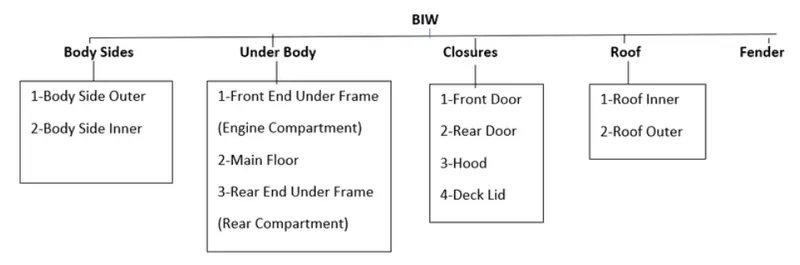
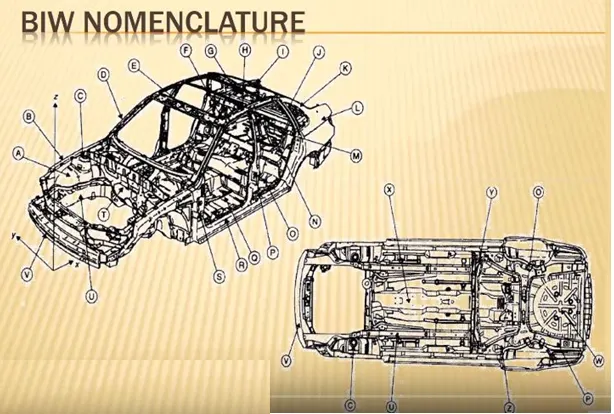
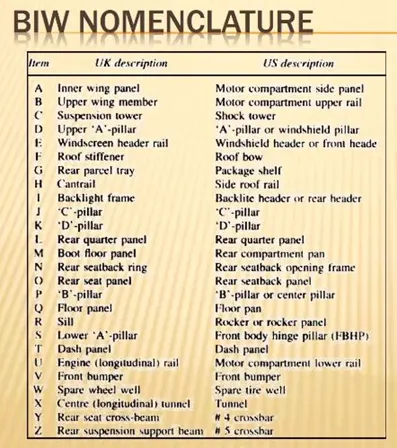
2. BIW Nomenclature:
3. Fixture: A fixture is a device which holds the work piece to be processed (welded), by using 3-2-1 principle.
In general a welding fixture (tool) consists of number of units together to hold the car panel and is mounted on a a base unit.
Welding fixtures are normaly designed to hold and support the various components (work piece) to be welded. It is necessary to support them in a proper location which is capable of preventing distortions in work piece during welding. For this the locationg elements to be placed carefully. clamping has to be light but firm, placement of clamping elements has to be clear of the welding area and the fixture has to be quite stable and rigid to withstand the welding stresses.
Types of Fixtures:
Below are the general types of BIW Fixtures:
- Production Fixture: mass production purpose
- Pre production operation fixture (PPO): for initiaal batch production to study the feasibility
- Checking fixture: For car panel geometric inspection purpose.
4. Basic Principle of fixture design:
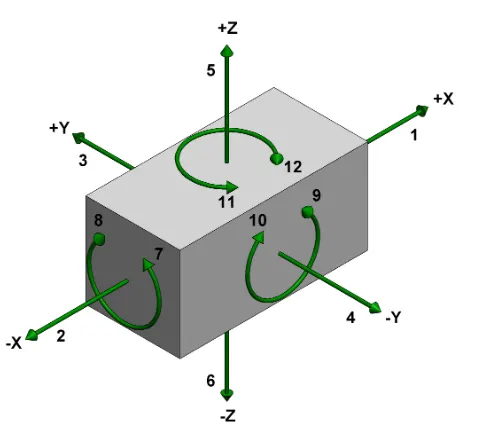
For a fixture designer, the major portion of design time is spent deciding how to locate the work piece in the fixture.
You know that any free body has a total of twelve degrees of freedom as below:
6 translational degrees of freedom**: +X, -X, +Y, -Y, +Z, -Z
And 6 rotational degrees of freedom:
- Clockwise around X axis (CROT-X)
- Anticlockwise around X axis (ACROT-X)
- Clockwise around Y axis (CROT-Y)
- Anticlockwise around Y axis (ACROT-Y)
- Clockwise around Z axis (CROT-Z)
- Anticlockwise around Z axis (ACROT-Z)
All the 12 degrees of freedom must be fixed in order to locate the work piece in the fixture.
5. Types of BIW stations:
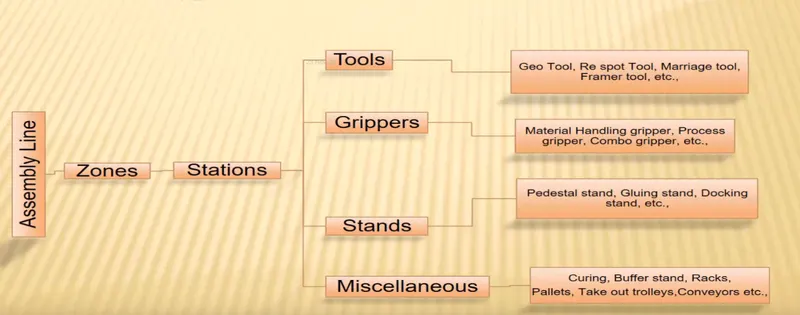
6. Basic terminologies used in BIW fixture:
- NC/Mylars/Fingers : Mylar are the components which hold the panel while operation is going on. These are placed from top side and from bottom side. The top side are called clamping mylars whereas bottom side are called resting mylars. Mylars don’t allow deformation of the part due to welding stresses.
- Principal Locating Point (PLP): These are the points which are used for the accurate location of the part to maintain the geometry of the assembly. There are lots of holes on the panel which are not accurate due to stamping operation. The PLP are defined in the drawing. The positional dimensions or relative dimensions are very precise in stamping and in fixtures also.
- Risers: Risers are of different type like L-type risers, square tube riser etc. Riser is the manufacturing part which gives height to the assemblies.
- Blade: Blades are the plates mounted on the riser. Other parts like cylinder, arms are mounted on the blade.
- Shims: Shims are the small parts which come with the thickness of 0.1mm, 0.2mm, 0.5mm, etc. These will compensate the stack up tolerance which reflects at the panel holding part called Mylars. We give tolerance to all parts of the fixture. Due to these tolerances, mylars will either lift up or goes down from its defined height and will make impression or dent on the panel. So, to adjust mylars at proper position shims are used.
- Rough locators: The operator can place the part in wrong orientation by mistake. The rough locator will work as guide while placing the part in the fixture and the part will be loaded in desired orientation.
- Hardware’s: Hardware’s are Hex head bolts, Allen bolts, Hex nuts, spring washers etc used in BIW fixtures.
- CMM: CMM stands for coordinate measuring machine. It is a device that measures the geometry of physical objects by sensing discrete points on the surface of the object with a probe. The generated report is then compared with the CAD data.
- Unit: The fixture is the assembly of different types of units to form fixture. There are different units like pin unit, base unit, clamping unit etc.
- Number plates: Number plate is the aluminium embossed plate on each unit for easy recognition of unit. Name plate: The data like manufacturing company name, fixture type, fixture weight etc is embossed on the plate and joined to the fixture.
- Clamp Arm : Clamp arm is the part of the clamp unit which moves over an axis. Mylars are mounted on clamp arm.
- Pivot: It is an axis about which the clamp arm will rotate.
- Class A surface/Skin surface: The outer panels of the car like hood, door, fender, roof, etc. are visible to the customer. These should be aesthetically good and should not be damaged or scratched in fixtures. These are called Class A or Skin surfaces.
- Reed Switches and sensors: These are electric components used in automated fixtures. The reed switch is an electrical switch operated by an applied magnetic field. These detects if panels are loaded or not by using sensors.