Week 1 : Exploring the GUI of GT-POWER
1.Ans-
There are different modules available in the GT-Power software. The list of modules are as follows:-
a)Engine Performance and Acoustics:-
- This includes SI and CI ignition systems. With the help of this we can model the engine with the multiple features.
- Each engine can analyse by predictive and non-predictive modes.
- By the post-processing we can get the results based on our inlet parameters, with the help of it we can analyse the different parameters of engine.
- GT-SUITE is able to analyze a signal in the time domain by transforming it to the frequency
domain. - Also with the help of it we can calculate the frequency response of various systems in the frequency
domain.
b)Exhaust Aftertreatment:-
- GT-SUITE can model numerous exhaust aftertreatment components and complete
aftertreatment systems. - The methodology is highly flexible and gives the user complete control over the reaction kinetics being used.
- The kinetics are NOT hard-wired, nor do they require the user to modify user subroutines or use a compiler.
- The kinetics are user-defined via an intuitive Graphical User Interface(GUI).
c)Cooling Systems and Thermal Management:-
- GT-SUITE is an advanced code for design and analysis of engine thermal management systems that has been specifically designed to handle this wide range of heat management issues and disciplines.
- It can be used to integrate all of the activities related to heat management to meet design objectives such as engine durability, emissions, fast warm-up, passenger cabin heating, component sizing and specification, and system control.
- It is based on one-dimensional fluid dynamics.
- It representing the flow and heat transfer in the piping and in the other components of a cooling system.
d)Air Conditioning/Waste Heat Recovery:-
- GT-SUITE is a multi-disciplinary tool that can use in the development of such systems by accurately predicting the behavior of such system in different stages of design.
- GT-SUITE is based on one-dimensional fluid dynamics, representing the flow and heat transfer in the
piping and in the other components of a two phase system. - Several parallel fluid circuits can be modeled simultaneously, each containing a different fluid.
- These circuits interact through heat exchangers, transferring heat from one circuit to another, which allows the calculation of the overall heat balance in the system
e)Fuel Injection:-
- This module focus on the application of GT-SUITE for modeling fuel injection and general hydraulic components and systems.
- It is able to model the coupled behavior of hydraulic and mechanical components.
- In the case of fuel systems, it is applicable to any diesel or gasoline system, including both common rail and unit pump systems.
- Alternative fuels can also be handled.
- GT-SUITE has been designed to study steady-state and transient system response.
- Flow and heat transfer in the piping and volumes can be modeled, as well as mass dynamics, and the combined interaction of the mechanical and hydraulic systems.
- The flow solver includes models for cavitation, frequency dependent friction, species transport, and non-equilibrium aeration everywhere in the system.
- Detailed injector models can also be integrated with engine models for predictive combustion.
f)Hydraulics and Pneumatics:-
- GT-SUITE can be used to model any type of hydraulic or fuel system pump including low and high pressure pumps.
- The modeling capability ranges from simply imposing the performance characteristics to predicting the performance based on pump geometry and mechanics.
- For system level models including the low and high pressure systems, the low pressure pump is
commonly modeled with a simple pump model. - If modeling only the high pressure system of a common rail injection system, the high pressure pump may be modeled simply as a constant or known pressure in an 'EndEnvironment'or as a flow rate source through 'EndFlowInlet' or 'PumpFlow.
g)Lubrication Circuits:-
- GT-SUITE is a great tool for modeling engine lubrication systems, using a compressible 1-D CFD solution that solves for mass, momentum, energy and species.
- The primary purpose of modeling a lubrication system is to predict flow rate and pressure distribution throughout the system.
- Other studies can be performed as well, including priming, studying resonance, and pump dynamics.
- Also, lubrication system model can be integrated into a cooling system model to study the complete thermal behavior of the engine.
- All major components of a lubrication system can be modeled in GT-SUITE, including predictive models for bearings, heat exchangers, Hydroulic Latch Assemly's, chain tensioners, piston cooling jets,
cam phasers, and relief valves. - Flow losses can also be easily imposed to model components such as an oil filter.
- Minor losses are also accounted for including losses from pipe friction, bends, sudden contractions/expansions, and flowsplits.
h)Vehicle and HEV Fuel Economy & Performance:-
- The GT-SUITE Vehicle Library provides users with a set of standard driveline components and connections that can be used to construct various driveline layouts and configurations.
- There are only a few areas where the layout is fixed.
- The basic and default simulation mode for a vehicle and driveline model in GT-SUITE is dynamic.
- In this mode the states of the engine, driveline and vehicle respond to mechanical power addition from sources such as an engine or electric motor, and power losses to “sinks” such as aerodynamics and rolling resistance, brakes, other component friction and generators.
i)Transmission and Shift Quality:-
- Geartrain, chain or belt drive systems transfer rotational motion and power between mechanical 1-D rotational/torsional systems.
- They can also be used to achieve a desired kinematic speed ratio, as well as torque reduction.
- In engines, gear, chain or belt systems are used primarily as timing drives for subsystems such as mechanically actuated valvetrains and injections systems (via camshafts), and also to transmit power to auxiliary systems such as (oil, coolant etc.) pumps, superchargers or power turbines.
j)Cranktrain and Crankshaft Dynamics:-
- With the help of this module user can build valid GT-SUITE Cranktrain models aimed at simulation of IC engine cranktrain dynamics and engine block vibrations.
- One of the two main sources of forces, moments and torques which affect the dynamics of an IC engine is the cranktrain, or the moving parts which transmit torque and power
for external use, e.g. for propelling a vehicle (the other is the combustion chamber/cylinder ). - The cranktrain is made up of the crankshaft, connecting rods and pistons. Part of the crankshaft design, specifically the angular positions of throws, or crankpins, is very much a function of engine configuration, i.e. whether the engine is 4- or 2-stroke, in a line or V-type, and the number of cylinders.
- In GT-SUITE Cranktrain, users do not explicitly describe angular placement of throws on the crankshaft.
- Instead, the user specifies engine type (e.g. 4-stroke), cylinder configuration, the number of cylinders, the firing order and firing angles of cylinders as data in a 'CrankAnalysis' object, and creates a part derived from this object.
- This information determines precisely the "throw angles", "banks" and "bank (or cylinder) angles" for each throw and crankpin of the crankshaft.
k)ValveTrain Kinematics and Dynamics:-
- A library of "valvetrain" components, internally built from (mostly 2-D, i.e. planar) multi-body dynamics primitives.
- This is the core GT-SUITE library for building multi-body dynamic (MBD) models of single valvetrain "branches" or entire valvetrain systems and camshafts, in which rigid- and/or flexible-body parts are connected by contact, joint, spring and damper.
- This is a GT-SUITE library of fixed-topology Kinematic and Quasi-Dynamic Analyzers, applicable to the five commonly used valvetrain types and their variants (the ones
in VTDESIGN), plus two additional variable-lift (VVA) mechanisms.
l)Timing and Front End Drive Systems:-
- Traditionally, timing and accessory drives were designed independently of the crankshaft and camshaft.
- However, it is increasingly clear that the response of these drives affect the entire system interaction.
- These same models can be linked to already-existing crankshaft and/or camshaft models to study bearing loads, torsional vibrations, and bending effects. Static layout and dynamic response can now be performed with a single model, in a single tool: GT-SUITE.
m)Aerospace Systems:-
- GT-SUITE provides a comprehensive set of validated 0D/1D/3D multi-physics component libraries, which simulate the physics of fluid flow, thermal, mechanical, multi-body, structural, electrical, magnetic, chemistry, and controls.
- Utilizing combinations of these libraries, accurate models can be built of practically any system such as turbines, burners, hydraulic systems, fuel systems, landing gears, environmental control systems, cryogenic systems and many more.
- All this makes GT-SUITE a leading aerospace engineering software
Question 2)-
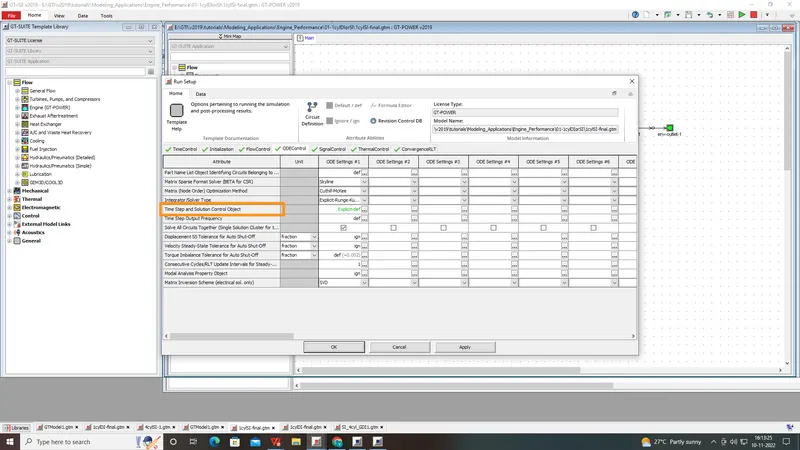
a)Time Step and solution Control Object:-
Run Setup>> Time Step and solution Control Object
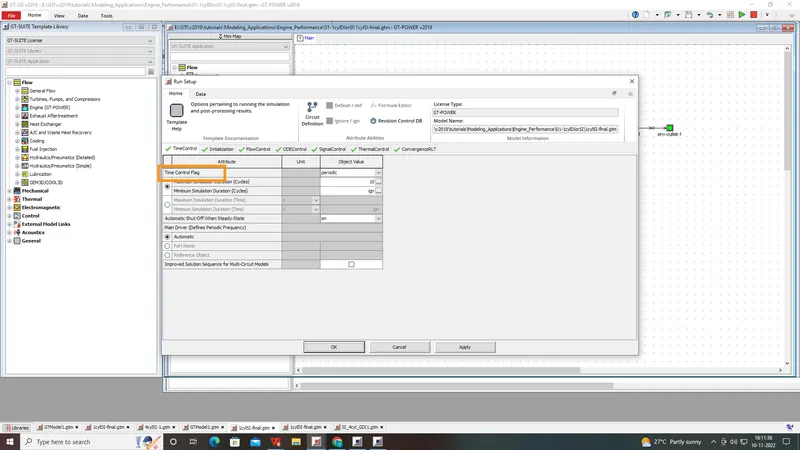
b) Time Control Flag:-
Run Setup>> Time Control>>Time Control Flag
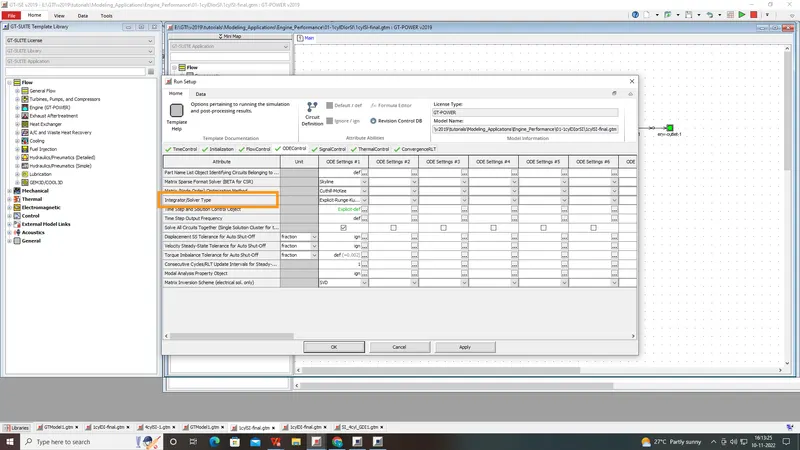
c)Integrator/ Solver Type:-
Run Setup>>ODE Control>>Integrator/ Solver Type
Question 3)-
Answer-
- Run setup :-
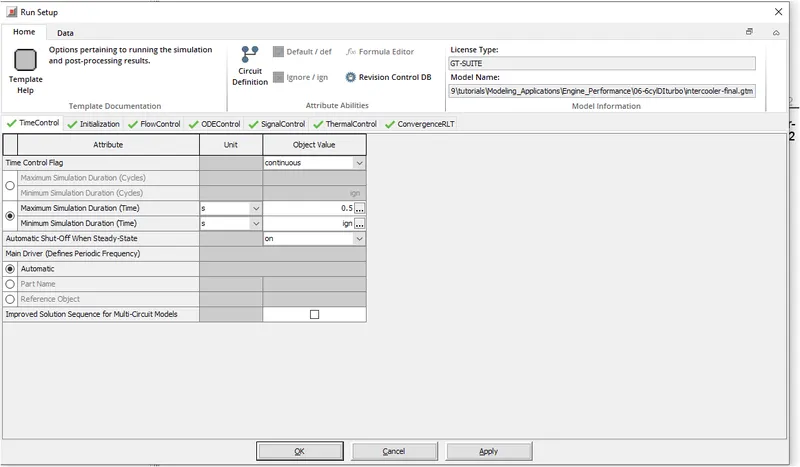
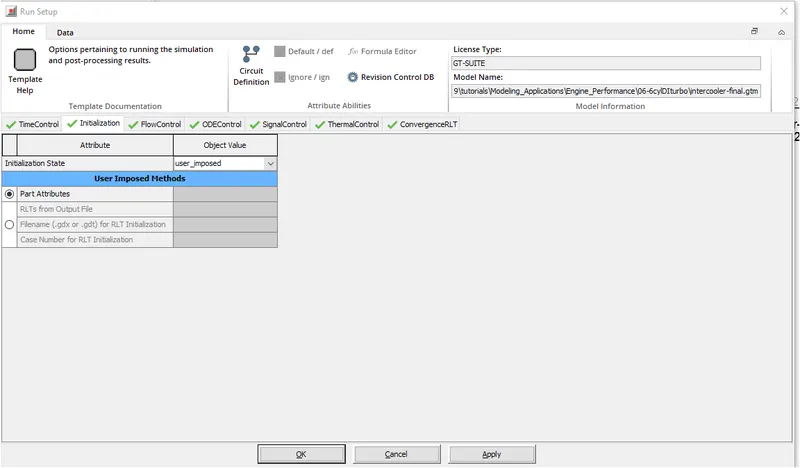
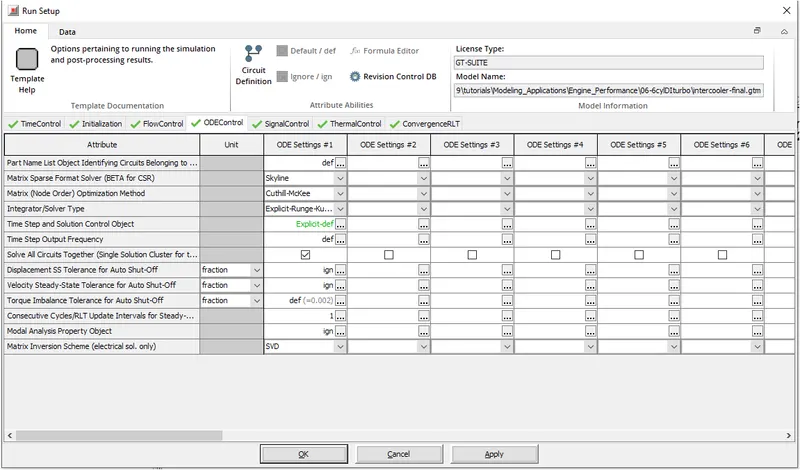
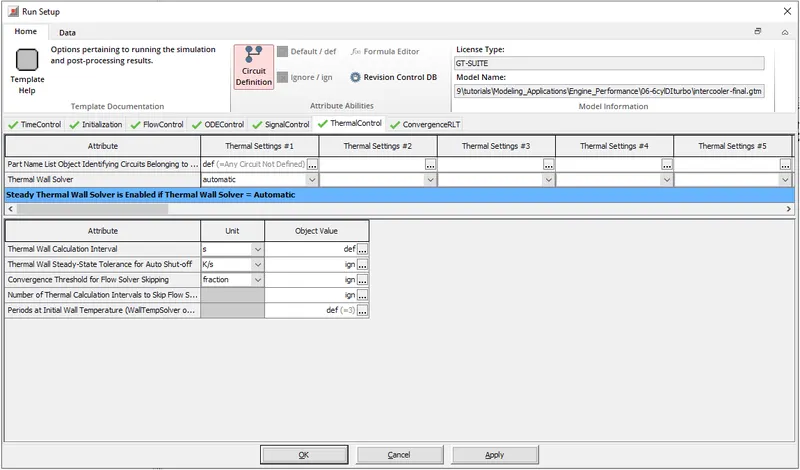
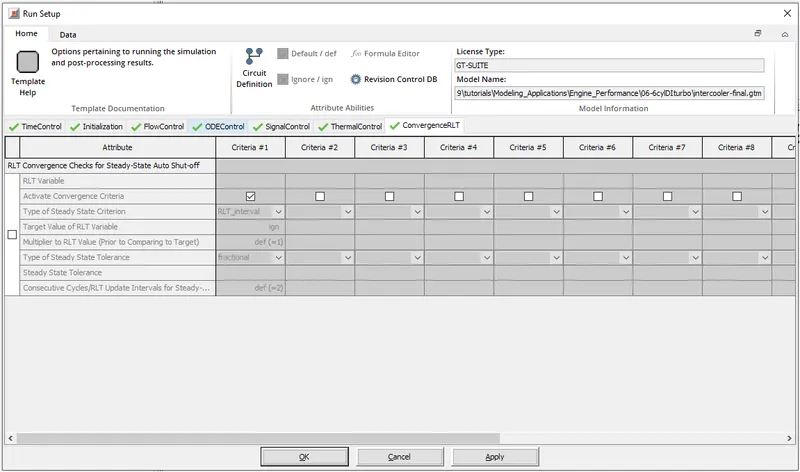
Advanced setup :-
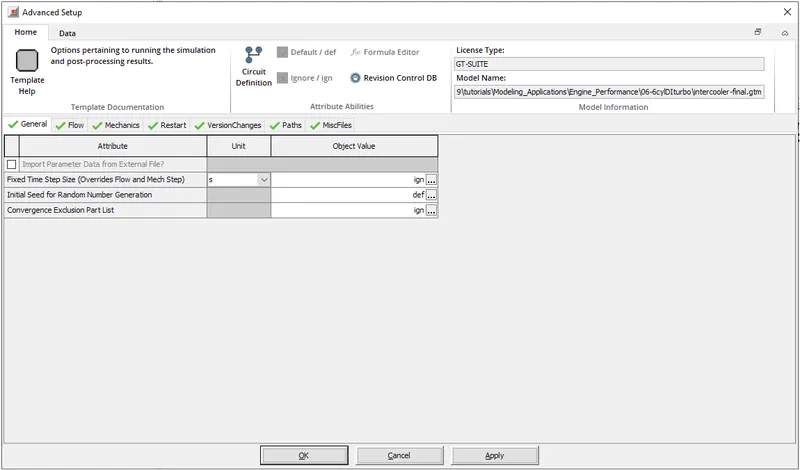
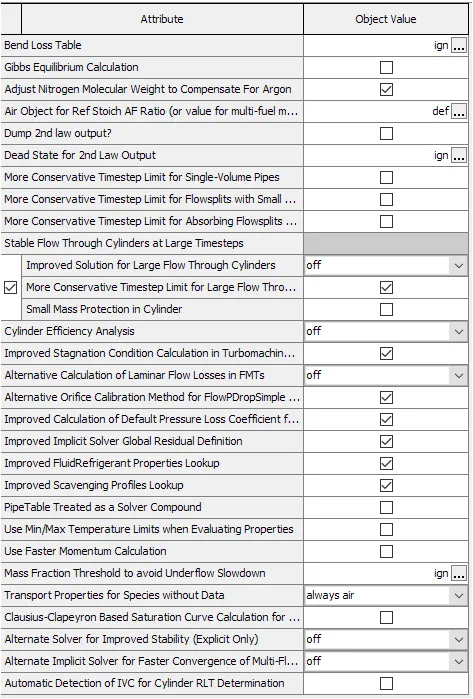

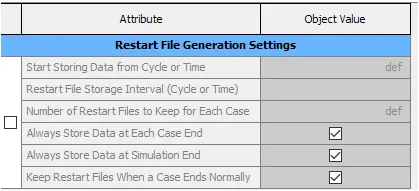
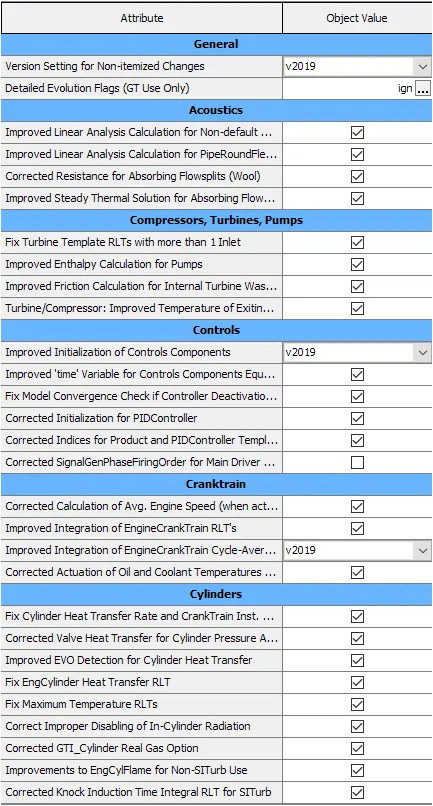
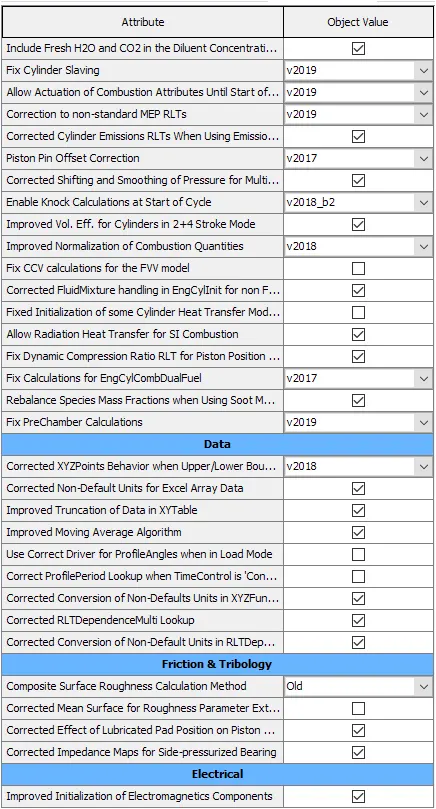
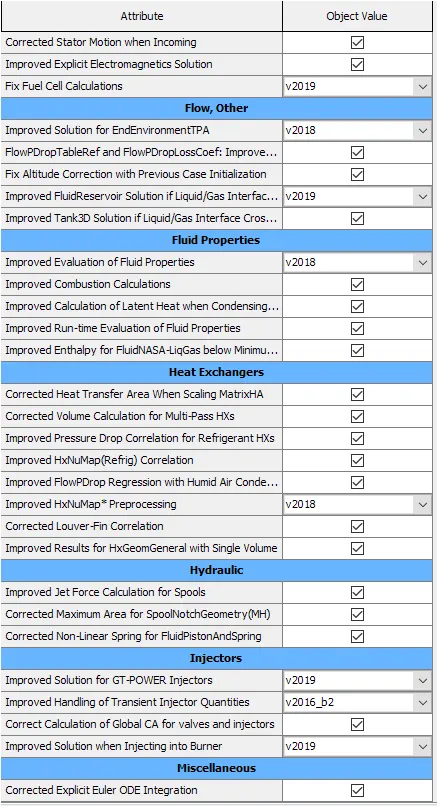
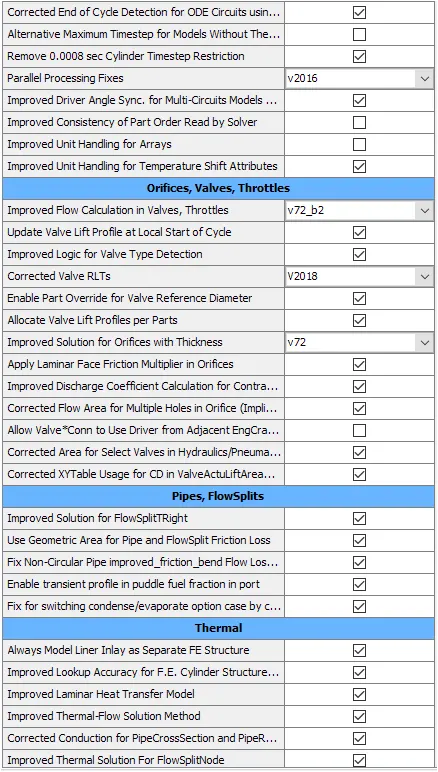
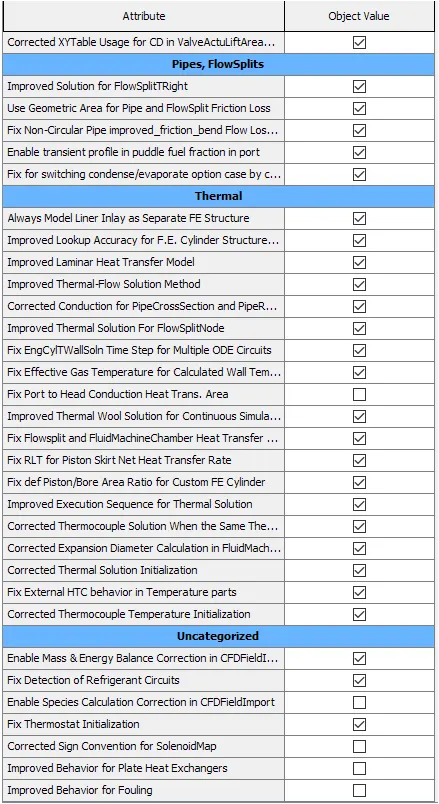
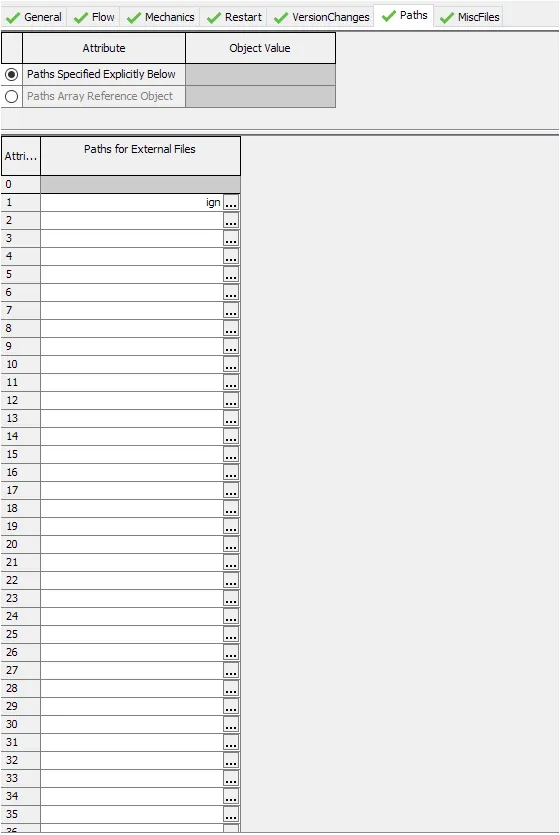

- Plot setup :-
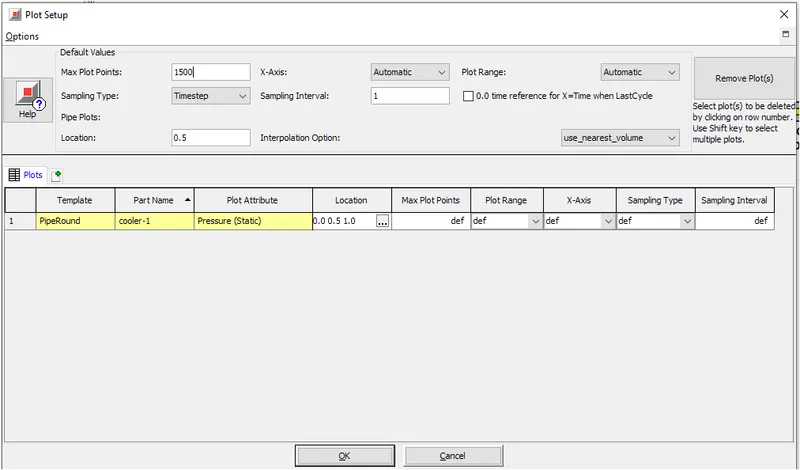
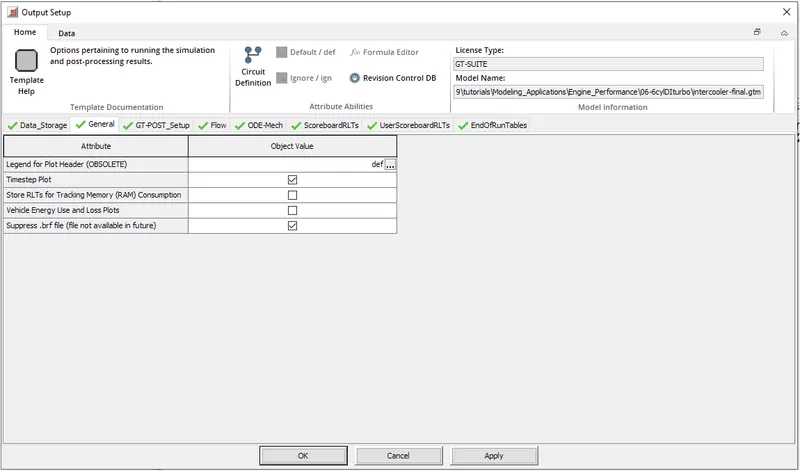
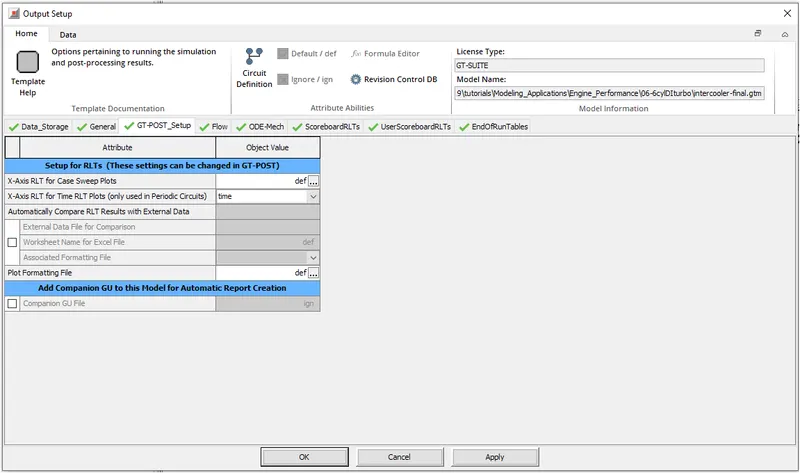
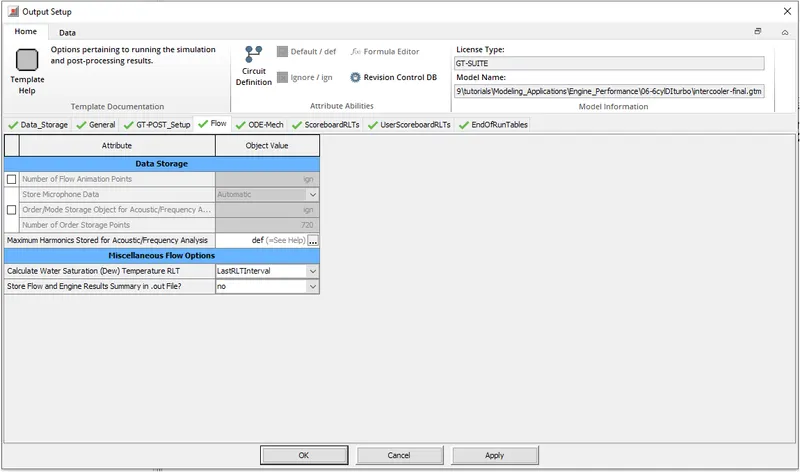
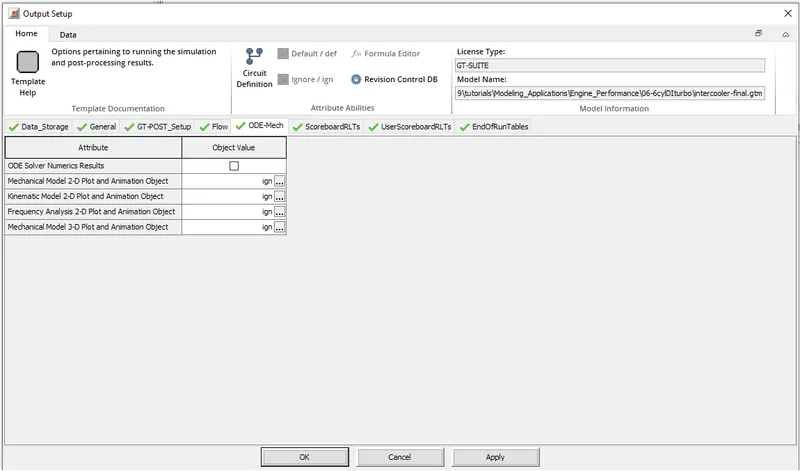
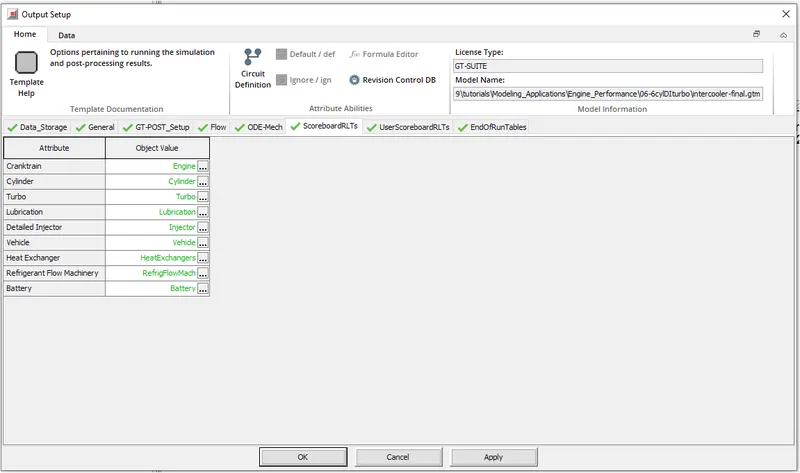
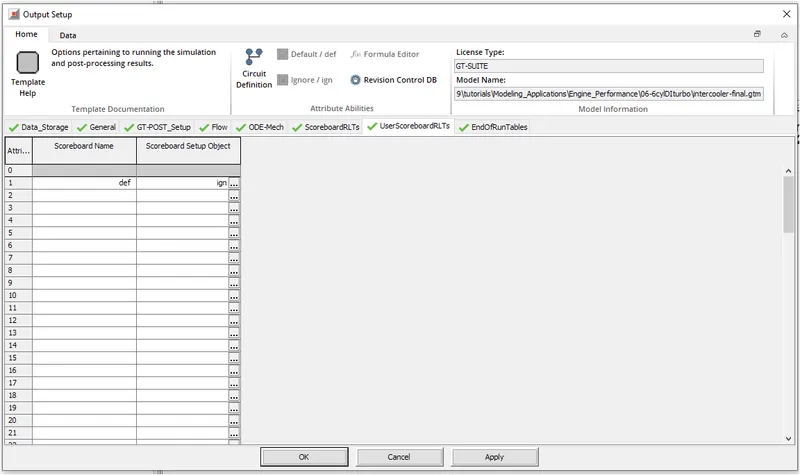
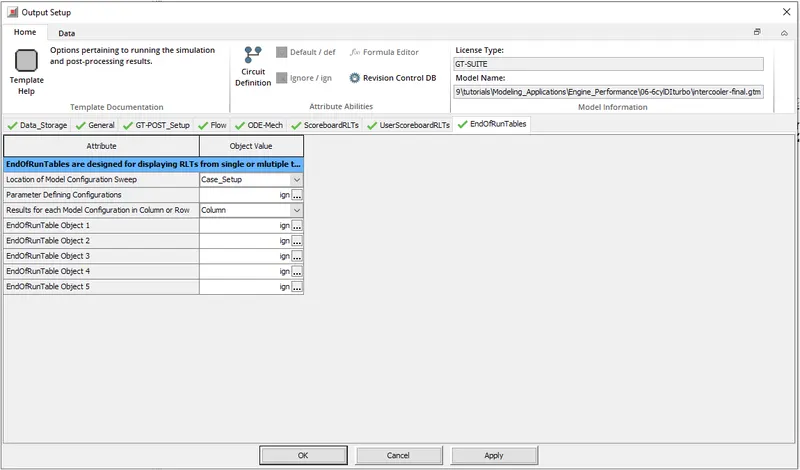
- Output setup :-
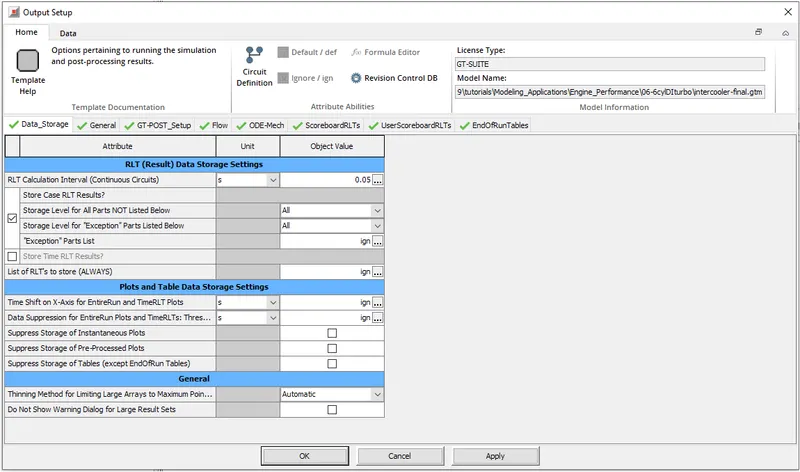
Question 04)
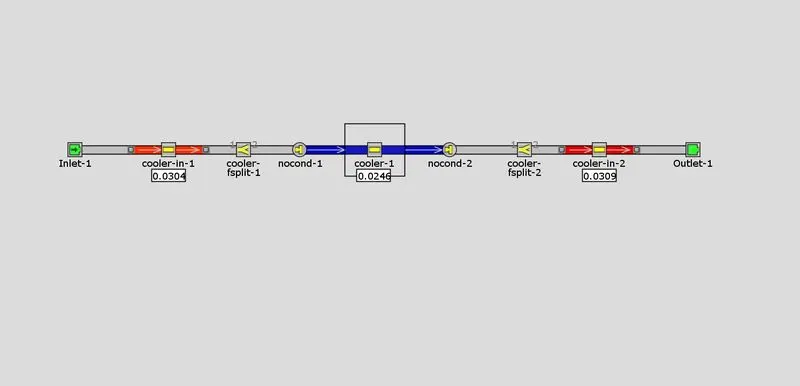
a)Average heat transfer(flux) at Charge air cooler:- 8.44 W/m^2
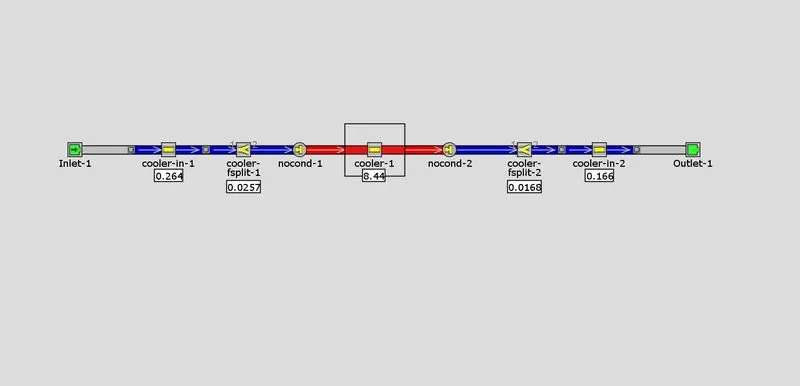
b) pressure drop across CAC:- 0.0246 bar