Week 1 Challenge
AIM:
- To know first models of fuel cell vehicles developed in Asia, Europe and North America, there specifications and comparison.
- Trend of cost in USD per kW of fuel cell production in the past and the prediction of the cost in the future, probable reasons for the improvement.
In north america the country which was in to the developement of FCV (Fuel cell vehicle) was USA. Infact the first FCV developed was in america. In 1966, General Motors developed the first fuel cell road vehicle, the Chevrolet Electrovan. It had a PEM fuel cell, a range of 120 miles and a top speed of 70 mph. There were only two seats, as the fuel cell stack and large tanks of hydrogen and oxygen took up the rear portion of the van. Only one was built, as the project was deemed cost-prohibitive.
In asia, japan was the country who was showing a promising interest in FCV. The first FCV in japan as per the records was Honda FCX Clarity. The Honda FCX Clarity concept car was introduced in 2008 for leasing by customers in Japan and Southern California and discontinued by 2015. From 2008 to 2014, Honda leased a total of 45 FCX units in the US. Over 20 other FCEVs prototypes and demonstration cars were released in that time period, including the GM HydroGen4, and Mercedes-Benz F-Cell. In europe
Mercedes benz was the autombile company which developed the first FCV in europe. The F-Cell is a hydrogen fuel cell electric vehicle developed by Daimler AG. Two different versions are known - the previous version was based on the Mercedes-Benz A-Class, and the new model is based on the Mercedes-Benz B-Class. The first generation F-Cell was introduced in 2002, and had a range of 100 mi (161 km), with a top speed of 82 mph (132 km/h).
But Honda FCX-V4 First fuel-cell vehicle to be approved for American roads by the Environmental Protection Agency and the California Air Resources Board, with subsequent leasing in California. Also approved for Japanese roads by Japan's Ministry of Land, Infrastructure and Transport. Approximately 30 leased in the Los Angeles area and Tokyo. Leasing later expanded to 50 states.
The first FCV to be comercially avilable in asia, europe and north america was toyota MIRAI. It is truly considered to be the first FCV which people can drove like another regular vehicle.
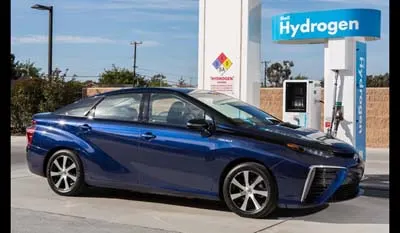
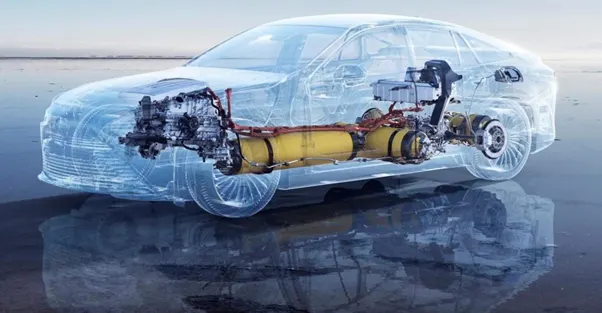
About Mirai FCV:
The Toyota Mirai (from Mirai , Japanese for "future") is a mid-size hydrogen fuel cell vehicle (FCV) manufactured by Toyota, and represents one of the first FCV automobiles to be mass produced and sold commercially. The Mirai was unveiled at the November 2014 Los Angeles Auto Show. As of December 2019, global sales totalled 10,250 Mirais. The top-selling markets were the U.S. with 6,200 units, Japan with 3,500 and Europe with 640.
Mirai FCV concept
The Mirai is based on the Toyota FCV-R (Fuel Cell Vehicle) concept car, which was unveiled at the 2011 Tokyo Motor Show and the Toyota FCV (Fuel Cell Vehicle) concept car, which was unveiled at the 2013 Tokyo Motor Show.[14] The unveiled FCV concept was a bright blue sedan shaped like a drop of water "to emphasize that water is the only substance that hydrogen-powered cars emit from their tailpipes." The FCV has a large grille and other openings to allow cooling air and oxygen intake for use by the fuel cell. According to Toyota, the FCV concept is close in appearance to the expected production version of the car. The FCV size is similar to the Camry. The FCV range is expected to be approximately 700 km (430 mi) under Japan's JC08 test cycle.
Toyota FCV concept car
According to Toyota, the FCV features a fuel cell system with an output power density of 3.0 kW/L, which is twice as high as that of its previous fuel cell concept, the Toyota FCHV-adv, delivering an output power of more than 100 kW, despite significant unit downsizing. The FCV uses Toyota's proprietary, small, light-weight fuel cell stack and two 70 MPa high-pressure hydrogen tanks placed beneath the specially designed body. The Toyota FCV concept can accommodate up to four occupants. For the full-scale market launch in 2015, the cost of the fuel cell system is expected to be 95% lower than that of the 2008 Toyota FCHV-adv.
The FCV concept also uses portions of Toyota's Hybrid Synergy Drive technology including the electric motor, power control unit and other parts and components from its hybrid vehicles to improve reliability and minimize cost. The hybrid technology is also used to work together with the fuel cell. At low speeds such as city driving, the FCV runs just like any all-electric car by using the energy stored in its battery, which is charged through regenerative braking. At higher speeds, the hydrogen fuel cell alone powers the electric motor. When more power is needed, for example during sudden acceleration, the battery supports the fuel cell system as both work.
Specification when the vehicle was launch Specification as of now
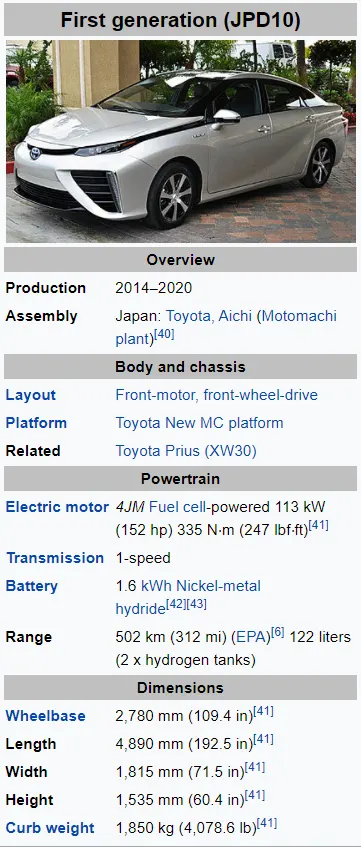
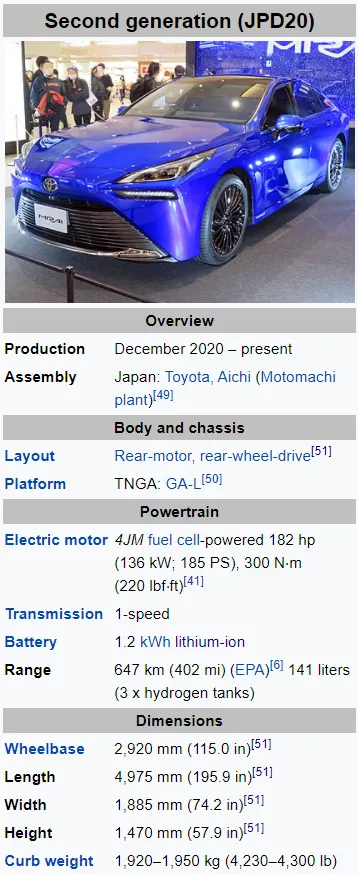
Upon comparison it can be seen that mirai first generation was the fuel cell version of toyota prius and the Mirai second generation was given a specific design to make changes in powertrain and storage system. This design change was followed by the changes in drive system. Mirai first genertaion is front motor, front wheel drive system where as 2nd generation is rear motor, rear wheel drive system. Some major changes in powertrain can be seen. Electric motor is bit more powerful in 2nd generation though torque is compromised. Battery capacity is reduced to 1.2 kWH and the chemistry is changed from NMH to li-ion. Range has been increased from 502 km to 647 km which is the result of 3 hydrogen tank as compared to the 2 hydrogen tanks in first generation MIRAI.
TREND OF COST IN USD PER KW OF FUEL CELL PRODUCTION
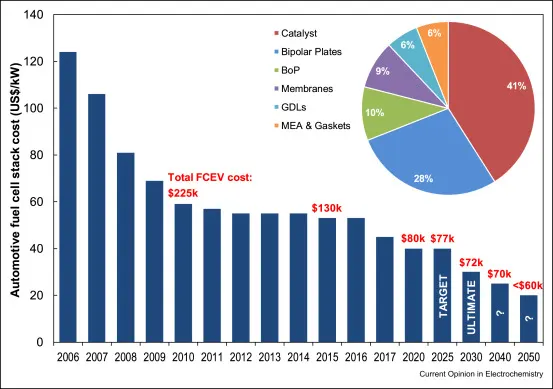
As you can see the price of fuel cell stack system in the year was around 125$/kW. The year 2008 saw the highest dip in the price. As of now the year 2020 and 2021 we didnt saw the dip due to the COVID-19 pandemic. As things get to normal the projected price for the year 2025 is 77$/kW.
The probale reasons for the improvement of FC stack system could be in research in more efficient and advanced FC components which are listed below:
Bipolar Plates
- Plate Forming: Despite the ability to produce bipolar plates at fast rates in progressive stamping presses (a few seconds per plate), the rates are not fast enough for the millions of plates needed per year. High numbers of parallel forming lines would be required, leading to infeasible factory setups and difficult quality control issues. Faster bipolar plate forming systems are needed.
- Plate Coating: There is no clearly identified pathway to a low cost, high volume-feasible bipolar plate coating (for corrosion resistance and electrical contact improvement).
- Laser welding: (to seal and create a cooling cell between the plates).
- Laser welding lengths needs to be minimized to achieve low cost. Systems with low effective welding cycle times need to be demonstrated.
- High rate, low cost, alternates to laser welding should be explored.
- Clamping of the BPPs to ensure plate contact while welding is identified as a key parameter for welding success. Additional research is needed for optimization.
- Material: Metal plates (as opposed to graphite, Graf oil, or composite materials) appear to be preferred for automotive applications. Alternate alloys with both lower cost and inherent anticorrosion properties should be explored.
Membranes
- Increased power density remains the number one pathway to reduced system cost.
- While ePTFE has proven to be an effective membrane support, its cost is high. Fabrication (at production level) and performance assessment of alternate supports (such as the Ginner DSM) should be conducted.
Catalysts
- Non-Pt based catalysts: Pt based catalysts have been demonstrated to be most cost effective. To achieve competitiveness, non-Pt catalysts need to substantially improve their power density.
- Pt Usage: Substantial strides have been achieved in reducing Pt usage (and improving kW/gPt). Nonetheless, Pt cost is one of the largest cost elements within the fuel cell system. Efforts to further reduce Pt while maintaining performance and durability should continue.
- Catalyst Synthesis: Synthesis is complicated but appears to be relatively inexpensive (excluding Pt cost), particularly at high-rate production. It appears to be a favourable trade off to exchange synthesis complexity (possibly higher cost) for high polarization performance.
- Durability: Catalyst (and membrane) durability has not been explicitly factored in the cost analyses. However, it is clear that durability improvements are needed to meet minimum customer requirements.
Gas Diffusion Layers
- There is a wide distribution in GDL costs seemingly due to a combination of production scale, material wastage, and GDL company markup. More investigation is warranted to better understand these cost drivers.
Manufacturing Research
- Numerous components can be produced in quantities suitable for 1,000 vehicle systems per year but require manufacturing process development to achieve 100k vehicles per year production capability. They require not only a high-confidence market demand (to allow confidence in capital investment) but also substantial R&D dollars to develop the high-speed production systems