Week 1 Challenge
1 The full form of OEM is Original Equipment Manufacturer.
2
- Concept design: This is the stage where the overall look and feel of the vehicle is determined. The automotive designer will work with a team of engineers and other stakeholders to develop a design that meets the needs of the target market and complies with all relevant safety and emissions regulations.
- Styling: This is the stage where the details of the vehicle's exterior and interior are finalized. The automotive designer will work closely with a team of clay modelers and digital artists to create a three-dimensional representation of the vehicle.
- Engineering: This is the stage where the vehicle is designed to meet its performance, safety, and emissions requirements. The automotive designer will work closely with a team of engineers to ensure that the vehicle's design is feasible and meets all relevant regulations.
- Manufacturing: This is the stage where the vehicle is actually built. The automotive designer will work closely with a team of manufacturing engineers to ensure that the vehicle can be produced efficiently and cost-effectively.
3
Basically Raw material suppliers
- Continental International - Chassis & safety ADAS, hydraulic brake systems components, passive safety & sensonics, vehicle dynamics, powertrains, fuel & exhaust management
- ZF Friedrichshafen - Transmission systems, steering systems, braking systems, axles components, clutches, dampers, car powertrain technology
- Electronics Automotive Products Pvt Ltd
- Sri Sairam Auto Components
4 1886
5 Wooden seats
6
-
X-Axis: This is the horizontal axis, extending from left to right. Positive values along this axis usually indicate movement to the right, and negative values indicate movement to the left.
-
Y-Axis: This is the vertical axis, extending from bottom to top. Positive values along this axis usually indicate movement upward, and negative values indicate movement downward.
-
Z-Axis: This is the depth or vertical axis, extending from front to back. Positive values along this axis usually indicate movement towards the viewer, and negative values indicate movement away from the viewer.
7 To locate parts in the System, Volume allocation and smoothen communication between Stakeholders
8 he X-axis is the longitudinal axis of the vehicle, which runs from the front to the rear. The positive X-axis points towards the rear of the vehicle, and the negative X-axis points towards the front
9 Zero plan is a term used to describe the location of the center of the front drive shaft in the vehicle's coordinate system. The zero plan is typically located at the intersection of the X-axis, Y-axis, and Z-axis.
10 The point of origin is the place where all the coordinate points are zero. It is the starting point for any coordinate system. In a Cartesian coordinate system, the point of origin is typically located at the intersection of the X-axis and the Y-axis.
11 Most OEMs (Original Equipment Manufacturers) use the bumper as the point of origin for their vehicles. This is because the bumper is a fixed point on the vehicle that is not likely to move. It is also a relatively large and easy-to-identify point.
12
- Work lines: Work lines are typically used to represent the edges of objects that are being studied or designed. They are typically drawn in black and are often thicker than grid lines.
- Grid lines: Grid lines are typically used to create a background for engineering and drafting drawings. They are typically drawn in light grey or blue and are often thinner than work lines.
13 . Work lines and grid lines are not interconnected by default
14 Body position is a term used to describe the location of a part in the vehicle with respect to the body. The body is the main structure of the vehicle, and it includes the frame, the body panels, and the interior.
15 Body position
16 . In car design, the center line is the longitudinal axis of the vehicle that divides it into two halves. It has positive and negative Y values, with positive Y being towards the right side of the vehicle and negative Y being towards the left side of the vehicle.
17 midpoint
18 In the automotive coordinate system, the positive Z direction refers to the height of the vehicle from the seat to the top of the vehicle. The negative Z direction refers to the height of the vehicle from the bottom of the vehicle to the seat.
19 In the automotive coordinate system, the positive Y direction is towards the right side of the vehicle when facing forward. The negative Y direction is towards the left side of the vehicle when facing forward.
20 Left hand Drive, Right Hand Drive
21 Left Hand Side of the Car
22 Negative
23 Left Hand Side of the Car
24 Negative, Left
25 left
26 Right
27 Reference
28 IB - Inboard
OB - Outboard
29 Fore
30 aft
31 Positive X
32 China
33
| 1 | Toyota |
| 2 | Volkswagen Group |
| 3 | Hyundai / Kia |
| 4 | General Motors |
| 5 | Ford |
| 6 | Nissan |
34 United States
35
| Maruti Suzuki | |
| 2 | Hyundai |
| 3 | Mahindra |
| 4 | Tata Motors |
| 5 | Honda |
| 6 | Toyota |
36 US, Canada, Australia, New Zealand
37 India, Japan, South Africa, UK.
1
Eyellipses are important for OEMs because they can be used to ensure that drivers have adequate visibility of the road and surrounding area. By considering the eyellipse when designing vehicles, OEMs can minimize the risk of accidents caused by obstructed vision.
Here are some of the ways in which eyellipses are used by OEMs:
- To determine the size and placement of mirrors: Mirrors are an important safety feature that allow drivers to see behind them without having to turn their heads. Eyellipses can be used to determine the optimal size and placement of mirrors so that they provide the driver with the best possible view of the rear.
- To design instrument panels: The instrument panel is the dashboard of a vehicle, and it houses a variety of controls and displays that are important for driving. Eyellipses can be used to ensure that the controls and displays on the instrument panel are easy for drivers to see and reach.
- To develop safety features: Eyellipses can also be used to develop safety features such as blind spot monitoring and lane departure warning systems. These systems can help to prevent accidents by alerting drivers to potential hazards that they may not be able to see.
2
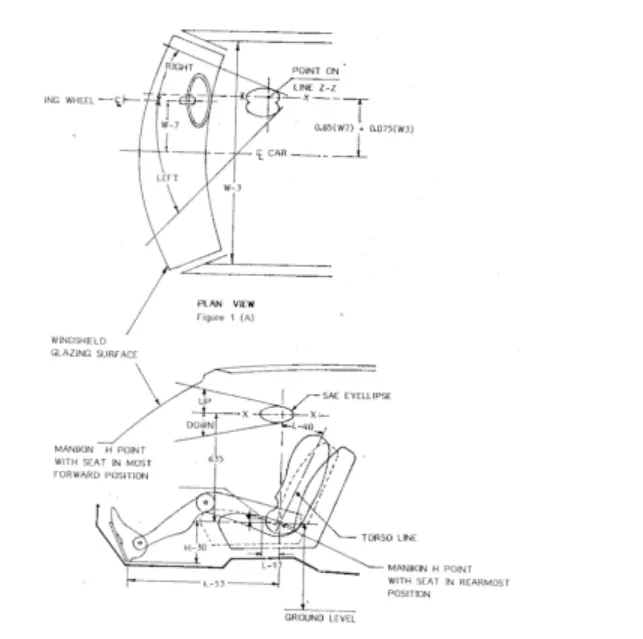
3 The E-point, also known as the eye point, is a statistical representation of the location of the driver's eyes when they are seated in a vehicle. It is typically defined as the center of the driver's left and right eye, and is typically spaced 65mm apart.
4 P-point represents the Neck pivot point.
5 The E-point and the P-point are two important reference points used in automotive design to ensure that drivers have adequate visibility of the road and surrounding area.
The E-point is the center of the driver's eyes, while the P-point is a point located 98mm in front of the E-point. The P-point is used to determine the driver's field of view, and it is typically located at the same height as the driver's eyes.
The correlation between the E-point and the P-point is important because it ensures that the driver has a consistent field of view regardless of their head position. This is important for safety, as it allows the driver to see potential hazards even when they are not looking directly at them.
In the case of a 95% Mannequin, the E-points are 65mm apart from each other. This means that the P-point is located 49mm in front of the left eye and 107mm in front of the right eye.
6
- First, calculate the distance between the two E-points. This distance is typically 65mm for a 95% Mannequin.
- Next, calculate the distance between the P-point and the centroid of the two E-points. This distance is typically 98mm for a 95% Mannequin.
- Finally, use these two distances to calculate the semi-major and semi-minor axes of the eyellipse. The semi-major axis is the longer of the two axes, and the semi-minor axis is the shorter of the two axes.
7 Seating Reference Point
8 The seat reference point and the H-point both are the same points. The tier-1 suppliers call the SgRP an H-point.
9 The H-point and the SgRP are the same thing. They are both a reference point used in automotive design to determine the location of the driver's hip.
10 The heel point is the point of contact of the occupant's heel with the floor of the vehicle. It is important for automotive designers to consider the heel point when designing seats and footrests.
11 Oscar is the name given to the 2D or 3D device used to define and measure vehicle-seating accommodation.
12
- Oscar is the name given to the 2D or 3D device used to define and measure vehicle-seating accommodation.
- The 2D device is called as Oscar template
- The 3D device is called an Oscar or Oscar machine.
13 To evaluate Roominess and Ergfonomic constraints
14 The design H-point and the actual H-point are two different measurements used in automotive design to determine the location of the driver's hip.
15
- Small Women Type: This Oscar represents the 5th percentile of female drivers. This means that 5% of female drivers weigh less than this Oscar.
- Mid-Sized Man: This Oscar represents the 50th percentile of male drivers. This means that 50% of male drivers weigh more than this Oscar and 50% weigh less.
- Large Size Man: This Oscar represents the 95th percentile of male drivers. This means that 95% of male drivers weigh less than this Oscar.
16
- The weight (in kg) of 95% Oscar-
- Large Size man: 102.5 kgs (represent the 95th percentile of drivers)
17 The H-point is an important measurement in automotive design because it is used to determine the driver's position in the seat. The H-point is also used to verify the fit of the seat to the driver. By ensuring that the H-point is within an acceptable range, automotive designers can help to ensure that the driver is comfortable and safe in the seat.
18 The tolerance of the H-point is given using an H-point tolerance band. The H-point tolerance band is a graphical representation of the acceptable range for the H-point. The H-point tolerance band is typically either circular or square in shape.
19
The D-point is the lowest point on the buttock contour of the seated Oscar template or Oscar machine in the installation position. It is used to determine the location of the driver's hip in the seat. The D-point is typically located approximately 50mm behind the H-point.
The D-point is important for automotive design because it is used to ensure that the driver's hip is properly supported in the seat. By ensuring that the D-point is located in the correct position, automotive designers can help to prevent driver fatigue and discomfort.
20
AHP stands for Acceleration Heel Point. It is the point of contact between the driver's heel and the accelerator pedal when the foot angle is at a minimum of 87 degrees.
The AHP is important for automotive design because it is used to determine the location of the driver's heel in relation to the accelerator pedal. By ensuring that the AHP is located in the correct position, automotive designers can help to prevent driver fatigue and discomfort.
21 The reaching position for a specific driver population is called the Hand reach Envelope.
22
- Primary DHC: Steering, Gearshift, Turn Signal, Ignition.
- Secondary DHC: Climate, Radial, Accessory Control.
23 The back angle is the angle of recline of the torso line relative to the vertical, while the cushion angle is the angle of incline for the cushion relative to the horizontal.
24 The ischium is one of the three bones that make up the pelvis, along with the ilium and the pubis. It is the lowest and strongest bone of the pelvis, and it is located at the back of the hip joint. The ischium is the main point of contact between the body and the seat when sitting.
25 Condition when an occupant is seated for an extended period of time
26 The lumbar region of the spine is located in the lower back, between the ribs and the pelvis. It is made up of five vertebrae, which are the largest and strongest vertebrae in the spine. The lumbar region helps to support the weight of the upper body and allows for movement in the back.
27
- SgRP
- Foot Angle
- Knee Angle
- Heel Point
- Hip Point
- Back Angle
1
- Support the occupant: The seat should provide adequate support for the occupant's weight and prevent them from sliding around. This is important for both comfort and safety.
- Position the occupant: The seat should be adjustable so that the occupant can find a comfortable and safe position. This includes adjusting the seat back angle, the height of the seat, and the distance between the seat and the pedals.
- Provide comfort for the occupant: The seat should be made of materials that are comfortable to sit on and should provide good cushioning. The seat should also be properly ventilated to prevent the occupant from getting too hot or too cold.
- Protect the occupant: The seat should be designed to protect the occupant in the event of a crash. This includes features such as airbags and seat belts.
2
Seat support is the most basic function of an automotive seat. It helps to keep the occupant in the correct position and prevents them from sliding around. This is important for both comfort and safety.
There are a few different ways that seats provide support:
- Cushioning: The seat cushion should be made of a material that provides good cushioning and support. This helps to reduce fatigue and discomfort.
- Bolstering: The seat bolsters should provide support for the occupant's sides and back. This helps to prevent the occupant from sliding around.
- Adjustability: The seat should be adjustable so that the occupant can find a comfortable and supportive position. This includes adjusting the seat back angle, the height of the seat, and the distance between the seat and the pedals.
3
The position of the occupant in the seat is extremely important for safe vehicle operations. There are three key elements of occupant position:
- Hand-arm and Legroom: These are important for both the safety and control of the occupant. The occupant should have enough room to comfortably reach all of the controls and to operate the vehicle safely.
- Field of Vision: The driver's field of vision as defined by the eyellipse should have minimal obstruction from the steering wheel, instrument panel, roofline, beltline, and pillar. The driver should be able to clearly see in all the mirrors while in driving position.
- Driver’s proximity to hand Control: The occupant must be able to reach appropriate controls while in the driving position. This includes the steering wheel, pedals, gear shifter, and other controls.
4
Seats provide comfort for the occupant in a few different ways:
- Seat padding: The seat padding should be made of a material that is comfortable to sit on and should provide good cushioning. The padding should also be properly ventilated to prevent the occupant from getting too hot or too cold.
- Bolstering: The seat bolsters should provide support for the occupant's sides and back. This helps to prevent the occupant from sliding around and helps to keep them comfortable.
- Adjustability: The seat should be adjustable so that the occupant can find a comfortable position. This includes adjusting the seat back angle, the height of the seat, and the distance between the seat and the pedals.
- Materials: The materials used in the seat, such as the fabric or leather, can also affect comfort. Some materials are more comfortable than others, and some materials are better suited for different climates.
- Ventilation: The seat should be properly ventilated to prevent the occupant from getting too hot or too cold. This can be done through the use of air vents or through the use of fabric that is designed to be breathable.
5
ILD stands for Indentation Load Deflection. It is a measurement of the firmness of a seat or foam. It is defined as the amount of load required to compress the seat or foam to 50% of its original thickness.
The ILD is important for a number of reasons. First, it can help to determine the comfort of a seat. A seat with a higher ILD will be firmer and less comfortable than a seat with a lower ILD. Second, the ILD can help to determine the safety of a seat. A seat with a higher ILD will be more likely to provide adequate support in the event of a crash.