Week 1 Challenge
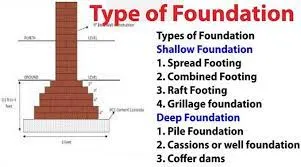
Q1 Solution : Types of Foundation :
- Shallow Foundation :
- Depth of foundation is lesser than or equal to the breadth of foundation
- D <= B
- Combined footing = 1 footing for 2 piers
- Mat footing
- Spread or Isolated footing
- Strip footing for multiple piers more than 2 piers
- Strap or Cantilever footing
- Isolated footing used most common
- This type of foundation used where the hard strata or suitable strata is availaible at a shallow depth
- where the load is lesser
2. Deep Foundation :
- Depth of footing is more than the breadth of footing
- Used where the poor bearing capacity of soil
- hard strata is availaible at deep depth
- structure near the seashore or riverbed
- presence of canal or deep drainage line are near the foundation
2. Components of RCC Bridge :
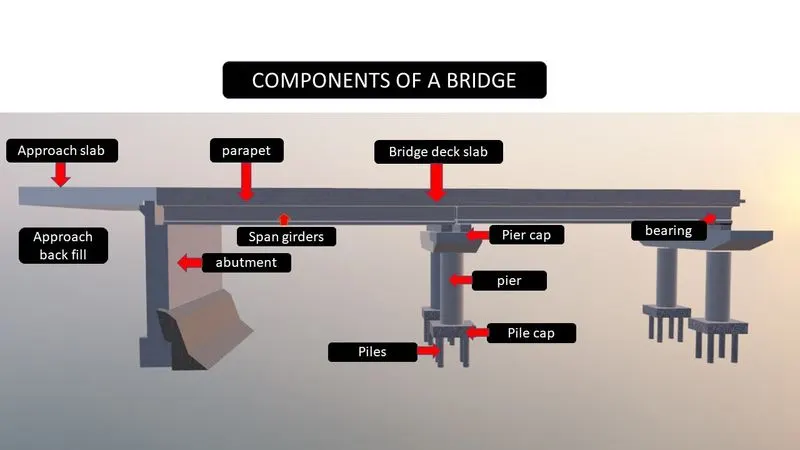
- Substructure : The components of A bridge which lies below the Bearing of Bridge is called as a Substructure
Components of Substructure :
- Bearing :Bearing is a device which supports the parts of superstructure and transfers loads and movements from the deck to the substructure and foundation.The main purpose of providing a bearing is to permit controlled movement and decrease the stress involved.
- Pier Cap :Pier cap is the topmost part of a pier that transfers loads from the superstructure to the pier. It is also known as headstock. It provides sufficient seating for the girders and distributes the loads from the bearings to the piers.
- Pier :Pier is the part of the substructure that supports the superstructure and transfers loads of superstructure to the foundations. Pier is suitable for spanned bridges with a maximum width of deck up to 8 m (2 traffic lanes).The shape and size of the pier mainly depend on aesthetics, site, space, and economic constraints of the construction. Usually, bridge pier is constructed by in situ method with large panel formwork.
- Foundation: Foundation is the portion that transmits loads to the bearing strata. Foundation is required to support the piers, bridge towers, and portal frames. Generally, piles and well foundations such as H-pile, bore piles, pipe piles, or precast concrete piles are adopted.
- Pile : The Pile is a fundamental component. A pile-type foundation is generally needed when the upper soil layer is loose. Pile depth depends on the soil layer. To find the hard soil layer which will make the structure stable, the pile is usually extended to some depth into the hard soil layer.
Components of Bridge Superstructure : The portion supports the deck slab and girder and connects one sub-structure to the other. That means all the elements of the bridge attached to a supporting system can be categorized as superstructure.
- Girders :The beam or girder is the part of the superstructure which bends along the span. The deck is supported by beams.
- Deckslab : Deck is the portion that carries all the traffic
- Abutements : It is a structure mostly used for bridges and dams as a substructure at the ends of a bridge span or dam and on that superstructure is a rest.A bridge with a single span has two abutments that offer vertical and lateral support. It also plays the role of retaining walls to resist lateral movement of the earthen fill of the bridge approach.
- Wing wall : It is one of the earth-retaining structures in the bridge. They are located adjacent to the abutments and act as retaining walls.
- Parapet and Handrails : The parapet is one of the safety components of any bridge which prevent the vehicle from falling off where there is a drop.
Components oF Adjoining Structure :
Approaches
It is structured and constructed at the start or end of any bridge. Its main function is to provide smooth and easy entry or exit from the bridge.
Guard Stones
They are used to restrict traffic on a particular lane or sometimes as road railings but are generally positioned to protect a specific object, such as a corner of a street or the side of a gate.
- SEISMIC EFFECTS ON BRIDGE: Earthquakes damage bridges by shaking and causing structural damage, in an RCC bridge Bearings gets damaged, a bridge may fall down, it cracks severely.
- a) Bridges more than 150 m span
b) Bridges with piers taller than 30 m in Zones IV and V
c) Cable supported bridges, such as cable-stayed and suspension
bridges
d) Arch bridges having more than 50 m span. - the above is as per IRC clause 218 (GUIDELINES FOR SEISMIC DESIGN OF ROAD BRIDGES).
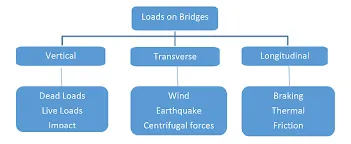
- Loads to be considered on the bridge :
- Dead load
- Live load
- Impact load
- Wind load
- Longitudinal forces
- Centrifugal forces
- snow load.
- Effect of water current
- Temperature load effects
- Seismic loads
- Barge impact load.
Forces on Shallow Foundation :
lateral loads
zvetical loads
soill and water pressure
Effect of forces :
- Sliding: if the depth of the foundation is small or the sub-soil below the foundation is of a sliding nature it may slip away under the loads and cause the failure of the foundation.
- Overturning: Due to some loads the structure may overturn that causing failure.
- uplift, soil and water pressure are the loads acting the shallow foundation
FUNCTIONS OF PIER AND ABUTMENT:
- A abutment is a structure which connects the deck of a bridge to the ground at the ends of a bridge span, supports its weight both horizontally and vertically.
- Abutments at each end provide vertical and lateral support for the span, as well as acting as retaining walls to resist lateral movement of the earthen fill of the bridge.
- To transfer the superstructure vertical loads to the foundation and to resist all horizontal and transverse forces acting on the bridge.