Week 1 Challenge
1 – What is the full form of OEM ?
- Original Equipment Manufacturer
2 – How the Design Responsibility goes in Automotive
- OEM: - Designing cycle start from OEM. OEM directly provide design to the Tier-1 supplier or sometimes they provide only designing inputs to the Tier-1 for designing.
- TIER-1:- Tier-1 supplier provide the parts to the OEM which directly fitted in Car. Sometimes Tier-1 takes the ownership to design the part for OEM.
- TIER-2:- Tier-2 supplier parts not directly fitted in car but the support the tier-1 supplier to manufacturing the parts for OEM. They provide sub-assembly and parts to Tier-1 supplier.
3 – Name some Tire 4 Supplier and what they manufacture?
- I don’t know about Tier-4 suppliers.
- Tier-1 Supplier: - Magna Automotive – Automotive Seat
- Schaeffler Group – Hub Bearing
- JBM Group – Exhaust System
- Caparo India Pvt Ltd – Steel Tubes
4 – When was the first Car Made?
- 1886
5 – What kind of Seats are used in the first Car?
- Wooden Seat
6 – Define 3D reference System?
- 3D reference system is a global reference system which is used to define location of the object.
7 – Why 3D reference System is needed?
- We defined the position of the object with respect to the 3D reference system in space.
8 – What is X Plane and in a Car what is positive “x”?
- X plane is a vertical transverse plane
- Positive X is a right side of to the point of origin in car.
9 – What is “Zero Plan”?
- The plane of points where one of the coordinate “0”
10 – Define Point of origin?
- It is a intersection of coordinates in 3D system where all coordinates are “0”
11 – Where Most OEM Point of Origin keep?
- Point of origin differs from OEM to OEM. Mostly it’s keep on bumper.
12 – Difference between Work Line and Grid Lines?
- Grid Lines: They are intersections of planes which located at 100mm increments.
- Work Lines: They are located on individual parts.
13 – Are Work Line and Grid Lines are inter connected?
- Yes
14 - What is Body Position?
- Location of the part in the vehicle with respect to the body.
15 – When a Car comes out of OEM Yard, Seat will be at what position?
- At Body Position
16 – How Centre Line is used in terms of Car Design?
- Centre line used as a longitudinal axis during car design which divided the vehicle in two halves from center.
17 – Usually Centre Line is placed at Centre plane?
18 – What is Positive Z Direction?
- Vehicle upper vertical direction from the point of origin is positive Z-direction.
19 – What is Positive Y Direction?
- Right hand side direction from point of origin is positive Y-direction.
20 – What are LHD and RHD?
- LHD: LHD which stand for Left Hand Drive in which all design & seat elements placed in left side of centreline.
- RHD: RHD which stand for Right Hand Drive in which all design & seat elements placed in right side of centreline.
21 – A Driver driving a Car in US will be sitting which side of Car?
- Left Hand Drive or LHD
22 – Driver in US is in Negative Y Direction.
23 – An Indian Cab Driver went to USA and started driving a Car, which side of the Car he will be sitting?
- He sits on left side in car for driving.
24- I opened the Door of my Car and saw my room keys on centre console , so my keys are inboard side against the Door.
25 – Belt Buckle attached on the Inboard Side of the Seat.
26-The Recliner handle is placed Outboard side of the seat.
27 – Inboard/Outboard is a part position based system.
28 – IB Inboard, OB Outboard
29 – Going from rear bumper to forward is Fore Movement.
30 – C- Pillar to B – Pillar movement is Fore Movement.
31 – An aft movement of seat is Positive X Movement
32 – Volume wise which country produce max number of Cars?
- China
33 – Volume wise production please places all OEM in global?
34 – Which country India will replace in next 10 year in term of Volume production?
- China
35 - Volume wise production please places all OEM in India?
- Maruti Suzuki : 1364.70
- Hyundai : 505.03
- Tata : 331.18
- Mahindra : 201.5
36 – Name Countries which follow LHD Drive?
- Australia
- Bangladesh
- Bahamas
- Bhutan
- Hong Cong
37 - Name Countries which follow RHD Drive?
- India
- Afghanistan
- Belgium
- Bulgaria
- France
- What is Eyellipse and how it important from OEM purpose?
- Eyelipse is form of eye and ellipse which create occupant visibility zone at interior and exterior.
2. Draw the complete Eyellipse Zone in a OEM environment?
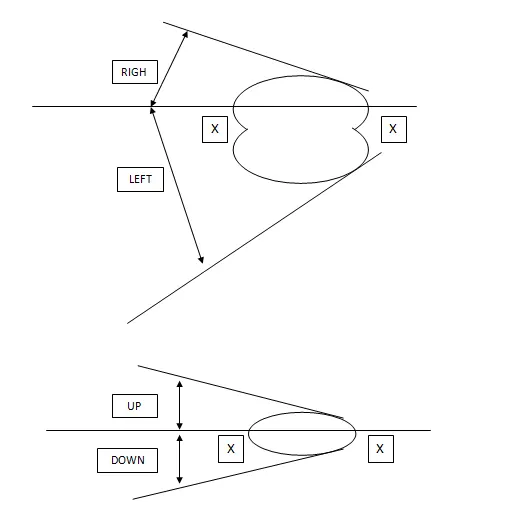
- What is E – Point?
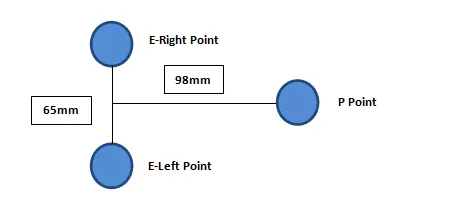
- It’s a two points which shown the left and right hand eye of driver.
- What is P – Point?
- It is a neck pivot point by which turn the neck in horizontal and from left to right.
- Correlation between E Point and P Point?
- E-Point: E-point are 2 points of eye which 65mm apart from each other.
- P-Point: P-Point is neck pivot point by which driver neck moment horizontally, vertically, Left & Right. It is distance 98mm rear side from E-Points for 95%.
- Eyellipse calculation as per E – Point and P – Point?
- What is full form of “SgRP” ?
- Seat Reference Point
- What is H – Point?
- Seat reference point use as a H-point by Tier-1 for avoiding confusion. H-Point is a theoretical , Relative location of an occupant’s hip which is used in seat design.
- Difference between “SgRP” and “ H – Point “ ?
- Both are called seat reference point but “SgRP” is used by OEM and H-Point is used by Tier-1 supplier during seat design.
- What is heel point?
- It is a shoe point of an occupant’s which touch to the accelerator during un-depressed condition.
- What is Oscar?
- Oscar is a 2D & 3D device which is used to measure and define vehicle-seating accommodation.
- Difference between Oscar and Oscar Template?
- A 3D device called Oscar and a 2D device called Oscar Tempate.
- What is the purpose of Oscar?
- The Oscar machine is used to define the H-Point which very important during seat design.
- What is Design H – Point and Actual H - Point?
- Design H-Point: It is the approximate determined point after sit to the 2D Oscar template. It is the pivot point of Oscar torso & Thigh which should match with OEM seat reference point.
- Actual H-Point: It is determined by 95% leg size installed in any designated seat.
- What is H-Point Window?
- The H-Point travel along a line is called H-Point Window.
- Type of Oscar?
- There 3 types of Oscar :-
- Small Women Type : 104 lbs (Represent 5th percentile of driver)
- Mid Sized Men : 169 lbs (Represent 50th percentile of driver)
- Large Size Men: 226 lbs (Represent 95th percentile of driver)
- What is the weight (in Kg) of 95 % Oscar?
- 226 lbs
- What is the Importance of H – Point?
- Seat design has a direct effect on the occupant’s relationship to the vehicle control.
- Careful measurement and testing are required to ensure occupant positioning adhere to OEM specification.
- Over time the H-point shift because of deterioration of seat, particularly of the foam.
- How the tolerance of H – Point Given?
- OEM’s used tolerance bend for H-point as a circle zone and few used as Rectangle zone.
- What is D – Point regarding a Seat?
- D-point is lowest point of buttock contour of seated Oscar machine in installed position.
- What is the full form of AHP? Define its usage for seats?
- AHP (Acceleration Heel Point) refer to Oscar’s heel point with the shoe on the un-depressed accelerator pedal.
- What is Hand Reach Envelop?
- For reach the hand of occupants to all of the control in vehicle for appropriate driving during seating of occupant when car move. The reaching distance for specific driver population is called Hand Reach Envelope.
- Types of Hand Reach Envelop? And how it is categories?
- Mainly 2 Types of driver hand control in vehicle.
- Primary Driver Hand Control.
- Steering Control
- Gearshift Control
- Turn Signal Control
- Ignition Control
- Audible Control
- Headlamp Control
- Hand Break
- Wiper/Defroster Control
- Secondary Driver Hand Control.
- Climate Control
- Radio Control
- Accessory Control
- What is Back/Cushion Angle?
- Back Angle: The angle of recline of torso line from the vertical.
- Cushion Angle: The inclination of cushion from the horizontal.
- What is Ischium?
- The Iachium is the lowest of the three major bones comprise each half of the pelvis.
- What is Tail Burn?
- A condition when an occupant seated for a long time.
- How lumber help driver?
- Lumber help driver to support the back during comfortable driving.
- During RFQ what is expected from OEM?
- During RFQ, OEM provide few basic inputs which are help in seat design which are:
- Seating reference point
- Foot Angle
- Knee Angle
- Heel Point
- Hip Point
- Back Angle
- What is the function of a seat?
- There mainly 4 functions of seat :-
- Support the occupant
- Position the occupant
- Provide comfort for the occupant
- Protect the occupant
- How the seat Support the Occupant?
- The seat support of the occupant like he can’t feel uncomfortable during riding condition.
- How the seat Position the Occupant?
- The seat position for the occupant like that he get proper hand arm and leg room and proper field of vision and appropriate hand control for safe driving.
- How seat provide comfort for the occupant?
- Many factors which are consider during seat design which are provided good comfort to the occupant.
- Determining the amount of seat padding.
- Locating and avoiding hard point in the seat.
- Determine the angle of seat back and cushion.
- Deciding on correct amount of Thighs and Lumber support.
- Establishing seat width and height.
- What is the full form of ILD? And how it is define?
- ILD full form is “Indentation Load Deflection” and it is define by how much firmness in the seat.