Week 1 Challenge
1. Original equipment manufacturer
2. As an automotive designer, you'll draft layouts of automobile components, assemblies and systems using sketches, models and prototypes. You'll also determine factors that may affect design proposals by using previous car models, understanding manufacturing limitations and collaborating with automotive engineers.
3. tier 4 suppliers provides materials for part manufaturing.
4. in 1886
5. wooden seats
6. The 3D coordinate system allows us to represent a quantity in a space that contains three mutually perpendicular axes. Through the 3D coordinate system, we can now visualize points and surfaces with respect to three axes.
7. Reference system is needed to identify and incorporate positions of all interior and exterior components and elements.
8. X plane of a car is the vertical transverse plane which the positions along the x direction are provided. positive x direction goes towards the car from from front.
9. Zero plane is a imaginary horizontal plane where the origin of the coordinate sytem lies.
10. Point of origin is the ultimate Center point of the entire coordinate system. all dimension through x,y,z axes are 0 in the origin.
11. On the hood or roof
12. Grid lines are formed by the intersection of planes located at 100 mm increments parallel to the X-Z, Y-Z & X-Y planes.
Work Lines are located on individual parts.
13. yes
14. Body position refers to where a part is located in the vehicle wrt the body.
15. Inbody position
16.The centerline is the longitudinal axis of the vehicle that divides it into two haves.
17. center line is placed along the longitudinal direction through the middle of car.
18. positive z position points towards upward movements.
19. positive y direction is points to the right side of a car( driver side)
20. LHD means Left hand drive, RHD means Right hand drive
21. Left
22. -ve y direction
23.Left
24. Inboard
25. outboard
26.outboard
27.center line
28. IB:inboard, OB:outboard
29: fore
30. fore
31. +ve x movement
32. China
33.
| Rank | Company | Country |
|---|---|---|
| #1 | Toyota | Japan |
| #2 | Volkswagen | Germany |
| #3 | Daimler | Germany |
| #4 | Ford Motor | United States |
34. china
36.
- Australia.
- Christmas Island.
- Cocos (Keeling) Islands.
- Cook Islands.
- Fiji.
- Kiribati.
- Nauru.
- New Zealand.
37. India, Japan, Cyprus, South Africa, and Malta
1. Eyellipse-
It's used to determine the eye position of an average individual sitting on the driver seat. Eyellipse helps to find appropriate visual properties required for a driver to make better visibility.
2.
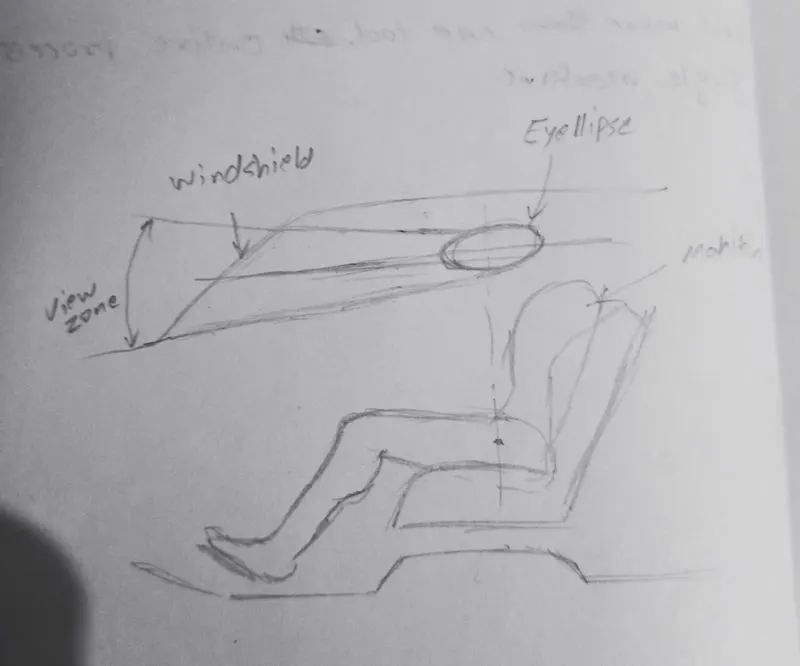
3. E-point - It represents the left and right eye of a driver.
4. P-point - this represends the nek pivot point
5. the area of the eyellipse is alculated using E, P points.
6. Eyellipse calculation-
Distance between E points= 65 mm
Distance to p point from line joining E points= 98mm
7. Seating reference point
8. H-point- A point that represents the pivot pivot point of an oscar thigh and torso is known as Design H point.
9. SgRP establishes the rearmost normal design driving or riding position of the each designated seating position. SgRP is used as the origin for H point.
10. Heel point represents the reference area of which the heel is placed.
11. Oscar is the name given to the 2D and 3D devices used to define and measure vehicle-seating accommodation.
12. Oscar is a coomon name for the testing devices whereas the 2D device is called the Oscar template.
13. Design H point is stable point that match the seat reference point, and actual H point is calclated using the oscar templet.
14. The principal area which the H point can travel through when the seat is adjusted is called H point window.
15. Types of oscar-
1. 2d device- oscar templet
2. 3d device- oscar machine
16. 225 lbs
17. The importance of H-Point :
-Seat Design has a direct effect on the occupant's relationship to other vehicle controls.
-Careful measurements & testing are required to ensure occupant positioning adheres to OEM Specification.
-Over time the H-Point shifts because of deterioration of seat, particularly of the Foam.
18. Tolerence is given as a distance range which the H point may move as time goes on.
19. D-Point: The D-Point is the lowest point on the buttock contour of the seated Oscar template or Oscar machine in the installed position.
20. AHP- Accelerator Heel point - It gives the heel point of oscar on pedal and foot angle of minimum 85 degree.
21. Reaching distance of hand of an average driver population is taken as hand reach envelope.
22. There are two types of driver hand controls:
1- Primary Driver Hand Controls: Wearing a lap & shoulder belt in driving position
2-Secondary Driver Hand Controls: Wearing a lap belt.
Primary DHC-
1-Steering Control
2- Gearshift Control
3- Turn Signal Control
4-Ignition Control
5-Audible Horn
6- Headlamp Control
7- Hand Break
8-Wiper/Defroster Control
Secondary DHC
1-Climate Control
2- Radio Control
3- Accessory Control
23.
Back Angle: The back angle is the angle of recline of the torso line relative to the vertical. Back angle doesn't measure the angle of the seat structure.
Cushion Angle: The Cushion angle is the angle of incline for the cushion relativento horizontal. The cushion angle helps determine the amount of thigh support the occupant will have.
24.Ischium: The ischium is the lowest of three major bones comprising each half of the pelvis. It is part of the body that support you when you sit in the seat.
25. A condition called "Tail Burn" when an occupant is seated for an extended period of time. The cushion should be designed to prevent tail burn.
26. it gives support to the lumber region of your back on a seat.
27.
OEM provides the following to be used in seat design :
1-Seating reference point
2- Foot Angle
3- Knee Angle
4- Heel Point
5- Hip Point
6- Back Angle
1. Function of a seat-
1- Support the Occupant
2- Position the Occupant
3- Provide comfort for the occupant
4- Protect the occupant
2. Seats will have all the ergonomical features to support all parts required parts of body safely and comfortably.
3. Position the occupant :
The position of the occupant is extremely important to safe vehicle operation. There are three key elements to occupant position :
1-Hand, arm and Leg room
2-Field of vision
3-Driver proximity to hand controls
4. The seat must be designed to provide comfort for the occupant.
Factors that must be research on comfort are done are:
1- Determining the amount of Seat padding
2- Locating and avoiding hard points in the seat
3-Determining the angle of the seat back and cushion
4-Deciding on the correct amount of Thigh & Lumber support
5-Establishing seat width and Height
5. ILD= Intendation load deflection.
ILD is defined as the measurement process to assess the firmness of the seat