Vehicle Ride 2
Given:
Total Weight = 1900 Kg
F/R distribution = 55%
Unsprung Mass Front = 90 Kg
Unsprung Mass Rear = 60 Kg
1.A. Sprung mass critical damping for Front:
Ks = 20 N/mm
Wheel rate(Kw) = Ks * (motion ratio)^2
= 20*0.97^2
= 18.818 N/mm
Kt = 250 N/mm
Equivalent stiffness(Keq) = `(Kw*Kt)/(Kw+Kt)`
= 17500.68 N/m
Front mass = 55% of 1900
= 1045 Kg
Front sprung mass = 1045 - 90
= 955 Kg
For a quarter car model, sprung mass at each wheel(Mfs) = 955/2
= 477.5 Kg
Critical damping for front sprung mass = `2*sqrt(Keq*Mfs)`
= 5781.54 Ns/m
1.B. Sprung mass critical damping for Rear:
Ks = 30 N/mm
Wheel rate(Kw) = Ks * (motion ratio)^2
= 30 * 0.85^2
= 21.675 N/mm
Kt = 250 N/mm
Equivalent stiffness(Keq) = `(Kw*Kt)/(Kw+Kt)`
= 19945.70 N/m
Rear mass = 45% of 1900
= 855 Kg
Rear sprung mass = 855 - 60
= 795 Kg
For a quarter car model, sprung mass at each wheel(Mrs) = 795/2
= 397.5 Kg
Critical damping for front sprung mass = `2*sqrt(Keq*Mrs)`
= 5631.48 Ns/m
2.A. UnSprung mass critical damping for Front:
Ks = 20 N/mm
Wheel rate(Kw) = Ks * (motion ratio)^2
= 20*0.97^2
= 18.818 N/mm
Kt = 250 N/mm
Equivalent stiffness(Keq) = `(Kw+Kt)`
= 268818 N/m
Front mass = 90 Kg
For a quarter car model, Unsprung mass at each wheel(Mfus) = 90/2
= 45 Kg
Critical damping for front Unsprung mass = `2*sqrt(Keq*Mfus)`
= 6956.09 Ns/m
2.B. UnSprung mass critical damping for Rear:
Ks = 30 N/mm
Wheel rate(Kw) = Ks * (motion ratio)^2
= 30 * 0.85^2
= 21.675 N/mm
Kt = 250 N/mm
Equivalent stiffness(Keq) = `(Kw+Kt)`
= 271675 N/m
Rear mass = 60 Kg
For a quarter car model, Unsprung mass at each wheel(Mrus) = 60/2
= 30 Kg
Critical damping for front Unsprung mass = `2*sqrt(Keq*Mrus)`
= 5709.72 Ns/m
3. Sprung mass initial damping coefficient for front = Sprung mass damping ratio front * Critical damping for front sprung mass
= 0.70 * 5781.54
= 4047.07 Ns/m
Sprung mass initial damping coefficient for rear = Sprung mass damping ratio rear * Critical damping for rear sprung mass
= 0.70 * 5631.48
= 3942.03 Ns/m
4. UnSprung mass initial damping coefficient for front = UnSprung mass damping ratio front * Critical damping for front Unsprung mass
= 0.20 * 6956.09
= 1319.21 Ns/m
UnSprung mass initial damping coefficient for rear = UnSprung mass damping ratio rear * Critical damping for rear Unsprung mass
= 0.20 * 5709.72
= 1141.94 Ns/m
5. Initial damping = Average of rebounce and compression damping
= (R +C)/2
R/C = 3 (For all speed)
= (3C + C)/2
= 2C
So, compression damping is half of initial damping.
Front low speed compression damping coefficient = 4047.08/2
= 2023.54 Ns/m
Rear low speed compression damping coefficient = 3942.04/2
= 1971.02 Ns/m
6. Front high speed compression damping coefficient = 1391.21/2
= 695.60 Ns/m
Rear high speed compression damping coefficient = 1141.94/2
= 570.47 Ns/m
7. Front low speed rebounce damping coefficient = 3*low speed compression damping coefficient in front
= 6070.62 Ns/m
Rear low speed rebounce damping coefficient = 3*low speed compression damping coefficient in rear
= 5913.06 Ns/m
8. Front high speed rebounce damping coefficient =3*high speed compression damping coefficient in front
= 2086.8 Ns/m
Rear high speed rebounce damping coefficient =3*high speed compression damping coefficient in rear
= 1711.41 Ns/m
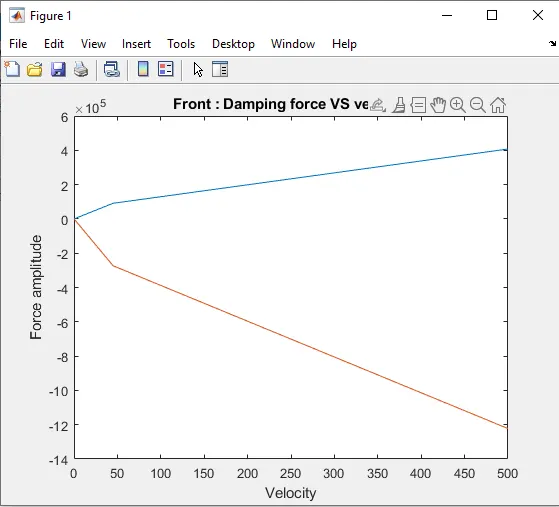
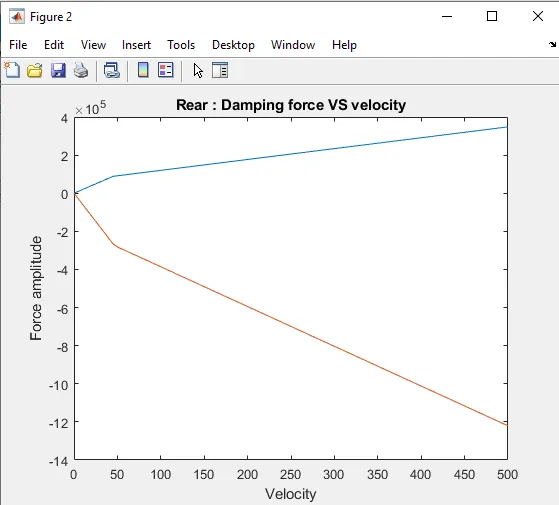
2. Using the information calculated above, come up with a force vs. velocity shock curve for the front and rear suspensions (velocity range = 0 to 500 mm/sec)
Answer: Matlab script is given below:
clear all
close all
clc
cdamp_low_front = 2023.54;
cdamp_low_rear = 1971.02;
cdamp_high_front = 695.60;
cdamp_high_rear = 570.47;
rdamp_low_front = 6070.62;
rdamp_low_rear = 5913.06;
rdamp_high_front = 2086.8;
rdamp_high_rear = 1711.41;
vel = (0:5:500);
t=1;
for i = 1:101
if i==1
cforce_front(t) = 0;
cforce_rear(t) = 0;
rforce_front(t) = 0;
rforce_rear(t) = 0;
elseif i<=10
cforce_front(t) = cdamp_low_front*vel(i);
rforce_front(t) = -rdamp_low_front*vel(i);
cforce_rear(t) = cdamp_low_rear*vel(i);
rforce_rear(t) = -rdamp_low_rear*vel(i);
else i>10
cforce_front(t) = cforce_front(t-1)+(vel(i)-vel(i-1))*cdamp_high_front;
rforce_front(t) = rforce_front(t-1)-(vel(i)-vel(i-1))*rdamp_high_front;
cforce_rear(t) = cforce_rear(t-1)+(vel(i)-vel(i-1))*cdamp_high_rear;
rforce_rear(t) = rforce_front(t-1)-(vel(i)-vel(i-1))*rdamp_high_rear;
end
t=t+1;
end
figure(1)
plot(vel,cforce_front)
hold on
plot(vel,rforce_front)
hold off
xlabel('Velocity')
ylabel('Force amplitude')
title('Front : Damping force VS velocity')
figure(2)
plot(vel,cforce_rear)
hold on
plot(vel,rforce_rear)
hold off
xlabel('Velocity')
ylabel('Force amplitude')
title('Rear : Damping force VS velocity')
Result: