Understanding the concepts on Degrees of Freedom
Question 1:
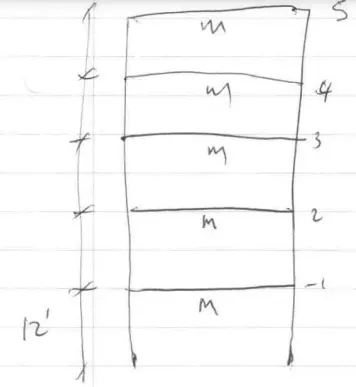
A five-story structure with 5 translational DOF is shown here. Each story has mass ‘m’. The eigenvalue problem has been solved and the 5 periods of vibration Tn and their corresponding mode shapes, φn has been derived.
SOLUTION:
As given in the question,
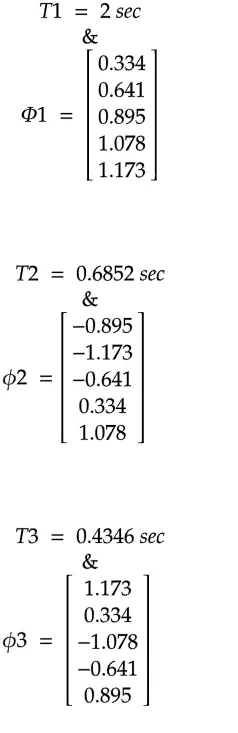
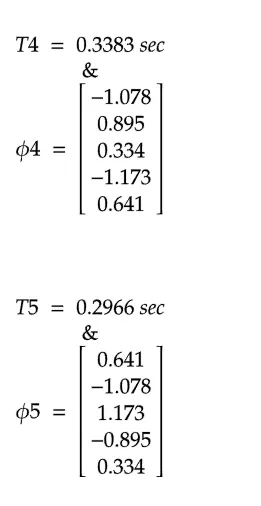
CALCULATING Mn: (Modal Mass)
The expression for computing value of Mn is as follows:
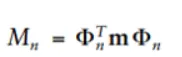
Now, by substituting the relevant values in the above formula we get the following results for each mode shape.
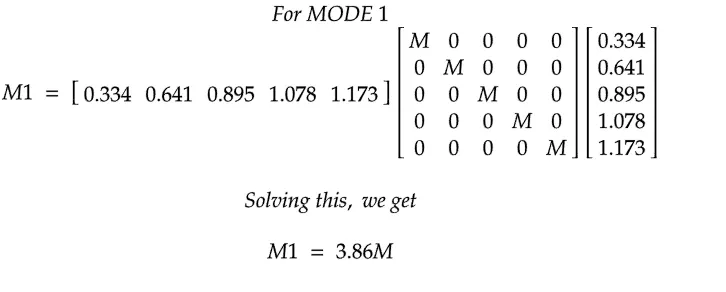
Using the same approach executed above, the following values for Mn related to every mode shape were obtained.
M2 = 3.861M
M3 = 3.85M
M4 = 3.86M
M5 = 3.86M
CALCULATING Ln:
As we know that the formula for obtaining Ln is given as:
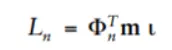
Substituting the relevant values for each modal shape, we get:
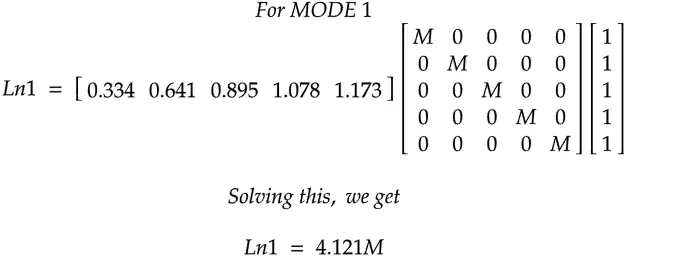
Now, following the same approach executed above for the remaining modes, we get the following values for the Ln corresponding to the respective modal shape.
Ln2 = -1.297
Ln3 = 0.687
Ln4 = -0.381
Ln5 = 0.175
CALCULATING Mn*: (Effective Modal Mass)
The formula for calculating Mn* goes as follows,
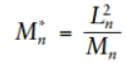
Substituting the relevant values for mode 1, we get:
M1* = Ln1^2/M1 = (4.121M)^2/3.86M = 4.39
Similarly,
M2* = 0.43
M3* = 0.12
M4* = 0.03
M5* = 0.008
CALCULATING THE MODAL PARTICIPATION RATIO:
The modal participation ratio = Mn*/Mj
here, Mj = total lumped mass present in the structure which is equal to 5 in the given five-story frame.
Therefore, the following values were obtained for the respective modal shapes,
The ratio for mode 1 = 4.39 / 5 = 0.88
Similarly,
For mode 2 = 0.086
For mode 3 = 0.024
For mode 4 = 0.006
For mode 5 = 0.001
CALCULATING MODAL PARTICIPATION FACTOR: Γn
The formula goes as follows for calculating Γn,
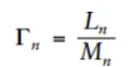
Substituting the relevant values for the first mode shape, we get:
Γ1 = L1/M1 = 4.121M/3.86M = 1.067
Similarly,
Γ2 = -0.335
Γ3 = 0.177
Γ4 = -0.098
Γ5 = 0.045
CALCULATING THE PSEUDO ACCELERATION: An
The relative value for An can be obtained from the graphical representation given in the question,
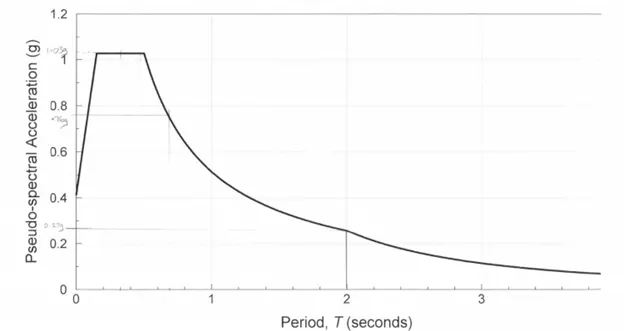
From the above graph, we can compute the following values for the pseudo acceleration for each mode deflection.
A1 = 0.3
A2 = 0.76
A3 = 1.03
A4 = 1.03
A5 = 1.03
CALCULATING THE Vbn:
The formula is,
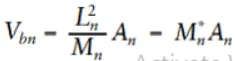
Substituting the relevant values for each mode, we get the following results:
Vb1 = (L1^2/M1)A1 = M1*.A1 = 4.39 x 0.3 = 1.317
Similarly,
Vb2 = 0.327
Vb3 = 0.124
Vb4 = 0.061
Vb5 = 0.008
OBTAINING THE TOTAL RELATIVE BASE SHEAR FOR THE ENTIRE STRUCTURE:
As we have got five different base shear values relating to each modal deflection. So, we need to combine it into a single relevant applicable base shear force. And the same is done by applying the SRSS rule.
Therefore, by applying the SRSS rule,
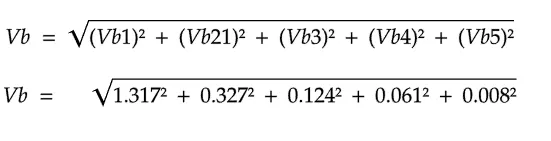
= 1.364
- How many modes are to be considered such that a modal mass participating ratio of 90% is obtained?
As indicated by the modal participation ratio calculated in one of the previous sections, the modal participation ratio for the first mode is 0.88 which means it accounts for 88% of the total deflection taking place.
Similarly,
The modal participation ratio for the second mode is 0.086 = 8.6%
Thus, when we combine both these values, we get:
88 + 8.6 = 96.6 > 90%
Hence, we only need to consider the first two modes in order to obtain the modal participating ratio of more than 90%.