Understanding the concepts on Degrees of Freedom
Ans-
From the given data from question,
Each floor having mass m,
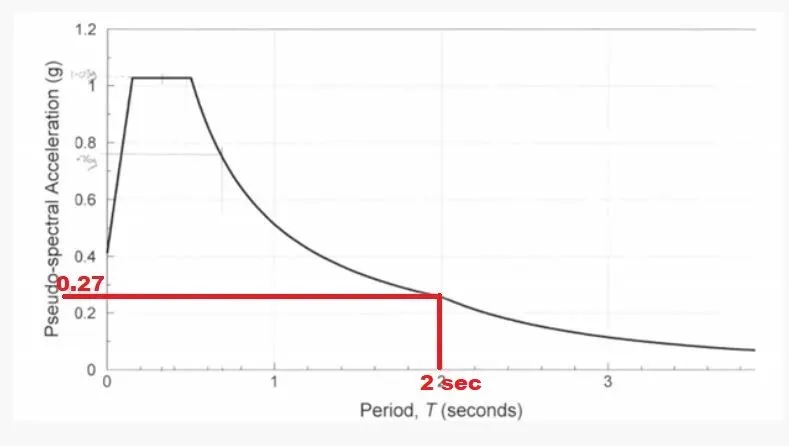
The fundamental period of vibration T1= 2 seconds and its associated mode shape is
`phi1= [(0.334), (0.541), (0.895), (1.078), (1.173)]`
The second mode of vibration having time period T2= 0.6852 seconds and its associated mode shape is
`phi2= [(-0.895), (-1.173), (-0.641), (0.334), (1.078)]`
The third mode of vibration having time period T3= 0.4346 seconds and its associated mode shape is
`phi3= [(1.173), (0.334), (-1.078), (-0.641), (0.895)]`
The fourth mode of vibration having time period T4= 0.3383 seconds and its associated mode shape is
`phi4 = [(-1.078), (0.895), (0.334), (-1.173), (0.641)]`
The fifth mode of vibration having time period T5= 0.2966 seconds and its associated mode shape is
`phi5= [(0.641), (-1.078), (1.173), (-0.895), (0.334)]`
Calculation of modified mass matrix (M) and modal property (L) of first mode i.e. n=1
Mass matrix (m)= `[[m, 0, 0, 0, 0], [0, m, 0, 0, 0], [0, 0, m, 0, 0], [0, 0, 0, m, 0], [0, 0, 0, 0, m]]`
Modified mass matrix [M]= `phi^T.m.phin`
for the first mode n=1, M1=
`[[0.334, 0.541, 0.895, 1.078, 1.173]] [[m, 0, 0, 0, 0], [0, m, 0, 0, 0], [0, 0, m, 0, 0], [0, 0, 0, m, 0], [0, 0, 0, 0, m]] [(0.334), (0.541), (0.895), (1.078), (1.173)]`
M1= 3.861 m
Modal property (L)= `phi^T.m.i`
Where i is the influence factor, i= `[(1), (1), (1), (1), (1)]`
For the first mode n=1,
L1= `[[0.334, 0.541, 0.895, 1.078, 1.173]] [[m, 0, 0, 0, 0], [0, m, 0, 0, 0], [0, 0, m, 0, 0], [0, 0, 0, m, 0], [0, 0, 0, 0, m]] [(1), (1), (1), (1), (1)]`
L1= 4.021 m
Calculation of modified mass matrix (M) and modal property (L) of second mode i.e. n=2
Modified mass matrix `(M)= phi^T.m.phin`,
M2=
`[[-0.895, -1.173, -0.641, 0.334, 1.078]] [[m, 0, 0, 0, 0], [0, m, 0, 0, 0], [0, 0, m, 0, 0], [0, 0, 0, m, 0], [0, 0, 0, 0, m]] [(-0.895), (-1.173), (-0.641), (0.334), (1.078)]`
M2= 3.861 m
Modal property `(L)= phi^T.m.i`
Where i is the influence factor,`i= [(1), (1), (1), (1), (1)]`
For the first mode n=2,
`L2= [[-0.895, -1.173, -0.641, 0.334, 1.078]] [[m, 0, 0, 0, 0], [0, m, 0, 0, 0], [0, 0, m, 0, 0], [0, 0, 0, m, 0], [0, 0, 0, 0, m]] [(1), (1), (1), (1), (1)]`
L2= -1.297 m
Calculation of modified mass matrix (M) and modal property (L) of third mode i.e. n=3
Modified mass matrix `(M)= phi^T.m.phin`
M3=
`[[1.173, 0.334, -1.078, -0.641, 0.895]] [[m, 0, 0, 0, 0], [0, m, 0, 0, 0], [0, 0, m, 0, 0], [0, 0, 0, m, 0], [0, 0, 0, 0, m]] [(1.173), (0.334), (-1.078), (-0.641), (0.895)]`
M3= 3.861 m
Modal property `(L)= phi^T.m.i`
Where i is the influence factor, `i= [(1), (1), (1), (1), (1)]`
For the first mode n=2,
`L3= [[1.173, 0.334, -1.078, -0.641, 0.895]] [[m, 0, 0, 0, 0], [0, m, 0, 0, 0], [0, 0, m, 0, 0], [0, 0, 0, m, 0], [0, 0, 0, 0, m]] [(1), (1), (1), (1), (1)]`
L3= 0.683 m
Calculation of modified mass matrix (M) and modal property (L) of fourth mode i.e. n=4
Modified mass matrix `(M)= phi^T.m.phin`
M4=
`[[-1.078, 0.895, 0.334, -1.173, 0.641]] [[m, 0, 0, 0, 0], [0, m, 0, 0, 0], [0, 0, m, 0, 0], [0, 0, 0, m, 0], [0, 0, 0, 0, m]] [(-1.078), (0.895), (0.334), (-1.173), (0.641)]`
M4= 3.861 m
Modal property `(L)= phi^T.m.i`
Where i is the influence factor, `i= [(1), (1), (1), (1), (1)]`
For the first mode n=2,
`L4= [[-1.078, 0.895, 0.334, -1.173, 0.641]] [[m, 0, 0, 0, 0], [0, m, 0, 0, 0], [0, 0, m, 0, 0], [0, 0, 0, m, 0], [0, 0, 0, 0, m]] [(1), (1), (1), (1), (1)]`
L4= -0.381 m
Calculation of modified mass matrix (M) and modal property (L) of fifth mode i.e. n=5
Modified mass matrix `(M)= phi^T.m.phin`
M5=
`[[0.641, -1.078, 1.173, -0.895, 0.334]] [[m, 0, 0, 0, 0], [0, m, 0, 0, 0], [0, 0, m, 0, 0], [0, 0, 0, m, 0], [0, 0, 0, 0, m]] [(0.641), (-1.078), (1.173), (-0.895), (0.334)]`
M5= 3.861 m
Modal property `(L)= phi^T.m.i`
Where i is the influence factor, `i= [(1), (1), (1), (1), (1)]`
For the first mode n=2,
`L5= [[0.641, -1.078, 1.173, -0.895, 0.334]] [[m, 0, 0, 0, 0], [0, m, 0, 0, 0], [0, 0, m, 0, 0], [0, 0, 0, m, 0], [0, 0, 0, 0, m]] [(1), (1), (1), (1), (1)]`
L5= 0.175 m
Calculation of Modal participation factor for first mode i.e. n=1,
Modal participation factor `(Gamma)= L/M`
For the first mode, n=1 and `Gamma1= (L1)/ (M1)`
`Gamma1= (4.021 m)/ (3.861 m)`
`Gamma1= (1.041)`
Calculation of Modal participation factor for second mode i.e. n=2,
Modal participation factor `(Gamma)= L/M`
For the second mode, n=2 and `Gamma2= (L2)/ (M2)`
`Gamma2= (-1.297 m)/ (3.861 m)`
`Gamma2= (-0.336)`
Calculation of Modal participation factor for third mode i.e. n=3,
Modal participation factor `(Gamma)= L/M`
For the third mode, n=3 and `Gamma3= (L3)/ (M3)`
`Gamma3= (0.683 m)/ (3.861 m)`
`Gamma3= (0.177)`
Calculation of Modal participation factor for fourth mode i.e. n=4,
Modal participation factor `(Gamma)= L/M`
For the fourth mode, n=4 and `Gamma4= (L4)/ (M4)`
`Gamma4= (-0.381 m)/ (3.861 m)`
`Gamma4= (-0.099)`
Calculation of Modal participation factor for fifth mode i.e. n=5,
Modal participation factor `(Gamma)= L/M`
For the fifth mode, n=5 and `Gamma5= (L5)/ (M5)`
`Gamma5= (0.175 m)/ (3.861 m)`
`Gamma5= (0.045)`
Calculation of Effective modal mass for first mode i.e. n=1,
Effective modal mass`(M^**) = (L n^2)/ (Mn)`
For the first mode, n=1
Effective modal mass `(M1^**) = (L1^2)/ (M1)`
`(M1^**) = ((4.021 m)^2)/ (3.861 m)`
`M1^**= 4.188 m`
Calculation of Effective modal mass for second mode i.e. n=2,
Effective modal mass `(M^**) = (L n^2)/ (Mn)`
For the first mode, n=2
Effective modal mass `(M2^**) = (L2^2)/ (M2)`
`(M2^**) = ((-1.297 m) ^2)/ (3.861 m)`
`M2^**= 0.436 m`
Calculation of Effective modal mass for third mode i.e. n=3,
Effective modal mass `(M^**) = (L n^2)/ (Mn)`
For the first mode, n=3
Effective modal mass `(M3^**) = (L3^2)/ (M3)`
`(M3^**) = ((0.683m) ^2)/ (3.861 m)`
`M3^**= 0.121 m`
Calculation of Effective modal mass for fourth mode i.e. n=4,
Effective modal mass `(M^**) = (L n^2)/ (Mn)`
For the first mode, n=4
Effective modal mass `(M4^**) = (L4^2)/ (M4)`
`(M4^**) = ((-0.381 m) ^2)/ (3.861 m)`
`M4^**= 0.038 m`
Calculation of Effective modal mass for fifth mode i.e. n=5,
Effective modal mass `(M^**) = (L n^2)/ (Mn)`
For the first mode, n=5
Effective modal mass `(M5^**) = (L5^2)/ (M5)`
`(M5^**) = ((0.175m) ^2)/ (3.861 m)`
`M5^**= 0.008 m`
Calculation of modal participation ratio
Modal mass participation ratio = `(Mn^**)/ (mj)`
Where mj= total mass of the building = m+ m+ m+ m+ m= 5m
Modal mass participation ratio for first mode (n=1) = `(4.188 m)/ (5 m) = 0.8376`
Modal mass participation ratio for second mode (n=2) = `(0.436 m)/ (5 m) = 0.0872`
Modal mass participation ratio for third mode (n=3) = `(0.121 m)/ (5 m) = 0.0242`
Modal mass participation ratio for fourth mode (n=4) = `(0.038 m)/ (5 m) = 0.0076`
Modal mass participation ratio for fifth mode (n=5) = `(0.008 m)/ (5 m) = 0.0016`
Adding First two mode mass participation ratio, we get `0.8376+ 0.0872= 0.9248` i.e. 92.48%.
To achieve minimum 90% of modal mass participation ratio, the first two modes are enough.
Base shear calculation,
Base shear `(Vb)= (Mn^**)* (An)`
Where An = pseudo spectral acceleration
For the first mode (n=1),
`Vb1= ((4.398 m) * (0.27 g))`
Vb1= 1.187 mg
An is observed from graph for 2 sec time period
For the second mode (n=2),
An is observed from graph for 0.6852 sec time period,
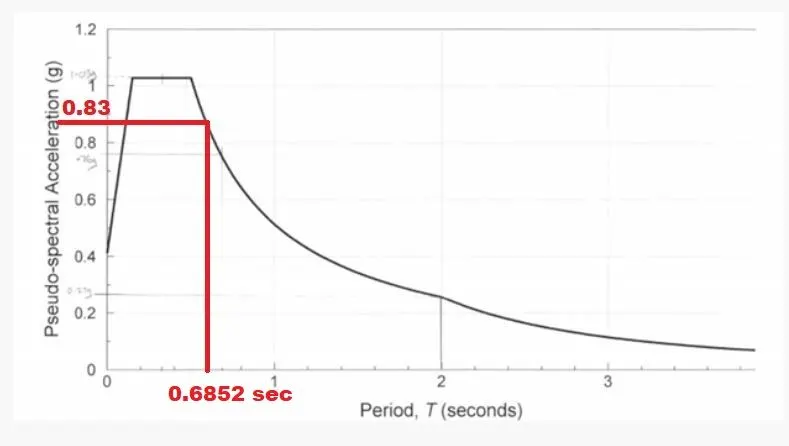
`Vb2= ((0.436 m) * (0.83 g))`
Vb2= 0.362 mg
For the third mode (n=3),
An is observed from graph for 0.4346 sec time period
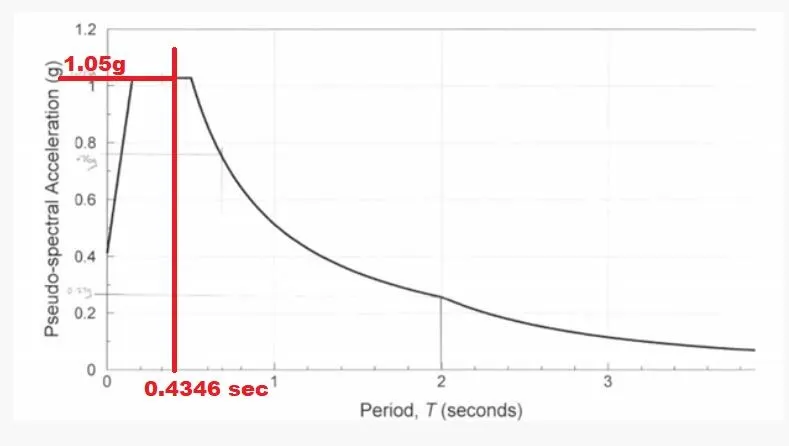
`Vb3= ((0.121 m) * (1.05 g))`
Vb3= 0.127 mg
For the fourth mode (n=4),
An is observed from graph for 0.3383 sec time period
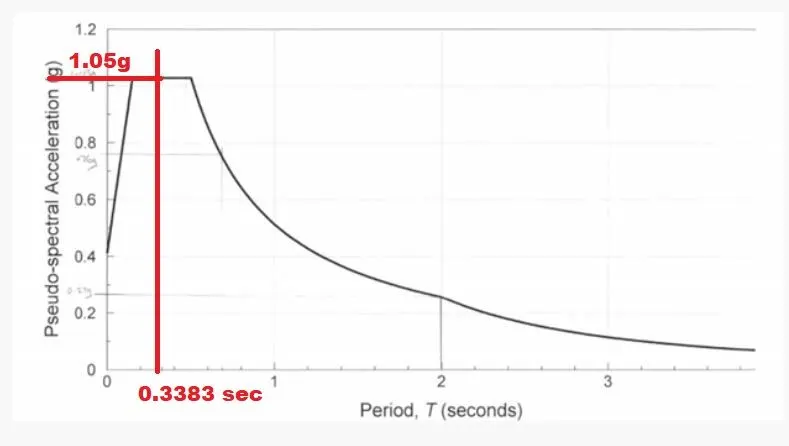
`Vb4= ((0.038 m) * (1.05 g))`
Vb4= 0.04 mg
For the fifth mode (n=5),
An is observed from graph for 0.2966 sec time period
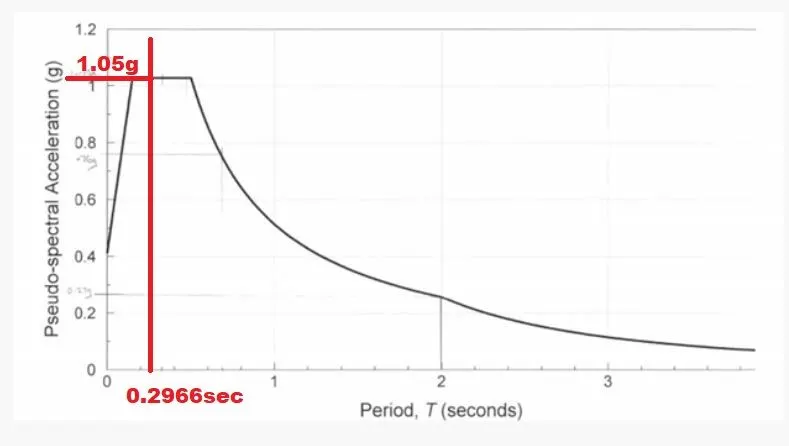
`Vb5= ((0.008 m) * (1.05 g))`
Vb5= 0.0084 mg
Average base shear is calculated by the method of square root of sum of square,
`Vb= sqrt((Vb1^2)+ (Vb2^2)+ (Vb3^2)+ (Vb4^2)+ (Vb5^2))`
`Vb= sqrt((1.131^2)+ (0.362^2)+ (0.127^2)+ (0.04^2)+ (0.0084^2))`
`Vb= sqrt(1.428)`
`Vb= 1.195 mg`