Understanding the concepts on Degrees of Freedom
AIM:
To compute Ln , Mn and Γn for each of the five modes from the given equations.To calculate the effective modal mass Mn* and the modal mass participating ratio for the 5 modes.To obtain the base shear for each of the 5 modes of vibration and the combined base shear as per SRSS rule.
INTRODUCTION:
Degrees of freedom refers to the maximum number of logically independent values, which are values that have the freedom to vary, in the data sample. Degrees of freedom is calculated by subtracting one from the number of items within the data sample.
PROCEDURE:
Step 1: Mn = ønTmøn
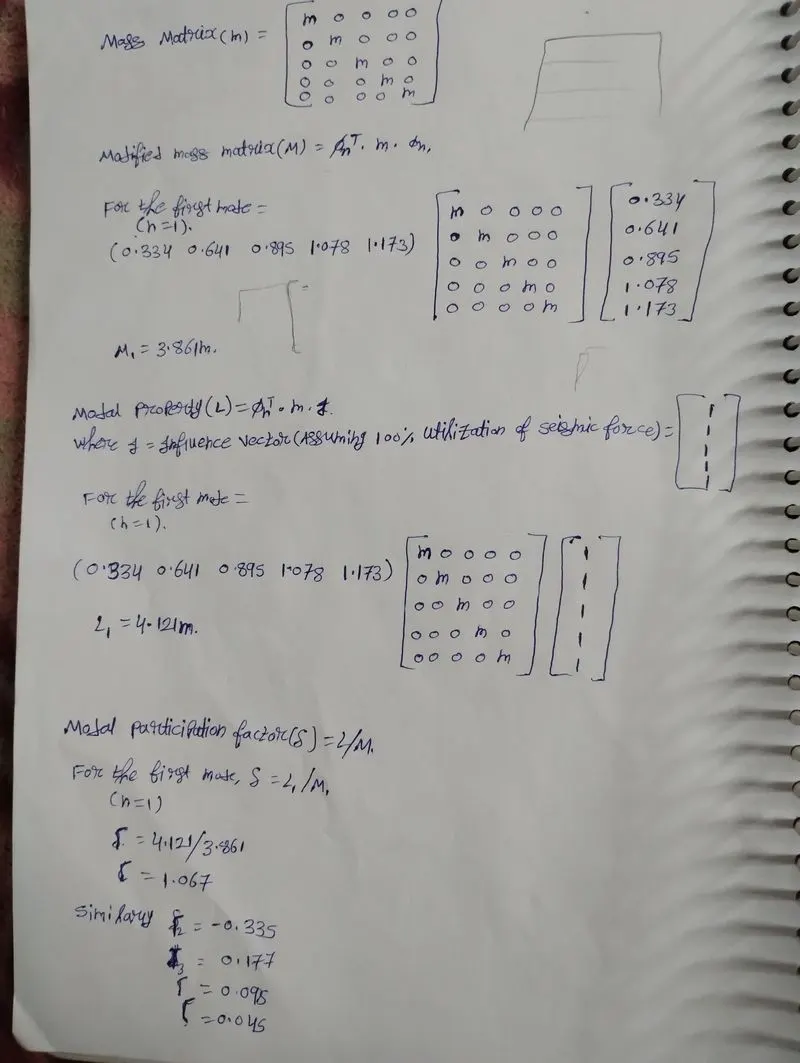
Mode 1:
Mode of vibration, T1 = 2 sec
M1 = ø1Tm ø1
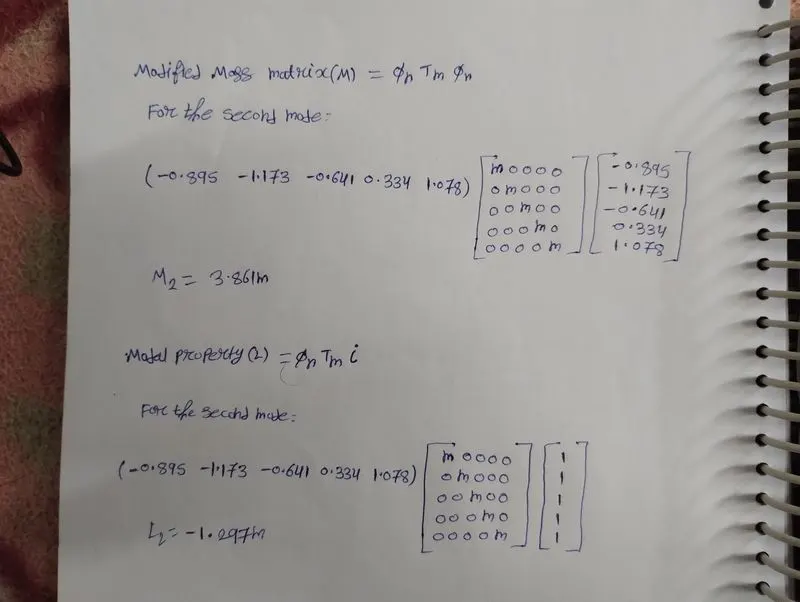
Mode 2:
Mode of vibration, T2 = 0.6852 sec
M2 = ø2Tmø2
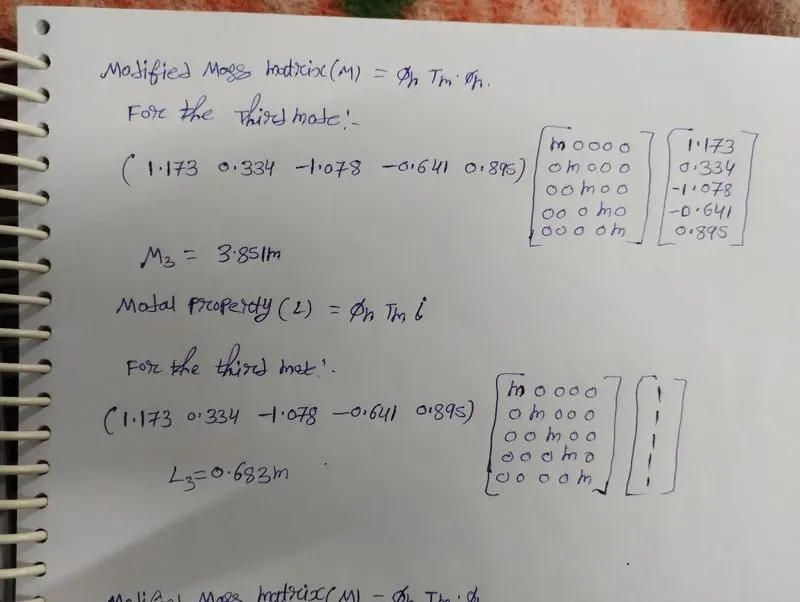
Mode 3:
Mode of vibration, T3 = 0.4346 sec
M3 = ø3Tmø3
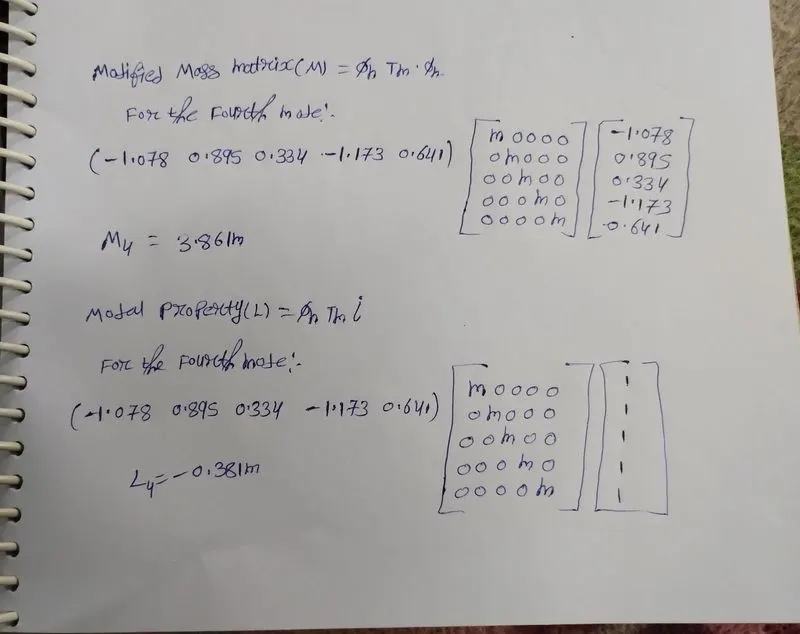
Mode 4:
Mode of vibration, T4 = 0.3383 sec
M4= ø4Tm ø4
Mode 5:
Mode of vibration, T5 = 0.2966 sec
M5= ø5Tmø5
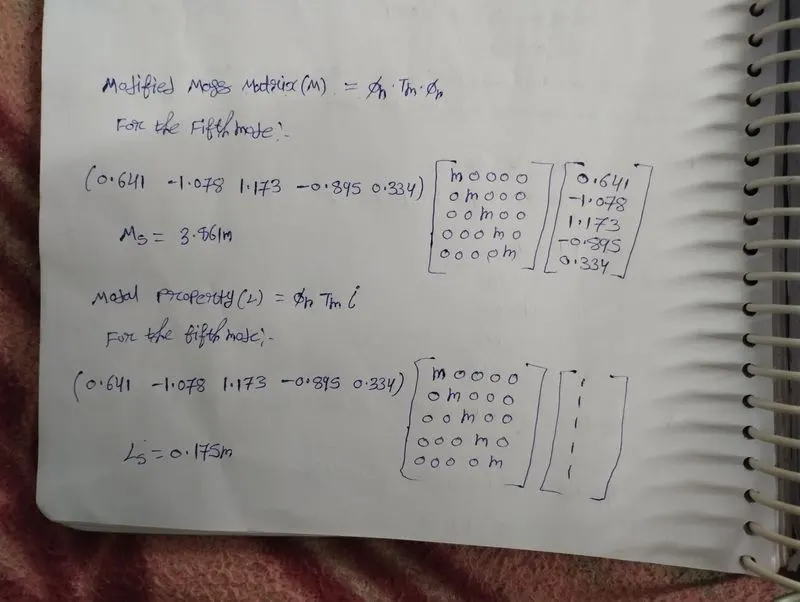
Step 2: To find Ln
Ln =ønTmI
Mode 1:
Mode of vibration, T1 = 2 sec
L1 =ø1TmI
Mode 2:
Mode of vibration, T2 = 0.6852 sec
L2 =ø2TmI
Mode 3:
Mode of vibration, T3 = 0.4346 sec
L3 =ø3TmI
Mode 4:
Mode of vibration, T4 = 0.3383 sec
L4 = ø4TmI
Mode 5:
Mode of vibration, T5 = 0.2966 sec
L5 =ø5TmI
Step 3:
Modal participation factor (Γ) :
Γ = L/M
Γ1 =L1/M1 = 1.067
Γ2 =L2/M2 = -0.335
Γ3= L3/M3 = 0.178
Γ4 = L4/M4 = 0.095
Γ5 = L5/M5 = 0.045
Step 4:
Finding Effective modal mass, (M) :
M = Ln2 /Mn
M1 = L12 / M1 = 4.398M
M2 = L22 / M2 = 0.436M
M3 = L32 / M3 = 0.12M
M4 = L42 / M4 = 0.038M
M5 = L52 / M5 = 0.008M
Step 5:
Finding Modal mass participating ratio :
Modal mass participating ratio = Mn / Mj
M j = M+M+M+M+M = 5M
Modal mass participating ratio for Mode 1 = M1 / Mj = 0.879
Modal mass participating ratio for Mode 2 = M2 / Mj = 0.0872
Modal mass participating ratio for Mode 3 = M3 / Mj = 0.0242
Modal mass participating ratio for Mode 4 = M4 / Mj = 0.01
Modal mass participating ratio for Mode 5 = M5 / Mj = 0.002
Step 6:
To obtain the Base shear :
Vbn = Mn * An
For Mode 1
For T1 = 2 sec, A1 = 0.28g
Vb1 = M1 * A1 = 2.612
For Mode 2
For T2 = 0.6852 sec, A2 = 0.77g
Vb2 = M2 * A2 = 0.719
For Mode 3
For T3 = 0.4346 sec, A3 = 1.03g
Vb3 = M3* A3 = 0.272
For Mode 4
For T4 = 0.3383 sec, A4 = 1.03g
Vb4 = M4 * A4 = 0.067
For Mode 5
For T5 = 0.2966 sec, A5 = 0.77g
Vb5 = M5 * A5 = 0.011
Step 7:
Using Square root of sum of square:
Average base shear is calculated by the method of square of sum of square.
= √(Vb12+ Vb22+ Vb32+ Vb42+ Vb52)
= √(2.613)^2+(0.719)^2+(0.272)^2+(0.067)^2+(0.011)^2
= 3.2 kips
- The two modes are to be considered such that a modal mass participating ratio of 90% is obtained.
- M1∗Mj">M1∗MjM1∗Mj + M2∗Mj">M2∗MjM2∗Mj = 88% + 8.6% = 96.6%
RESULT:-
- Finallhy we Calculated Ln , Mn and Γn for each of the five modes from the given equations.
- Calculated the effective modal mass Mn* and the modal mass participating ratio for the 5 modes.
- The base shear for each of the 5 modes of vibration are obtained.
- As per SRSS rule the combined base shear is obtained.
- The two modes are to be considered such that a modal mass participating ratio of 90% is obtained.