Understanding the concepts on Degrees of Freedom
1. A five storey structure with 5 translational DOF is shown here. Each storey has mass ‘m’. The eigenvalue problem has been solved and the 5 periods of vibration Tn and their corresponding mode shapes, φn has been derived.
aim afive storey structure with 5 translational dof is shown herre. each storey has massm the eigenvalue problem hass been solved nd the 5 periods of vibration Tn and their corresponding mode shapes sigh n has been derived
The fundamental period of vibration (T1 = 2 seconds) and its associated mode shape:
The second mode of vibration (T2 = 0.6852 seconds) and its associated mode shap
The third mode of vibration (T3 = 0.4346 seconds) and its associated mode shape:
The fourth mode of vibration (T4 = 0.3383 seconds) and its associated mode shape:
The fifth mode of vibration (T4 = 0.2966 seconds) and its associated mode shape
answer

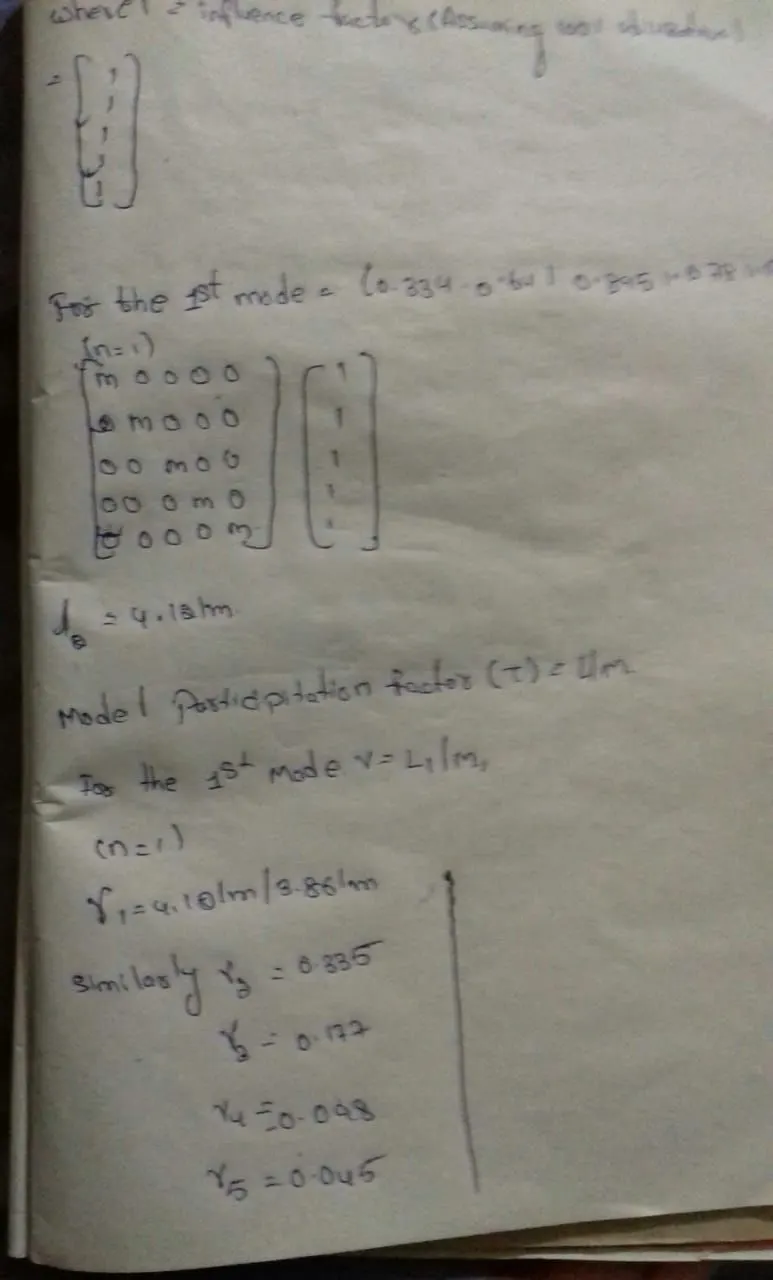
effective model space(M+) =Ln2/Mn
for the firstnode M*1=(L1)2/M1
M1* =(4.121m)2/3.861m
m1*=4.398m
similarly m2=0.436
m3* =0.121
m4* =0.038m
m5* =0.008m
modal mass participitation ratio mn*/mj
where mj= total mass of the building=m+m+m+m+m=5m
similarly second mode n=2=0.09
n=3 =0.02
n=4 =0.01
n=5= 0.002
adding first two mass participitation ratio wee get 0.88+0.09=0.97
to achieve minimum 90% of modal mass participitation ratio first two are enough
base shear vb=Mb*.An
for the first node vb1= 4.398mx0.27g
for n=1
vb1=1.187mg
similarly
vb2=0.327mg
vb3=0.126mg
vb4 =0.039mg
vb5 =0.008mg
average base shear is calculated by the method
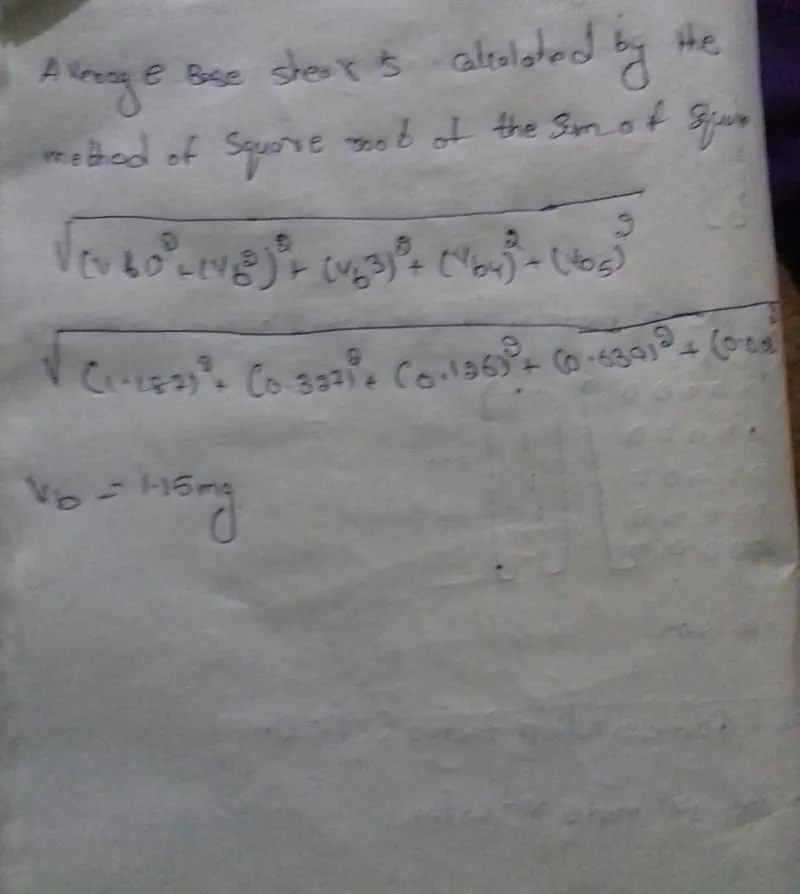
finally obtain the base shear vb=1.15mg