Understanding the concepts on Degrees of Freedom
Aim:
To compute the values of seismic parameters based on the given structural data
Step 1:
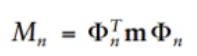
Mode 1 :
The first mode of vibration (T1) = 2 seconds
`Phi1 = [ [0.334], [0.64], [0.895], [1.078], [1.173] ]`
M1 = `Phi1^1 m Phi1`
= `[[0.334,0.064,0.895,1.078,1.173]][[M,0,0,0,0],[0,M,0,0,0],[0,0,M,0,0],[0,0,0,M,0],[0,0,0,0,M]][[0.334],[0.641],[0.895],[1.078],[1.173]]`
= 3.861 M
Mode 2:
The second mode of vibration (T2) = 0.6852 seconds
``Phi1 = [ [-0.895], [-1.173], [-0.641], [0.334], [1.078] ]``
M2 = `Phi2^1 m Phi2`
= `[[-0.895, -1.173, -0.641, 0.334, 1.078]][[M,0,0,0,0],[0,M,0,0,0],[0,0,M,0,0],[0,0,0,M,0|],[0,0,0,0,M]][[-0.895],[-1.173],[-0.641],[0.334],[1.078]]`
= 3.86 M
Mode 3:
The third mode of vibration T3 = 0.4346 seconds
`Phi3 = [ [1.173], [0.334], [-1.078], [-0.641], [0.895] ]`
M3 `= `Ph31^1 m Phi3`
= `[[1.173, 0.334, -1.078, -0.641, 0.895]][[M,0,0,0,0],[0,M,0,0,0],[0,0,M,0,0],[0,0,0,M,0|],[0,0,0,0,M]][[1.173],[0.334],[-1.078],[-0.641],[0.895]]`
= 3.85 M
Mode 4:
The fourth mode of vibration T4 = 0.3383 seconds
`M4 = Phi4^TmPhi4`
= `[[-1.078, 0.895, 0.334, -1.173, 0.641]][[M,0,0,0,0],[0,M,0,0,0],[0,0,M,0,0],[0,0,0,M,0|],[0,0,0,0,M]][[-1.078],[0.895],[0.334],[-1.173],[0.641]]`
= 3.861 M
Mode 5:
The fifth mode of vibration T5 = 0.2966 seconds
`M5 = Phi5^T m Phi5`
= `[[0.641, -1.078, 1.173, -0.895, 0.334]][[M,0,0,0,0],[0,M,0,0,0],[0,0,M,0,0],[0,0,0,M,0|],[0,0,0,0,M]][[0.641],[-1.078],[1.173],[-0.895],[0.334]]`
= 3.861 M
Step 2:
Ln = `Phin^Tm iota`
Mode 1:
T1 = 2 seconds
`Phi1 = [ [0.334], [0.64], [0.895], [1.078], [1.173] ]`
Ln = `Phi1 m iota`
= `[[0.334,0.641,0.895,1.078,1.173]][[M,0,0,0,0],[0,M,0,0,0],[0,0,M,0,0],[0,0,0,M,0],[0,0,0,0,M]][[1],[1],[1],[1],[1]]`
= 4.121M
Mode 2 :
T2 = 0.6852seconds
`Phi1 = [ [0.334], [0.64], [0.895], [1.078], [1.173] ]`
L2 = `Phi2 m iota`
= `[[-0.895, -1.173, -0.641, 0.334, 1.078]][[M,0,0,0,0],[0,M,0,0,0],[0,0,M,0,0],[0,0,0,M,0|],[0,0,0,0,M]][[1],[1],[1],[1],[1]]`
= -1.298 M
Mode 3:
T3 = 0.4346 seconds
`Phi3 = [ [1.173], [0.334], [-1.078], [-0.641], [0.895] ]`
L3 = `Phi3 m iota`
= `[[1.173, 0.334, -1.078, -0.641, 0.895]][[M,0,0,0,0],[0,M,0,0,0],[0,0,M,0,0],[0,0,0,M,0|],[0,0,0,0,M]][[1],[1],[1],[1],[1]]`
= 0.687 M
Mode 4:
T4 = 0.3383 seconds
L4 = `Phi4 m iota`
= `[[-1.078, 0.895, 0.334, -1.173, 0.641]][[M,0,0,0,0],[0,M,0,0,0],[0,0,M,0,0],[0,0,0,M,0|],[0,0,0,0,M]][[1],[1],[1],[1],[1]]`
= -0.381 M
Mode 5:
T5 = 0.2966 seconds
L5 = `Phi5 m iota`
= `[[0.641, -1.078, 1.173, -0.895, 0.334]][[M,0,0,0,0],[0,M,0,0,0],[0,0,M,0,0],[0,0,0,M,0|],[0,0,0,0,M]][[1],[1],[1],[1],[1]]`
= 0.175 M
Step 3:
Tn = Ln/Mn
Mode 1 = 4.121M/3.861M
= 1.067
Mode 2 = -1.298M/3.861M
= -0.33
Mode 3 = 0.687M/3.85M
= 0.178
Mode 4 = -0.381M/3.861M
= 0.09
Mode 5 = 0.175M/3.861M
= 0.004
Step 4:
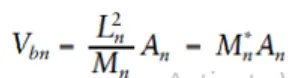
Mn* = Ln^2/Mn
Mode 1 = 4.121M^2 / 3.861 M
= 4.39M
Mode 2 = -0.298M^2 / 3.861 M
= 0.43M
Mode 3 = 0.687M^2 / 0.12 M
= 0.12M
Mode 4 = (-0.381M)^2 / 3.861 M
= 0.03 M
Mode 5 = 0.175M^2 / 3.861 M
= 0.007 M
Step 5:
Modal mass participating ratio = Mn*/ Mj
Mn* = Effective Modal Mass
Mj = Total Mass
= M + M + M + M + M
= 5M
Mode 1 = (4.39 M / 5 M) * 100
= 88%
Mode 2 = (0.43 M / 5 M) * 100
= 8.6 %
Mode 3 = (0.12 M / 5 M ) * 100
= 2.4 %
Mode 4 = ( 0.03 M / 5 M ) * 100
= 0.6 %
Mode 5 = (0.007 M / 5 M ) * 100
= 0.1 %
Step 6:
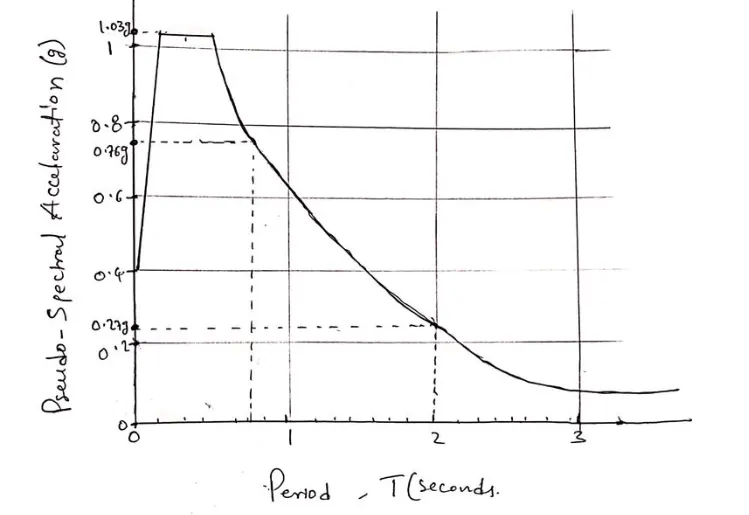
T1 =2 seconds A1 = 0.27 g
T2 = 0.6252 seconds A2 = 0.76g
T3 = 0.4346 seconds A3 = 1.03g
T4 = 0.3383 seconds A4 = 1.03g
T5 = 0.2966 seconds A5 = 0.76 g
Mode 1 : Vb1 = (4.39 x 0.27 )
= 2.629 kips
Mode 2 : Vb2 = (0.43 x 0.76 )
= 0.719 kips
Mode 3 : Vb3 = (0.12 x 1.03 )
= 0.272 kips
Mode 4 : Vb4 = (0.03 x 1.03 )
= 0.067 kips
Mode 5 : Vb5 = (0.007 x 0.76 )
= 0.011 kips
Steps 7 :
As per SRSS Rule
Vb = `sqrt((Vb1)^2+(Vb2)^2+(Vb3)^2+(Vb4)^2+(Vb5)^2)`
= `sqrt((2.613)^2+(0.719)^2+(0.272)^2+(0.067)^2+(0.011)^2)`
= 3.20 kips
Steps 8 :
The 2 modes are to beconsidered such that a modal mass particiating ratio is obtained as follow
M1*/Mj + M2*/Mj = (88 + 8.6) %
= 96.6 %
Result:
- Ln , Mn and Γn for each of the five modes are computed.
- Also, calculated the effective modal mass Mn* and the modal mass participating ratio for the 5 modes.
- Obtained the base shear for each of the 5 modes of vibration and the combined base shear as per SRSS rule.
- The 2 modes are to beconsidered such that a modal mass particiating ratio is obtained