Understanding the concepts on Degrees of Freedom
1Q]
AIM: -
- Compute `L_n`, `M_n` and `Gamma_n` for each of the 5 modes.
- Calculate the Effective Modal Mass Mn* and the Modal mass Participating Ratio for the 5 modes.
- Obtain the Base Shear for each of the 5 modes.
- Obtain the combined Base Shear as per SRSS rule.
- Calculate how many modes to be considered such that a modal mass participating ratio of 90% is obtained.
PROCEDURE: -
Given data:
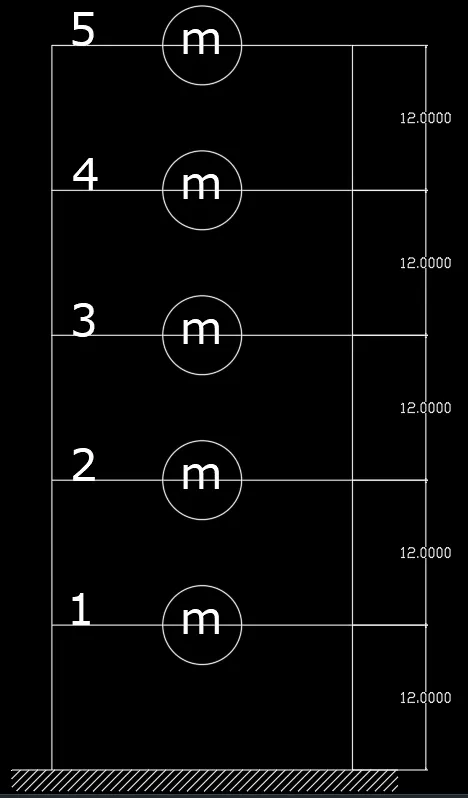
The fundamental period of vibration (T1 = 2 seconds) and its associated mode shape:
`phi_1 = ((0.334),(0.641),(0.895),(1.078),(1.173))`
The second mode of vibration (T2 = 0.6852 seconds) and its associated mode shape:
`phi_2 = ((0.895),(-1.173),(-0.641),(0.334),(1.078))`
The third mode of vibration (T3 = 0.4346 seconds) and its associated mode shape:
`phi_3 = ((1.173),(0.334),(-1.078),(-0.641),(0.895))`
The fourth mode of vibration (T4 = 0.3383 seconds) and its associated mode shape:
`phi_4 = ((-1.078),(0.895),(0.334),(-1.173),(0.641))`
The fifth mode of vibration (T5 = 0.2966 seconds) and its associated mode shape:
`phi_5 = ((0.641),(-1.078),(-1.173),(-0.895),(0.334))`
MASS MATRIX: -
`m = [[m,0,0,0,0],[0,m,0,0,0],[0,0,m,0,0],[0,0,0,m,0],[0,0,0,0,m]]`
- MODIFIED MASS MATRIX (M): -
To get modified Mass matrix we need to apply modal Orthogonality.
ORTHOGONALITY: -
Mode shape is defined as a particular example of the vibration executed by a mechanical framework at a particular frequency.
There are different mode shapes which are connected with various frequencies. The test system of modular examination finds these mode shapes and the frequencies.
Orthogonality makes the modular arrangements autonomous with normal mode shapes. It makes an entire set or a premise of the boundless arrangement of modular arrangements, so that, any self -assertive reaction can be shaped as a linear combination of these ordinary mode arrangements.
We use Orthogonality in converting a coupled equation in to a Decoupled equation.
Modified mass matrix for nth mode
`(M)_n = phi_n^T*m*phi_n`
For the First mode (n=1)
`(M)_1 = phi_1^T*m*phi_1`
`M_1`= `[0.334, 0.641, 0.895, 1.078, 1.173]`*`[[m,0,0,0,0],[0,m,0,0,0],[0,0,m,0,0],[0,0,0,m,0],[0,0,0,0,m]]`*`[[0.334],[0.641],[0.895],[1.078],[1.173]]`
`M_1 = [0.334, 0.641, 0.895, 1.078, 1.173]m`*`[[0.334],[0.641],[0.895],[1.078],[1.173]]`
`M_1 = 3.861m`
For the Second mode (n=2)
`(M)_2 = phi_2^T*m*phi_2`
`M_2`= `[-0.895, -1.173, -0.641, 0.334, 1.078]`*`[[m,0,0,0,0],[0,m,0,0,0],[0,0,m,0,0],[0,0,0,m,0],[0,0,0,0,m]]`*`[[-0.895],[-1.173],[-0.641],[0.334],[1.078]]`
`M_2 = `[-0.895, -1.173, -0.641, 0.334, 1.078]m`*[[-0.895],[-1.173],[-0.641],[0.334],[1.078]]`
`M_2 = 3.861m`
For the Third mode (n=3)
`(M)_3 = phi_3^T*m*phi_3`
`M_3`= `[1.173, 0.334, -0.1.078, -0.641, 0.895]`*`[[m,0,0,0,0],[0,m,0,0,0],[0,0,m,0,0],[0,0,0,m,0],[0,0,0,0,m]]`*`[[1.173],[0.334],[-1.078],[-0.641],[0.895]]`
`M_3 = `[1.173, 0.334, -0.1.078, -0.641, 0.895]m`*[[1.173],[0.334],[-1.078],[-0.641],[0.895]]`
`M_3 = 3.861m`
For the Fourth mode (n=4)
`(M)_4 = phi_4^T*m*phi_4`
`M_4`= `[-1.078, 0.895, 0.334, -1.173, 0.641]`*`[[m,0,0,0,0],[0,m,0,0,0],[0,0,m,0,0],[0,0,0,m,0],[0,0,0,0,m]]`*`[[-1.078],[0.895],[0.334],[-1.173],[0.641]]`
`M_4 = `[-1.078, 0.895, 0.334, -1.173, 0.641]m`*[[-1.078],[0.895],[0.334],[-1.173],[0.641]]`
`M_4 = 3.861m`
For the Fifth mode (n=5)
`(M)_5 = phi_5^T*m*phi_5`
`M_5`= `[0.641, -1.078, 1.173, -0.895, 0.334]`*`[[m,0,0,0,0],[0,m,0,0,0],[0,0,m,0,0],[0,0,0,m,0],[0,0,0,0,m]]`*`[[0.641],[-1.078],[1.173],[-0.895],[0.334]]`
`M_5 =`[0.641, -1.078, 1.173, -0.895, 0.334]m` *[[0.641],[-1.078],[1.173],[-0.895],[0.334]]`
`M_5 = 3.861m`
- MODAL PROPERTY OR EARTHQUAKE EXCITATION FACTOR (`L_n`): -
Li is an earthquake excitation factor, representing the extent to which the earthquake tends to excite response in mode i.
M i is called the modal mass.
The dimensionless factor L i/M i is the ratio of the response of an MDOF structure in a particular mode to that of an SDOF system with the same mass and period.
(L) = `phi_n^T*m*iota`
m = mass matrix
`phi_n` = mode shape (Eigen vector)
`iota` = influence vector
INFLUENCE VECTOR (`iota`): -
It is the vector of static displacements in the structural DOFs due to `U_(gl)` = 1.
It describes the influence of support displacements on the structural displacements
The definition of the influence vector is often given as a “displacement transformation vector that expresses the displacement of each structure degree of freedom due to static application of a unit support displacement” or something similar.
Influence vector represents the displacement of the masses resulting from static application of a unit ground displacement”
For the First mode (n=1)
`(L_1) =phi_1^T*m*iota`
`L_1`= `[0.334, 0.641, 0.895, 1.078, 1.173]`*`[[m,0,0,0,0],[0,m,0,0,0],[0,0,m,0,0],[0,0,0,m,0],[0,0,0,0,m]]`*`[[1],[1],[1],[1],[1]]`
`L_1 = 4.121m`
For the Second mode (n=2)
`(L_2) =phi_2^T*m*iota`
`L_2`= `[-0.895, -1.173, -0.641, 0.334, 1.078]`*`[[m,0,0,0,0],[0,m,0,0,0],[0,0,m,0,0],[0,0,0,m,0],[0,0,0,0,m]]`*`[[1],[1],[1],[1],[1]]`
`L_2`= `[-0.895, -1.173, -0.641, 0.334, 1.078]m*[[1],[1],[1],[1],[1]]`
`L_2 = -1.297m`
For the Third mode (n=3)
`(L_3) =phi_3^T*m*iota`
`L_3`= `[1.173, 0.334, -0.1.078, -0.641, 0.895]`*`[[m,0,0,0,0],[0,m,0,0,0],[0,0,m,0,0],[0,0,0,m,0],[0,0,0,0,m]]`*`[[1],[1],[1],[1],[1]]`
`L_3`= `[1.173, 0.334, -1.078, -0.641, 0.895]m`*`[[1],[1],[1],[1],[1]]`
`L_3 = 0.684m`
For the Fourth mode (n=4)
`(L_4) =phi_4^T*m*iota`
`L_4`= `[-1.078, 0.895, 0.334, -1.173, 0.641]`*`[[m,0,0,0,0],[0,m,0,0,0],[0,0,m,0,0],[0,0,0,m,0],[0,0,0,0,m]]`*`[[1],[1],[1],[1],[1]]`
`L_4`= `[-1.078, 0.895, 0.334, -1.173, 0.641]m`*`[[1],[1],[1],[1],[1]]`
`L_4 = -0.381m`
For the Fifth mode (n=5)
`(L_5) =phi_5^T*m*iota`
`L_5`= `[0.641, -1.078, 1.173, -0.895, 0.334]`*`[[m,0,0,0,0],[0,m,0,0,0],[0,0,m,0,0],[0,0,0,m,0],[0,0,0,0,m]]`*`[[1],[1],[1],[1],[1]]`
`L_5`= `[0.641, -1.078, 1.173, -0.895, 0.334]m``*[[1],[1],[1],[1],[1]]`
`L_5 = 0.175m`
- MODAL PARTICIPATION FACTOR (`Gamma`): -
Every structure has the tendency to vibrate at a given set of natural frequencies. Each natural frequency is associated with a shape, called a Mode shape, that the model tends to assume when vibrating at that frequency.
The Modal Participation factor is a measure of how strongly a given mode contributes to the response of the structure when subjected to force/displacement excitation in a specific direction.
Modal Participation factors are scalars that measure the interaction between the modes and the directional excitation in a given reference frame. Larger values indicate a stronger contribution to the dynamic response.
`Gamma_n = L_n/M_n`
M = Modified Mass Matrix
L = Earthquake Excitation Factor
For the First mode (n=1)
`Gamma_1 = L_1/M_1`
`Gamma_1 = (4.121m)/(3.861m)`
`Gamma_1 = 1.067`
For the Second mode (n=2)
`Gamma_2 = L_2/M_2`
`Gamma_2 = (-1.297m)/(3.861m)`
`Gamma_2 = -0.335`
For the Third mode (n=3)
`Gamma_3 = L_3/M_3`
`Gamma_3 = (0.684m)/(3.861m)`
`Gamma_3 = 0.177`
For the Fourth mode (n=4)
`Gamma_4 = L_4/M_4`
`Gamma_4 = (-0.381m)/(3.861m)`
`Gamma_4 = -0.098`
For the Fifth mode (n=5)
`Gamma_5 = L_5/M_5`
`Gamma_5 = (0.175m)/(3.861m)`
`Gamma_5 = 0.045`
- EFFECTIVE MODAL MASS (Mn*): -
The modal effective mass is a modal dynamic property of a structure associated with the modal characteristics; natural frequencies, mode shapes, generalised masses, and participation factors.
The modal effective mass is a measure to classify the importance of a mode shape when a structure is excited by base acceleration (enforced acceleration).
A high effective mass will lead to a high reaction force at the base, while mode shapes with low associated modal effective mass are barely excited by base acceleration and will give low reaction forces at the base.
The effective mass factors associated with each mode represents the amount of system mass participating in that mode in a given excitation direction.
This value is given as a percentage of the total system mass.
Therefore, a mode with a large effective mass will be a significant contributor to the system’s response in the given excitation direction.
`M_n^ast= L_n^2/M_n`
For the First mode (n=1)
`M_1^ast = L_1^2/M_1`
`M_1^ast = (4.121m)^2/(3.861m)`
`M_1^ast = 4.398m`
For the Second mode (n=2)
`M_2^ast = L_2^2/M_2`
`M_2^ast = (-1.297m)^2/(3.861m)`
`M_2^ast = 0.436m`
For the Third mode (n=3)
`M_3^ast = L_3^2/M_3`
`M_3^ast = (0.684m)^2/(3.861m)`
`M_3^ast = 0.121m`
For the Fourth mode (n=4)
`M_4^ast = L_4^2/M_4`
`M_4^ast = (-0.381m)^2/(3.861m)`
`M_4^ast = 0.038m`
For the Fifth mode (n=5)
`M_5^ast = L_5^2/M_5`
`M_5^ast = (0.175m)^2/(3.861m)`
`M_5^ast = 0.008m`
- MODAL MASS PARTICIPATION RATIO (`M_n^ast/m_j`): -
Mass Participation Ratio specifies the percentage of how much the structural mass of the model is participating for a given direction and mode.
Modal mass participation Ratio = `M_n^ast/m_j`
`m_j`= Total mass of the building. = m+m+m+m+m = 5m
For the First mode (n=1)
`= M_1^ast/m_j`
= `(4.398m)/(5m)`
= 0.88
For the Second mode (n=2)
`= M_2^ast/m_j`
= `(0.436m)/(5m)`
= 0.09
For the Third mode (n=3)
`= M_3^ast/m_j`
= `(0.121m)/(5m)`
= 0.02
For the Fourth mode (n=4)
`= M_4^ast/m_j`
= `(0.038m)/(5m)`
= 0.01
For the Fifth mode (n=5)
`= M_5^ast/m_j`
= `(0.008m)/(5m)`
= 0.002
To achieve minimum 90% of modal mass participation ratio, add the the mass ratios till we acheive 90%
1st modal mass participation ratio - 0.88 <0.9
1st and @2nd modal mass ratio - 0.88+0.09
= 0.97>0.9
First 2 modes are suffucient to achieve minimum 90% of modal mass participation ratio.
- BASE SHEAR (Vb): -
Base shear is an estimate of the maximum expected lateral force on the base of the structure due to seismic activity.
`V_b = M_n^ast * A_n`
Mn* = Effective modal Mass
An = Pseudo Acceleration
PSEUDO ACCELERATION: -
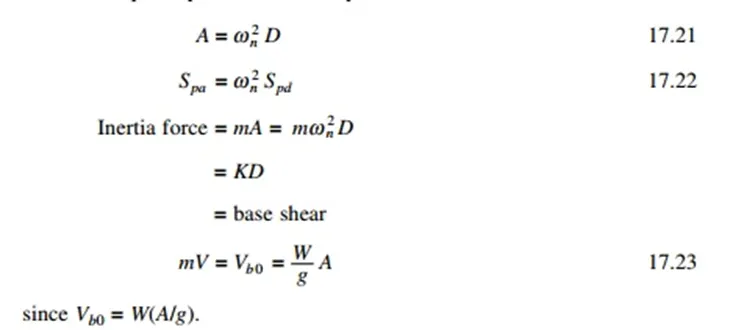
Let “A/g” be called base shear coefficient or lateral force coefficient.
It is used in building codes to represent the coefficient by which structural weight is multiplied to obtain the base shear. A is the peak pseudo-acceleration.
A pseudo-acceleration response spectrum is a plot of A as functions of Tn.
`A_n(t) = omega_n^2(t)*D_n(t)`
For the First mode (n=1)
T1 = 2 sec
`M_1^ast = 0.436m`
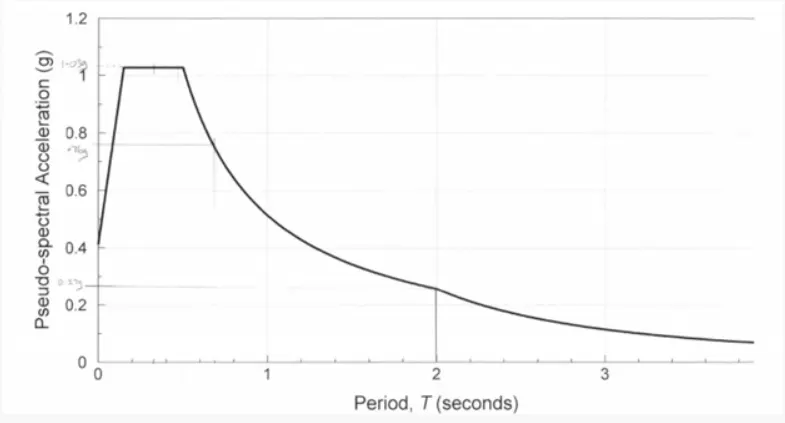
From the graph A1 = 0.27g
`V_(B1) = M_1^ast * A_1`
`V_(B1) = 4.398m *0.27g`
`V_(B1) = 1.187mg`
For the Second mode (n=2)
T2 = 0.6852sec
`M_2^ast = 0.436m`
From the graph A2 = 0.75g
`V_(B2) = M_2^ast * A_2`
`V_(B1) = 0.436m *0.75g`
`V_(B2) = 0.327mg`
For the Third mode (n=3)
T3 = 0.4346sec
`M_3^ast = 0.121m`
From the graph A3 = 1.041g
`V_(B3) = M_3^ast * A_3`
`V_(B3) = 0.121m *1.041g`
`V_(B3) = 0.126mg`
For the Fourth mode (n=4)
T4 = 0.3383sec
`M_4^ast = 0.038m`
From the graph A4 = 1.026g
`V_(B4) = M_4^ast * A_4`
`V_(B4) = 0.038m *1.026g`
`V_(B4) = 0.039mg`
For the Fifth mode (n=5)
T5 = 0.2966 sec
`M_5^ast = 0.008m`
From the graph A5 = 1.041g
`V_(B5) = M_5^ast * A_5`
`V_(B5) = 0.008m *1.00g`
`V_(B5) = 0.008mg`
- AVERAGE BASE SHEAR: -
It is calculated by the method of Square Root of Sum of Square (SRSS)
SRSS METHOD: -
The Square Root of the Sum of the Squares (SRSS) procedures are often used to obtain seismic design response. The design inputs for such procedures are usually defined in terms of pseudo velocity or acceleration response spectra.
= `sqrt(V_(B1)^2+V_(B2)^2+V_(B3)^2+V_(B4)^2+V_(B5)^2`
= `sqrt((1.187mg)^2+(0.327mg)^2+(0.126mg)^2+(0.039mg)^2+(0.008mg)2`
= 1.15mg
RESULT: -
- Computed `L_n`, `M_n` and `Gamma_n` for each of the 5 modes.
| Sr.no | MODE | `L_n` | `M_n` | `Gamma_n` |
| 1 | n=1 | 4.121 m | 3.861 m | 1.067 |
| 2 | n=2 | -1.297 m | 3.861 m | -0.335 |
| 3 | n=3 | 0.684 m | 3.861 m | 0.177 |
| 4 | n=4 | -0.381 m | 3.861 m | -0.098 |
| 5 | n=5 | 0.175 m | 3.861 m | 0.045 |
- Calculated the Effective Modal Mass Mn* and the Modal mass Participating Ratio for the 5 modes.
| Sr.no | MODE | EFFECTIVE MODAL MASS (`M_n^ast`) | MODAL MASS PRTICIPATING RATIO |
| 1 | n=1 | 4.398 m | 0.88 |
| 2 | n=2 | 0.436 m | 0.09 |
| 3 | n=3 | 0.121 m | 0.02 |
| 4 | n=4 | 0.038 m | 0.01 |
| 5 | n=5 | 0.008 m | 0.002 |
- Calculated the Base Shear for each of the 5 modes.
| Sr.no | MODE | BASE SHEAR (`V_(Bn)`) |
| 1 | n=1 | 1.187 mg |
| 2 | n=2 | 0.327 mg |
| 3 | n=3 | 0.126 mg |
| 4 | n=4 | 0.039 mg |
| 5 | n=5 | 0.008 mg |
- Calculated the combined Base Shear as per SRSS rule.
= `sqrt(V_(B1)^2+V_(B2)^2+V_(B3)^2+V_(B4)^2+V_(B5)^2`
= 1.15mg
- Calculated how many modes to be considered such that a modal mass participating ratio of 90% is obtained.
First 2 modes are sufficient.