Understanding the concepts on Degrees of Freedom
Answer
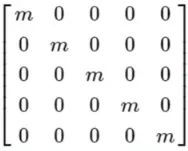
Mass matrix (m) =
Modified mass matrix (M) = ɸnT. m . ɸn
For the first mode (n=1), =
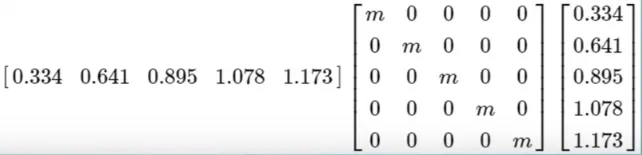
M1 = 3.861 m
Modal property (L) = ɸnT. m . l
Where, l = Influence Vector (Assuming 100% utilization of seismic force) =
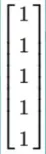
For the first mode (n=1), =
L1 = 4.121 m
Modal participation factor (⎾) = L/M
For the first mode (n=1), ⎾1 = L1/M1 = 4.121/3.861 = 1.067
⎾1 = 1.067
Similarly,
⎾2 = -0.335
⎾3 = 0.177
⎾4 = -0.098
⎾5 = 0.045
Effective modal mass (M*) = Ln2/Mn
For the first mode (n=1), M1* = L12/M1 = (4.121)2/3.861 = 4.398 m
M1* = 4.398 m
Similarly,
M2* = 0.436 m
M3* = 0.121 m
M4* = 0.038 m
M5* = 0.008 m
Modal mass participation ratio = Mn*/ mj
Where, mj = Total mass of the building = m+m+m+m+m = 5 m
Modal mass participation ratio of first mode (n=1) = 4.398/5 = 0.88
(n=1) = 0.88
Similarly,
Second mode, (n=2) = 0.09
Third mode, (n=3) = 0.02
Fourth mode, (n=4) = 0.01
Fifth mode, (n=5) = 0.002
Adding first two mode mass participation ratios, we get
0.88 + 0.09 = 0.97
To achieve minimum 90% of modal mass participation ratio, First two modes are enough
Base shear (VB) = Mn*. An
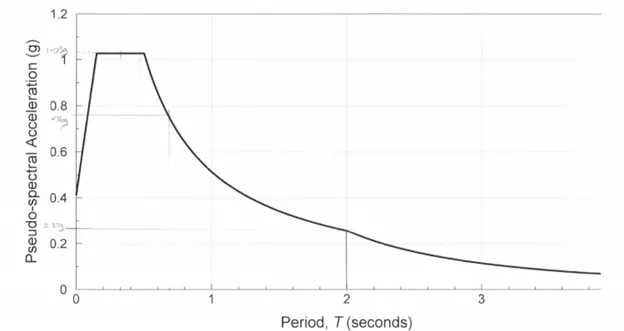
A1 = 0.27 g (From the graph)
For the first mode (n=1), Vb1 = 4.398 m x 0.27 g = 1.187 mg
Vb1 = 1.187 mg
Similarly,
Vb2 = 0.327 mg
Vb3 = 0.126 mg
Vb4 = 0.039 mg
Vb5 = 0.008 mg
Average base shear = √( (Vb12)+(Vb22)+(Vb32)+(Vb42)+(Vb52) ) = 1.15 mg
Vb = 1.15 mg