Understanding the concepts on Degrees of Freedom
AIM:
To compute `L_(n), M_(n) and T_(n)` for each of the five modes from the given equations
To calculate the effective modal mass `M_(n)^*` and the modal mass participating ratio for the 5 mode
To obtain the base shear for each of 5 modes of vibration and the combined base shear as per SRSS rule
INTRODUCTION:
- Modal effective mass is a modal dynamic property of a structure associated with the modal characteristics; natural frequencies, mode shapes, generalised masses, and participation factors.
- Modal participation factors - Mass participation ratio specifies the percentage of how much the structural mass of the model is participating for a given direction and mode.modal participation factors are scalars that measure the interaction between the modes and the directional excitation in a given reference frame. Larger values indicate a stronger contribution to the dynamic response.
- Effective mass factors - the effective mass factors associated with each mode represents the amount of system mass participating in that mode in a given excitation direction. This value is given as a percentage of the total system mass. Therefore, a mode with a large effective mass will be a significant contributor to the system’s response in the given excitation direction. A common rule of thumb for linear dynamic analysis is that a mode should be included if it contributes more than 1-2% of the total effective mass.
- Base shear is an estimate of the maximum expected lateral force on the base of the structure due to seismic activity.
PROCEDURE
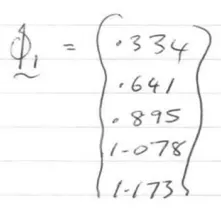
The fundamental period of vibration (T1 = 2 seconds) and its associated mode shape:
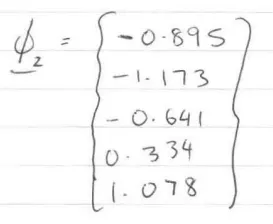
The second mode of vibration (T2 = 0.6852 seconds) and its associated mode shape:
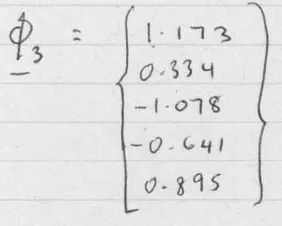
The third mode of vibration (T3 = 0.4346 seconds) and its associated mode shape:
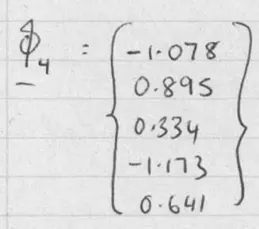
The fourth mode of vibration (T4 = 0.3383 seconds) and its associated mode shape:
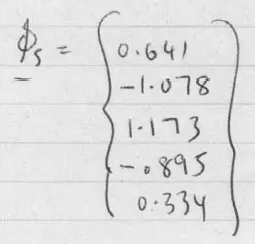
The fifth mode of vibration (T4 = 0.2966 seconds) and its associated mode shape:
- Ln , Mn and Γn for each of the five modes are to be computed from Equations below.
-

Taking first equation of Mn into consideration.
`M_(n)= phi_(n)^Tmphi_(n)`
`m=[[m,0,0,0,0] , [0,m,0,0,0] , [0,0,m,0,0] , [0,0,0,m,0] , [0,0,0,0,m]]`
SOLUTION
`M_(1)= phi_(1)^Tmphi_(1)`
`M_(1)`= [0.334 0.641 0.895 1.078 1.173]
`[[m,0,0,0,0] , [0,m,0,0,0] , [0,0,m,0,0] , [0,0,0,m,0] , [0,0,0,0,m]]` `((0.334),(0.641),(0.895),(1.078),(1.173))`
`M_(1)`= 3.614m
Similarly
`M_(2)`= [-0.895 -1.173 -0.641 0.334 1.078]
`M_(2)` =`[[m,0,0,0,0] , [0,m,0,0,0] , [0,0,m,0,0] , [0,0,0,m,0] , [0,0,0,0,m]]``((-0.895),(-1.173),(-0.641),(0.334),(1.078))`
`M_(2)` =3.861m
`M_(3)`= [1.173 0.334 -1.078 -0.641 0.895 ]
`[[m,0,0,0,0] , [0,m,0,0,0] , [0,0,m,0,0] , [0,0,0,m,0] , [0,0,0,0,m]]``((1.173),(0.334),(-1.078),(-0.641),(0.895))`
`M_(3)`= 3.861m
`M_(4)`= [-1.078 0.895 0.334 -1.173 0.641]
`[[m,0,0,0,0] , [0,m,0,0,0] , [0,0,m,0,0] , [0,0,0,m,0] , [0,0,0,0,m]]``((-1.078),(0.895),(0.334),(-1.173),(0.641))`
`M_(4)`= 3.861m
= [0.641 -1.078 1.173 -0.895 0.334 ]
`[[m,0,0,0,0] , [0,m,0,0,0] , [0,0,m,0,0] , [0,0,0,m,0] , [0,0,0,0,m]]``((0.641),(-1.078),(1.173),(-0.895),(0.334))`
`M_(5)`= 3.861m
`Ln= phi_(n)^Tml`
`m=[[m,0,0,0,0] , [0,m,0,0,0] , [0,0,m,0,0] , [0,0,0,m,0] , [0,0,0,0,m]]`
I = `((1),(1),(1),(1),(1))`
SOLUTION
`L_(1)= phi_(1)^Tml`
`L_(1)`= [0.334 0.641 0.895 1.078 1.173]
`[[m,0,0,0,0] , [0,m,0,0,0] , [0,0,m,0,0] , [0,0,0,m,0] , [0,0,0,0,m]]` `((1),(1),(1),(1),(1))`
`L_(1)`= 4.121m
Similarly,
`L_(2)`= -1.29 m
`L_(3)`= 0.68 m
`L_(4)`= 0.381 m
`L_(5)`=0.175 m
`T_(n)=L_(n)/M_(n)`
SOLUTION
`T_(1)=L_(1)/M_(1)`
4.121/3.8614
`T_(1)`= 1.067
Similarly:
`T_(2)`= -0.336
`T_(3)`= 0.177
`T_(4)`= 0.009
`T_(5)`= 0.045
`M_(n)^*=L_(n)^2/M_(n)`
Participating ratio= `M_(N)^*/M_(i)`
`M_(1)^*`= 4.398 m
Participating ratio= 0.8796
`M_(2)^*= 0.435m`
Participating ratio= 0.087
`M_(3)^*= 0.121m`
Participating ratio= 0.0242
`M_(4)^*= 0.037m`
Participating ratio= 7.4 x 10^-3
`M_(5)^*= 0.008m`
Participating ratio= 1.6 x 10^-3
- Obtain the base shear for each of the 5 modes of vibration and the combined base shear as per SRSS rule. The pseudo acceleration design spectrum to obtain the base shear for each mode is provided below.
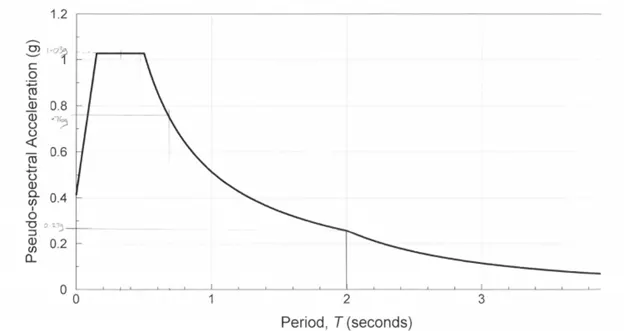
`T_(1)=2`
`A_(1)=0.27`g
`T_(2)=0.6852`
`A_(2)=0.76`g
`T_(3)=0.43446`
`A_(3)=1.03`g
`T_(4)=0.3383`
`A_(4)=1.03`g
`T_(5)=0.2966`
`A_(5)=1.03`g
`V_(bn)=M_(n)^*A_(n)`
SOLUTION:
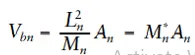
`V_(b1)=M_(1)^*A_(1)`
`V_(b1)=1.1874m`
Similarly,
`V_(b2)=0.3306m`
`V_(b3)=0.12463m`
`V_(b4)=0.3811m`
`V_(b5)=`8.24 x 10^-3m
As per SRSS method:
=`V_(b)= root`(1.187)^2 + (0.3306)^2 + (0.12463)^2 + (0.3811)^2 + (0.00824)^2`
`V_(b)= 1.457m`
- Modal effective mass:
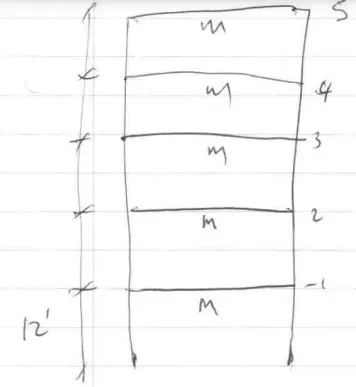
Modal mass participating ratio= `M_(n)^*/M_(j)`
`M_(n)^*=`effective modal mass`
`M_(j)`= Total mass = M+M+M+M+M=5M
Mode 1
`M_(1)^*/M_(j)`
= 4.39m/5m= 0.88
=88%
Mode 2:
`M_(2)^*/M_(j)`
0.43m/5m= 0.086
=8.6%
Mode 3
`M_(3)^*/M_(j)`
0.12m/5m= 0.024
= 2.4%
Mode 4
`M_(4)^*/M_(j)`
0.03m/5m=0.006
0.6%
Mode 5
`M_(5)^*/M_(j)`
0.007m/5m=0.001
=0.1%
- How many modes are to be considered such that a modal mass participating ratio of 90% is obtained?
THE TWO MODES ARE TO BE CONSIDERED SUCH THAT A MODEL MASS PARTICIPATING RATIO = 90% IS OBTAINED
`M_(1)^*/ M_(j) + M_(2)^*/ M_(j)`
= 88% + 8.6% = 96.6%
First two modes are enough for us to obtain 90% modal mass participating ratio
RESULT:
Calculated `L_(n), M_(n) and T_(n)`for each of the five modes from the given equations
Calculated the effective modal mass `M_(n)^*`and the modal mass participating ratio for the 5 modes
The base shear for each of the 5 modes of vibration are obtained
As per SRSS rule the considered such that a modal mass participating ratio of 90% is obtained