Understanding DC machine relations and behavior
AIM: To Understand the DC machine or motor.
OBJECTIVES:
- Implement DC machine torque-speed characteristics equations in the MATLAB script file. It asks the user to input data and plots speed (RPM) versus torque (Nm). Submit the .m file for evaluation and attach the screenshots of all the required plots.
- How can you distinguish between power cables and signal cables and prepare a table where these cables are used to wiring an electric vehicle?
- What voltage levels are considered as high & low for a battery pack of electric vehicles?
INTRODUCTION:
A DC motor is any of a class of rotary electric motor that converts direct current electrical energy into mechanical energy. The most common types rely on the forces produced by magnetic fields. Nearly all types of DC motors have some internal mechanism, either electromechanical or electronic, to periodically change the direction of current in a part of the motor.
DC motors were the first form of motor widely used, as they could be powered from existing direct-current lighting power distribution systems. A DC motor's speed can be controlled over a wide range, using either a variable supply voltage or by changing the strength of the current in its field windings. Small DC motors are used in tools, toys, and appliances. The universal motor can operate on direct current but is a lightweight brushed motor used for portable power tools and appliances. Larger DC motors are currently used in the propulsion of electric vehicles, elevators, and hoists, and in drives for steel rolling mills.
Objective 1- Implement DC machine torque-speed characteristics equations in the MATLAB script file. It asks the user to input data and plots speed (RPM) versus torque (Nm).
Understanding the speed Vs torque characteristic
- Understanding the torque and the relationship between speed and torque is an important part of selecting and operating a DC motor.
- When the load on the motor is constant, speed is proportional to supply voltage and when the supply voltage is constant, speed is inversely proportional to the load on the motor.
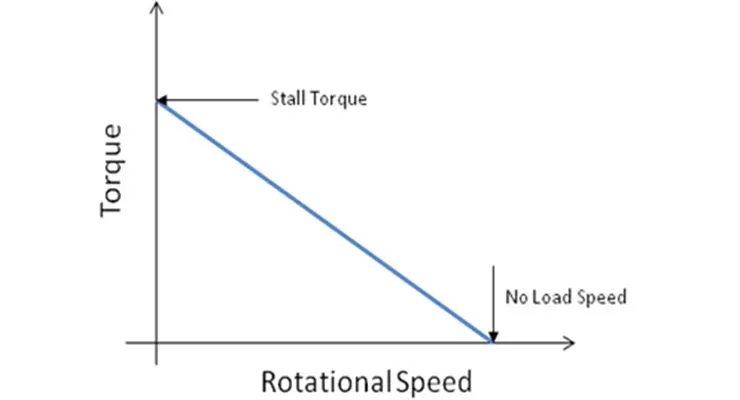
- The inverse relationship between the speed and torque means that an increase in the load on the motor will cause a decrease in speed. This means that the torque-speed curve is a descending line with a negative slope.
- The torque-speed curve begins at the crossing of the Y-axis, where torque is maximum and the speed is zero. This is the holding torque.
- The line falls down until it intersects the X-axis that is zero torque and maximum speed and it is known as the no-load speed.
GOVERNING EQUATIONS
The torque equations and the relationship with DC motor
- `w = (v/K)-(T/k^2)**R`
Where
w - Rotation speed
v- voltage
K - motor constant
T - Torque in N-m
R - Armature
- `K = (E_b **60)`
Where
K - Motor constant
Eb - Back EMF
Ns - Constant Speed
- `T_s = (v**K)/R`
Where
Ts - Stall torque
V - voltage
K - Motor constant
R - Armature resistance
- No load speed `w_max - (v/K)`
v - Volatge
K - Motor constant.
CODE: -
clear all
close all
clc

%Inputs
%voltage supply
v = input('Enter the voltage supply in volts - ');
%Armature resistance
R = input('Enter the armature resistance in ohm - ');
%Back EMF
Eb = 1 ;
Ns = 15;

%Calculation
%Motor constant
Km = (Eb*60)/(2*3.14*Ns);
%Maximum speed
Nmax = (v/Km);
%stall torque
Ts = ((v*Km)/R);
%Torque value in N-m
T = linspace (0,Ts,20);
%Speed value in rad/sec
N = ((v/Km)-((T/(Km^2))*R));
%speed value in RMP
N = ((N*60/(2*3.14)));
Nmax = (Nmax*(60/(2*3.14)));

%plotting
plot(N,T)
xlabel('Rotation speed in (rpm)')
ylabel('Torque in N-m')
axis tight
grid on

%stall torque and a no-load speed of the motor
disp('peak torque or stall torque of the motor is ')
disp(Ts)
disp('No-load speed and a maximum speed of the motor is ')
disp(Nmax)
EXPLANATION-
- We will be having the voltage and the armature resistance as the input to the program, the back EMF, and the constant speed as the fixed inputs.
- Using the back EMF and the constant speed we will be calculating the motor constant.
- Next, we will be calculating the max speed of the motor
- The next step is to calculate the stall torque.
- Once we have calculated the max and the minimum speed we will create the array between the max and the min value of the torque.
- Using the standard relations of the speed of the motor we will calculate the speed of the motor, which will be calculated using the torque values that are generated in the array.
- So, N and T will be two arrays that are created, these can be plotted against each other. To see the relation between the two.
- The disp command is used to display the max torque and the max speed on the motor.
OUTPUT-
The input and the output value in the command windows are
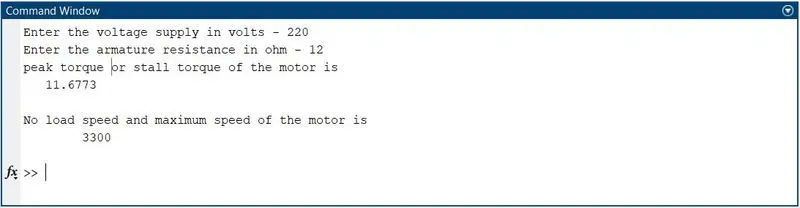
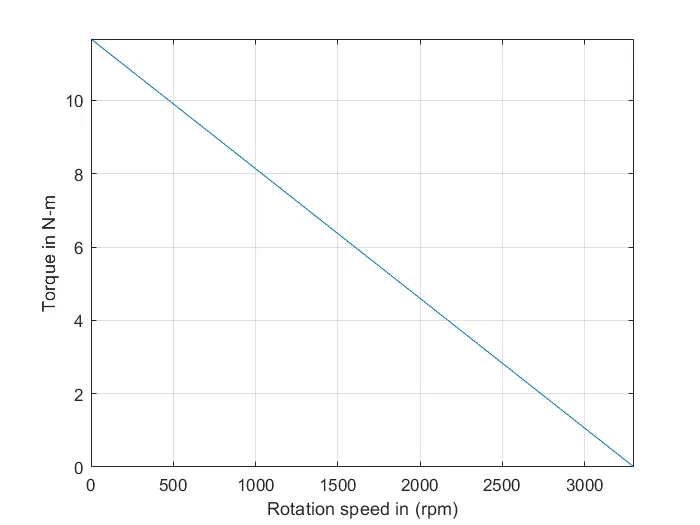
The relation between the torque and the speed is given below.
OBSERVATION-
- As we know that there is an inverse relationship between the Torque and Rotation speed of the motor, and we can see that we got the inverse relation with the negative slope for the data that we provided in the code.
2. How can you distinguish between power cables and signal cables and prepare a table where these cables are used to wiring an electric vehicle?
- There are two main types of cables that are used in an electric vehicle Power cables and signal cables. Both these type of cable are having their respective functions.
- Signal cable as their name suggests is mainly used for transmitting electricity and used for purpose link input data, feedback data, control data.
- The power wiring as the name implies has as its primary purpose to transmit electrical purpose, because of this the size of the cable.
Difference between the power cable and signal cable
| Power cable | Data cable |
| 1. Cross-section is large | 1. Cross-section is small |
| 2. Carries larger current | 2. Carry small current |
| 3. They are not shielded | 3. Shielded for minimum data loss |
| 4. Multi-strand copped wire. | 4. Copper wires or tinted cu wires |
| 5. Cable usually carry power as energy | 5. They are used to carry moderate power. |
| 6. For powering instruments and machines. | 6. For powering low and high-level analogy signals. |
| 7. Lagre gauge cable | 7. Smaller gauge cable |
- Electric vehicle wiring is similar to battery cable in conventional vehicles, except that EV cables are shielded. The shield is typically foil covered by a tinned-copper braided shield. The shielding is required to reduce electromagnetic and radio frequency interference caused by the electrical noise generated by the high-frequency switching that takes place in the inverter.
- In the traditional vehicle, the most cost-effective method of suppressing Em/RFl noise is through the use of components such as capacitors, inductors, and diodes. But, shielding electronics and wiring becomes more cost-effective solutions in HVE because the traditional suppression components required would be too large and heavy to be practical. Hence this brings us to the need of having perfect wiring, to make the manufacturing productive.
Application of cable in EV
| Signal cable | Power cable |
| 1. Automotive battery cable | 1. Engine power transmission |
| 2. Sensor cable | 2. Control actuator switches |
| 3. Camera Sensors | 3. Battery, lighting car interior. |
| 4. Car audio stereo | 4. Car roof, floor, Door |
| 5. Car dashboard | 5. Power transmission |
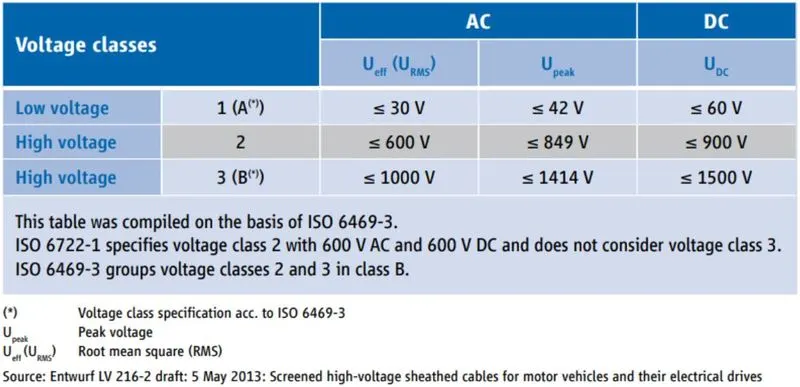
3. What voltage levels are considered as high & low for a battery pack of electric vehicles?
- It should come as no shock that the dated 12-V auto electrical system is no longer viable in new vehicles, especially hybrid electric vehicles and the new all-electric vehicles. The replacement system uses either 48V batteries for HEV or 400+-V batteries for EVs. These systems rely on the higher voltage as well as switch-mode techniques that give them the efficiency necessary to make them practical.
- The dramatic increase in electronic design into vehicle and advanced driver assistance systems over the years have weaknesses of the standard 12-V electrical systems. For a given amount of power, a higher voltage reduces the current. The mean smaller wire can be used, thereby reducing cost and weight.
CONCLUSION
From the above exercise, we can conclude that the speed and torque relation of the motor is proved with the negative slope. The difference between the signal cable and power cable is understood and the use of in the EV vehicles. The voltage requirement of the EV and HEV are also discussed and understood ranging from low voltage to high voltage.