Underbody Coating
UNDERBODY COATING:-
Underbody coating is applied on the underside of the car. It is a thick cladding that is usually made up of rubber and is placed uniformly to the car's underside. Due to Today's road conditions, a car's underbody is most prone to corrosion. Underbody coating provides long-term protection from corrosion to the car’s underbody. This layer is mainly applied to fenders, weld points, upper body panels, and tailgates. It usually has a life span of 5 years, if the automobile is worn out, it is sprayed or painted over.
TYPES OF UNDERBODY COATING:-
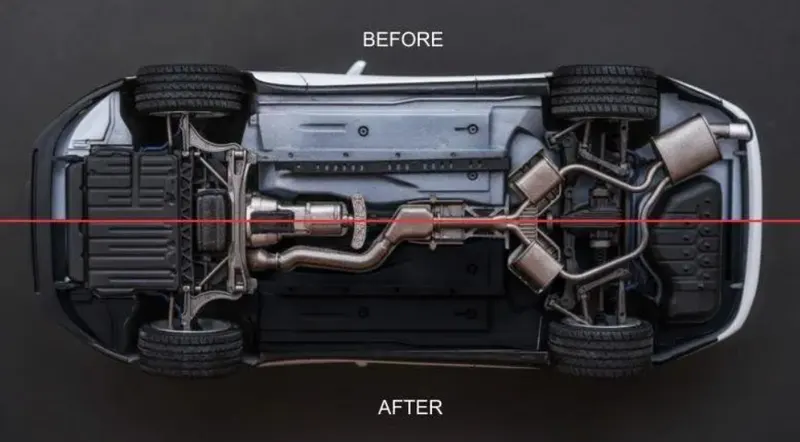
- Rubberized Underbody Coating:- This type of coating is usually used on the underside of the cars. This is widely considered to be the best underbody coating for a car. It protects the underbody from scratches and keeps it properly. Rubberized coating is ideal if you want to keep the road noise to a minimum and rust and corrosion away. This coating provides long-term stone chip damage and corrosion protection as well as sound deadening effects.
- Wax-Based Underbody Coating:- In this coating wax-based products are used for coating the underside of the car. This transitory undercoating will, on the whole, fade away after a few months. On the plus side, wax-based undercoating is resistant to dampness. It is also the most cost-effective alternative.
- Asphalt Based Underbody Coating:- This type of coating is suitable for lorries, trucks, and other heavy vehicles. In comparison to rubber-based coatings, this gives a higher level of protection. Asphalt-based coatings, on the other hand, incorporate a small quantity of rubber for sound insulation. The application of this coating takes some time.
- Polyurethane Underbody Coating:- This covering seals breaks and fractures in the vehicle’s underbody. It provides strong corrosion resistance and also binds to the metal. The benefit of this coating is being suitable for a wide range of substrates and they can be painted over. Can be spray-applied, high build, and particularly good for salted roads.
ADVANTAGES OF UNDERBODY COATING:-
- Helps to fight rust or corrosion:- It has a crucial function in preventing corrosion. Underbody coating is particularly useful if you live near the sea, where there is excessive humidity and rust is a common occurrence. If you live somewhere where it snows in the winter, or also during the monsoon season, cars are at high risk of getting corrosion. Hence, the coating protects the car from rust.
- It absorbs the noise:- A very strong undercoating can attenuate noises that enter the cabin. The undercoating, which is frequently made of rubber, absorbs part of the rackets. The car’s occupants could avoid the road sounds — at least to some extent. The noise of debris hitting a vehicle can be dampened by the application of a car underbody coating. As the undercoating is elastic it makes less noise when it gets struck by any obstacle.
- Reinforcement:- Applying another coat of the coating on top of the original will not harm it. It will provide further protection for the underbody from water, road debris, gravel, and tiny stones. The factory coat would also have a lower risk of flaking away.
- Prolong Life of Car:- A good undercoat protects not just the underbody from corrosion, but also the engine and gearbox! Less corrosion combined with slower wear and tear hence can extend the life of your car by many years. On the undercarriage, there would be fewer dents, dings, and scratches due to undercoating.
- It protects the underbody components.
- Helps in absorbing Vibration.
- Prevents water ingress, Stone-chip:- By covering cracks in the paintwork or joints in the undercarriage of a vehicle, moisture or water from humid or wet environments is prevented from creeping into the underbody and causing corrosion. A car underbody coating provides a durable elastic over the underbody and wheel arches which protects the substrate from stones, gravel, salt, and other debris which is thrown up by the road.
DISADVANTAGES OF UNDERBODY COATING:-
- High Cost:- After the lifespan of the car, re-application of the undercoating on the vehicle, becomes costly.
- Risk of Damage:- For reducing cost, different kinds of sprays are available on market. But it is risky to apply. Care must be taken while applying underbody coating. This thick rubberized paint if not applied properly, can get into moving mechanical parts and cause premature failures – such as into the U-joint or CV joints in a car's propeller shaft or drive shafts.
PROCESS OF APPLICATION OF UNDERBODY COATING IN INDUSTRY:-
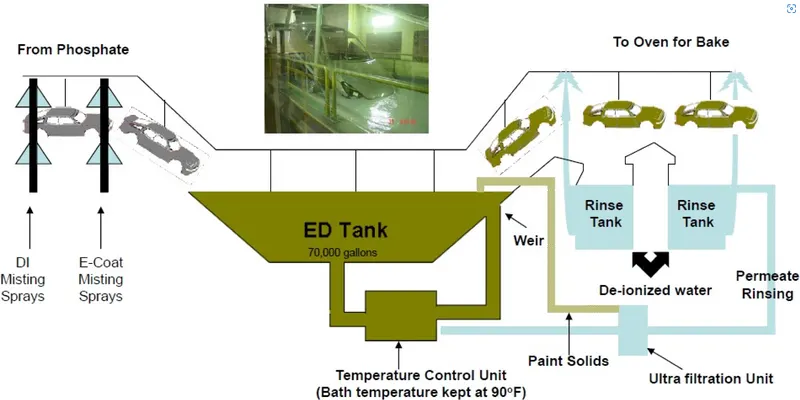
Modern automotive coating methods consist of five main steps. They include the following:
-
Pretreatment: removes and cleans excess metal and forms an appropriate surface structure enabling bonding of a corrosion protection layer.
-
The next step is electrodeposition (ED) of the anti-corrosion or rust prevention layer.
-
A sealer like Poly Vinyl Chloride (PVC) is applied for anti-corrosion, elimination of water leaks, and minimization of chipping and vibrational noise.
-
A primer is then applied to promote adhesion between the surface and the basecoat.
-
Finally, the topcoats that include a basecoat and clearcoat are applied; they provide surface properties that are sought after, including color, appearance, gloss, smoothness, and weather resistance.
As shown in the above figure, E-coating involves dipping automobile bodies into the coating solution and passing an electric current through the body and the liquid ED paint solution. Because of the charged nature of this coating process, the ED paint penetrates places a spray would not reach. The ED paint is promoted to bond with the metal substrate, and a uniform coating thickness is produced. The result is an insoluble, deposited layer with a very high solids content and firm adherence to the pretreated body. As shown in the above figure, the car body is tilted at a specified angle so the ED paint flows through all the points on the car body.
During operation, a mixture of resin, binder, and a paste containing the pigments is fed into the electrodeposition tank. The automobile body is lowered into the tank, and an electric current is applied. After the E-coat, the automobile body enters a bake oven, in which heating and keeping at a temperature of 160 °C for 10 min cause film curing to promote maximum performance properties.
A common challenge in the current E-coating process is that of water spots that contaminate coated surfaces. These spots can appear on the air-dried surface if water droplets from the conveyor or other sources fall on the body, especially if the water in the tanks is not deionized properly and has high conductivity.