Underbody Coating
UNDERBODY COATING
The underbody coating that is most commonly used on cars in India and supplied by companies such as 3M is a thick, rubberized paint that forms a 2-3 mm thick coating all along the underside of the car when sprayed on. You also get a thinner clear coat underbody coating which is like a lacquer that coats the entire underside of the car. Some even inject rust-preventive coating material into crevices such as the bottom of doors and door sills, to protect them from rust.
Some car manufacturers already offer some underbody coating straight out of the factory which is usually sprayed inside the wheel arches and under the floorboard of the car.
Benfitis of underbody coating
Rust prevention
Ideally, any additional underbody coating should be applied when the car is brand new and clean. Car manufacturers use thick paints and sealants for the underbody, but adding an underbody coat especially in coastal cities is useful. Saltwater tends to corrode cars really badly.
Sound isolation
The thicker underbody coatings used on cars also act as effective sound dampeners. They can reduce road noise and tyre noise and make the cabin seem quieter – due to the sound absorptive nature of rubberized paints.
Easy maintenance
A uniform black underbody coating gives a car a clean look. It also makes the car easier to maintain by just hosing the underside down. You can be confident that slush build-up won’t lead to rusting easily. Most underbody coats these days come with a five-year warranty, which is the lifetime of such a coating
The major drawback about underbody coating it isn't cheap it comes at a very high cost.
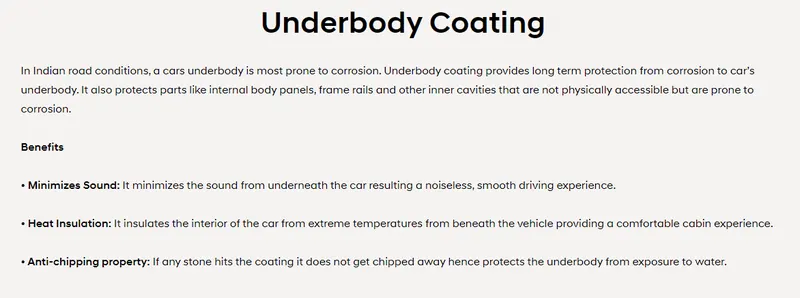
Here is the best example I took from the Hyundai site about the underbody coating and its prices.