Underbody Coating
Automotive Coating Processes
Modern automotive coating methods consist of five main steps. They include the following:
-
Pretreatment: removes and cleans excess metal and forms an appropriate surface structure enabling bonding of a corrosion protection layer.
-
The next step is electrodeposition (ED) of the anti-corrosion or rust prevention layer.
-
A sealer like Poly Vinyl Chloride (PVC) is applied for anti-corrosion, elimination of water leaks, and minimization of chipping and vibrational noise.
-
A primer is then applied to promote adhesion between the surface and the basecoat; it also imparts a smoother surface for subsequent layers and has anti-chipping properties.
-
Finally, the topcoats that include a basecoat and clearcoat are applied; they provide surface properties that are sought after, including color, appearance, gloss, smoothness, and weather resistance.
Underbody coating and its purposes.
The third step is underbody coating (UBC) and seam sealing using PVC (Polyvinyl Chloride) and urethane. This sealing has multiple purposes
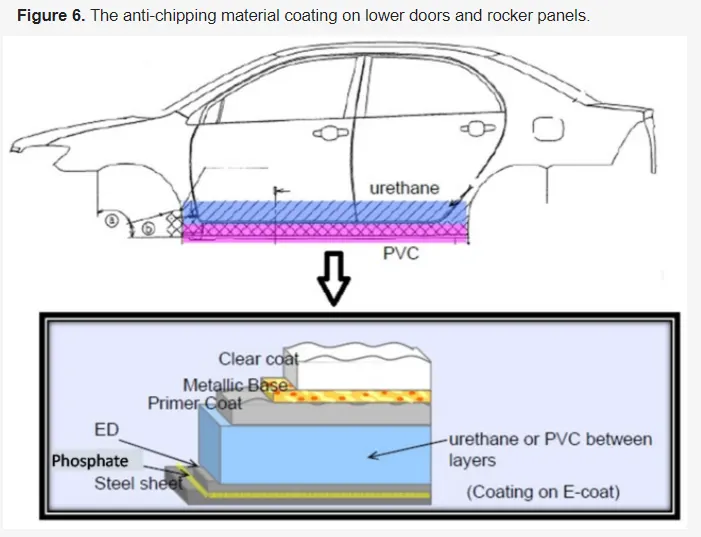
The sealant is applied around and inside the doors, hood, trunk, and front dash, and onto the exterior and interior of metal joints and outer area of the back wheel well; application of the sealant is accomplished either manually or with robots and prevents air and water ingress and inhibits rust formation. Recently, PVC and acryl/urethane sealants have also been used in the underbody areas, a process called the Dampening Coat (DC), to impart noise-proofing and vibration-deadening. The noise and vibration are transferred from the engine, drive train, suspension system, road noise of the tires, and flowing air, and the underbody sealants reduce noise transfer into the passenger compartment of the automobile. The underbody coating also provides anti-corrosion and chipping protection; typically, it is accomplished using robots equipped with airless sprayers. figure displays the lower door sections and rocker panel locations where PVC or urethanes are applied as an anti-chipping protection, and shows the cross section of this layer with respect to the other coatings on the body parts.