Underbody Coating
The bare metal surface of the vehicle body is first treated with Electrolyte Discharge (ED) process. In this process, the bare metal surface of the vehicle body is dipped into an electrolyte bath. The angle at which it is dipped is dependent on the area of the facility of OEM and the amount of time for which it is dipped is dependent on the weight that is desired on the BIW (Body In White). The more is the ED coating the better will be the corrosion resistance and also better will be the paint absorption during painting process. The entire body is rotated 360 degrees inside the bath. The angle at which the body is taken out of the bath is such that it ensures most of the ED droplets are let out. Also, some holes are provided on the bare metallic surface to drain out the droplets. Further, the body is made to go through a heating chamber that inflects heat on the body so that few more droplets which may have been leftover are drained out. It is important to not allow extra depositon of ED on the body as extra deposition of ED droplets can give chemical reaction thereby giving more coating than that desired and thus giving rise to unevenness of coating composition across the body section.
The body is then treated with a preliminary coating called primer. The higher is the primer coating the higher will be the weight added by the body and also greater will be the abrasive resistance, UV light protection and rust prevention. OEMs arrive at a particular thickness level for the primer by balancing out on these parameters.
Now, on the underbody, a sealant is applied over the primer and this is what refers to underbody coating. It ensures air-tight closing is imparted on the underbody. The thickness of this coating varies from one section to the other depending on the OEM. In general, the more is the underbody coating the better is the protection given to underbody against any external impacts like stones or other objects hitting against it. This also offers added rust prevention from water or any substance.
Images:
The following images show underbodies of 2 vehicles, one without coating and the other with coating. The 1st image refers to the underbody of the Toyota INNOVA that has no underbody coating, whereas 2nd image refers to the underbody of the facelifted version of the INNOVA i.e. INNOVA CRYSTA that has a coated underbody.
1. Vehicle with uncoated underbody (Toyota INNOVA)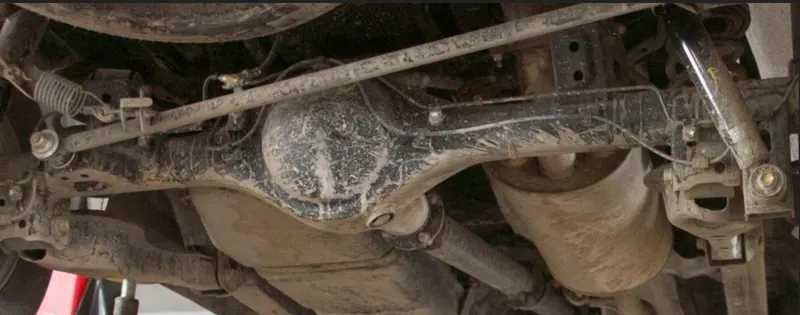
2. Vehicle with coated underbody (Toyota INNOVA CRYSTA)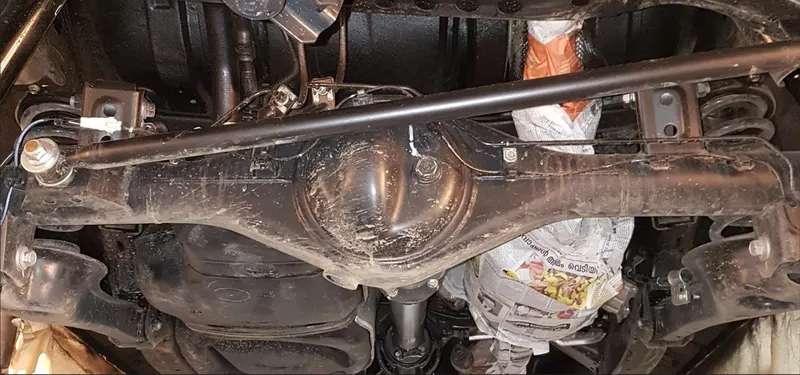
Types of underbody coating:
The following are the types of underbody coating that are commonly used on vehicles.
1. Wax or Paraffin based coating
This is the cheapest of all, though the protection offered against rust, abrasion due to stone or any object htiing against the underbody is slightly lower. It is relatively thin in thickness and can sustain for about 3-4 months.
2. Polyurethene coating
This coating is made up of polyurethene. The material exhibits elastic property and tends to go well for absorbing impact generated due to stone hitting, metal or any other object hitting against the underbody. It also tends to seperate out moisture and other substances such as salt thereby helping in rust prevention.
3. Asphalt-based coating
The asphalt coating is used where the underbody is expected to experience higher external impacts such as large stones or rocks or other objects of large size hitting it. Asphalt aids in water repulsion thereby offering rust prevention. Generally, on the construction or mining sites large stones, rocks and objects are present and water and soil seem to be spread over large area. Construction machineries, trucks and other equipments generally operate at such sites and thus asphalt coating is preferred for them.
Advantages and Limitations:
Advantages:
1. Offers rust protection against water and other elements spilled agianst underbody and prevents material chip-off due to stones or objects hitting underbody.
2. Tends to control noise and vibrations coming into the vehicle cabin via its floor as the coating forms a layer to absorb impacts due to objects hitting underbody and also aids in sound insulation.
3. Increases longetivity of the parts or components present in the underbody.
Limitations:
1. In order for the coating to be effective it has to be applied at timely intervals, the frequency of which varies according to the type of coating.
2. Cost involved- The cost for underbody coating is fairly high and increases with increase in vehicle size.