Fender Design Challenge
Fender is the US English term for the part of an automobile that frames a wheel well. Its primary purpose is to prevent sand, mud, rocks, liquids, and other road material from being thrown into the air by rotating tyre. When the vehicle is moving, the tyre picks up stones and other materials and hurls them in all directions. The fender thus prevents damage that may occur to the engine compartment and body of the vehicle due to chipping or hitting and also prevents injuries to pedestrians present in the vicinity of the vehicle.
In some cases, rear-view mirrors are mounted on the fender. Some vehicles may also have radiator housing on fender. Also, holes are provided in some cases to house the turn/ hazard indicator light on the fender.
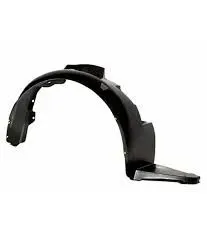
Mostly, the fender also has a provision for fixing the baffle plate on its wheel arch area. The baffle plate helps in absorbing vibrations coming onto the fender from the engine compartment thereby improving the NVH levels of the vehicle. The following image shows the baffle plate of fender of a car.
The fender is basically of two types: full and half bumper type.
The full bumper type is the conventional type of fender used in vehicles. It comprises a complete section of the fender profile extending up to the front portion of the vehicle. Also, the material blank used for this is long and material wastage is observed while manufacturing this. This type has become obsolete and is not used in vehicles now.
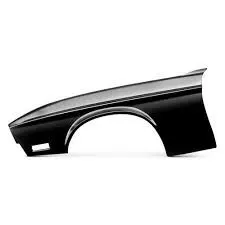
In the half bumper type, the fender profile extends only to a certain portion of the wheel arch and not up to the front section of the vehicle. Since the fender profile is up to a certain portion of the wheel arch, the rest of the portion is covered by the bumper usually made of plastic and thus minimizing the usage of metal. This results in reduced weight of the vehicle and improving its performance. As the fender profile is present till the wheel arch, by slightly increasing the material blank size the same blank can be used to produce two fenders. This helps in reducing the amount of material used thus minimizing the cost. The half bumper type is the most commonly used fender nowadays. The following image shows a modern-day fender i.e. a half bumper type fender.
Previously, the conventional methodology was to have a bracket to mount the fender. This resulted in higher NVH (Noise, Vibration, and Harshness) levels in the vehicle. This methodology is not used now.
Nowadays, the fender is usually mounted on 5 major points of the vehicle: Bumper, Body/ A-Pillar, Sill, Cowl and Drip. Fasteners are used to mount the fender on these points. This methodology helps in reducing the NVH levels.
Design methodology for fender
In order to comply with pedestrian safety regulations, the fender height from its bottom-most portion till its top-most portion should be a minimum of 80 mm for child Wrap-Around-Distance (WAD) of 1100 mm - 1300 mm and adult WAD of up to 1700 mm. For adult WAD of more than 1700 mm the minimum fender height should be 94 mm along with an additional 14 mm that corresponds to an increase in inertial energy.
Also, to meet pedestrian safety regulations, the distance between the tip /point at 45 degrees to the side reference line and the edge of the fender should be less than 50 mm. If it's more than 50 mm, either length of the hood or the size of the fender should be decreased.
The edges or corners of the fender generally have a minimum radius of curvature of 2.5 mm to avoid sharp edges so as to improve pedestrian safety in the event of a collision along with improving the aesthetics of vehicle.
When seen from outside, a small gap is generally present between the hood-outer and fender. After the start point of fender drip, which is generally 9 mm, a flange is provided so as to block the view of the fasteners from that gap in order to improve the aesthetics.
The depth of the fender drip should be less than 60 mm since a depth of more than 60 mm results in an increase in wrinkling and spring-back effect. A depth of 40 to 60 mm ensures that there is no wrinkling and spring-back effect on that area. Also, when the depth exceeds 40 mm rigidity beads are to be provided.
The fender drip area distance is generally between 35 to 40 mm to ensure tool workability in that region during assembly. A clearance of 10 mm is ensured from the end portion of the drip area on the engine compartment side so that parts in the engine compartment are not damaged when mounting of drip is done during assembly of fender.
Mounts provided on the fender should be embossed. For holes present in the mounts, a flat surface of up to 5 mm should be provided around the holes.
A thickeness of around 0.75 mm should be imparted on the fender surface after required mounts have been designed.
Result of the challenge
Using the master section provided, the depth of the drip for the fender drip area is ensured to be less than 40 mm. A distance of 150 mm is left from the front side of fender and a distance of another 150 mm has been left from the rear side of the fender such that the drip area is located between these 2 points.
The distance of 150 mm from the front side of fender has been left in order to allow installation of the headlamp unit in that area. The distance of 150 mm from the rear side of fender has been left so as to allow installation of the cowl top in this area. The master section has been followed for the design of fender drip area.
Mounts have been created for A-pillar, drip, sill and bumper mounting on the fender.
Emboss is provided on all the mounting points. The embossed surface is blended with the fender surface to allow smooth surface transition in that area.
Dart on the bumper mount and beads on the drip area & A-pillar mount have been provided to impart strength on bends present in the areas of these mounts.
The following images show the mounts created on the fender.
A-pillar mount: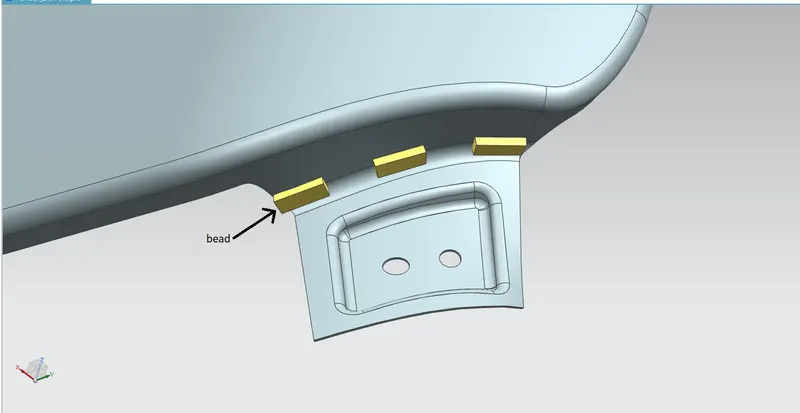
Drip area mount: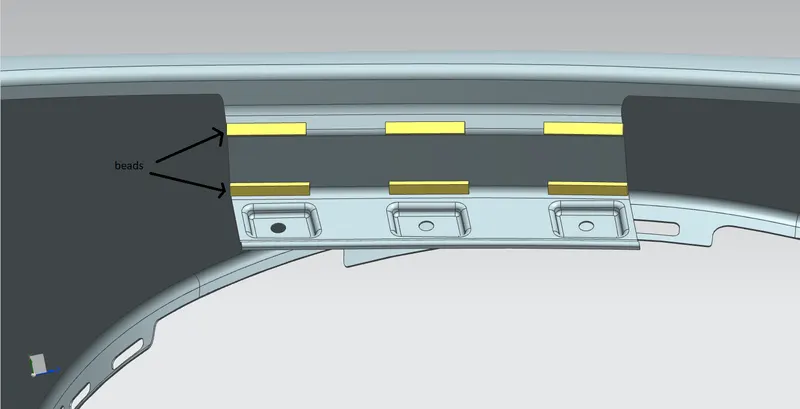
Bumper mount: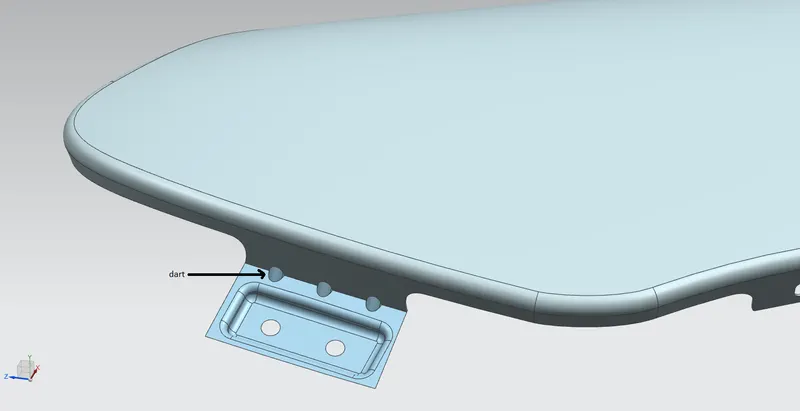
Sill mount: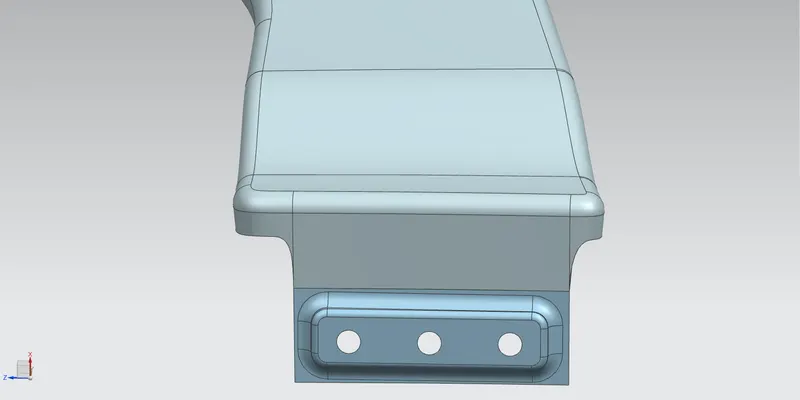
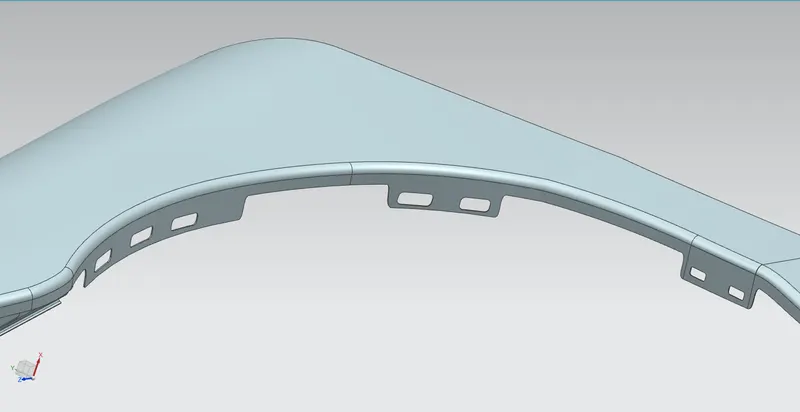
Also, slots have been provided on the fender wheel arch area to allow the baffle plate to be clipped. The following image shows slots on the fender for fixing the baffle plate.