Underbody Coating
- Undercoating:
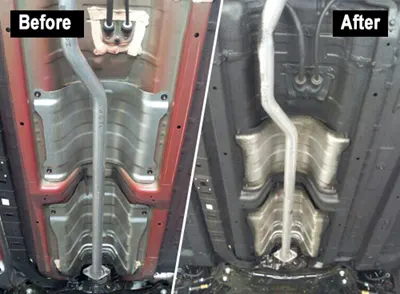
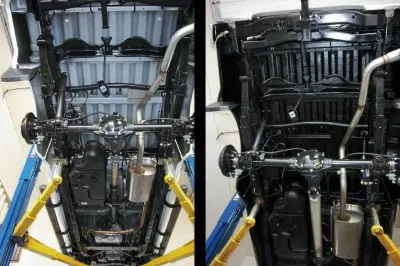
In automotive industry, undercoating process which is used to resist the corrosion form atmosphere and other elements. It is also use for Heat resistant and anti-chipping property.
Undercoating Process is defined as the process of layering the Body (BIW) to resist the corrosion, heat absorption, anti-chipping property and improves the life of body.
Process:
- Clean(Pretreatment):
Prior to applying a rust-repelling vehicle undercoating, you will need to remove all excessive corrosion build-up, caked-on road debris, or any other crap-testis contaminant from the underside of the vehicle.
Pretreatment consists of cleaning the body surface to remove remaining oils from the stamping process and welding residues through three primary liquid dip processes of degreasing, conditioning, and phosphating. An additional pretreatment cleaning that employs ~pH 9 hot water can also be used. Pretreatment helps the primer to bond onto the metal. A phosphate treatment applies an inert layer of metal phosphate, providing resistance to corrosion spread. The degreasing solution is composed of alkaline salts and surfactants and can include caustic soda, trisodium phosphate, and sodium carbonate. The surfactants are types of detergents for emulsifying oils and lubricants on the BIW. The degreasing zone typically consists of at least two sequences, including a spray stage known as knock-off-degrease (KOD) and a dip sequence. The advantage of using these two is that a significant portion of the oil and dirt will be removed by the high-pressure spray, thereby leaving a relatively lower load for the dip sequence to clean.
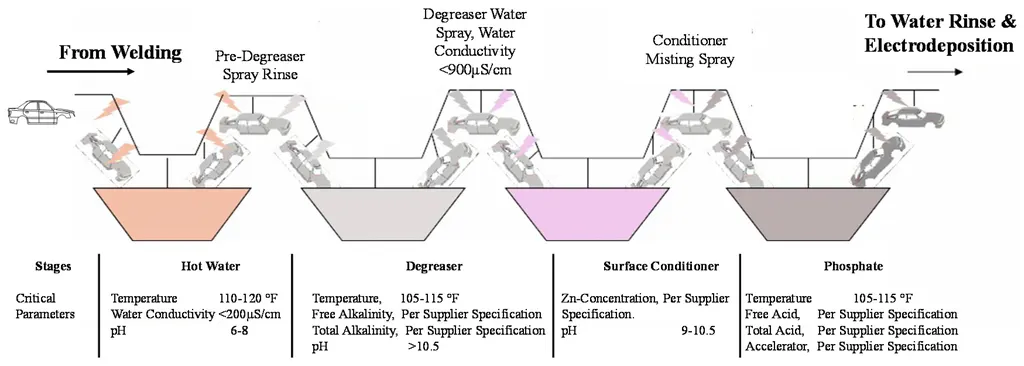 Pretreatment sequences for the body-in-white.
2. Ed coating:
E-coating is a method of painting which uses electrical current to deposit the paint. The process works on the principal of "Opposites Attract". This process is also known as Electro Deposition (ED).
Electro-deposition of primer coating has become universal for a modern automotive paint shop. In ED, charged particles from the paint emulsion move to Anode (AED) or Cathode (CED) under electrical forces. The direct current established through the bath makes the pigment and resin base of the paint wander towards the body surfaces. Coating reaches all the recessed area. Deposited film does not re-dissolve. However, the un-deposited material is rinsed. Ultra filtrate (UF) equipments are used for ED paint ingredients separation of those not forming film and recovery of Paints. Deposited film after stoving becomes hard, durable polymeric film.
3. Prime Time:
Most of the undercoating products for consumers requires a primer of some sort to serve as a basecoat. We’ve found that the best type of primers is those with high zinc levels, as this provides as additional layer of corrosion resistance.
The primer fills and smooths minor imperfections and scratches that may be created during prior steps and by the intermediate sanding or grinding used to remove small imperfections. Additionally, most automobile bodies have surface imperfections that arise from the pressing, stamping, and welding operations, and these defects are typically accentuated during the ED step. Hence, although the main purpose of the primer has been to act as a leveler that produces a smoother finished surface, it also provides additional protection against corrosion and maximizes adhesion between it and the E-coat and basecoat; thereby, the primer increases paint durability. However, as pressing and stamping operations become more sophisticated and create fewer imperfections, the smoothing characteristics of primers become less important.
4. Undercoating:
The final step is the application of the undercoating itself. Most of these products involves a two-stage or duel-layer spray-on procedure. While the first round of undercoating should be relatively thin, know that it is not there to be the first line of defense, but to serve as the basecoat for the far thicker outer coating. An hour or two of downtime on a warm day should allow this first layer ample time to cure and once it becomes tacky to the touch, it’s time to move on the final outer coating.
The final coating on an automobile’s surface is the clearcoat; it provides durability, environmental etch, and scratch resistance to the overall coating. It protects against damage such as fading that is caused by UV rays from the sun and imparts a gloss and depth that otherwise are not as vivid. The clearcoat also makes repairs and maintenance easier.After the process it goes to Paint Buth.
- How does undercoating protect form Rust?
Electric Shock Therapy:
Utilizing an “electric shock” method, like the one we previously mentioned, means relying upon an electrical current to prevent the anode from circulating electrons. The basic here is that if you continuously charge the metal itself with a negative current, it can’t throw electrons the cathode’s direction, thus preventing corrosion from occurring in the first place. This designed to be a permanent solution and one that does not need reinstallation or routine servicing. The only issue that it really doesn’t seem to working so well. On automobiles as opposed to say, tug boats and it’s also quite expansive.
- Types of Undercoating
- Rubberized Undercoating
- Polyurethane Undercoating
- Wax or paraffin-Based Undercoating
- Asphalt-Based Undercoating
- Advantages of Undercoating
- It is used to resist the corrosion
- It have property to resist Heat corrosion and resistance
- Anti-chipping Property
- Improves the life of Body
- Disadvantages Of Undercoating
- Cost of Process is very expensive
- It is helpless if corrosion is already in Body
- After some year, body need undercoating service
- some coating like grease is very bad smell.