Underbody Coating
UNDERBODY COATING
- In Indian road conditions, a cars underbody is most prone to corrosion.
- Underbody coating provides long term protection from corrosion to car’s underbody.
- It also protects parts like internal body panels, frame rails and other inner cavities that are not physically accessible but are prone to corrosion.
- No matter the climate, the underbelly of every vehicle needs proper care and protection. Undercoating helps protect your vehicle against rust and corrosion.
- Seals on the underbelly parts have gotten a lot tighter and more effective at keeping out dust and moisture, but there are other factors to consider.
- Poor roads, rocks getting thrown from the tires and denting the metal, and corrosion from road salt in the winter all play a huge part in the damage or decay of a vehicle's underbelly.
- Used vehicles especially will need a little underbelly protection, while it's already been exposed to contaminants and rust, applying undercoating will prevent further damage.
Modern Automotive Coating Processes:
Modern automotive coating method consists of five Steps.
- Pre-treatment: removes and cleans excess metal and forms an appropriate surface structure enabling bonding of a corrosion protection layer.
- Electrodeposition (ED) of the anti-corrosion or rust prevention layer.
- A sealer like Poly Vinyl Chloride (PVC) is applied for anti-corrosion, elimination of water leaks, and minimization of chipping and vibrational noise.
- A primer is then applied to promote adhesion between the surface and the basecoat; it also imparts a smoother surface for subsequent layers and has anti-chipping properties.
- Finally, the topcoats that include a basecoat and clearcoat are applied; they provide surface properties that are sought after, including colour, appearance, gloss, smoothness, and weather resistance.
The areas of an automobile depicted and where these five steps of coating and other additional coatings are used were shown in below image.
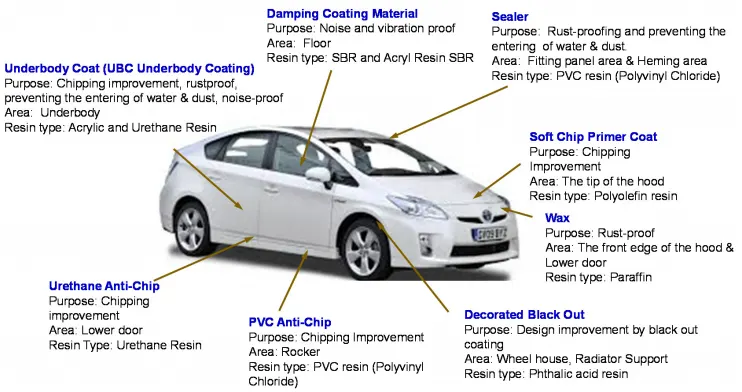
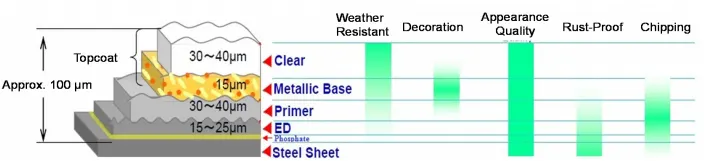
- For the external surfaces of an automobile to be easily visualized, the five main steps of coating
produce a layered structure as shown in below image. - These coatings are applied in a particular order and have different material and protection or finishing functionalities; also, each layer relates to the others and imparts a desired balance of properties.
1.Pre-treatment:
- When the automobile body sheet metal components are welded together, the resulting structure is referred to as the body-in-white (BIW). The first sequence in preparing the BIW for subsequent coating is pretreatment.
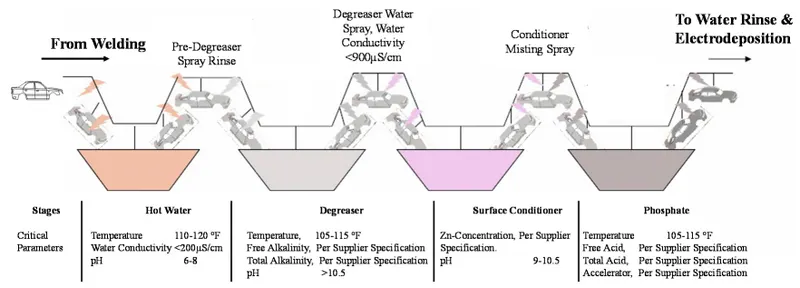
- Pre-treatment consists of cleaning the body surface to remove remaining oils from the stamping process and welding residues through three primary liquid dip processes of degreasing, conditioning, and phosphating.
- The process done on pre-treatment were shown in below image.
2.Electrodeposition (ED):
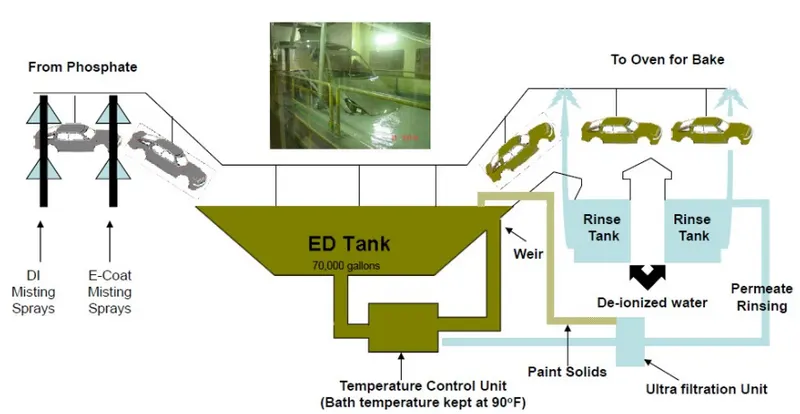
- E-coating involves dipping automobile bodies into the coating solution and passing an electric current through the body and the liquid ED paint solution.
- Because of the charged nature of this coating process, the ED paint penetrates into places a spray would not reach.
- The ED paint is promoted to bond with the metal substrate, and a uniform coating thickness is produced.
- The result is an insoluble, deposited layer with a very high solids content and firm adherence to the pretreated body.
3.Rust-Proof Materials: Sealer/PVC
- The third step is underbody coating (UBC) and seam sealing using PVC (Polyvinyl Chloride) and urethane.
- The sealant is applied around and inside the doors, hood, trunk, and front dash, and onto the exterior and interior of metal joints and outer area of the back wheel well; application of the sealant is accomplished either manually or with robots and prevents air and water ingress and inhibits rust formation.
4.Primer:
- The fourth coating step is the application of a primer surfacer or simply primer.
- It can be water-borne, solvent-borne, or a powder.
- The main reason for primer application was to improve weather resistance, appearance, and chipping resistance.
- The primer fills and smooths minor imperfections and scratches that may be created during prior steps and by the intermediate sanding or grinding used to remove small imperfections.
5.TopCoat:
- The final step in the body coating process is to apply the topcoat, which consists of two layers—the basecoat and clearcoat.
- The basecoat contains the primary coloring pigment, and the clearcoat provides a protective coating against environmental effects, corrosion, and UV light degradation, promotes unmatched color retention, and provides a smooth, unblemished, and even finish.
Types of UnderCoating:
Rubberized Undercoating:
- Rubberized undercoating is easy to apply, and generally offers the best protective coating for your car’s undercarriage.
- It cushions surfaces against moisture, rust, dings, and dents.
- Rubberized undercoating is safe to use on quarter panels and wheel wells and dries with a soft rubbery finish.
Asphalt-based Undercoating:
- Asphalt-based undercoating offers a higher level of protection suitable for large trucks, recreational vehicles, and heavy machinery.
- It’s formulated with some bits of rubberized material to aid in noise reduction.
- It offers extra protection against chips and moisture but is not paintable and, therefore, only suitable for undercarriages.
Polyurethane Coating:
- Polyurethane coating is easy to apply and works by sealing up cracks and seams.
- The compound displaces salt and moisture and protects the unoxidized metal from rust.
- It’s often sold in canisters that are ready to preload into an application gun.
- It, however, requires some surface prep work before application, like degreasing, and applying an etching primer to the bare metal.
Wax or Paraffin-based Undercoating:
- Wax or paraffin-based undercoating sprays are the cheapest and quickest options available.
- However, their results don’t last long, and you may have to apply a fresh coat after only a few months.
- In addition, the wax isn’t very adhesive on a metal surface.
- Its main advantage is that it seeps quickly into cracks and seams, and offers moderate protective properties against moisture.
Before Treatment: After Treatment:
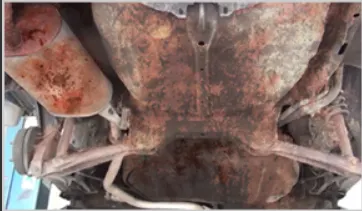
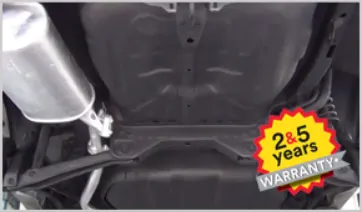
Advantages:
- It extends the life span of the car
- No more loud road noice.
- It provides extra layer of protection from rust and corrosion.
- Heat Insulation: It insulates the interior of the car from extreme temperatures from beneath the vehicle providing a comfortable cabin experience.
- Anti-chipping property: If any stone hits the coating it does not get chipped away hence protects the underbody from exposure to water.
Disadvantages:
- It won't do anything about the corrosion which is already present(Major damages).
- It add weights to the vehicle, results reduce in fuel economy (Research done that there is reduction of mileage of 1.6 km for every 3 to 4 litres of fuel).
- Risk of damage during application, an improper coat to body may cause extra damage to car.
- Cost will be high for the aged vehicles, from the 6th year it starts rusting (the term may be varied depend upon the wether condition of that area).