Underbody Coating
UNDERBODY COATING
Underbody coating is a thick cladding that is placed uniformly to the car’s underside. It provides long-term protection from corrosion to the car’s underbody. It also protects parts like internal body panels, frame rails, and other inner cavities that are not physically accessible but are prone to corrosion.
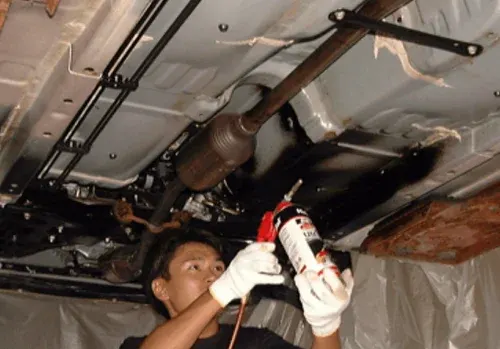
There are different types of underbody coatings available in the market. Some of them are:
- Rubberized Underbody Coating
- Wax-Based Underbody Coating
- Asphalt-Based Automotive Undercoating
- Polyurethane Underbody Coating
Rubberized underbody coating is widely considered to be the best underbody coating for your car. It protects the underbody from scratches and keeps it properly. It’s also not difficult to apply this to the undercarriage. This can be done at the authorized service center or by the local repair shop at a reasonable price.
Wax-based undercoating is resistant to dampness and is also the most cost-effective alternative.
Asphalt-based coatings give a higher level of protection compared to rubber-based coatings. They incorporate a small quantity of rubber for sound insulation.
Polyurethane underbody coating seals breaks and fractures in the vehicle’s underbody. It provides strong corrosion resistance and also binds to the metal. Unlike an asphalt-based coating, the polyurethane coating may be painted over.
The advantages of undercoating are as follows:
- Fights Rust
- Absorbs Noise
- Reinforcement
- Prolong Car’s Life
Underbody coating plays an important role in keeping corrosion at bay. It can come in handy especially if you live near the sea, where there is too much humidity, and rusting is just one of those everyday things.
However, there are some cons as well:
- The application of this coating takes some time.
- Wax-based undercoating will fade away after a few months.
- Rubberized undercoating is ideal if you want to keep road noise to a minimum but it can be expensive.