Underbody Coating
Under Body coating
In Indian road conditions, a cars underbody is most prone to corrosion. Underbody coating provides long term protection from corrosion to car’s underbody. It also protects parts like internal body panels, frame rails and other inner cavities that are not physically accessible but are prone to corrosion.
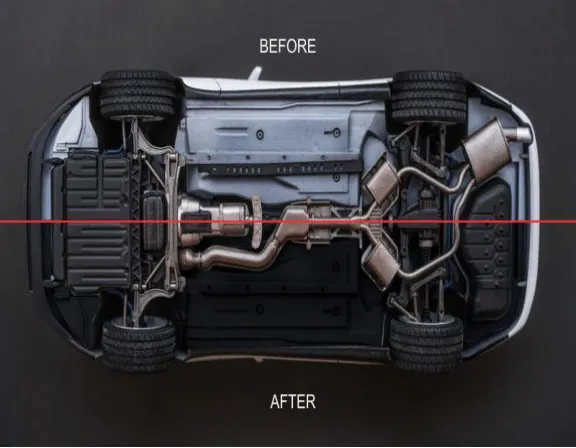
The below figure shows under body coating before coating and after coating
Purpose of under body coating
- Protects Against Rust & Corrosion
The primary objective of getting underbody coating done is preventing metal components that are exposed on the bottom side of the car to damage from corrosion. You can shut out the Adverse effects of corrosion on your car by simply applying a rubberised anti-rust coating all over the belly of your car.
- Prevents Paint Chipping
Running on the highway or while pacing through a city road, you will often encounter sharp gravel or any other unattended object hitting the belly of your car with high momentum. This scrapes and chips off the metal from down below. A thick layer of Underbody Coating definitely comes to aid and minimises the effects of such contacts on the body.
- Protects Vital Components
Underneath a car is somewhere a lot of indispensable parts of a car are left exposed like the Engine, silencer, etc. One simply can’t afford to let these parts go bad due to rusting and hence in order to save yourself from a hefty repair bill, a considerably less expensive Anti-Rust Coating is a must.
- Reduces NVH (Noise Vibrations Harshness) Levels
Our country is filled with roads having uneven patches and potholes and while we manoeuvre our cars through such sections, the unpaved crumbs, and pebbles hit the car from underneath or get stuck in the wheel wells. The underbody coating’s consistency is so thick that the layer it creates absorbs all the unpleasant noises and vibrations and marginally improves the driving experience.
Modern Automotive Coating Processes
Modern automotive coating methods consist of five main steps as follows
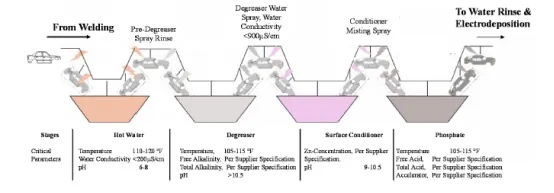
Pretreatment: Removes and cleans excess metal and forms an appropriate surface structure enabling bonding of a corrosion protection layer.
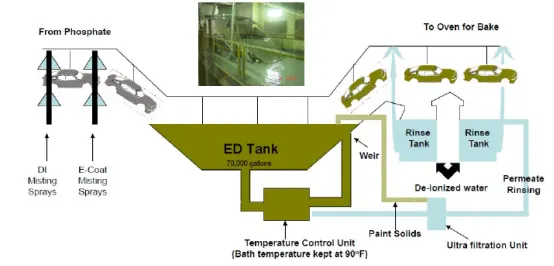
Electrodeposition (ED) : For anti-corrosion or rust prevention layer.
Poly Vinyl Chloride (PVC) :This is applied for anti-corrosion, elimination of water leaks,and minimization of chipping and vibrational noise.
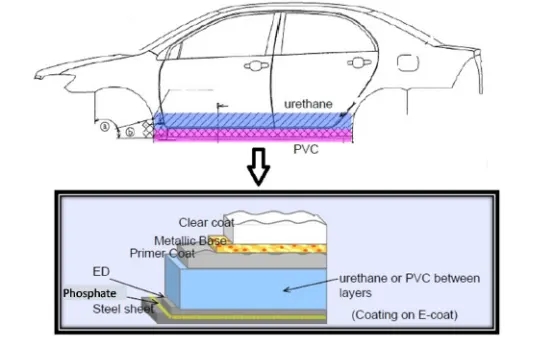
Primer :This is applied to promote adhesion between the surface and the basecoat, it also imparts a smoother surface for subsequent layers and has anti-chipping properties.
Topcoats :This include a basecoat and clearcoat are applied,they providesurface properties that are sought after, including color, appearance, gloss, smoothness, and weather resistance.
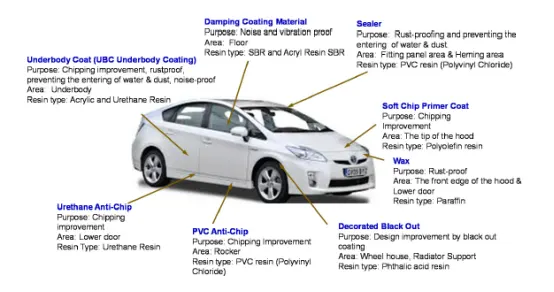
The areas of an automobile depicted in Figure show where these five steps of coating and otheradditional coatings are used. As can be realized when examining this figure, a significant number of specific coatings and materials are needed in addition to the above-listed steps to manufacturea salable automobile.