Underbody Coating
Underbody Coating
UNDERBODY COATING
Under body coating (anti rust coating) as the name suggests ,it's a coating provided to prevent rusting . Under body coating will protect the vehicle chassis from external environment (i.e muddy water stone, patholed roads,other obstacles on the road),to ensure the intergrity and safety of car. Under body coating play a very important role in the service of the vehicle. In general under body coating there are various methods.
The automobile industry is the most growing industry and economical value is been improoving in INDIA with increase in population. Now a days many people are using car. When people buys a car it is advisable to take care of car through out its life.A very good Underbody Coating also increases the value of the car, it determines how well the car manufacturing company has taken responsibilities in maintain not only the outer esthetics but also has taken care of the under surface. Different countries and car companies have different standards or types of underbody coatings. The underbody coating cost depends on the budget of the car, segment of the car and purpose of the car(i.e., is the car used to transport only people or only goods or both or is it a luxury car, etc.).
Process:
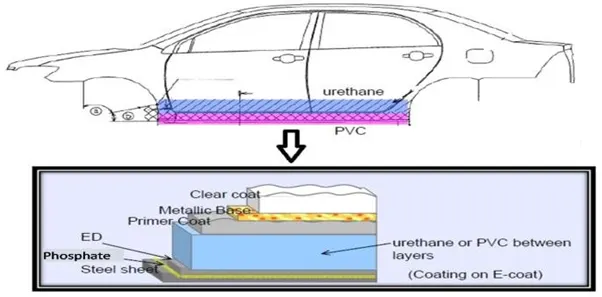
For a new car the underbody coating is applied during the process of the painting. Initially the car body is dipped in the ED Bath and is dried to make the ED deposits on the car body uniform by throughly checking for any spots where more paint or no paint is present and the ED bath process can be carried out multiple times. Once the ED Bath is completed the underbody coating is carried out. Sealants are applied to close the spot welds and other joining areas and later the underbody coating is sprayed and care is taken to ensure uniform distribution of under coat.
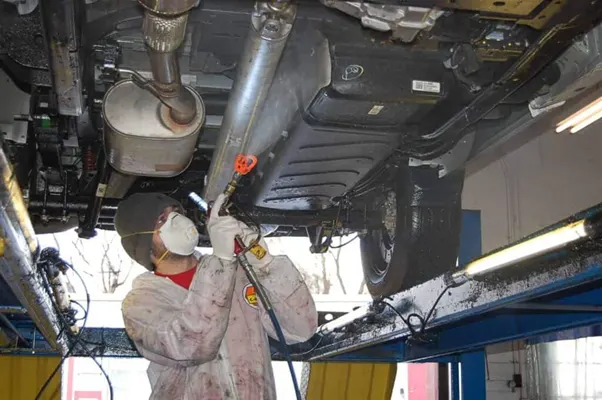
For an old or used car the underbody coating process is different. Here the rust and dirty is initially removed by use of certain chemical or scrubbing. Once the rust and dirt are removed the underbody is thoroughly washed and is dried using high pressure blowers to ensure there is no moisture or specs of dirty still remaining on the underbody. Once the underbody is completely dry the coating is sprayed uniformly. Multiple layers of the coating are applied depending on the requirement of the customer or how much the customer is willing to spend on the underbody coating.
Pros:
This treatment is designed to provide long-term protection from rust to the under chassis. It protects the underbody substrates from
- Environmental conditions
- Impacts
- Dampens sound and vibration
- Insulates against cold and heat
- Protects against Corrosion
- Seals off seams
- Hides welds, repairs & bodywork with spray.
Cons:
High cost
The cost of underbody coating is very expensive
Risk of damage during application
The thick rubberized paint if not applied properly can get into moving mechanical parts and may cause premature failures.
IN AUTOMOTIVE INDUSTRY:
- Pretreatment: removes and cleans excess metal and forms an appropriate surface structure enabling bonding of a corrosion protection layer.
- Electrodeposition (ED) of the anti-corrosion or rust prevention layer.
- A Sealer like Poly Vinyl Chloride (PVC) is applied for anti-corrosion, elimination of water leaks, and minimization of chipping and vibrational noise.
- A Primer is then applied to promote adhesion between the surface and the basecoat; it also imparts a smoother surface for subsequent layers and has anti-chipping properties.
- Finally, the topcoats that include a basecoat and clearcoat are applied; they provide surface properties that are sought after, including color, appearance, gloss, smoothness, and weather resistance.
Types of Underbody Coatings:
- Rubberized Undercoatingis very easy to apply and is one of the best protective coats that can be applied to a car. It provides a soft rubbery finish once it dries off.
- Asphalt based Undercoatingis used when higher level of protection is required and is suitable for large trucks, recreational vehicles, and heavy machinery. It’s formulated with some bits of rubberized material to aid in noise reduction. It offers extra protection against chips and moisture but is not paintable and, therefore, only suitable for undercarriages.
- Polyurethane Undercoatingseals the cracks and seams and it very easy to apply. This undercoat prevents the metals from oxidizing from salts and moisture. This undercoat is sprayed on the underbody using spray guns.
- Wax or Paraffin based Undercoating is for temporary or short term undercoats are easiest to apply and are the cheapest of all undercoats. It provides moderate protection and is not recommended for long term or high protection.
Benefits:
- Underbody coating reduces the sound from outside (Esp. from underneath the car) entering into the car cabin and thereby aiding a noiseless and smooth driving experience.
- It also insulates the car cabin from the heat or cold or dirt emerging from the ground/beneath the car.
- It protects the underbody metal of the car from stones hitting which tend to scratch the underbody. These scratches when come in contact with water or moisture they are susceptible to corrosion and this in-turn leads to high maintenance of the car.
- When the car is very well taken car not just on the upper surface and even on the underbody it will have a very good resale value.
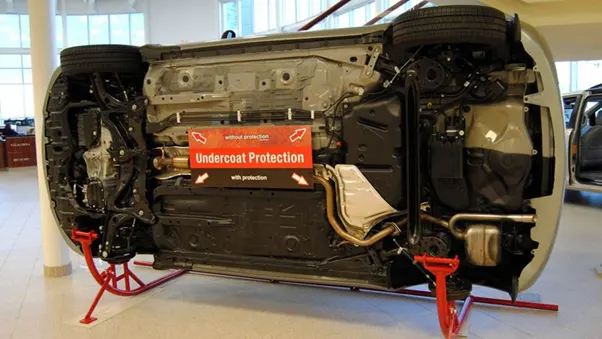
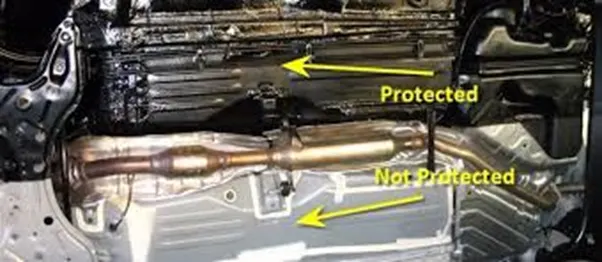
Some Pics of Underbody Coating: