Underbody Coating
The automotive painting process in the factory
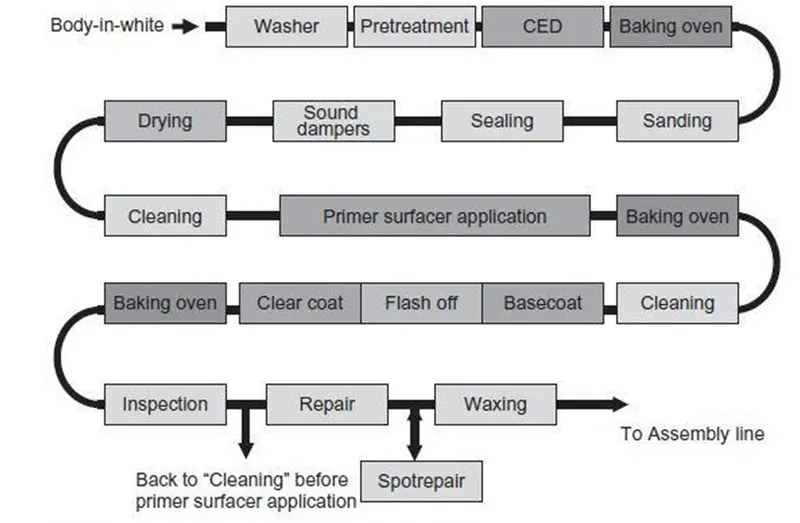
Basically in manufacturing unit, the body is washed, degreased, electro dipped in zinc phosphate, oven baked, sanded, sealed, dried, cleaned (with chemicals), primered, baked, painted, baked, clear coated, baked and then inspected for faults. All high volume manufacturers have fully automated lines that take between 14-18 hours to finish a single body.
Process Flow chart
The result is layers of carefully laid out coats, all of which put together is only slightly thicker than the average human hair.
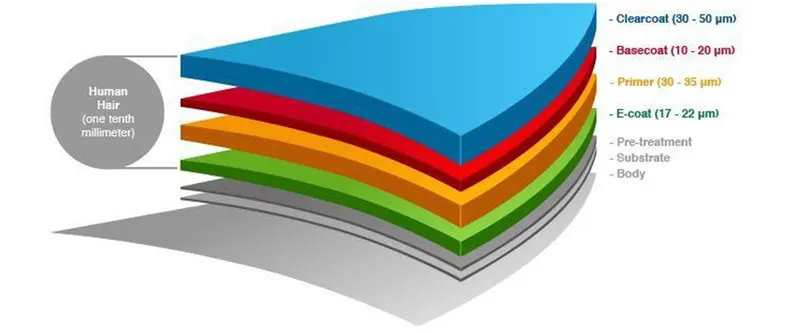
- Cathodic e-coatinggives the car body a primer coat. It protects the car from corrosion , especially the cavities of the body that cannot be reached easily by spray application.
Primer: evens out any irregularities of the underlying layer. It can be sanded easily and provides a smooth surface. - Basecoat: gives the main color to the piece, therefore it plays a significant role in establishing the final visual impression.
- Clear coat: seals everything else and is applied last. It protects the car from external elements like snow, UV radiation, dirt, etc…
Methods of Underbody Coating :
Rubberized Undercoating
Rubberized vehicle undercoating is easy to apply and offers sound-cushioning as well as protection from dust, moisture, and dings or dents.
In addition to your undercarriage, rubberized undercoating is also safe to use on wheel wells and quarter panels, and dries to a soft rubbery finish that prevents further rust, damage, or moisture seeps. The coating can be painted over and, if necessary for bodywork, can be easily removed with an undercoating removal spray.
Overall, rubberized coating is generally the best option for protecting your vehicle's undercarriage, as it provides the simplest and best protective measures against rust and moisture.
Advantages:
- Easy to apply
- Quickly applied with no fuss
- Undercoat can be painted for a neat finish
- Provides satisfactory protection
Polyurethane Undercoating
The other option for undercoating your vehicle is to use a polyurethane based sealant. This type of vehicle undercoating is a little bit quicker and easier to apply.
Oftentimes, polyurethane undercoating will come in canisters ready to preload into an application gun. This type of sealant works by seeping into all cracks and seams, displacing salt and moisture and oozing around rusty areas to bond with and protect unoxidized metal. It also sands quickly in case you'll need to perform bodywork and can be painted over.
On the flipside, this type of car undercoating generally requires a little bit more surface prep work before applying -- sanding and applying an etching primer to bare metals before using are generally recommended.
Advantages:
- It has a long lifespan and is resistant to wear and tear
- Easily and quickly applicable
- Trickles into cracks and rusty spots already present on the underbelly of your car and fills them, hence protecting the underlying metal
- Quick and simple to remove, as it sands easily
- Dislodges salt, moisture, and oozing around rusty areas to bond with and protect unoxidised metal
- Can be painted over
Disadvantages:
- For better adherence, needs undercarriage preparation before application
- Requires time-consuming etching with primer to bare metals
Wax or Paraffin-Based Undercoatings
A paraffin-based undercoating will be the cheapest and quickest option available with which to protect the undercarriage of your vehicle. However, keep in mind that it will wear off quicker than other types of undercoating and will need to be stripped and reapplied at least once every year.
Wax-based undercoatings never truly harden. During application, they drip or flow into seams and cracks to provide protective properties. They are usually available in a spray gun canister or in an aerosol can and offer at least a base protection in moderately humid climates.
Advantages:
- Readily flows into seams to guarantee any exposed and prone surfaces are protected
- The most inexpensive undercoating option
- Conveniently available in spray guy canisters or aerosol cans
Disadvantages:
- Wears off quicker in comparison to other types
- Unlike the rubberized type, it does not really dry
- Needs to be stripped and reapplied at least once a year as soon as signs of wear and tear start to show
Asphalt-Based Undercoating
For standard vehicles, any of the aforementioned types of undercoating will provide sufficient protection. For large trucks and heavy machinery, asphalt-based undercoating provides a bit of extra durability against rocks, chips, and moisture.
Asphalt-based undercoating generally contains a little bit of rubberized material that sets up firmly and also helps soften noise. Generally sold in five gallon containers, this type of undercoating also needs more cure time than the other three, and is NOT paintable, making it best to use only for undercarriages.
Advantages:
- Formulated to protect from dirt, rust, and corrosion, it normally has a shelf life of up to two years. Sold in five-gallon containers
- Provides extra durability as it is the strongest and thickest undercoating available
Disadvantages:
- It takes time to harden and so requires more cure time than the other three types
- Unlike the other three, it is also, not paintable as such, not very aesthetically suitable for standard vehicles
- For best used only for the undercarriages of utility vehicles and trucks
- The only type of undercoating with a limited warranty
Why Car need Underbody coating?
Cars & its underbody should be given extra care. A car’s underbody is exposed the most to muddy terrains, potholes, debris and stones, and wet and even flooded roads that lead to corrosion of the underbody. Since the underbody is hard for us to inspect by ourselves, it is important to have an underbody coating in order to ensure your car is protected during these times.
But here’s a list of reasons why should get underbody coating and what all external factors it prevents.
Protection against corrosion :
The main reason for getting an underbody coating is to prevent rusting and corrosion. This is not only required during the monsoon season but also in hot and humid climatic conditions. The coating is also a must if you tend to live in coastal regions where the humidity in these areas speeds up the process of corrosion. This can be eliminated by asking your car service professional to apply a rubberized anti-rusting coat on your car’s underbelly.
Protection of vital car components :
The car underneath holds vital components like the silencer, engine, and numerous other wires and small engine components for different purposes in the car. The car’s underneath cannot simply be led to corrosion and further damage due to the car being driven during any weather condition. To avoid further major issues, the antirust coating is a must for the underbody. This is again extremely important if you’re living in an all-year monsoon season or moderately high rainy regions as underbody coating is highly necessary for these situations.
Reduces NVH (Noise Vibration Harshness) levels :
Being in a country where not all roads are smooth enough and are filled with potholes, stones, debris, and uneven road leveling, the underbody coating prevents and absorbs all noise created by the contact of the surface of the road and the car by minimising this.
Car underbody coating prevents paint from chipping :
When your car travels at high speed on a highway, the small stones and debris hit your car’s underbody in this process and may lead to chipping of the underbody paint. Hence, it is advisable to have a thick layer of underbody coating to prevent paint from chipping.