Section Modulus calculation and optimization
SECTION MODULUS CALCULATION AND OPTIMIZATION
Aim:
To calculate the section modulus of the hood design. Analyzing and optimizing the design to achieve improved bending strength of the hood.
Section Modulus:
Section Modulus is the geometric property of the given cross-section of any shaft or beam structures. It is the direct measure of the strength of the shaft section or the beam section. Higher the section modulus of a structure, the more the resistive it becomes to bending.
Section modulus is defined as the ratio of polar moment of inertia to the radius of the shaft or the distance from the neutral axis to the outer fibers.
In Mathematical expression,
It is defined as the ratio of the moment of inertia of a section about its centroidal axis and to the distance of the extreme layer from the neutral axis.
S = I / Y
Where,
S = section Modulus (m³)
I = Moment of Inertia (m⁴)
Y = distance from NA to extreme layer (m)
The unit of section modulus is m³.
Types of Section Modulus
There are two types of section modulus:
- Elastic Section Modulus
- Plastic Section Modulus
Elastic Section Modulus:
The elastic section modulus is used, applicable up to the yield point for most metals and other common materials.
The elastic section modulus is defined as S = I / y, where I is the second moment of area (or area moment of inertia, not to be confused with moment of inertia) and y is the distance from the neutral axis to any given fiber. It is often reported using y = c, where c is the distance from the neutral axis to the most extreme fiber, as seen in the table below. It is also often used to determine the yield moment (My) such that My = S ⋅ σy, where σy is the yield strength of the material.
Plastic Section Modulus:
The plastic section modulus is used for materials where elastic yielding is acceptable and plastic behavior is assumed to be an acceptable limit. Designs generally strive to ultimately remain below the plastic limit to avoid permanent deformations, often comparing the plastic capacity against amplified forces or stresses.
The plastic section modulus depends on the location of the plastic neutral axis (PNA).The PNA is defined as the axis that splits the cross section such that the compression force from the area in compression equals the tension force from the area in tension. So, for sections with constant, and equal compressive and tensile yielding stress, the area above and below the PNA will be equal, but for composite sections, this is not necessarily the case.
The plastic section modulus is the sum of the areas of the cross section on each side of the PNA (which may or may not be equal) multiplied by the distance from the local centroids of the two areas to the PNA

Moment of Inertia (I):
Moment of inertia is nothing but offering resistance against of moment, bending or twisting, that if we applied any external load on the body, how much resistance it’s offering to tend to deform.
Experimental work:
Case 1: Before Optimization
- The Hood which was already created is imported and the section inertia analysis is done.
- Consider only the Min. Moment of Inertia value.
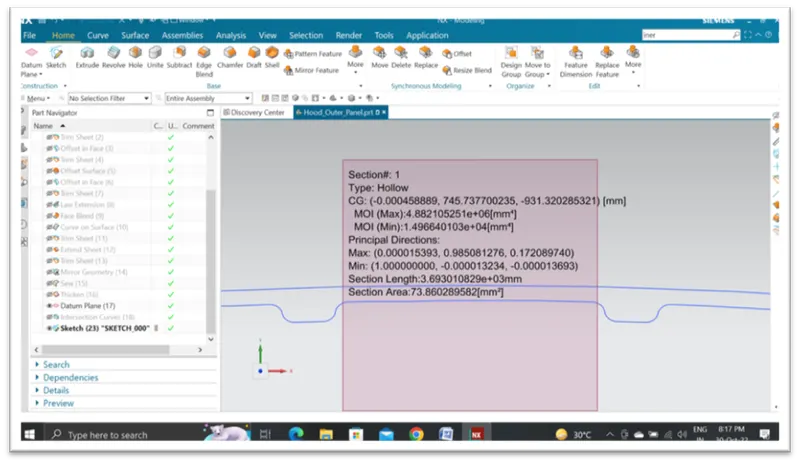
Min. MOI – 1.494964195e+04(mm^4)
Max. MOI – 4.880164110e+06(mm^4)
Distance – 881.3396mm (overall length)
From neutral axis – (881.3396 / 2) = 440.6698 mm
S = I / Y
S = (1.494X10^4) / 440.6698
S = 33.90 mm^3
Case 2: After Optimization
- The hood inner panel’s curve is offset by 0.6mm outwards.
Why optimization need?
S = I / Y
From the above mentioned equation, the section modulus is directly proportional to the Moment of Inertia (I).
Here the cross sectional area is increased by offsetting the inner panel by 0.6 mm. This increases the Moment of Inertia (I) and also the Section modulus value increases.
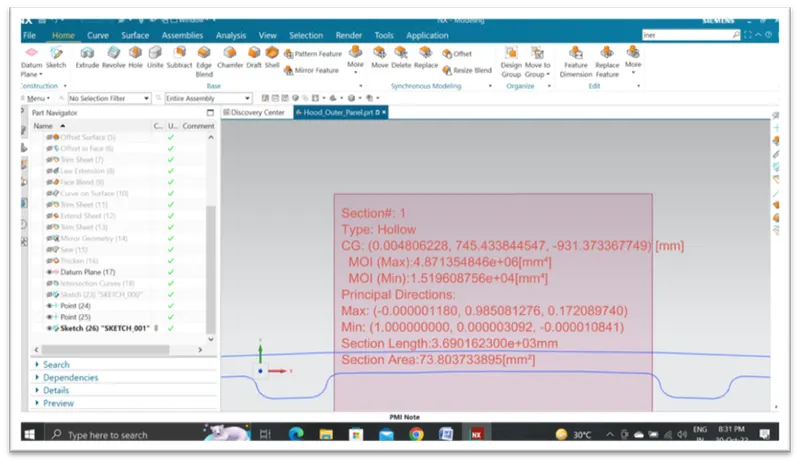
Min. MOI – 1.519608756e+04(mm^4)
Max. MOI – 4.871354846e+06(mm^4)
Distance – 881.3396mm (overall length)
From neutral axis – (881.3396 / 2) = 440.6698 mm
S = I / Y
S = (1.519X10^4) / 440.6698
S = 34.47 mm^3
Conclusion:
- When comparing Case 1 & Case 2, clearly we noticed that the Section modulus increased in Case 2.
- Increase the cross sectional area will result, the moment of inertia & section modulus increases. This means bending strength increase.